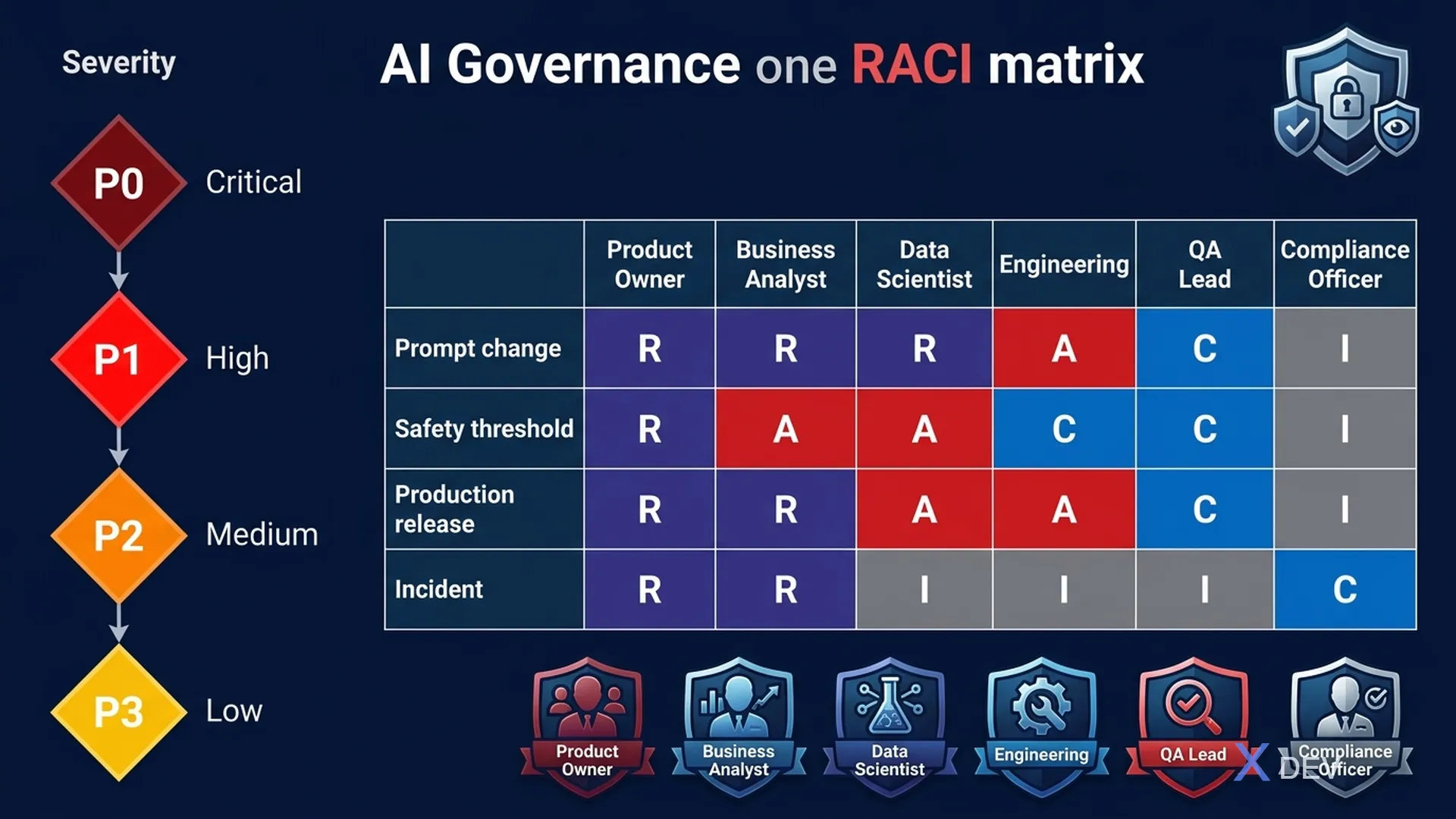
When AI features produce incorrect results, the first question is always: "Who will review? Who decides whether to accept or reject?"
Without clear RACI from the start, teams become confused, delays happen, or worse — everyone thinks "it's not my job."
This guide teaches BA how to build a governance framework for AI features.
1. Why RACI Matters for AI
| Scenario | No Governance | Clear RACI |
|---|---|---|
| Prompt produces wrong output | Entire team in confusion, no one is sure | BA identifies immediately: AI team owns, Product approves |
| Safety incident | Who follows up? Who decides rollback? | Clear escalation path → SOP |
| Release delay | Waiting for approval from whom? | Clear owner, SLA, go/no-go criteria |
2. RACI Matrix for AI Features
RACI = Responsible, Accountable, Consulted, Informed
| Activity | Product | BA | Data/AI | Engineering | QA | Compliance |
|---|---|---|---|---|---|---|
| Define AI requirements | A | R | C | C | - | C |
| Prompt design & tuning | - | R | R | - | - | - |
| Test AI output quality | - | C | R | - | R | - |
| Safety/bias testing | - | - | R | - | C | A |
| Production release approval | A | R | C | R | - | A |
| Incident response | C | R | A | C | C | - |
| Model rollback decision | A | C | A | R | - | - |
Legend:
- R (Responsible) = Does the actual work
- A (Accountable) = Ultimately responsible (must be 1 person)
- C (Consulted) = Asked for input before decision
- I (Informed) = Notified after decision is made
3. Key Decision Points Requiring RACI
1. Prompt Change Approval
Scenario: AI team wants to update prompt to improve output

Activity: Prompt change approval
Responsible: AI Engineer (proposes change + tests)
Accountable: Product Manager (final yes/no decision)
Consulted: BA (impact analysis), QA (regression testing)
Informed: Engineering lead (performance impact)

Process:
1. AI Engineer drafts prompt change + A/B test results
2. BA reviews: any impact on acceptance criteria?
3. QA runs regression test on golden test set
4. Product Manager: approve or reject
5. If approved: deploy to staging → final QA test → production
2. Safety Threshold Decision
Activity: Confidence threshold adjustment (e.g., 0.75 → 0.80)
Responsible: Data Scientist (analyzes trade-off between accuracy and escalation rate)
Accountable: Compliance / Legal (final approval, bears legal risk)
Consulted: BA (impact on business workflow), Product (impact on UX)

Decision criteria:
- accuracy_delta (e.g., +2%)
- escalation_rate_delta (e.g., +8%)
- business_impact (cost, user experience)
→ Synthesize findings, Compliance decides
3. Go/No-Go Production Release
Activity: Go-live decision
Responsible: QA (execute UAT), BA (verify business criteria)
Accountable: Product Manager (final go/no-go call)
Consulted: Data/AI (quality metrics), Engineering (technical readiness)
Informed: Support/Operations (ready to handle escalations?)

Criteria to pass:
☐ Accuracy ≥ threshold
☐ 0 critical defects
☐ UAT sign-off from business
☐ Rollback procedure tested
☐ Monitoring dashboards live
☐ Escalation playbook ready
4. Incident Response & Escalation
When: AI output causes harm (wrong diagnosis, incorrect financial decision)

Severity Level → Response Owner:
- P0 (Customer harm, immediate): CEO/CRO decides escalation/pause
- P1 (Major bug): Product + Engineering + Compliance within 1h
- P2 (Minor bug): BA + AI team within 4h
- P3 (Enhancement): Regular sprint backlog

Escalation path:
User Reports → QA logs ticket
↓
QA severity P0/P1? → Immediate notification
↓
On-call engineer + BA + Compliance
↓
Analyze: rollback? hotfix? monitor?
↓
Product decides: pause feature / limit user % / full rollback
4. RACI Template for BA to Fill
# RACI Matrix: [AI Feature Name]

## Core Team
| Role | Name | Email | Availability |
|------|------|-------|--------------|
| Product Manager | ... | ... | ... |
| BA | ... | ... | ... |
| Data Scientist | ... | ... | ... |
| AI Engineer | ... | ... | ... |
| QA Lead | ... | ... | ... |
| Engineering Lead | ... | ... | ... |
| Compliance Officer | ... | ... | ... |

## Decision Matrix

| Decision | Responsible | Accountable | Consulted | Informed | Timeline |
|----------|-------------|-------------|-----------|----------|----------|
| Prompt design approval | AI Eng | Product | BA, QA | Eng Lead | Before dev |
| Accuracy threshold | Data Sci | Compliance | BA, Product | AI Eng | Before UAT |
| UAT sign-off | BA | Product | QA | All | End of UAT |
| Production release | QA | Product | All | Ops | Release day |
| Incident > P1 | BA | Product | Data Sci, Eng | All | Within 1h |
| Rollback decision | Eng Lead | Product | All | - | Immediate |
5. Escalation Playbook
AI Output Concern Detected
    │
    ├─→ Is customer impacted? NO
    │       └─→ Log ticket, standard process
    │
    └─→ YES
        ├─→ Severity?
        │
        ├─→ P0 (immediate harm)
        │   ├─→ Immediate pause / limit AI to 5%
        │   ├─→ Notify Product + Engineering + Compliance
        │   ├─→ Start incident postmortem
        │   └─→ Decision: rollback vs hotfix
        │
        └─→ P1 (significant issue)
            ├─→ Investigate within 2 hours
            ├─→ If root cause = prompt → AI team fixes + tests
            ├─→ If root cause = data → Data team validates data quality
            ├─→ If unclear → escalate to senior (BA review)
            └─→ Implement fix → staging test → production
6. Common Anti-Patterns
❌ "Everyone owns the decision" → delays, finger-pointing ✅ Clear A (Accountable) owner per decision
❌ "Compliance checks everything" → slow velocity ✅ Compliance A for safety-critical, C for others
❌ "No R on data quality" → bugs slip through ✅ Explicit R for data validation before AI processing
❌ "Escalation unclear" → incidents mishandled ✅ Escalation playbook with clear owner per severity level
Summary
AI Governance isn't complex if you:
- Define RACI clearly for each decision (Prompt, Threshold, Release, Incident)
- Assign clear Accountable (1 person, not a committee)
- Document escalation path with severity levels
- Review quarterly — update RACI if team/process changes
Teams with clear governance deliver AI features faster, with confidence, and with accountability.