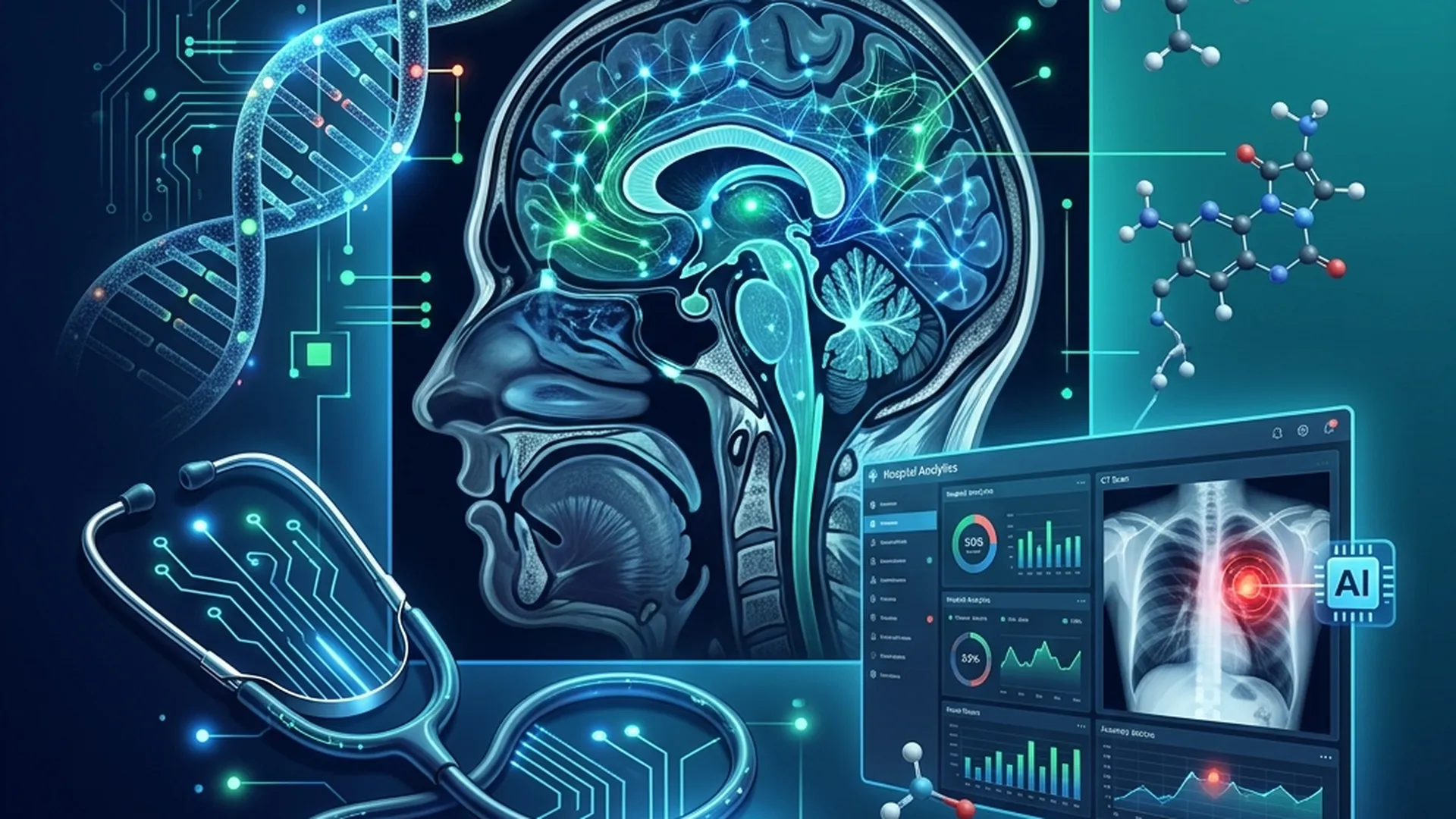
1. Overview: How AI Is Reshaping Healthcare
Global healthcare faces a paradox: an aging population, increasingly complex diseases, and a specialist physician supply that cannot keep pace. In the United States, an estimated shortage of 124,000 physicians is projected by 2034. In Vietnam, the physician-to-10,000-population ratio is approximately 9 — far below the WHO's recommended 25.
AI does not replace physicians — AI is a capability amplifier for physicians.
1.1. Market Scale
| Year | Global AI in Healthcare Market Size |
|---|---|
| 2023 | $19.27 billion USD |
| 2024 | $26.69 billion USD |
| 2026 | ~$45 billion USD |
| 2030 | $187.95 billion USD |
CAGR ~38.5%/year — one of the highest growth rates in the technology sector.
1.2. Primary Application Categories
AI in Healthcare
├── Diagnosis
│   ├── Medical Imaging (X-ray, CT, MRI, Pathology)
│   ├── Clinical Decision Support
│   └── Symptom Checker
├── Treatment
│   ├── Treatment Planning
│   ├── Robotic Surgery
│   └── Radiation Therapy Planning
├── Drug Discovery
│   ├── Target Identification
│   ├── Molecule Generation
│   └── Clinical Trial Optimization
├── Genomics & Precision Medicine
│   ├── Variant Calling
│   ├── Gene Expression Analysis
│   └── Pharmacogenomics
├── Patient Management
│   ├── EHR Analysis (NLP)
│   ├── Remote Patient Monitoring
│   └── Readmission Prediction
└── Administration
    ├── Medical Coding (ICD-10/11)
    ├── Insurance Claims Processing
    └── Appointment Scheduling
2. Medical Imaging AI
2.1. Why Medical Imaging Is the "Golden Problem" for Deep Learning
Medical images have characteristics ideal for CNNs:
- Unstructured data requiring pattern recognition — deep learning's core strength
- Large volume: A 500-bed hospital generates ~50 GB of DICOM images per day
- Relatively clear ground truth: Histopathology results and surgery provide definitive labels
- Measurable expert error rates: ~4% of chest X-rays are misread; 28% of skin cancers are initially misdiagnosed
2.2. CNN Architectures for Medical Imaging
ResNet / DenseNet are the most common backbones in medical imaging because:
- Skip connections address vanishing gradients in deep networks
- DenseNet with feature reuse performs especially well with limited data
import torch
import torch.nn as nn
from torchvision import models

class ChestXRayClassifier(nn.Module):
    """
    Chest X-ray classification model for 14 pathologies
    (pneumonia, pleural effusion, atelectasis, etc.)
    """
    def __init__(self, num_classes=14, pretrained=True):
        super().__init__()
        # Transfer learning from ImageNet — reduces required data by 80%
        self.backbone = models.densenet121(pretrained=pretrained)

        # Replace the final classifier
        in_features = self.backbone.classifier.in_features
        self.backbone.classifier = nn.Sequential(
            nn.Dropout(p=0.5),
            nn.Linear(in_features, 512),
            nn.ReLU(),
            nn.Dropout(p=0.3),
            nn.Linear(512, num_classes),
            nn.Sigmoid()  # Multi-label: patient may have multiple conditions simultaneously
        )

    def forward(self, x):
        return self.backbone(x)

# Loss function for multi-label classification
# Weighted BCELoss handles class imbalance (rare Hernia vs common No Finding)
class WeightedBCELoss(nn.Module):
    def __init__(self, pos_weights):
        super().__init__()
        self.pos_weights = pos_weights

    def forward(self, pred, target):
        return nn.functional.binary_cross_entropy(
            pred, target,
            weight=self.pos_weights.unsqueeze(0).expand_as(target)
        )
Data augmentation is particularly important because medical datasets are always small and imbalanced:
from torchvision import transforms
import albumentations as A
from albumentations.pytorch import ToTensorV2

# Augmentation must be "medically reasonable" — do NOT flip chest X-rays vertically!
train_transform = A.Compose([
    A.RandomRotate90(p=0.0),        # NO 90° rotation (heart does not sit on the right)
    A.Rotate(limit=10, p=0.5),      # Only small ±10° rotations
    A.HorizontalFlip(p=0.5),        # OK: horizontal flip for chest
    A.RandomBrightness(limit=0.2),
    A.RandomContrast(limit=0.2),
    A.GaussNoise(var_limit=(0, 25)),
    A.Resize(224, 224),
    A.Normalize(
        mean=[0.485, 0.456, 0.406],  # ImageNet mean (grayscale → 3 channels)
        std=[0.229, 0.224, 0.225]
    ),
    ToTensorV2()
])
2.3. Real-World Results of AI Medical Imaging
| Application | Model | AUC | vs. Physicians |
|---|---|---|---|
| Chest X-ray (14 pathologies) | CheXNet (Stanford) | 0.90 | Outperforms 4 radiologists |
| Skin cancer (melanoma) | Google Inception | 0.991 | Equivalent to 21 dermatologists |
| Diabetic retinopathy | DeepMind | 0.997 | Equivalent to specialists |
| Colon polyps (colonoscopy) | GI Genius | +14% detection | Augments, doesn't replace |
| Brain MRI reading | AI Radiology | ~95% acc | 40× faster |
2.4. Segmentation — Tumor Boundary Delineation
Detecting tumors is only the first step. Segmentation (precisely delineating boundaries) is essential for radiation therapy and surgery:
# U-Net — the gold standard architecture for medical image segmentation
class UNet(nn.Module):
    """
    U-Net with skip connections for tumor segmentation
    Input: 512x512 CT image, Output: 512x512 mask (0=background, 1=tumor)
    """
    def __init__(self, in_channels=1, out_channels=1, features=[64, 128, 256, 512]):
        super().__init__()
        self.encoder = nn.ModuleList()
        self.decoder = nn.ModuleList()
        self.pool = nn.MaxPool2d(kernel_size=2, stride=2)

        # Encoder (Contracting path)
        for feature in features:
            self.encoder.append(self._double_conv(in_channels, feature))
            in_channels = feature

        # Bottleneck
        self.bottleneck = self._double_conv(features[-1], features[-1] * 2)

        # Decoder (Expansive path) with skip connections
        for feature in reversed(features):
            self.decoder.append(
                nn.ConvTranspose2d(feature * 2, feature, kernel_size=2, stride=2)
            )
            self.decoder.append(self._double_conv(feature * 2, feature))

        self.final_conv = nn.Conv2d(features[0], out_channels, kernel_size=1)

    def _double_conv(self, in_ch, out_ch):
        return nn.Sequential(
            nn.Conv2d(in_ch, out_ch, 3, padding=1, bias=False),
            nn.BatchNorm2d(out_ch),
            nn.ReLU(inplace=True),
            nn.Conv2d(out_ch, out_ch, 3, padding=1, bias=False),
            nn.BatchNorm2d(out_ch),
            nn.ReLU(inplace=True),
        )
Metric: Dice Coefficient is the standard metric for medical segmentation (a spatially-aware F1 score). Dice ≥ 0.85 is the accepted clinical threshold for tumor segmentation.
3. AI and Electronic Health Records (EHR / EMR)
3.1. NLP for Extracting Information from Medical Text
90% of clinical information lives in unstructured text — physician notes, narrative lab results, discharge summaries. NLP transforms this text into structured data:
import spacy
from transformers import AutoTokenizer, AutoModelForTokenClassification
import torch

# BioBERT / ClinicalBERT — BERT pretrained on PubMed + MIMIC-III
# Understands medical terminology 40–60% better than standard BERT
model_name = "dmis-lab/biobert-base-cased-v1.2"
tokenizer = AutoTokenizer.from_pretrained(model_name)
model = AutoModelForTokenClassification.from_pretrained(
    model_name,
    num_labels=9  # B/I/O for: DISEASE, DRUG, DOSAGE, SYMPTOM
)

def extract_medical_entities(clinical_note: str) -> dict:
    """
    Extracts: diseases, drugs, dosages, symptoms from clinical notes

    Input: "Patient with hypertension, on Amlodipine 5mg/day,
            complaining of headache and dizziness."
    Output: {
        "diseases": ["hypertension"],
        "drugs": ["Amlodipine"],
        "dosages": ["5mg/day"],
        "symptoms": ["headache", "dizziness"]
    }
    """
    inputs = tokenizer(
        clinical_note,
        return_tensors="pt",
        truncation=True,
        max_length=512
    )

    with torch.no_grad():
        outputs = model(**inputs)

    predictions = torch.argmax(outputs.logits, dim=2)
    tokens = tokenizer.convert_ids_to_tokens(inputs["input_ids"][0])

    # Merge subword tokens and extract entities
    entities = {"diseases": [], "drugs": [], "dosages": [], "symptoms": []}
    # ... (NER post-processing logic)

    return entities
3.2. 30-Day Readmission Prediction
30-day readmissions are an important hospital quality indicator. AI predicts which patients are at high risk for proactive intervention:
import pandas as pd
from sklearn.ensemble import GradientBoostingClassifier, RandomForestClassifier
from sklearn.preprocessing import StandardScaler
from sklearn.pipeline import Pipeline
import xgboost as xgb

# Feature engineering from EHR
def create_readmission_features(patient_df: pd.DataFrame) -> pd.DataFrame:
    features = pd.DataFrame()

    # Demographic features
    features["age"] = patient_df["age"]
    features["age_squared"] = patient_df["age"] ** 2  # Non-linear age effect

    # Clinical severity
    features["num_diagnoses"] = patient_df["diagnoses"].apply(len)
    features["num_procedures"] = patient_df["procedures"].apply(len)
    features["icu_days"] = patient_df["icu_stay_days"]
    features["los_days"] = patient_df["length_of_stay"]

    # Lab values (trend matters more than absolute values)
    features["hba1c_latest"] = patient_df["hba1c"].apply(lambda x: x[-1] if x else None)
    features["hba1c_trend"] = patient_df["hba1c"].apply(
        lambda x: (x[-1] - x[-2]) if len(x) >= 2 else 0
    )

    # Social determinants of health (SDOH) — increasingly important
    features["insurance_type"] = patient_df["insurance"].map({
        "Medicare": 2, "Medicaid": 3, "Private": 0, "Uninsured": 4
    })
    features["discharge_to_home"] = (patient_df["discharge_destination"] == "Home").astype(int)

    # Prior utilization
    features["prior_admissions_1yr"] = patient_df["admissions_12m"]
    features["prior_er_visits"] = patient_df["er_visits_12m"]

    return features

# Ensemble model
readmission_model = Pipeline([
    ("scaler", StandardScaler()),
    ("xgb", xgb.XGBClassifier(
        n_estimators=500,
        max_depth=6,
        learning_rate=0.05,
        subsample=0.8,
        colsample_bytree=0.8,
        scale_pos_weight=3,  # Handle class imbalance (10-20% readmitted)
        eval_metric="aucpr",
        random_state=42
    ))
])
Real-world results: UCSF deployed a similar model, reducing 30-day readmission rates by 30% for cardiac patients — saving ~$4,500 per patient.
3.3. Early Sepsis Detection
Sepsis kills 270,000 Americans per year. Detecting it 1 hour earlier increases survival rates by 7%:
import numpy as np
from typing import List, Dict

# LSTM for time-series vitals analysis
import torch.nn as nn

class SepsisEarlyWarning(nn.Module):
    """
    LSTM model analyzing real-time vital sign sequences
    Inputs each hour: HR, BP (sys/dia), Temp, RR, SpO2, WBC, Lactate, Creatinine
    Output: probability of sepsis in the next 6 hours
    """
    def __init__(self, input_size=8, hidden_size=128, num_layers=2):
        super().__init__()
        self.lstm = nn.LSTM(
            input_size=input_size,
            hidden_size=hidden_size,
            num_layers=num_layers,
            batch_first=True,
            dropout=0.3,
            bidirectional=False  # Causal: only uses past data
        )
        self.attention = nn.MultiheadAttention(
            embed_dim=hidden_size,
            num_heads=8,
            dropout=0.1
        )
        self.classifier = nn.Sequential(
            nn.Linear(hidden_size, 64),
            nn.ReLU(),
            nn.Dropout(0.3),
            nn.Linear(64, 1),
            nn.Sigmoid()
        )

    def forward(self, x, mask=None):
        # x: [batch, time_steps, features]
        lstm_out, _ = self.lstm(x)

        # Attention to focus on the most important time steps
        attn_out, _ = self.attention(
            lstm_out.transpose(0, 1),
            lstm_out.transpose(0, 1),
            lstm_out.transpose(0, 1),
            key_padding_mask=mask
        )

        # Use the final output
        output = self.classifier(attn_out[-1])
        return output
The Epic Sepsis Model (deployed in 170+ US hospitals) achieves AUC ~0.76, detecting sepsis 9–12 hours in advance.
4. AI in Drug Discovery
4.1. The Problem: Enormous Cost and Time
Traditional drug development pipeline:
Target ID → Hit Discovery → Lead Optimization →
Preclinical → Phase I → Phase II → Phase III → FDA Approval

Timeline: 12–15 years
Cost: $1.3–2.6 billion USD
Success rate: ~0.01% (1/10,000 compounds)
AI compresses the early stages from 4–6 years down to 12–18 months.
4.2. AlphaFold 2 — The Protein Folding Revolution
The protein folding problem has existed for 50 years: given an amino acid sequence → predict the 3D structure.
3D structure determines protein function and drug molecule binding ability.
# Using AlphaFold2 via ColabFold
from colabfold.batch import get_queries, run

# Target protein sequence (example: SARS-CoV-2 spike protein)
sequence = """
MFVFLVLLPLVSSQCVNLTTRTQLPPAYTNSFTRGVYYPDKVFRSSVLHSTQDLFLPFFSNVTWFHAIHVSGTNG
TKRFDNPVLPFNDGVYFASTEKSNIIRGWIFGTTLDSKTQSLLIVNNATNVVIKVCEFQFCNDPFLGVYYHKNNK
SWMESEFRVYSSANNCTFEYVSQPFLMDLEGKQGNFKNLREFVFKNIDGYFKIYSKHTPINLVRDLPQGFSALEP
"""

queries = [("SARSCoV2_Spike", sequence, None)]

results = run(
    queries=queries,
    result_dir="./alphafold_results",
    use_templates=False,
    num_recycles=3,          # Number of recycling steps to improve accuracy
    model_type="alphafold2_ptm",
    num_models=5
)

# Output: PDB file with 3D coordinates + per-residue confidence (pLDDT score)
# pLDDT > 90: very high confidence — suitable for drug design
AlphaFold 2 predicts structure with median TM-score 0.92 — nearly matching experimental X-ray crystallography, but 100,000 times faster.
4.3. Generative AI for Novel Drug Molecule Design
After obtaining the target structure, the next step is generating drug molecules that can bind to the target:
import torch
from rdkit import Chem
from rdkit.Chem import AllChem, Descriptors

# Graph Neural Network for molecule representation
# Atoms = nodes, Bonds = edges
class MoleculeGNN(nn.Module):
    """
    Predicts drug-target binding affinity (pIC50)
    Combining molecular graph + protein pocket fingerprint
    """
    def __init__(self, atom_features=74, bond_features=12, hidden_dim=256):
        super().__init__()
        # Message Passing Neural Network
        self.conv1 = nn.Linear(atom_features, hidden_dim)
        self.conv2 = nn.Linear(hidden_dim, hidden_dim)
        self.conv3 = nn.Linear(hidden_dim, hidden_dim)

        # Protein binding site encoder
        self.protein_encoder = nn.Sequential(
            nn.Linear(1000, 512),  # Protein sequence features
            nn.ReLU(),
            nn.Linear(512, 256)
        )

        # Binding affinity predictor
        self.predictor = nn.Sequential(
            nn.Linear(hidden_dim + 256, 512),
            nn.ReLU(),
            nn.Dropout(0.2),
            nn.Linear(512, 1)  # Predict pIC50
        )

    def forward(self, molecule_graph, protein_features):
        # Graph convolution to learn molecular representation
        mol_repr = self.graph_conv(molecule_graph)

        # Protein binding site representation
        protein_repr = self.protein_encoder(protein_features)

        # Combine and predict
        combined = torch.cat([mol_repr, protein_repr], dim=-1)
        return self.predictor(combined)

# Goal-directed molecule design
# Uses Reinforcement Learning: simultaneously optimize multiple objectives
def multi_objective_drug_design():
    """
    Simultaneously optimize:
    - High binding affinity to target protein
    - Good ADMET (absorption, distribution, metabolism, excretion, toxicity)
    - Drug-likeness (Lipinski's Rule of Five)
    - Synthesizability (ease of lab synthesis)
    """
    objectives = {
        "binding_affinity": lambda mol: predict_binding(mol),   # Maximize
        "toxicity": lambda mol: predict_toxicity(mol),           # Minimize
        "solubility": lambda mol: predict_logS(mol),             # Optimize
        "synthetic_accessibility": lambda mol: SAscore(mol),     # Minimize
        "drug_likeness": lambda mol: QEDscore(mol),              # Maximize
    }
    return objectives
4.4. Case Study: Insilico Medicine
- 2019: Insilico Medicine uses AI to design INS018_055 for idiopathic pulmonary fibrosis (IPF)
- 2021: Enters Phase I clinical trial after just 18 months from initiation
- 2023: Phase II shows promising results — this is the first drug designed 99% by AI to enter clinical trials
Compare to the typical 4–6 years for the equivalent stage.
5. Genomics and Precision Medicine
5.1. Single Nucleotide Polymorphisms (SNPs) and Disease
Each person's DNA differs at ~3 million positions (SNPs). Certain SNPs are directly associated with:
- Disease risk: BRCA1/2 mutation → 70–80% breast cancer risk
- Drug response: CYP2C19 variant → affects Clopidogrel metabolism
- Optimal dosage: VKORC1 variant → determines safe Warfarin dose
import numpy as np
from sklearn.linear_model import LassoCV
from sklearn.preprocessing import StandardScaler

# Polygenic Risk Score (PRS) — aggregates millions of small SNPs into an overall risk
def compute_polygenic_risk_score(
    genotype_matrix: np.ndarray,  # shape: [n_individuals, n_snps]
    effect_sizes: np.ndarray,      # Beta coefficients from GWAS
    allele_frequencies: np.ndarray
) -> np.ndarray:
    """
    PRS = Σ (effect_size_i × genotype_i)

    Example PRS for cardiovascular disease (based on ~6.6 million SNPs)
    Individuals in the top 1% PRS have 3× higher risk of HEART ATTACK than average
    """
    # Standardize genotypes
    scaler = StandardScaler()
    standardized = scaler.fit_transform(genotype_matrix)

    # Weighted sum
    prs = standardized @ effect_sizes

    # Convert to percentile
    percentile = (np.argsort(np.argsort(prs)) / len(prs)) * 100

    return prs, percentile

# Pharmacogenomics: personalized drug dosing
def warfarin_dosing_recommendation(patient_data: dict) -> float:
    """
    IWPC Algorithm combining ML + clinical factors

    Input: age, height, weight, indication,
           CYP2C9 genotype (*1/*1, *1/*2, *1/*3, *2/*2, *2/*3, *3/*3),
           VKORC1 genotype (-1639G>A)
    Output: recommended Warfarin dose mg/week
    """
    # VKORC1 -1639 G>A: AA reduces dose 35%, GA reduces 20%
    vkorc1_factor = {
        "GG": 1.0,
        "GA": 0.80,
        "AA": 0.65
    }.get(patient_data["vkorc1"], 1.0)

    # CYP2C9: *2, *3 variants reduce metabolism → lower dose needed
    cyp2c9_factor = {
        "*1/*1": 1.0, "*1/*2": 0.75, "*1/*3": 0.50,
        "*2/*2": 0.50, "*2/*3": 0.30, "*3/*3": 0.15
    }.get(patient_data["cyp2c9"], 1.0)

    # Base dose from ML model
    base_dose = predict_base_dose(patient_data)

    return base_dose * vkorc1_factor * cyp2c9_factor
5.2. Transformers for Genomic Sequences
# DNA BERT — BERT pretrained on the full human genome
# Tokenization: 6-mer (ATCGGA, TCGGAT, ...)

from transformers import AutoTokenizer, AutoModel

dna_bert = AutoModel.from_pretrained("zhihan1996/DNA_bert_6")
dna_tokenizer = AutoTokenizer.from_pretrained("zhihan1996/DNA_bert_6")

def analyze_regulatory_sequence(dna_sequence: str) -> dict:
    """
    Predicts promoter regions, enhancers, splice sites
    in genomic DNA sequences
    """
    # Tokenize into overlapping 6-mers
    kmers = [
        dna_sequence[i:i+6]
        for i in range(0, len(dna_sequence) - 5)
    ]
    kmer_sentence = " ".join(kmers)

    inputs = dna_tokenizer(
        kmer_sentence,
        return_tensors="pt",
        max_length=512,
        truncation=True
    )

    with torch.no_grad():
        outputs = dna_bert(**inputs)

    # Sequence-level representation
    sequence_embedding = outputs.last_hidden_state[:, 0, :]

    return {
        "embedding": sequence_embedding,
        # Downstream: classify promoters, exons/introns, transposons...
    }
6. NLP in Healthcare: From Text to Knowledge
6.1. A Comprehensive Clinical NLP Pipeline
Raw Clinical Text
        ↓
Sentence Segmentation (More complex than standard NLP:
  "pt c/o SOB, DOE x 3d. PMH: HTN, DM2." — specialized abbreviations!)
        ↓
Named Entity Recognition (NER)
  → Diseases (UMLS codes)
  → Medications (RxNorm codes)
  → Procedures (CPT/ICD codes)
  → Lab Values + units
  → Anatomy (body parts)
        ↓
Relation Extraction
  → Drug-Disease (treatment, contraindication)
  → Drug-Drug Interaction
  → Finding-Anatomy
        ↓
Temporal Reasoning
  → Timeline of events (onset, duration, resolution)
  → Disease progression
        ↓
Structured Knowledge Graph
6.2. Medical Question Answering with LLMs
from openai import OpenAI

client = OpenAI()

MEDICAL_SYSTEM_PROMPT = """You are a medical assistant supporting physicians with information retrieval.

IMPORTANT:
- Only answer based on evidence-based medicine (RCTs, systematic reviews, clinical guidelines)
- Always cite sources (UpToDate, PubMed, ACC/AHA guidelines...)
- Clearly distinguish "Evidence Grade A/B/C" per ACC/AHA grading
- DO NOT diagnose specific patients directly
- When uncertain, say "I'm not certain" and recommend consulting a specialist

Physicians use this tool for: consulting guidelines, calculating clinical scores (CHADS2,
Wells score...), drug interactions, treatment protocols."""

def clinical_decision_support(
    clinical_question: str,
    patient_context: str = None
) -> str:
    messages = [
        {"role": "system", "content": MEDICAL_SYSTEM_PROMPT}
    ]

    if patient_context:
        messages.append({
            "role": "user",
            "content": f"Clinical context: {patient_context}\n\nQuestion: {clinical_question}"
        })
    else:
        messages.append({"role": "user", "content": clinical_question})

    response = client.chat.completions.create(
        model="gpt-4o",
        messages=messages,
        temperature=0.1,   # Low to avoid hallucination — critically important in healthcare
        max_tokens=2000
    )

    return response.choices[0].message.content

# Example usage
answer = clinical_decision_support(
    clinical_question="Anticoagulation protocol for non-valvular atrial fibrillation?",
    patient_context="68-year-old male, CrCl 45 mL/min, HAS-BLED score 2, CHADS2-VASc score 4"
)
Important note about LLMs in healthcare: GPT-4 achieves 90%+ on USMLE Steps 1–3, but can still "hallucinate" medical information. Any clinical application requires human-in-the-loop and rigorous validation.
7. Remote Patient Monitoring (RPM)
7.1. RPM System Architecture
IoT Wearables (Apple Watch, CGM, Smart Patch)
        ↓ (BLE/WiFi)
Edge Processing (Phone/Hub)  ← AI: denoising, arrhythmia detection
        ↓ (HTTPS/MQTT)
Cloud Ingestion (Kafka/Kinesis)
        ↓
Stream Processing (Flink/Spark Streaming)  ← AI: anomaly detection
        ↓
├── Alert Engine (rule-based + ML hybrid)
│     → SMS/Push/Call to physician
├── Trend Analysis
│     → Weekly/monthly reports for physicians
└── Predictive Models
      → Predicts exacerbation 24–48 hours in advance
7.2. AFib Detection from PPG
Traditionally, an ECG with 12 leads is needed to diagnose AFib. AI can detect AFib from PPG (photoplethysmography) — the heart rate sensor on a smartwatch:
import numpy as np
from scipy.signal import butter, filtfilt
import torch.nn as nn

class AFibDetectorFromPPG(nn.Module):
    """
    Atrial fibrillation detection from PPG (photoplethysmography) signal
    Input: 30-second PPG signal at 100Hz = 3000 samples
    Output: AFib probability

    FDA 510(k) cleared — Apple Watch Series 9 uses a similar architecture
    """
    def __init__(self):
        super().__init__()
        # 1D CNN for feature extraction from time-series
        self.feature_extractor = nn.Sequential(
            nn.Conv1d(1, 32, kernel_size=7, stride=1, padding=3),
            nn.BatchNorm1d(32),
            nn.ReLU(),
            nn.MaxPool1d(2),
            nn.Conv1d(32, 64, kernel_size=5, padding=2),
            nn.BatchNorm1d(64),
            nn.ReLU(),
            nn.MaxPool1d(2),
            nn.Conv1d(64, 128, kernel_size=3, padding=1),
            nn.BatchNorm1d(128),
            nn.ReLU(),
            nn.AdaptiveAvgPool1d(32)
        )

        # Transformer encoder for long-range dependencies
        encoder_layer = nn.TransformerEncoderLayer(
            d_model=128, nhead=8, dropout=0.1, batch_first=True
        )
        self.transformer = nn.TransformerEncoder(encoder_layer, num_layers=4)

        self.classifier = nn.Sequential(
            nn.Linear(128 * 32, 256),
            nn.ReLU(),
            nn.Dropout(0.3),
            nn.Linear(256, 1),
            nn.Sigmoid()
        )

    def forward(self, ppg_signal):
        # ppg_signal: [batch, 1, 3000]
        features = self.feature_extractor(ppg_signal)
        # Reshape for transformer: [batch, seq, features]
        features = features.permute(0, 2, 1)
        attended = self.transformer(features)
        flat = attended.reshape(attended.size(0), -1)
        return self.classifier(flat)

def preprocess_ppg(raw_ppg: np.ndarray, fs: int = 100) -> np.ndarray:
    """Bandpass filter: retain 0.5–4 Hz (heart rate 30–240 bpm)"""
    b, a = butter(4, [0.5/(fs/2), 4.0/(fs/2)], btype='band')
    filtered = filtfilt(b, a, raw_ppg)
    # Normalize
    return (filtered - filtered.mean()) / filtered.std()
Results: Apple Watch Series 9 / Series Ultra achieves 98.3% sensitivity, 99.6% specificity for AFib detection — meeting FDA Class II Medical Device standards.
8. Robotic Surgery and AI Assistance
8.1. Robotic Surgery Systems
da Vinci Surgical System (Intuitive Surgical) — the most widely deployed surgical robot:
-
7 million surgeries since 1999
- Used for prostate, gynecology, cardiac, colorectal procedures
- AI integration: tremor filtering, force feedback, motion scaling
Latest trends:
| System | Company | AI Feature |
|---|---|---|
| da Vinci 5 | Intuitive | Force feedback, tissue tracking |
| Hugo RAS | Medtronic | Cloud-connected, performance data |
| Versius | CMR Surgical | Compact, modular |
| Mako | Stryker | Pre-op planning, real-time guidance |
| TouchSurgery | J&J | Surgical simulation + coaching AI |
8.2. Surgical Phase Recognition
AI monitors surgical video to identify the current phase, supporting coaching and error detection:
# Cholecystectomy (gallbladder removal) has 7 standard phases
CHOLEC_PHASES = [
    "Preparation", "CalotTriangleDissection",
    "ClippingCutting", "GallbladderDissection",
    "GallbladderPackaging", "CleaningCoagulation",
    "GallbladderRetraction"
]

class SurgicalPhaseRecognizer(nn.Module):
    """
    Video-based surgical phase recognition
    Input: 25fps surgical video
    Output: current phase + confidence
    """
    def __init__(self, num_phases=7):
        super().__init__()
        # ResNet50 to extract frame features
        backbone = models.resnet50(pretrained=True)
        self.frame_encoder = nn.Sequential(*list(backbone.children())[:-1])

        # LSTM to model temporal context (30-second sliding window)
        self.temporal_model = nn.LSTM(
            input_size=2048,   # ResNet50 output
            hidden_size=512,
            num_layers=2,
            batch_first=True,
            dropout=0.3
        )

        self.classifier = nn.Linear(512, num_phases)

    def forward(self, video_frames):
        # video_frames: [batch, frames, C, H, W]
        batch, frames = video_frames.shape[:2]

        # Encode each frame
        frame_features = []
        for i in range(frames):
            feat = self.frame_encoder(video_frames[:, i])
            frame_features.append(feat.squeeze())
        frame_features = torch.stack(frame_features, dim=1)

        # Temporal modeling
        lstm_out, _ = self.temporal_model(frame_features)
        phase_logits = self.classifier(lstm_out)

        return phase_logits  # [batch, frames, num_phases]
9. Technical Challenges and Ethical Issues
9.1. Data Challenges
Medical data is "gold data" but extremely difficult to obtain:
| Challenge | Specific Issue | Solution |
|---|---|---|
| Privacy | HIPAA (US), GDPR (EU), Decree 13/2023 (VN) | De-identification, Federated Learning |
| Class Imbalance | Rare diseases: 1:1,000, even 1:100,000 | Oversampling (SMOTE), cost-sensitive learning, one-shot learning |
| Label Noise | Different doctors read X-rays differently | Inter-rater reliability, soft labels |
| Distribution Shift | Model trained in US → deployed in VN differs | Domain adaptation, regular retraining |
| Small Dataset | Rare diseases may have only a few hundred cases | Transfer learning, data augmentation, synthetic data (GAN) |
| Multimodal | Combining images + text + structured data | Multimodal fusion architectures |
Federated Learning — a privacy-preserving training solution:
"""
Federated Learning: each hospital trains a local model,
sends gradients (not data) to a central server for aggregation.
Patient data never leaves the hospital.
"""

# FedAvg algorithm (McMahan et al., 2017)
def federated_averaging(
    global_model_weights: dict,
    client_updates: list[dict],
    client_sample_counts: list[int]
) -> dict:
    """
    Weighted average of client model updates
    Weight = number of samples per client
    """
    total_samples = sum(client_sample_counts)
    avg_weights = {}

    for key in global_model_weights.keys():
        # Weighted average
        avg_weights[key] = sum(
            client_update[key] * (n / total_samples)
            for client_update, n in zip(client_updates, client_sample_counts)
        )

    return avg_weights
9.2. Bias in Healthcare AI
Bias is a more serious issue in healthcare because it directly affects health outcomes:
- Pulse oximeter bias: Devices are 3× less accurate for Black patients — leading to under-treatment of O2 during COVID-19
- Dermatology AI: CheXNet trained primarily on lighter skin tones → less accurate for Black/Brown skin
- Pain Assessment AI: NIH Pain Consortium found AI underestimates pain in women
- Risk Score bias: OPTUM Sepsis model performs 4.5% worse for Black patients
# Fairness metrics to measure in medical AI

from fairlearn.metrics import (
    demographic_parity_difference,
    equalized_odds_difference,
    MetricFrame
)
import pandas as pd

def evaluate_fairness(
    model_predictions: np.ndarray,
    true_labels: np.ndarray,
    sensitive_attributes: pd.DataFrame  # race, sex, age_group, insurance
):
    """
    Evaluate fairness across multiple demographic groups

    Targets:
    - Demographic Parity Difference < 0.05
    - Equalized Odds Difference < 0.05
    - AUC gap across groups < 0.02
    """
    metrics = {
        "accuracy": lambda y, pred: (pred.round() == y).mean(),
        "false_negative_rate": lambda y, pred: ((pred.round() == 0) & (y == 1)).sum() / y.sum(),
        # FNR is important in healthcare: missing disease is more dangerous than false alarms
    }

    mf = MetricFrame(
        metrics=metrics,
        y_true=true_labels,
        y_pred=model_predictions,
        sensitive_features=sensitive_attributes
    )

    print("Performance by group:")
    print(mf.by_group)
    print(f"\nDemographic Parity Difference: {demographic_parity_difference(true_labels, model_predictions, sensitive_features=sensitive_attributes['race']):.4f}")
    print(f"Equalized Odds Difference: {equalized_odds_difference(true_labels, model_predictions, sensitive_features=sensitive_attributes['race']):.4f}")

    return mf
9.3. Explainability in Medical AI
The Black Box Problem: Physicians cannot accept unexplained decisions — "AI says the patient has cancer, but why?"
import shap
import numpy as np

# SHAP (SHapley Additive exPlanations) — explains local predictions

def explain_readmission_prediction(
    model,
    patient_features: pd.DataFrame,
    feature_names: list
):
    """
    Explain why the model predicts a high readmission risk for this patient

    Output: "High risk because:
    - Creatinine 2.8 mg/dL (+0.23 risk score)
    - 3 hospital admissions in the past year (+0.18)
    - No family caregiver at home (+0.12)
    - Age 78 (+0.09)"
    """
    explainer = shap.TreeExplainer(model)
    shap_values = explainer.shap_values(patient_features)

    # Waterfall plot for each specific patient
    shap.waterfall_plot(
        shap.Explanation(
            values=shap_values[0],
            base_values=explainer.expected_value,
            data=patient_features.iloc[0],
            feature_names=feature_names
        )
    )

    # Top 5 most influential factors
    feature_importance = sorted(
        zip(feature_names, shap_values[0]),
        key=lambda x: abs(x[1]),
        reverse=True
    )

    return feature_importance[:5]

# Grad-CAM for Medical Imaging — highlight which region in the image drove the decision
def generate_gradcam(model, image_tensor, target_class, target_layer):
    """
    Generate a heatmap highlighting the lung region AI considers abnormal
    Physicians need to see "AI found abnormality in upper right"
    not just "AI predicts pneumonia with 92% confidence"
    """
    gradients = []
    activations = []

    def save_gradient(grad):
        gradients.append(grad)

    def save_activation(module, input, output):
        activations.append(output)
        output.register_hook(save_gradient)

    target_layer.register_forward_hook(save_activation)

    output = model(image_tensor)
    model.zero_grad()
    output[0, target_class].backward()

    gradient = gradients[0].cpu().numpy()
    activation = activations[0].detach().cpu().numpy()

    # Pool gradients over spatial dimensions
    weights = np.mean(gradient, axis=(2, 3))

    # Weighted combination of activation maps
    cam = np.zeros(activation.shape[2:], dtype=np.float32)
    for k, w in enumerate(weights[0]):
        cam += w * activation[0, k]

    cam = np.maximum(cam, 0)  # ReLU
    cam = (cam - cam.min()) / (cam.max() - cam.min())

    return cam
9.4. Regulatory Framework
| Region | Regulation | AI Medical Device Requirements |
|---|---|---|
| USA | FDA 510(k) / De Novo / PMA | Software as Medical Device (SaMD) classification, clinical validation |
| EU | EU AI Act + MDR 2017/745 | High-risk AI: conformity assessment, CE marking, post-market surveillance |
| Vietnam | Decree 98/2021 + Circular 46/2017 | Medical device classification A/B/C/D, Ministry of Health registration |
FDA Pre-Determined Change Control Plan (PCCP): Allows AI to self-improve within approved limits without requiring resubmission — important because AI models need continuous updates.
10. AI in Healthcare in Vietnam
10.1. Current Landscape
Challenges unique to Vietnam:
- Public hospital system lacks digitization: <30% of provincial hospitals have complete HIS
- Fragmented, non-standardized data: each hospital uses different software
- Lack of labeled Vietnamese medical NLP data
- Healthcare workers lack digital skills
Strengths:
- Young population, high smartphone penetration (>70%)
- Low healthcare costs → high AI ROI
- Major hospitals (Bach Mai, Cho Ray) have enormous patient volumes → abundant data
10.2. Notable Projects and Startups
| Organization | Project | Results |
|---|---|---|
| VinAI Research | VinDr-CXR (AI Chest X-ray) | Published at MICCAI, AUC 0.88 for 18 pathologies, now used at Vinmec |
| VinBrain | DrAid™ | CE-marked AI for radiology, deployed at 40+ hospitals in Vietnam + exported |
| VNPT HealthConnect | Telemedicine + AI triage | 2 million users |
| Bach Mai Hospital | AI ECG Reading | Partnership with CardioAI, AFib detection |
| FPT Software | AI Pathology | Partnership with Roche, tissue sample analysis |
| Zalo AI | PhoBERT for Healthcare | Vietnamese NLP for medical records |
10.3. VinDr-CXR — Detailed Case Study
# VinDr-CXR dataset: 18,000 chest X-rays, annotated by 17 radiologists
# Published: https://www.nature.com/articles/s41597-022-01498-w

VINDR_FINDINGS = [
    "Aortic enlargement", "Atelectasis", "Calcification",
    "Cardiomegaly", "Clavicle fracture", "Consolidation",
    "Edema", "Emphysema", "Enlarged PA", "ILD",
    "Infiltration", "Lung Opacity", "Nodule/Mass",
    "Other lesion", "Pleural effusion", "Pleural thickening",
    "Pneumothorax", "Pulmonary fibrosis"
]

# Multi-label classification: patient may have multiple findings
# Class weights to handle imbalance
# Pneumothorax: ~1%, Cardiomegaly: ~20%

import torch
from torch.utils.data import Dataset
from PIL import Image
import pydicom

class VinDrDataset(Dataset):
    def __init__(self, df, dicom_dir, transform=None):
        self.df = df
        self.dicom_dir = dicom_dir
        self.transform = transform

    def __getitem__(self, idx):
        row = self.df.iloc[idx]

        # Load DICOM file
        dicom = pydicom.dcmread(f"{self.dicom_dir}/{row['image_id']}.dicom")
        image = dicom.pixel_array.astype(np.float32)

        # DICOM-specific preprocessing
        image = self._apply_windowing(image, row.get("window_center"), row.get("window_width"))
        image = Image.fromarray((image * 255).astype(np.uint8)).convert("RGB")

        if self.transform:
            image = self.transform(image)

        # Multi-label target
        labels = torch.zeros(len(VINDR_FINDINGS))
        for finding in row["findings"]:
            if finding in VINDR_FINDINGS:
                labels[VINDR_FINDINGS.index(finding)] = 1.0

        return image, labels

    def _apply_windowing(self, image, window_center=None, window_width=None):
        """DICOM windowing: normalize Hounsfield Units"""
        if window_center is None:
            window_center = image.mean()
        if window_width is None:
            window_width = image.std() * 4

        lower = window_center - window_width / 2
        upper = window_center + window_width / 2
        image = np.clip(image, lower, upper)
        return (image - lower) / (upper - lower)
10.4. Vietnam Healthcare AI Deployment Roadmap
Phase 1 (2024–2025): Foundation
├── Data standardization: HL7 FHIR for HIS
├── Build national health data lake
└── Train 5,000 digital health professionals

Phase 2 (2025–2027): Applications
├── Mass AI screening: X-ray, fundus photography, PAP smear
├── AI-assisted EMR: automated coding, clinical notes
└── Telepathology AI for district hospitals

Phase 3 (2027–2030): Comprehensive Integration
├── Precision medicine: pharmacogenomics pilot
├── AI-enabled rare disease diagnosis
└── Vietnam Health AI Benchmark dataset
11. Foundation Models and the Future of Medical AI
11.1. Medical Foundation Models
The new generation: instead of training many specialized models, train one large model pretrained on all medical data, then fine-tune for each task:
| Model | Organization | Modality | Scale |
|---|---|---|---|
| Med-PaLM 2 | Text (medical Q&A) | 540B params, USMLE 86.5% | |
| GPT-4V for Radiology | OpenAI | Image + Text | GPT-4 base |
| BioMedLM | Stanford | Text (biomedicine) | 2.7B params, open-source |
| CheXagent | Stanford | Chest X-ray + Text | Foundation model for radiology |
| Segment Anything Medical (SAM-Med) | Meta-based | Universal segmentation | Zero-shot medical segmentation |
| UniMedI | Research | Unified medical imaging | CT/MRI/X-ray in one model |
11.2. Multimodal Medical AI
# The future: one model handling all modalities
# "Patient, 65 years old, give me all imaging + labs + history → diagnosis"

class MultimodalMedicalAI(nn.Module):
    """
    Combines:
    - Medical imaging (X-ray, CT, MRI, Pathology slides)
    - Structured data (labs, vitals, demographics)
    - Clinical text (physician notes, discharge summaries)
    - Genomics (SNP array, WGS)
    - Wearable data (ECG, continuous glucose)
    """
    def __init__(self):
        super().__init__()
        # Vision encoder for medical images
        self.image_encoder = MedicalImageEncoder()     # ViT-based

        # Text encoder for clinical notes
        self.text_encoder = ClinicalBertEncoder()      # BioClinicalBERT

        # Structured data encoder
        self.tabular_encoder = TabTransformer()        # Tab Transformer

        # Cross-modal attention for fusion
        self.cross_attention = CrossModalAttention(
            hidden_dim=768,
            num_heads=12
        )

        # Task-specific heads
        self.diagnosis_head = nn.Linear(768, num_diagnosis_codes)
        self.prognosis_head = nn.Linear(768, 1)  # Survival probability
        self.treatment_head = nn.Linear(768, num_treatment_options)

    def forward(self, images=None, text=None, structured=None, genomics=None):
        embeddings = []
        if images is not None:
            embeddings.append(self.image_encoder(images))
        if text is not None:
            embeddings.append(self.text_encoder(text))
        if structured is not None:
            embeddings.append(self.tabular_encoder(structured))

        # Cross-modal fusion
        fused = self.cross_attention(embeddings)

        return {
            "diagnosis": self.diagnosis_head(fused),
            "prognosis": self.prognosis_head(fused),
            "treatment": self.treatment_head(fused)
        }
11.3. Digital Twins in Healthcare
Patient digital twins — digital physiological simulations of a specific patient's body:
- Cardiac simulation: Predicting intervention outcomes before surgery
- Personalized pharmacodynamics: Simulating drug metabolism with a specific patient's pharmacokinetic parameters
- Tumor virtual biopsy: Simulating tumor response to chemotherapy from imaging data
Dassault Systèmes and Siemens Healthineers are deploying this at pilot scale. Horizon 2030.