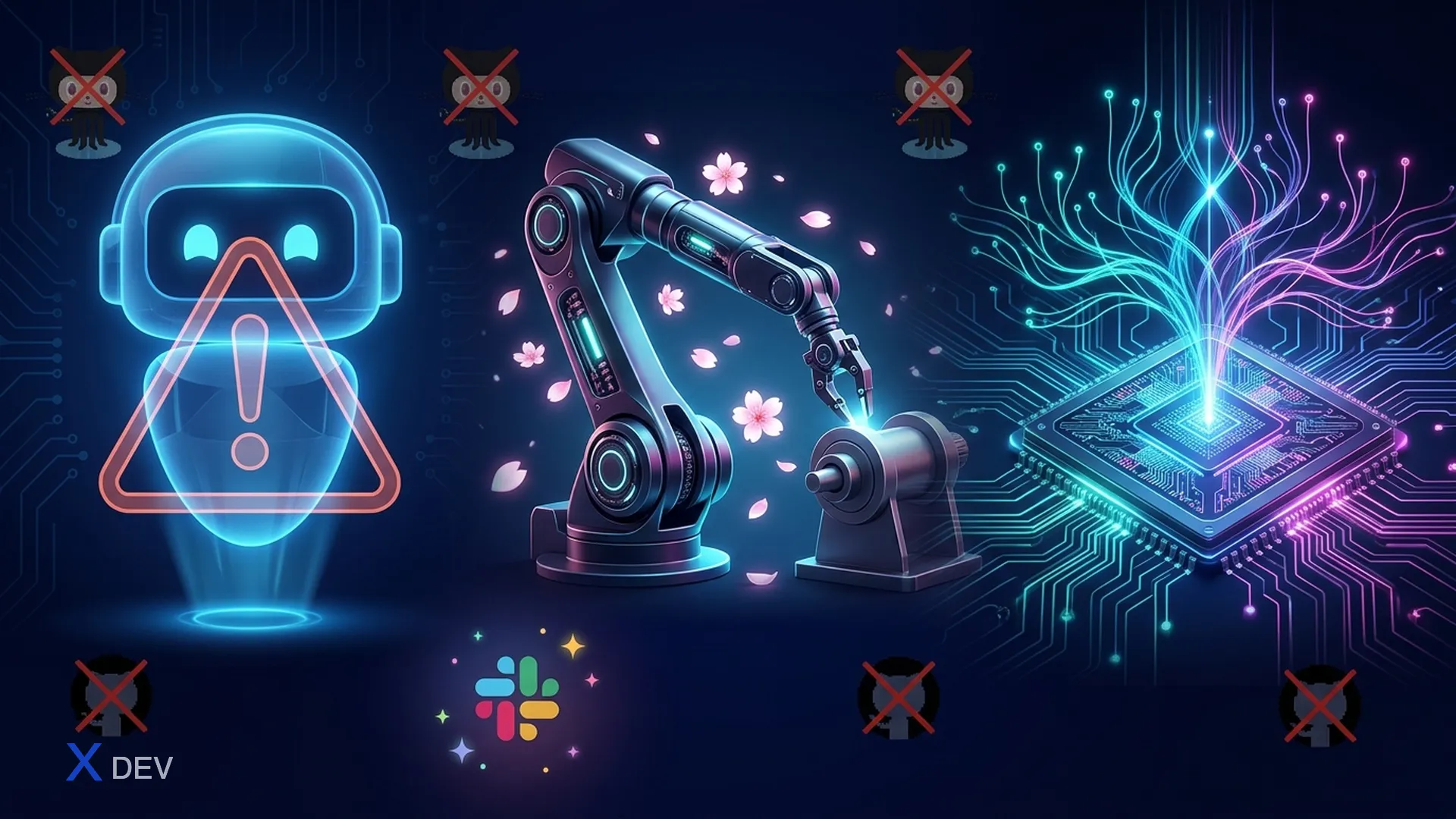
This weekend had way too many things to talk about: Microsoft was caught explicitly stating that Copilot is "for entertainment purposes only" in its terms, Japan poured $6.3 billion into Physical AI to address a labor crisis, Cognichip raised $60M toward AI-designed chips, and Anthropic accidentally took down over 8,000 GitHub repos. Let's break it all down.
📰 Quick Summary
| Event | Organization | Date | Significance |
|---|---|---|---|
| Copilot "for entertainment purposes only" | Microsoft | Apr 5 | ⭐⭐⭐⭐⭐ |
| Japan commits $6.3B to Physical AI | Japanese Government | Apr 5 | ⭐⭐⭐⭐⭐ |
| Cognichip raises $60M — AI chip design | Cognichip | Apr 1 | ⭐⭐⭐⭐ |
| Takedown of 8,100 GitHub repos via DMCA error | Anthropic | Apr 1 | ⭐⭐⭐⭐ |
| Salesforce turns Slack into an AI agent hub | Salesforce | Mar 31 | ⭐⭐⭐⭐ |
| Google Vids enables prompt-driven avatar navigation | Apr 2 | ⭐⭐⭐ | |
| OpenAI acquires TBPN — a business talk show platform | OpenAI | Apr 2 | ⭐⭐⭐ |
1. Microsoft Copilot "For Entertainment Only" — A Shocking Disclaimer
On April 5, 2026, the internet erupted after discovering that Microsoft's Copilot Terms of Use — last updated on October 24, 2025 — explicitly states:
"Copilot is for entertainment purposes only. It can make mistakes, and it may not work as intended. Don't rely on Copilot for important advice. Use Copilot at your own risk."
The irony is that Microsoft is actively convincing enterprise customers to pay for Copilot, positioning it as the center of its AI workplace strategy. Calling an AI assistant — deeply integrated into Word, Excel, and Outlook — "for entertainment only" left many questioning where legal accountability lies.
A Microsoft spokesperson told PCMag this was "legacy language" that would be updated: "As the product has evolved, that language is no longer reflective of how Copilot is used today."
Microsoft isn't alone — Tom's Hardware pointed out that both OpenAI and xAI have similar disclaimers. OpenAI warns against using its output as the "sole source of truth or factual information," while xAI bluntly advises users not to trust its output as "the truth."
The deeper issue: when companies push AI into every business process but legal disclaimers deny all accountability, who bears the consequences when AI makes a costly mistake? This question will intensify as AI agents handle more documents, emails, and transactions.
Key takeaway: The gap between marketing ("AI will transform how you work") and the legal fine print ("for entertainment only") has never been more visible.
2. Japan Bets $6.3 Billion on Physical AI — Targeting 30% Global Market Share
Japan officially announced its goal to capture 30% of the global Physical AI market by 2040, according to information from the Ministry of Economy, Trade and Industry (METI) in March 2026. Under Prime Minister Sanae Takaichi, the government committed approximately $6.3 billion to develop core AI capabilities, integrate robotics, and drive industrial deployment.
The primary driver? A severe labor crisis. Japan's population has been declining for 14 consecutive years as of 2024, with its workforce representing only 59.6% of the total population and expected to shrink by 15 million people over the next 20 years.
Sho Yamanaka (Salesforce Ventures) observed: "The motivation has shifted from mere efficiency to industrial survival. Physical AI is a national emergency to maintain industrial and social service standards."
Japan's strength lies in hardware and precision components — actuators, sensors, control systems — while the U.S. and China are ahead in full-stack AI systems. Mujin CEO Issei Takino warned: "In Physical AI, deep understanding of hardware's physical characteristics is paramount — this requires not only software but specialized control technologies."
Notable startups:
- Mujin: Logistics automation platform enabling robots to autonomously handle picking tasks
- WHILL: Autonomous personal mobility vehicle combining sensors + AI fleet management
- Terra Drone: Autonomous systems for defense and infrastructure
SoftBank has begun real-world deployment: combining vision-language models with real-time control systems so robots can independently interpret environments and perform complex tasks.
Key takeaway: Japan is demonstrating that Physical AI is no longer experimental — it's a survival solution for the economy.
3. Cognichip Raises $60M — AI Designing Chips for AI
On April 1, 2026, Cognichip announced a $60 million funding round led by Seligman Ventures, bringing total funding to $93 million since its founding in 2024. Notably, Intel CEO Lip-Bu Tan participated and will join the board.
The problem Cognichip wants to solve: advanced chip design takes 3–5 years from concept to mass production, with the design phase alone consuming up to 2 years. The Nvidia Blackwell contains 104 billion transistors — breathtaking complexity.
CEO Faraj Aalaei claims their technology can cut costs by 75% and reduce the chip design timeline by more than half. What's unique: Cognichip trains its own models specifically on chip design data (rather than using general-purpose LLMs), develops synthetic datasets, and licenses data from partners. When proprietary data isn't available, they use RISC-V (the open-source chip architecture).
Formidable competitors include: Synopsys, Cadence, startup ChipAgents ($74M Series A), and Ricursive ($300M Series A). Umesh Padval (Seligman) noted: "If this is a supercycle for semiconductors, it's also a supercycle for companies like Cognichip."
Key takeaway: AI designs chips → stronger chips → stronger AI — this loop could be the biggest acceleration the semiconductor industry has ever seen.
4. Anthropic Accidentally Takes Down 8,100 GitHub Repos — Then Quickly Reverses
In early April, Anthropic accidentally included the source code of Claude Code (their flagship command-line product) in a release. The AI community quickly analyzed and shared the code on GitHub.
Anthropic responded with a DMCA takedown notice — but the problem was that the targeted repo was part of a fork network linked to the official public Claude Code repo. The result: GitHub enforced the takedown across approximately 8,100 repositories, including legitimate forks.
Developer community backlash on X (Twitter) was fierce. Boris Cherny (Head of Claude Code) quickly acknowledged the error, withdrew most of the takedown notices, retaining only 1 main repo and 96 forks that contained the leaked source code.
Anthropic confirmed to TechCrunch: "The repo named in the notice was part of a fork network connected to our own public Claude Code repo, so the takedown reached more repositories than intended."
This incident is particularly damaging in the context of Anthropic preparing for an IPO — where execution and compliance are scrutinized. As TechCrunch noted: "Leaking your source code as a public company? You better believe there's a shareholder lawsuit coming."
Key takeaway: Anthropic is "having a month" — from leaking source code, to accidentally taking down 8,000 repos, to the OpenClaw controversy. Pre-IPO pressure is showing.
5. Salesforce Transforms Slack Into an AI Agent Hub With 30 New Features
On March 31, 2026, Salesforce announced 30 new AI features for Slack, transforming the familiar Slackbot chatbot into a comprehensive AI agent. This is a follow-up to the January 2026 update that first gave Slackbot agentic capabilities.
The standout feature: Reusable AI Skills — allowing users to define specific tasks for Slackbot, then reuse them across different contexts. For example: command "create a budget for an event" → Slackbot automatically gathers information from relevant channels and linked apps, creates an action plan, and sets up a meeting with the right people.
Other significant changes:
- Slackbot as an MCP client — connects to external tools via the Model Context Protocol, including Agentforce (Salesforce's AI agent platform)
- Transcription & summarization — automatically transcribes and summarizes meetings, including individual action items
- Desktop monitoring — tracks deals, conversations, calendar, and habits to suggest actions (with privacy controls)
CEO Marc Benioff stated Salesforce has achieved 2.5× Slack's revenue five years after the acquisition, with approximately 1 million businesses now using Slack.
Interim Slack CEO Rob Seaman noted that privacy protections are built into the design, with users able to adjust permissions.
Key takeaway: Slack is transitioning from "a place to chat" to "a place to work with AI" — MCP integration is a strategic move to make Slackbot an orchestrator for the entire enterprise toolchain.
6. Brief News
Google Vids enables prompt-driven avatar navigation
Google updated the Vids application, allowing users to navigate avatars using prompts — creating videos with virtual characters guided by natural language instructions. This is a step forward in text-to-video when avatars can receive specific directions rather than just following templates.
OpenAI acquires TBPN
OpenAI acquired TBPN — a viral business talk show platform led by founders. This is a surprising move showing that OpenAI doesn't just want to build models — it also wants to own media and content distribution channels.
Mercor hit by cyberattack via LiteLLM
Mercor — a rising AI startup — was targeted in a cyberattack related to a compromise of the open-source project LiteLLM. This incident underscores the security risks in AI supply chains as popular open-source tools become targets.
🔮 This Week's Analysis
Legal disclaimers are becoming a new battleground. When Microsoft calls Copilot "entertainment only," they inadvertently exposed the AI enterprise industry's biggest problem: nobody wants to be responsible when AI is wrong. The gap between marketing promises and legal reality will force legislators to act — especially in the EU where the AI Act is already in effect.
Physical AI is a national-scale game. Japan isn't investing in Physical AI because it's a trend — it's a survival necessity. With $6.3 billion committed, a 30% market share target, and solid robotics hardware foundations (70% of the global industrial robot market in 2022), Japan is betting that Physical AI will be the answer to its population crisis. This is a model that many aging nations (South Korea, Germany, Italy) will watch closely.
AI is consuming the very industry that creates AI. Cognichip uses AI to design chips for AI. Slackbot becomes an MCP client orchestrating other agents. OpenAI buys a media platform. The line between "AI company" and "company using AI" is blurring — and that may be the biggest signal that AI is truly becoming foundational infrastructure, not just a product.
📌 Further Reading
- TechCrunch: Copilot "for entertainment purposes only" — Analysis of the shocking disclaimer
- TechCrunch: Japan Physical AI — Detailed analysis of Japan's Physical AI ecosystem
- TechCrunch: Cognichip $60M — AI-for-chip-design startup
- TechCrunch: Anthropic takedown GitHub repos — The DMCA incident
- TechCrunch: Salesforce Slack AI makeover — 30 new AI features for Slack
- Microsoft Copilot Terms of Use — The original terms
The AI News Digest is updated daily at xdev.asia. Follow us so you never miss important AI news.