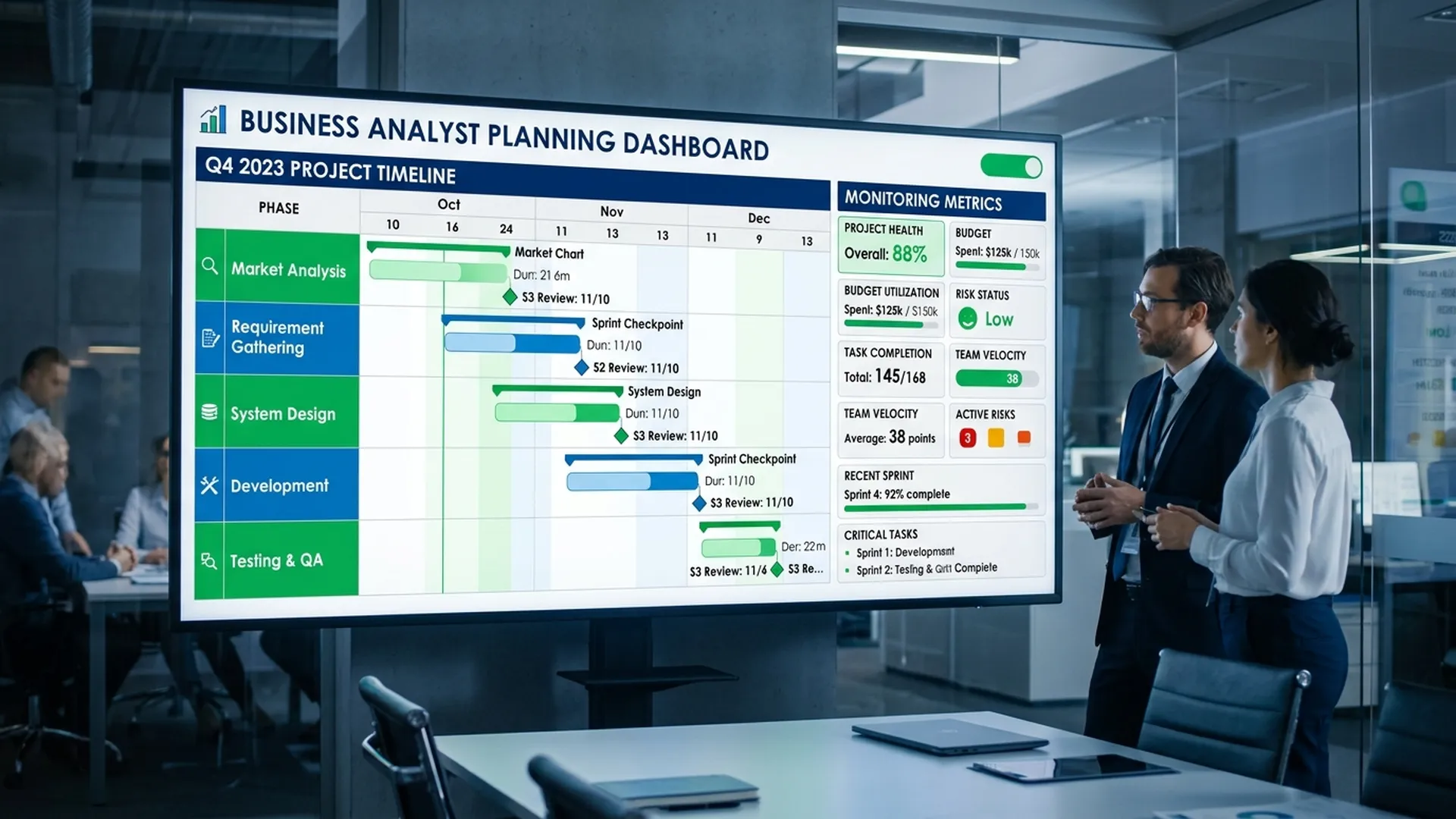
BA Planning in AI projects is fundamentally different from traditional projects in one core way: requirements are static, but AI output is probabilistic. That means your plan needs validation loops, not only linear milestones.
1. BA Planning Framework for AI Projects
1.1 Scope Definition with AI Boundaries
Before planning, BA must clearly define:
| Component | Questions to Answer | Example |
|---|---|---|
| AI Scope | Which part of the flow does AI handle? | "AI auto-classifies 70% of tickets" |
| Human Scope | Which cases are reviewed by humans? | "Tickets with confidence < 0.8 -> escalate" |
| Data Dependency | What data is needed for AI to work correctly? | "6 months of labeled ticket history" |
| Acceptance Threshold | When is the AI feature considered "done"? | "Accuracy >= 85% on test set" |
1.2 WBS for AI Features
Work Breakdown Structure for an AI feature has 5 work groups:
AI Feature: [Feature Name]
├── 1. Data & Requirements
│   ├── 1.1 Data audit (schema, volume, quality)
│   ├── 1.2 Elicitation with stakeholders
│   └── 1.3 Acceptance criteria drafting
├── 2. Design & Modeling
│   ├── 2.1 Flow diagram (happy + fallback path)
│   ├── 2.2 Prompt/model design review
│   └── 2.3 HITL escalation design
├── 3. Development Checkpoint
│   ├── 3.1 Prototype review (BA + Dev)
│   └── 3.2 Edge case identification
├── 4. Testing & Validation
│   ├── 4.1 UAT script writing
│   ├── 4.2 Bias & fairness check
│   └── 4.3 Performance baseline
└── 5. Go-live & Monitoring
    ├── 5.1 Go-live criteria sign-off
    └── 5.2 Post-launch tracking setup
2. Iterative Checkpoints, Not Waterfall
AI projects usually run with Agile/Sprints. BA should embed checkpoints into each sprint:
Sprint Planning Checklist (BA perspective)
- Is data ready for this sprint? (not "will be ready")
- Are acceptance criteria written in Given/When/Then format?
- Has fallback path been reviewed with Dev?
- Did thresholds change compared to the previous sprint?
Mid-Sprint Check (day 5-7)
- Is AI output meeting expected thresholds?
- Are new edge cases appearing?
- Which assumptions should be updated in ADR (Architecture Decision Record)?
3. BA Monitoring: Tracking After AI Goes to Production
Many BA think work ends at go-live. Incorrect. For AI features, BA must set up a monitoring framework:
3.1 Metrics to Track
| Metric Type | Specific Metric | Alert Threshold |
|---|---|---|
| Quality | Accuracy / F1 / Precision | Drop > 5% vs baseline |
| Business | Human override rate | Increase > 20% vs week 1 |
| Volume | Requests per day | Sudden spike > 3x |
| Feedback | User complaint rate | > 2% of total requests |
3.2 Drift Detection
AI models can suffer concept drift: the world changes while the model still learns from old data. BA should:
- Define the baseline in the final sprint before go-live
- Set re-evaluation triggers (monthly, or when metrics drop)
- Assign clear ownership: who is responsible when AI drifts? (RACI)
4. Practical BA Planning Template
## BA Plan: [Feature Name]
**Version:** 1.0 | **Date:** YYYY-MM-DD | **Owner:** [BA Name]

### Scope Summary
- AI handles: [short description]
- Human handles: [short description]
- Out of scope: [explicit list]

### Data Dependencies
| Data | Source | Owner | Status |
|------|--------|-------|--------|
| [data1] | [system] | [team] | ✅/❌ |

### Acceptance Criteria (top-level)
- [ ] AI accuracy >= [X]% on [Y] test cases
- [ ] Edge case coverage: [list] handled
- [ ] Human override rate <= [Z]%

### Monitoring Setup
- Dashboard: [link]
- Alert owner: [name]
- Review cadence: [weekly/monthly]
5. Common BA Planning Mistakes in AI
Mistake 1: Saying "accuracy" without defining which dataset
-> Fix: Specify "accuracy on test set from [source], within [time range]"
Mistake 2: Not tracking assumptions
-> Fix: Every assumption has ID, owner, and review date
Mistake 3: Treating AI feature like normal feature; done means done
-> Fix: Add "Post-launch monitoring period: 4 weeks" to Definition of Done
Conclusion
Effective BA Planning for AI features is not more complicated, but it requires probabilistic thinking instead of binary thinking. A good plan includes assumption-validation loops, clear numeric thresholds, and post-launch monitoring.
Next step: Read Strategy Analysis to learn how to analyze context before planning.