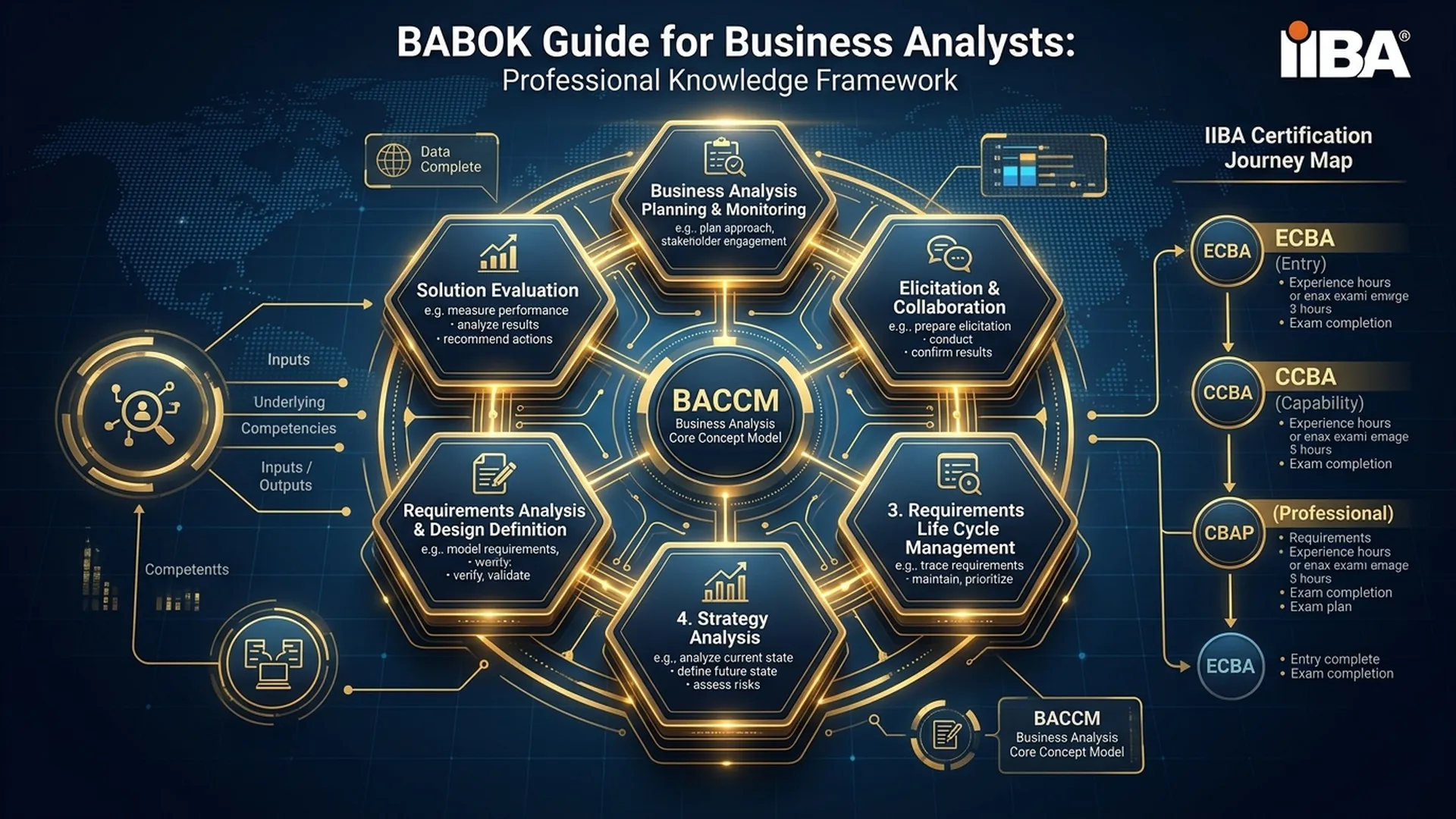
BABOK (Business Analysis Body of Knowledge) is the standard reference published by IIBA (International Institute of Business Analysis) - equivalent to PMBOK for Project Managers or SWEBOK for Software Engineers. If you want to practice BA professionally, BABOK is the foundation you must understand.
What is BABOK?
BABOK Guide (currently version 3.0) defines:
- Business Analysis: a set of activities used to identify needs and recommend solutions that create value for stakeholders
- 6 Knowledge Areas (KA): the core knowledge groups of BA
- 50+ techniques: specific tools and methods to perform each BA task
BABOK is not a framework or a process - it is a body of knowledge, meaning a consolidated set of knowledge. You can apply BABOK in any methodology: Agile, Waterfall, or Hybrid.
The 6 Knowledge Areas in BABOK
1. Business Analysis Planning & Monitoring
Planning the full BA effort:
- Identify stakeholders and how to engage them
- Choose the right methodology (Agile/plan-driven)
- Define governance for BA activities
- Track progress and adjust the plan
In AI projects: You need additional planning for data discovery, the model evaluation cycle, and AI-specific risk assessment.
2. Elicitation & Collaboration
Gathering information and collaborating to understand needs:
- Interviews, workshops, surveys
- Observation, prototyping, document analysis
- Focus groups, brainstorming
In AI projects: AI note-taking tools and AI interview summarizers help BA process outputs 3-4x faster.
3. Requirements Life Cycle Management
Managing the full lifecycle of requirements:
- Trace requirements from business need -> solution
- Maintain and prioritize the requirements backlog
- Assess impacts when requirements change
- Approve and baseline requirements
In AI projects: You also need traceability from business requirement -> AI capability requirement -> training data requirement -> evaluation metric.
4. Strategy Analysis
Analyzing strategy to define the right solution:
- Analyze current state (AS-IS)
- Define future state (TO-BE)
- Assess risks and feasibility
- Define change strategy
In AI projects: AI readiness assessment, build vs buy vs partner decisions, and data infrastructure gap analysis all matter.
5. Requirements Analysis & Design Definition (RADD)
Analyzing and designing detailed requirements:
- Model requirements (UML, BPMN, use cases)
- Verify and validate requirements
- Define acceptance criteria
- Prototype and mock up solutions
In AI projects: Add AI behavior specifications - expected outputs, edge cases, confidence thresholds, and fallback scenarios.
6. Solution Evaluation
Evaluating the solution after implementation:
- Measure solution performance
- Analyze performance gaps
- Assess solution limitations
- Recommend improvements
In AI projects: This includes tracking AI feature adoption, monitoring model drift, and measuring delivered business value.
Underlying Competencies
In addition to the 6 KA, BABOK defines the competencies every BA needs:
| Group | Example |
|---|---|
| Analytical Thinking | Problem decomposition, decision making, systems thinking |
| Behavioral Characteristics | Ethics, personal accountability, trustworthiness |
| Business Knowledge | Business principles, industry knowledge |
| Communication Skills | Oral, written, facilitation, negotiation |
| Interaction Skills | Facilitation, leadership, teamwork |
| Tools & Technology | Office tools, modeling tools, requirement management tools |
BABOK Techniques (50+ techniques)
These are the most practical techniques for BA working on AI projects:
Elicitation
| Technique | When to use it |
|---|---|
| Structured Interviews | Elicit needs from key stakeholders |
| Workshops | Align multiple stakeholders at the same time |
| Observation (Job Shadowing) | Understand the real user workflow |
| Prototyping | Validate AI UX early before building |
| Survey/Questionnaire | Collect data from many people |
Analysis
| Technique | When to use it |
|---|---|
| Business Rules Analysis | Define business logic for AI |
| Decision Analysis | Build decision trees for AI workflows |
| SWOT Analysis | Assess AI strategy |
| Process Modeling (BPMN) | Map flows with AI intervention |
| Use Cases / User Stories | Specify AI features |
Evaluation
| Technique | When to use it |
|---|---|
| Acceptance & Evaluation Criteria | Define "done" for AI features |
| Metrics & KPIs | Measure the business value of AI |
| Risk Analysis | Assess AI deployment risks |
| Root Cause Analysis | Investigate AI incidents |
BABOK vs Agile Extension
IIBA also published the Agile Extension to the BABOK (AgileBA) to fit Agile environments:
| BABOK | Agile Extension |
|---|---|
| Detailed requirements upfront | Just-in-time requirements |
| Formal documentation | Lightweight artifacts |
| Sequential approach | Iterative discovery |
| Separate BA phase | BA embedded in sprints |
In modern AI projects, you usually combine both - use Agile Extension for sprint-level work while using BABOK techniques for strategic analysis.
Applying BABOK in real AI projects
Week 1-2: Business Analysis Planning
1. Identify stakeholders (Product Owner, Data Scientist, End Users, Compliance)
2. Define BA approach (Agile sprints + lightweight documentation)
3. Set up requirements tool (Jira, Confluence, or Azure DevOps)
4. Create RACI matrix cho BA activities
Week 3-4: Elicitation
1. Workshop với business stakeholders → define problem + success criteria
2. Job shadowing với end users → understand current workflow pain points
3. Interview Data Scientist → understand technical constraints
4. Synthesize insights với AI tool → cluster themes, identify gaps
Sprint by Sprint: RADD + Solution Evaluation
Per sprint:
- Refine user stories với acceptance criteria
- Create AI behavior specification cho new features
- Validate with stakeholders
- Measure feature adoption post-release
IIBA certifications related to BABOK
| Certification | Requirement | Intended for |
|---|---|---|
| ECBA | 21 PD, 0 experience | Entry-level BA |
| CCBA | 21 PD, 2 years of experience | Mid-level BA |
| CBAP | 35 PD, 5 years of experience | Senior BA |
| AAC | Agile focus | BA in Agile teams |
Tips for studying BABOK effectively
- Do not read it from start to finish - BABOK is a reference, not a novel. Read the KA you need most right now.
- Map it to real work - Whenever you do a BA task, check how BABOK defines that task.
- Focus on Techniques - The Techniques section of BABOK is extremely practical. Memorize the 20 most common ones first.
- Combine it with AI tools - BABOK defines the WHAT, AI tools help you do the HOW faster.
- Study with the goal of taking ECBA/CCBA - Exam preparation forces you to understand BABOK systematically.
Conclusion
BABOK is not a document you read once and abandon - it is a reference guide you will return to many times during your BA career. Mastering the 6 Knowledge Areas and 20-30 core techniques is enough to work effectively. The rest will naturally come with real experience.
In the AI era, BABOK matters even more - because AI tools can automate many BA tasks, but analytical thinking and the ability to identify the right problem are things AI cannot replace.