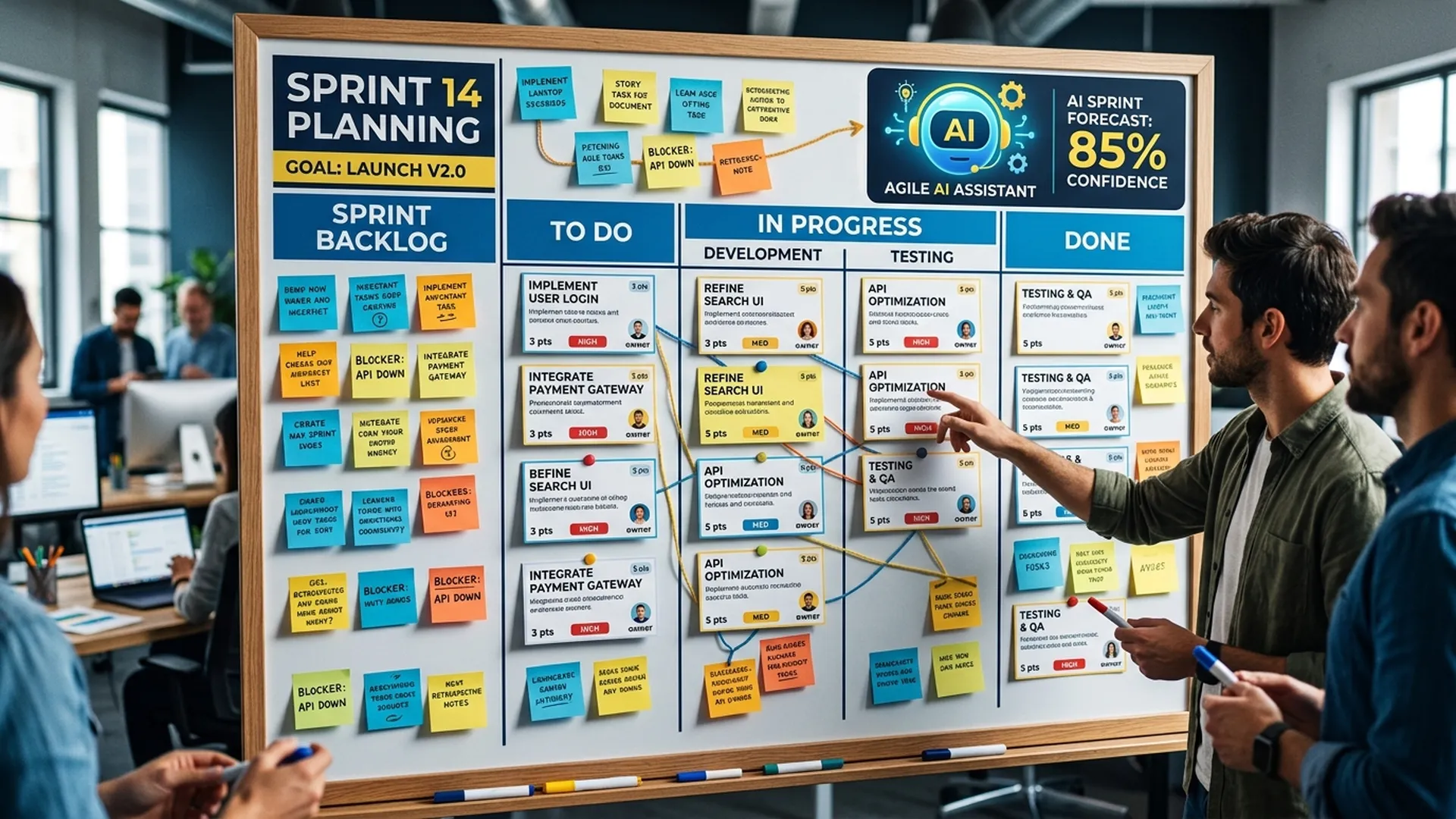
A skilled BA can refine 15–20 stories in 2 hours. With AI support, you can handle 40+ stories at the same quality in the same timeframe — but only if you use it correctly.
1. Tasks Where AI Can Help in Refinement
| Task | AI Support Level | BA Review Needed? |
|---|---|---|
| Detect duplicate stories | ✅ High | Always |
| Suggest acceptance criteria | ✅ High | Always |
| Split epic into stories | ✅ Pretty good | Always |
| Estimate story points | ⚠️ Reference only | Absolutely required |
| Detect missing edge cases | ✅ Good | Should review |
| Identify dependencies | ⚠️ Suggestions only | Needs validation |
| Prioritization | ❌ Don't use AI | BA + PM decide |
2. Prompt Templates for Backlog Refinement
2.1 AC Generation
Prompt: "Given this user story: '[STORY TEXT]'
Write 5-7 acceptance criteria in Given/When/Then format.
Consider: happy path, validation errors, empty state, loading state, and mobile behavior.
The system is [SYSTEM DESCRIPTION]."
Example of good output:
Story: "As a customer service agent, I want to see AI-suggested responses
        so that I can reply faster to customers."

AC:
Given: Agent opens a customer message
When: The message has been in queue > 2 seconds
Then: AI suggests 3 response options ranked by confidence score

Given: AI confidence score < 0.7
When: Agent views suggested response
Then: System displays warning "Low confidence - review before sending"

[...]
2.2 Story Splitting (Epic → Stories)
Prompt: "Split this epic into user stories following INVEST principles:
Epic: '[EPIC TEXT]'
Context: [SYSTEM CONTEXT]
Constraints: Each story must be completable in 1 sprint (2 weeks).
Output format: Story title, As a [user], I want [goal], so that [benefit]"
2.3 Duplicate Detection
Prompt: "Review these stories and identify:
1. Exact duplicates
2. Overlapping scope (partial duplicate)
3. Gaps (stories implied but missing)

Stories:
[PASTE LIST OF STORY TITLES AND DESCRIPTIONS]"
3. AI-assisted Refinement Workflow
Step 1: Pre-refinement (BA solo, 30 min)
├── Run AI on all stories in "Ready for Refinement" status
├── Flag: duplicates, missing AC, unclear acceptance criteria
└── Prepare: refined list sorted by priority

Step 2: Refinement Session (BA + Team, 90 min)
├── Walk through AI-flagged duplicates first (quick decisions)
├── For each story:
│   ├── Read AI-suggested AC aloud
│   ├── Team discussion: Add / Remove / Modify
│   └── BA updates in real-time (Jira/ADO)
└── Close: Team estimates points after AC is agreed

Step 3: Post-refinement (BA solo, 15 min)
├── Review AI's dependency suggestions against team's discussion
└── Add links between dependent stories in Jira
4. Backlog Quality After Refinement — Checklist
Definition of Ready (DoR) for AI-assisted Refinement:
Story is "Ready for Sprint" when:
- [ ] Title follows "As a [user], I want [goal]" format
- [ ] Acceptance criteria: minimum 4, written in G/W/T
- [ ] Edge cases covered: empty state, error state, loading state
- [ ] Dependencies: listed and stories exist in backlog
- [ ] Story points: estimated by team (Fibonacci)
- [ ] Priority: assigned (P0-P3)
- [ ] Labels/components: tagged correctly
- [ ] Linked to Epic/Feature
5. AI Tools for Backlog Refinement
| Tool | AI Feature | Best Fit |
|---|---|---|
| Jira AI | AC suggestion, story summarization | Jira teams |
| Azure DevOps Copilot | Work item creation from description | Microsoft stack |
| Linear + GPT | Custom workflow with AI | Startups/small teams |
| ChatGPT/Claude | General purpose prompting | Any setup |
| Atlassian Intelligence | Cross-tool insight, duplicate detection | Confluence + Jira bundle |
6. When NOT to Use AI in Refinement
- Prioritization: AI doesn't know business value, political context, or resource constraints
- Technical feasibility: AI can suggest but the dev team must decide
- Stakeholder alignment: If a story's scope is still being debated → don't rush through AI
- Regulatory requirements: Requirements from compliance/legal must be manually verified by BA
Conclusion
AI in backlog refinement doesn't replace the BA — it eliminates mechanical work so the BA can focus on judgment work: prioritization, trade-offs, and stakeholder alignment.
The goal: after every refinement session, the backlog is cleaner, stories are clearer, and BA gets fewer follow-up questions from dev.