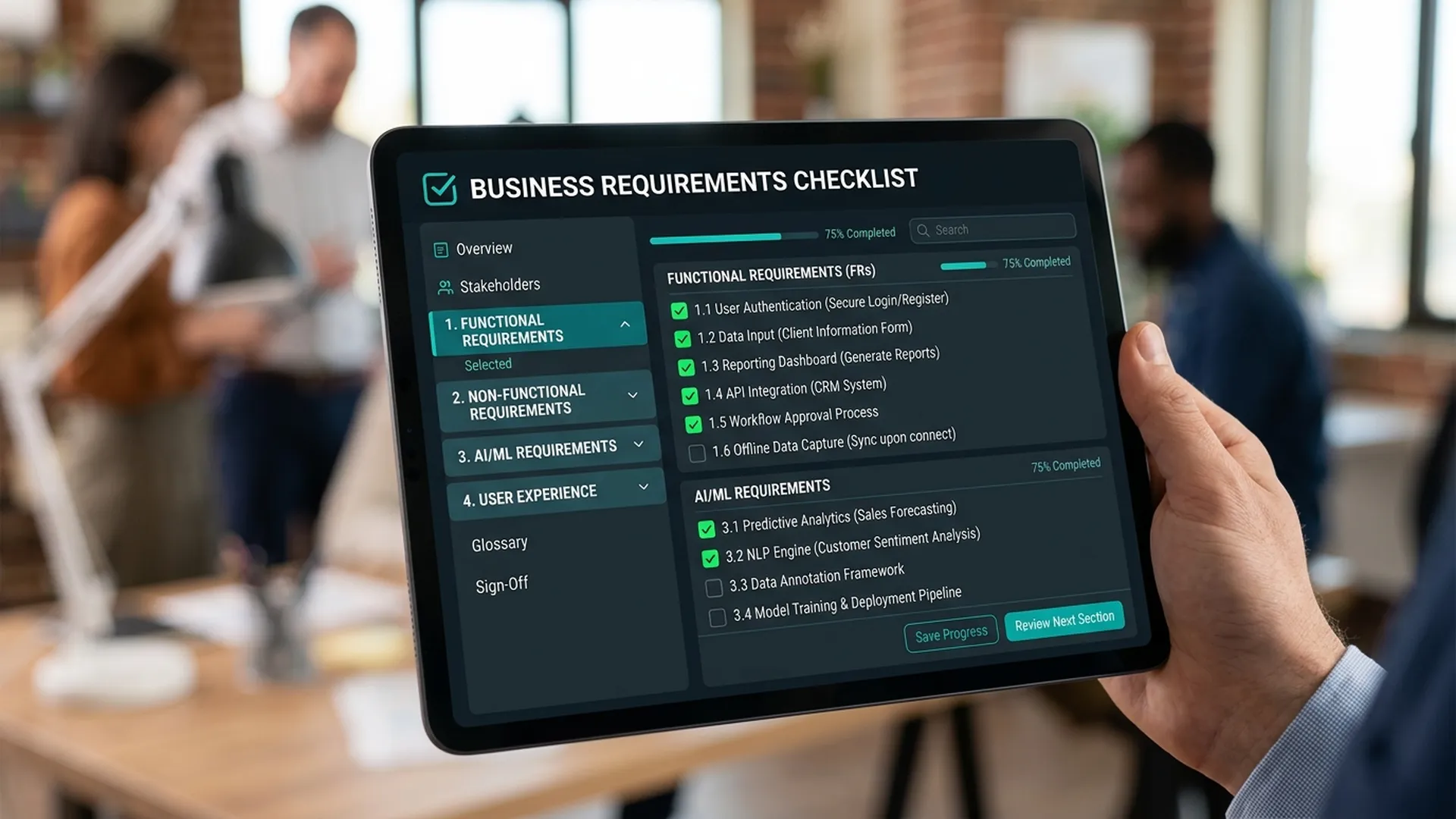
One of the most common reasons projects fail is incomplete requirements - not because the BA failed to ask questions, but because there is no consistent framework to ensure every angle is covered. A business requirements checklist solves that problem.
Why use a Checklist?
- Cognitive load: BA have to juggle many things at once -> details are easy to miss
- Consistency: Ensure every project is analyzed against the same standard
- Handoff quality: The dev team receives complete requirements -> fewer interruptions, less rework
- Audit trail: Evidence that the requirements were reviewed thoroughly
Checklist Part 1: Business Context
✅ Problem Definition
- Problem statement is written clearly (What, Who, When, Impact)
- Root cause has been analyzed (not just symptoms)
- Business objectives are linked to organizational goals
- Success metrics are defined and measurable (SMART)
- Scope boundaries are clear - in-scope and out-of-scope
✅ Stakeholder Analysis
- All stakeholders have been identified (primary, secondary, key decision makers)
- RACI matrix has been created
- Stakeholder concerns and pain points have been documented
- Communication plan for each stakeholder group
- Sign-off authority has been defined clearly
✅ Assumptions & Constraints
- All business assumptions are recorded
- Technical constraints have been documented
- Regulatory/compliance constraints have been checked
- Budget and timeline constraints
- Resource constraints (team size, available skills)
Checklist Part 2: Functional Requirements
✅ User Stories & Use Cases
- Each user story includes: Who (As a...) + What (I want...) + Why (So that...)
- Acceptance criteria follow the INVEST standard (Independent, Negotiable, Valuable, Estimable, Small, Testable)
- Happy path is fully documented
- Alternative flows (alternative paths) are covered
- Exception flows (error scenarios) are defined
✅ Business Rules
- All business rules are written explicitly (not implicit)
- Conditional logic is expressed clearly (if-then-else)
- Edge cases have been considered
- Conflicts between business rules have been resolved
- Business rules are traced to regulatory requirements (if any)
✅ Data Requirements
- Input data is defined (source, format, frequency)
- Output data is defined (destination, format, timing)
- Data validation rules are specified
- Data volume and peak load have been estimated
- Data retention policy has been defined
Checklist Part 3: Non-Functional Requirements
✅ Performance
- Response time expectations are defined (p50, p95, p99)
- Throughput requirements (requests/second, transactions/day)
- Concurrent users estimate
- Peak load scenarios are documented
✅ Security & Compliance
- Authentication requirements (SSO, MFA, etc.)
- Authorization model (RBAC, ABAC)
- Data classification (PII, sensitive, public)
- Compliance requirements check (GDPR, HIPAA, local regulations)
- Audit logging requirements
- Data encryption requirements (at rest, in transit)
✅ Usability
- Target user personas are defined
- Accessibility requirements (WCAG level)
- Supported devices and browsers
- Language and localization requirements
- Onboarding and help documentation needs
✅ Reliability & Availability
- SLA requirements (uptime %)
- Recovery time objective (RTO)
- Recovery point objective (RPO)
- Disaster recovery requirements
- Maintenance window constraints
Checklist Part 4: AI-Specific Requirements
This is the most important checklist section for BA working on AI projects - and often the one most frequently missed.
✅ AI Model Behavior
- Expected outputs are defined clearly (format, type, range)
- Confidence threshold is specified (when human review is required)
- Fallback behavior when the model is uncertain
- How edge cases and out-of-distribution inputs are handled
- Acceptable error rate is approved by stakeholders
✅ Human-in-the-Loop Requirements
- Escalation triggers are defined (when AI hands off to a human)
- Human review workflow is specified
- Override mechanism (human can override AI decision)
- Audit trail for AI decisions is required
- Labeling/feedback mechanism if continuous learning is needed
✅ AI Fairness & Ethics
- Demographic groups affected by the AI decision are identified
- Fairness metrics are defined (equal accuracy across groups?)
- Bias testing plan is prepared
- Explainability requirements (is a black box acceptable?)
- Impact assessment for decisions affecting individuals
✅ Data & Model Quality
- Training data requirements are specified (volume, quality, freshness)
- Minimum model performance metrics are agreed with stakeholders
- Model drift monitoring requirements
- Retraining trigger conditions are defined
- Data versioning requirements
✅ AI-Specific Non-Functional Requirements
- Inference latency requirements (real-time vs batch)
- Model serving infrastructure constraints
- Cost per inference estimate and budget
- Versioning and rollback requirements for models
Checklist Part 5: Process & Handoff
✅ Dependencies
- External system dependencies are mapped
- API integrations are documented (endpoint, contract, SLA)
- Third-party vendors/services are identified
- Team dependencies (other squads, infra team) are clarified
- Data pipeline dependencies are documented
✅ Testing Requirements
- UAT scenarios are written from the BA perspective
- Test data requirements are specified
- Performance test scenarios are defined
- AI model testing criteria (accuracy, precision, recall targets)
- Regression test scope is agreed
✅ Documentation & Traceability
- Requirements are assigned unique IDs
- Traceability matrix: Business Req -> System Req -> Test Case
- Glossary of domain-specific terms is maintained
- Requirements change log is set up
- Sign-off received from key stakeholders
Template: Requirements Review Sign-off
Before handing over a sprint backlog, the BA should obtain sign-off using this mini checklist:
REQUIREMENTS REVIEW SIGN-OFF
Sprint: ___________
Feature: ___________
BA: ___________
Date: ___________

✅ Functional requirements complete & approved
✅ Acceptance criteria testable & agreed
✅ Non-functional requirements defined
✅ AI-specific requirements reviewed (nếu applicable)
✅ Dependencies identified & communicated
✅ Out-of-scope items documented

Stakeholder Sign-off:
Product Owner: ___________  Date: ___
Tech Lead: ___________      Date: ___
QA Lead: ___________        Date: ___
How to use the Checklist effectively
- You do not need to tick everything - Mark items N/A when they are not applicable, and state the reason clearly.
- Use it as a conversation guide - The checklist helps you remember what to ask, not as a rigid form.
- Adapt it to the project context - A startup sprint is not the same as an enterprise compliance project.
- Review it with the team - Do not do it alone; review with the PO and Tech Lead.
- Store it centrally - Keep it in Confluence/Notion so the team can access and improve it.
Conclusion
Checklist is not bureaucracy - it is a quality tool that helps BA deliver requirements with fewer errors and less rework. In AI projects, the AI-specific checklist is especially important because this is still new territory for many teams.
Start with a simple checklist, then expand it gradually based on your team's real experience. The best checklist is the one used regularly - not the longest one.