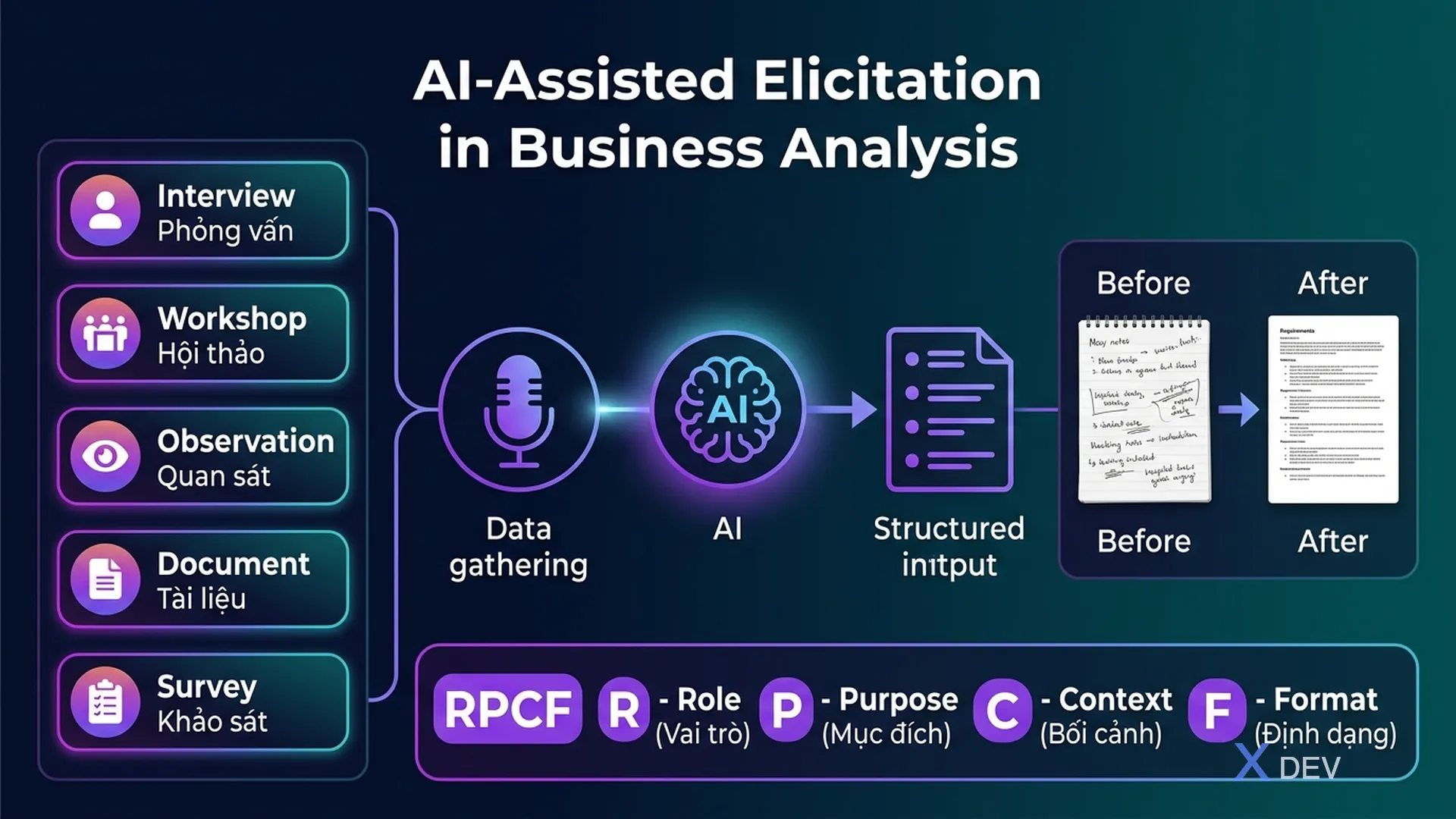
Elicitation — gathering requirements — is the core skill of any BA. But the most time-consuming part isn't asking questions; it's processing afterward: replaying recordings, transcribing notes, clustering insights, writing summaries, finding gaps, sending follow-ups. A 2-hour workshop can cost an additional 3–4 hours of synthesis work.
AI doesn't replace BA in the meeting room — but AI can handle most of the synthesis work afterward.
1. What is Elicitation and Why is it Complex?
Elicitation is the process BA pulls out (not passively collects) information from stakeholders: needs, goals, constraints, expectations, and even things they haven't said yet.
Common techniques:
- One-on-one interviews: Deep exploration by role
- Group workshops: Multi-stakeholder alignment
- Observation / Job shadowing: Watching users work in reality
- Document analysis: Reading SOPs, reports, complaint logs
- Surveys: Collecting large-scale quantitative data
The challenge: After each session, BA must connect multiple information sources, identify contradictions, prioritize — all by hand.
2. What Can AI Do in Elicitation?
AI doesn't sit in interviews on your behalf. But AI excels at the steps after the session:
| Step | Traditional | With AI |
|---|---|---|
| Transcribe recording | Listen back, type manually | Auto-transcribe (Whisper, Otter.ai) |
| Summarize content | Read again, highlight | Prompt → structured summary |
| Cluster insights by topic | Post-its + Miro | Prompt → affinity clusters |
| Detect gaps / contradictions | BA experience | Prompt cross-check multiple transcripts |
| Create action items | Write manually | Prompt → draft follow-up list |
| Draft follow-up email | Write from scratch | Prompt → email template |
3. Real-world Workflow: From Recording → Requirements
Step 1: Transcribe
Use Whisper (local, free) or Otter.ai / Fireflies (cloud). Output: .txt or .srt file.
# Local Whisper
whisper interview.mp3 --language Vietnamese --output_format txt
Step 2: Summary prompt
You are a Business Analyst. Here is a stakeholder interview transcript:
[PASTE TRANSCRIPT]

Summarize according to this format:
1. Stakeholder objectives (bullet points)
2. Current pain points (bullet points)
3. Implicit functional requirements (bullet points)
4. Constraints mentioned (time, budget, legal)
5. Questions needing clarification
Step 3: Affinity clustering
When you have multiple transcripts from different stakeholders:
Here are 3 summaries from 3 different stakeholders:
[SUMMARY 1] [SUMMARY 2] [SUMMARY 3]

Group insights by topic. For each topic:
- Which stakeholders agree
- Which have different viewpoints
- Points of conflict needing resolution
Step 4: Gap detection
Here are requirements from previous sessions:
[EXISTING REQUIREMENTS]

Here are new insights from today's workshop:
[NEW INSIGHTS]

Identify:
- Requirements that changed
- New gaps emerged
- Contradictions with old requirements
- Questions to ask stakeholders again
4. Prompt Pack for Interview Elicitation
Discovery interview (first stakeholder meeting)
As-is process questions:
- "How are you currently doing this step?"
- "What takes the most time?"
- "When does this process fail?"
- "Who else is affected when this happens?"

To-be vision questions:
- "If you could change 1 thing, what would it be?"
- "What does success look like in 6 months?"
- "What CANNOT change?"
Follow-up clarification template
Thank you for your time today. I have a few points to confirm:

1. [CLARIFICATION POINT 1] — I understood [YOUR INTERPRETATION], is that correct?
2. [CLARIFICATION POINT 2] — Can you give me a specific example?
3. [CONTRADICTION] — [STAKEHOLDER A] said X, while you mentioned Y. Who decides which direction?

Deadline for feedback: [DATE]
5. Quality Control for AI Output
AI can hallucinate — inventing "insights" that weren't actually in the transcript. BA must:
- Always cross-check against raw transcript: If AI claims stakeholder said X, find that exact sentence in the transcript.
- Tag confidence levels: High (stakeholder stated clearly) / Medium (implied) / Low (AI inference).
- Don't use AI output as a replacement for sign-off: AI summary still needs stakeholder confirmation.
[ELICITATION CONFIRMATION CHECKLIST]
☐ Each requirement has a source (stakeholder + session + quote)
☐ Contradictions are noted, not auto-resolved
☐ Stakeholder has reviewed and confirmed summary
☐ Action items have owner and deadline
☐ Recording/transcript stored in correct location
6. Tools BA Should Know
| Tool | Purpose | Free? |
|---|---|---|
| Whisper (OpenAI) | Local transcription, Vietnamese support | ✅ |
| Otter.ai | Live transcription, speaker detection | Freemium |
| Fireflies.ai | Google Meet/Zoom integration, AI summary | Freemium |
| Miro AI | Automatic affinity diagram from notes | Freemium |
| Notion AI | Page summarization, write follow-up emails | Freemium |
| Claude / ChatGPT | Analyze transcripts, detect gaps | Freemium |
7. Red Flags: Elicitation May Be Incomplete
Many BA think they have enough requirements when they actually don't. Warning signs:
- "I think the stakeholder wants..." — No evidence
- All requirements are HIGH priority — Haven't forced ranking
- No constraints mentioned — Haven't dug deep enough
- No non-functional requirements — Missing performance, security, scalability
- Zero contradictions between stakeholders — Haven't explored deeply enough
Summary
Good elicitation = Asking the right questions + Processing insights quickly + Finding gaps early + Confirming with stakeholders.
AI doesn't replace you asking questions, but AI helps you go from raw notes to structured requirements 3–4x faster. The key is BA maintaining quality control — AI is an accelerator, not a decision maker.