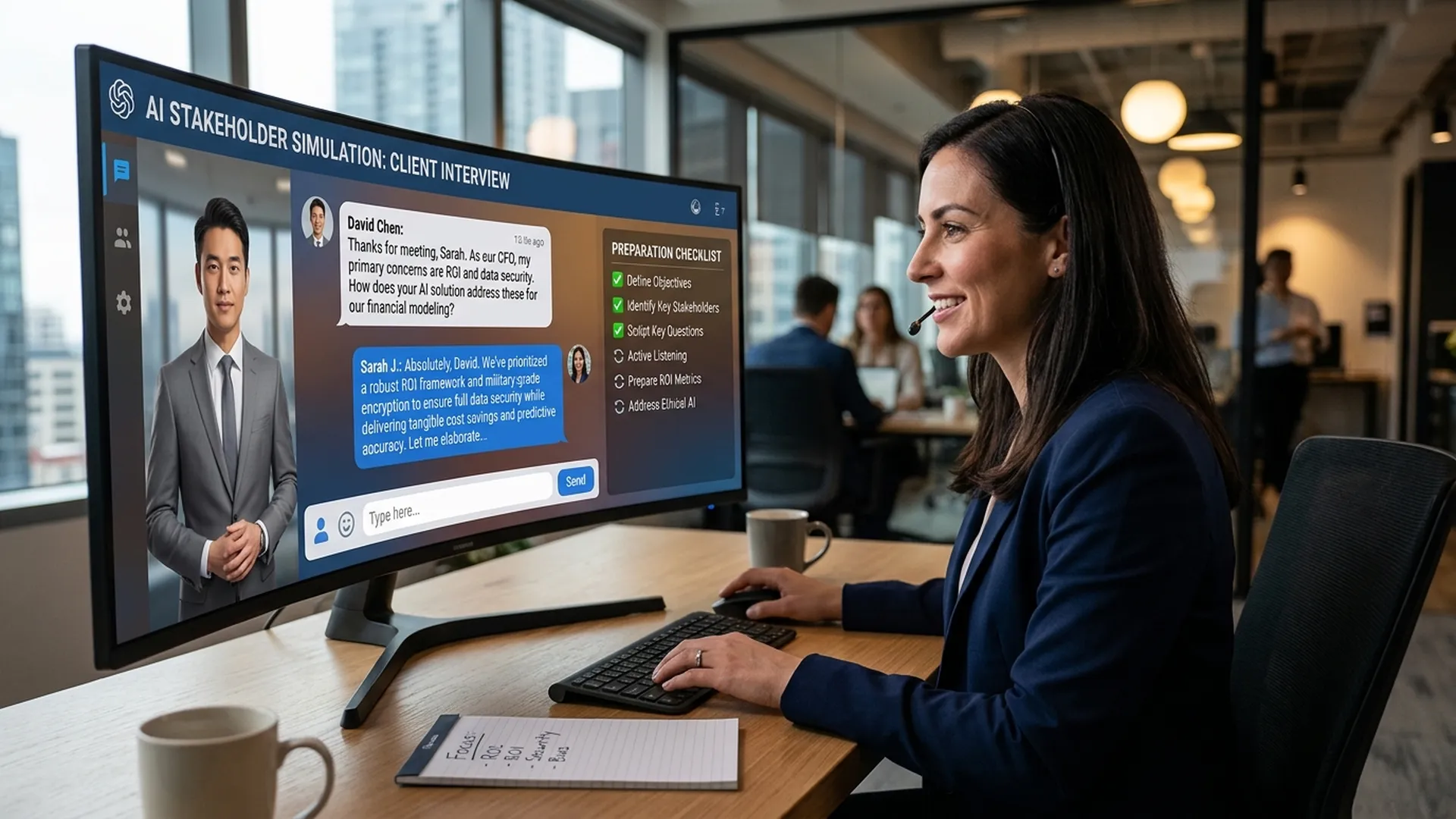
A BA who is technically brilliant but can't persuade stakeholders = project failure. A BA who is great at everything but can't interview = no opportunity to prove it. AI simulation is how you practice with feedback, at no cost, with no limit on repetitions.
1. Stakeholder Simulation with AI
1.1 Why Simulation Works
Difficult stakeholders have recurring patterns:
- The Skeptic: "Do we really need AI? Manual works just fine."
- The Over-requester: "Just add this feature too — it won't take long, right?"
- The Risk-avoider: "What if AI gets it wrong? I'm not signing off on this."
- The Budget Holder: "Is this ROI guaranteed? How was it calculated?"
- The Technical Champion: Wants AI to do everything; doesn't bother listening to user needs
Practicing with AI simulation → recognize patterns → handle them better in real situations.
1.2 Prompt Template for Stakeholder Simulation
Setup prompt:
You are [stakeholder name], [job title] at [company in industry X].
Your characteristics:
- [Characteristic 1: e.g., "Always asks about ROI and numbers before committing"]
- [Characteristic 2: e.g., "Skeptical about AI because a previous AI project failed"]
- [Characteristic 3: e.g., "Has budget authority but is not tech-savvy"]

I (the BA) will present an AI feature proposal to you.
Please react in character, ask hard questions, and push back when needed.
Start with: "OK, I have 20 minutes. Tell me what this feature is."
Scenario example:
Scenario: I need to convince the CFO to approve a $50K budget for an AI chatbot.
The CFO has rejected 2 previous AI proposals for "not showing clear ROI."
I have 15 minutes and 5 slides.
1.3 Types of Simulation Sessions
Session Type 1: Discovery Meeting
Scenario: New stakeholder, first meeting to elicit requirements.
Goal: Learn how to open the conversation, ask open-ended questions,
       listen actively, and avoid leading questions.
Session Type 2: Pushback Meeting
Scenario: Stakeholder disagrees with your requirement prioritization.
Goal: Learn how to handle objections, stay calm, and negotiate without losing ground.
Session Type 3: Executive Presentation
Scenario: 10-minute slot with a Director to get sign-off for go-live.
Goal: Clarity, confidence, and handling tough Q&A.
2. Mock Interview with AI
2.1 BA Interview Types and Simulation
Type 1: Behavioral Interview (STAR Format)
Prompt for AI:
"Please interview me for a Senior Business Analyst role specializing in AI.
Ask 5 behavioral questions and for each:
1. Ask the question
2. After I answer, give specific feedback:
   - Strengths in my answer
   - Weaknesses or gaps
   - Suggestions for improvement using STAR format"
Type 2: Case Study Interview
Prompt for AI:
"Give me a BA case study:
 A fintech company wants to automate credit approval with AI.
 Ask me questions like a tough interviewer,
 evaluating how I structure the problem, identify requirements,
 and handle ambiguity."
Type 3: Technical Depth Check
Prompt for AI:
"Test my BA knowledge of AI. Ask me sequentially about:
1. The difference between precision and recall — when do you use each?
2. How does a BA design a test set for an AI model?
3. Why is human-in-the-loop necessary?
4. How does GDPR Article 22 affect AI feature requirements?
After each answer, give me a score of 1–5 and explain why."
3. The Feedback Loop: Making Simulation Genuinely Valuable
3.1 After Each Simulation Session
Prompt to request feedback:
"Now step out of character.
Evaluate my performance in the simulation we just did:
1. Which response or argument was strongest? Why?
2. Where was I weak or missing something?
3. What questions might the stakeholder have asked that I wasn't ready for?
4. 3 things I should improve for next time?"
3.2 Progress Tracking Template
## Simulation Log

| Date | Type | Scenario | Score (1-5) | Key Weakness | Improved Next Time? |
|------|------|----------|-------------|--------------|---------------------|
| YYYY-MM-DD | Stakeholder | CFO Budget Approval | 3/5 | No specific ROI numbers | ☐ |
| YYYY-MM-DD | Mock Interview | Behavioral - conflict handling | 4/5 | Weak STAR structure | ☐ |
4. Advanced: Role-play with AI to Increase Difficulty
Increase Difficulty Gradually
Level 1: AI plays a cooperative, supportive stakeholder
Level 2: AI plays a skeptical but reasonable stakeholder
Level 3: AI plays a hostile stakeholder with their own agenda
Level 4: AI plays multiple stakeholders simultaneously (conflicting interests)
Level 4 Prompt:
"Play TWO stakeholders in the same meeting:
- A: CTO, wants the AI feature ASAP, doesn't care about the business case
- B: CFO, wants clear ROI, skeptical about AI

The two have dynamic tension. I need to convince both of them.
Start the meeting."
5. Practice Resources
| Resource | Use For | Level |
|---|---|---|
| ChatGPT/Claude | Simulation sessions (free) | All levels |
| IIBA BA Body of Knowledge | Theoretical framework | Junior-Mid |
| Glassdoor BA interview questions | Real interview patterns | Mid-Senior |
| Product School case studies | Complex case practice | Senior |
| Interviewbit BA questions | Technical depth | Mid |
Conclusion
AI simulation doesn't replace real experience — but it multiplies preparation speed. 10 simulation sessions with AI + 1 real stakeholder meeting = far better results than just 1 real meeting alone.
Practice until you are bored with those hard questions — that's when you're ready for the real thing.