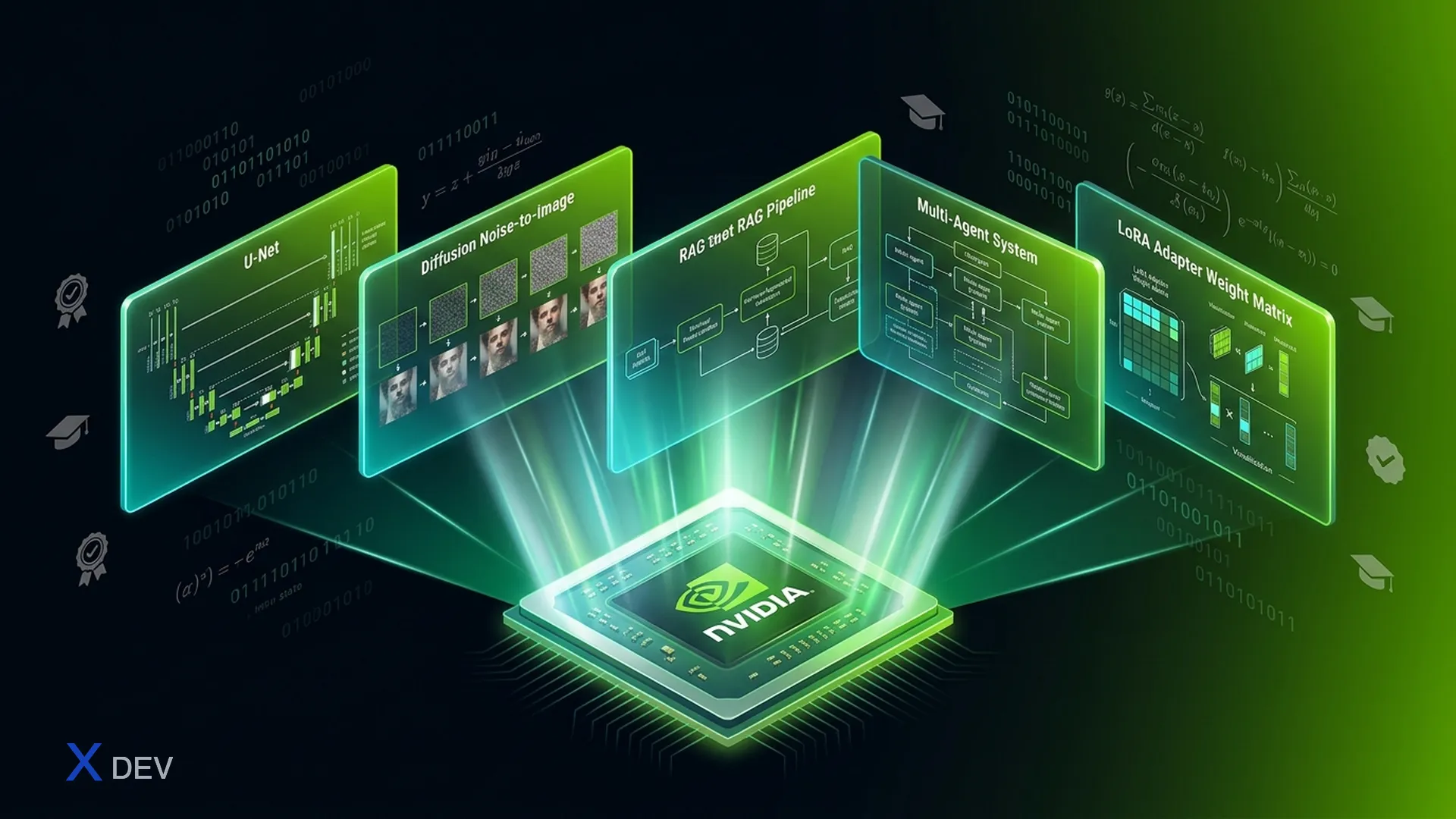
If you're looking for a hands-on AI certification rather than pure theory, the NVIDIA Deep Learning Institute (DLI) is the top choice. Unlike AWS or Azure that focus on their own cloud platforms, NVIDIA DLI teaches you hands-on coding directly on GPUs — from building a U-Net diffusion model from scratch to deploying a production-grade RAG agent.
This article goes deep into the complete Generative AI course and certification system at NVIDIA DLI: each course's content, assessment format, difficulty, sample questions, and a detailed preparation roadmap.
1. NVIDIA DLI System Overview
NVIDIA DLI is not a traditional certification exam like AWS or Azure. Instead, NVIDIA has 2 distinct credential types:
DLI Course Certificates (Completion-based)
- Complete a self-paced or instructor-led course
- Must pass the end-of-course assessment (hands-on coding, not MCQ)
- Receive certificate via email, verifiable on NVIDIA
- Price: $30–$90/course (self-paced) or workshop fee (instructor-led)
- No expiration date
NVIDIA Professional Certifications (Exam-based)
- Proctored exam via Pearson VUE
- Multiple-choice + scenario-based format
- Price: $125 (Associate) or $400 (Professional)
- Duration: 1–2 hours
- Validity: 2 years, then must retest
- Current certifications: NCA-AIIO (Associate), NCP-AII, NCP-AIO, NCP-AIN (Professional)
Important note: As of April 2026, NVIDIA does not yet have a Professional Certification specifically for Generative AI/LLM. Current professional certifications focus on AI Infrastructure, Operations, and Networking. However, DLI Course Certificates for GenAI/LLM are widely recognized in the industry and their assessments are significantly harder than typical MCQs.
2. Generative AI with Diffusion Models — Hardest Course
| Course Code | DLI+S-FX-14+V1 |
| Duration | 8 hours |
| Price | $90 |
| Level | Technical - Intermediate |
| Language | English |
| Framework | PyTorch, CLIP |
| Certificate | Yes (after passing assessment) |
Detailed Module Content
Module 1: From U-Net to Diffusion
- Build U-Net architecture from scratch using PyTorch
- Train a model to remove noise from images
- Understand encoder-decoder architecture with skip connections
- Hands-on: Write forward pass, loss function, training loop
Module 2: Diffusion Models
- Implement forward diffusion function — gradually add noise to an image
- Update U-Net architecture to accommodate timestep embeddings
- Implement reverse diffusion function — denoise an image from pure noise
- Math: Markov chains, variance schedule ($\beta_t$), reparameterization trick
Module 3: Optimizations
- Implement Group Normalization instead of Batch Norm (more stable for small batches)
- Implement GELU activation (Gaussian Error Linear Unit)
- Implement Rearrange Pooling for spatial downsampling
- Implement Sinusoidal Position Embeddings for timestep encoding:
$$PE(t, 2i) = \sin\left(\frac{t}{10000^{2i/d}}\right)$$ $$PE(t, 2i+1) = \cos\left(\frac{t}{10000^{2i/d}}\right)$$
Module 4: Classifier-Free Diffusion Guidance
- Add categorical embeddings to U-Net
- Train model with Bernoulli masking — randomly drop conditions
- Implement CFG scale ($w$) for inference:
$$\hat{\epsilon}\theta(x_t, c) = \epsilon\theta(x_t, \varnothing) + w \cdot (\epsilon_\theta(x_t, c) - \epsilon_\theta(x_t, \varnothing))$$
- Understand the trade-off between diversity vs. fidelity
Module 5: CLIP (Contrastive Language-Image Pretraining)
- Use CLIP Encodings to map text → embedding space
- Combine CLIP with U-Net to create a text-to-image pipeline
- Implement cross-attention between text embeddings and image features
- Hands-on: Generate images from English text prompts
Assessment
Format: Coding assessment directly in a Jupyter Notebook on cloud GPU
Requirements:
- Modify U-Net architecture to support a new condition (not copy-paste from the lab)
- Implement a custom diffusion pipeline combining multiple learned techniques
- Debug a model when output is incorrect — find bugs in the noise schedule or architecture
- Code must run successfully and output must meet the quality threshold
Passing score: Assessment is auto-graded; code must compile + output must match expected behavior
Difficulty: 🔴🔴🔴🔴🔴 (5/5)
This is the hardest course in the entire GenAI track because:
- No multiple-choice — you must write code from scratch
- Requires deep understanding of diffusion math: variance schedule, ELBO, score matching
- Must know PyTorch fluently: custom modules, autograd, tensor operations
- Time-limited — you can't Google every line of code
Sample Questions and Formats
Type 1: Implement Component Given skeleton code, implement the
SinusoidalPositionEmbeddingsclass with a timestep tensor as input and an embedding tensor of size(batch_size, dim)as output.
Type 2: Debug A diffusion model outputs pure noise after training. Find the bug in the
reverse_diffusion()function below. (Hint: check the variance schedule)
Type 3: Extend Architecture Add classifier-free guidance to an already-trained model. Implement function
guided_sampling(model, prompt, cfg_scale)such that:
- When
cfg_scale=0: output matches the unconditional model- When
cfg_scale=7.5: output matches the prompt
Type 4: Integration Combine a CLIP encoder with a diffusion model. Write the full pipeline from text input → generated image, including:
- Text encoding via CLIP
- Cross-attention injection into U-Net
- Reverse diffusion loop with DDPM scheduler
Exam Tips
- Do the labs thoroughly, don't just run cells — understand every line of code, especially tensor shapes
- Memorize the math formulas: $q(x_t | x_{t-1})$, $p_\theta(x_{t-1} | x_t)$, noise scheduling
- Practice PyTorch fundamentals:
nn.Module,forward(),torch.randn(), einops - Don't panic if the model outputs noise — debug systematically: check shapes → check loss → check scheduling
- Time management: Spend 60% of time on labs, 40% on the assessment
3. Building RAG Agents with LLMs — Most Popular Course
| Course Code | DLI+S-FX-15+V1 |
| Duration | 8 hours |
| Price | $90 |
| Level | Technical - Intermediate |
| Framework | LangChain, Gradio, LangServe |
| Certificate | Yes |
Detailed Module Content
Module 1: LLM Inference Interfaces & Microservices
- Setup environment to connect with NVIDIA NIM (Inference Microservices)
- Query LLM via API: prompt formatting, token management
- Understand inference parameters: temperature, top_p, max_tokens, stop sequences
Module 2: Pipeline Design with LangChain, Gradio, LangServe
- Build LLM pipeline with LangChain Expression Language (LCEL)
- Rapidly create UI prototypes with Gradio
- Deploy pipeline to production via LangServe (FastAPI-based)
- Chain multiple components: prompt template → LLM → output parser
Module 3: Dialog Management with Running States
- Implement conversation memory — maintain context across multiple turns
- Build state machines for dialog flow
- Extract structured information from free-text conversations
- Coerce LLM output into Pydantic models (structured output)
Module 4: Working with Documents
- Load, split, and parse documents (PDF, markdown, code files)
- Implement chunking strategies: recursive character, semantic, sentence
- Metadata extraction and document preprocessing
Module 5: Embeddings for Semantic Similarity & Guardrailing
- Use embedding models for semantic search
- Implement cosine similarity for retrieval ranking
- Build guardrails using embedding distance — detect off-topic queries
- Hands-on: Input/output guardrailing system
Module 6: Vector Stores for RAG Agents
- Set up a vector database (FAISS/Milvus)
- Implement full RAG pipeline: query → retrieve → augment → generate
- Evaluate RAG quality: relevance, faithfulness, answer correctness
- Build an agent capable of answering questions about research papers
Assessment
Format: Coding-based — build and deploy a complete RAG agent
Requirements:
- Implement a RAG pipeline that can answer questions from an unseen dataset
- Agent must handle multi-turn conversation — remember context
- Implement guardrailing — reject off-topic queries
- Code must run end-to-end; agent responses must be relevant and accurate
Difficulty: 🔴🔴🔴🔴⚪ (4/5)
Easier than Diffusion Models because:
- More abstraction layers (LangChain, Gradio) — less low-level coding
- No heavy math required
- But still difficult because you must integrate multiple components into a complete system
Sample Questions
Type 1: Pipeline Construction Given a dataset of PDF papers, build a RAG pipeline such that:
- Chunk size = 512, overlap = 128
- Embedding model:
NV-Embed-QA- Top-k retrieval: 5
- Output: answer + source citations
Type 2: Guardrailing Implement an input guardrail so that queries unrelated to the dataset are rejected with the message "I can only answer questions about AI research papers."
Type 3: State Management Modify the agent to support follow-up questions. User asks "What is attention?" → agent responds. User follows up "Who invented it?" → agent must understand "it" = attention mechanism.
Exam Tips
- Read LangChain docs thoroughly beforehand — especially LCEL syntax
- Understand embedding dimensions — dimension mismatch is the most common error
- Test the pipeline step by step: retrieval first, then add generation
- Chunk size matters — too small loses context, too large adds noise
4. Building Agentic AI Applications with LLMs — Most Advanced Course
| Course Code | DLI+C-FX-25+V1 |
| Duration | 8 hours |
| Price | Instructor-Led (contact NVIDIA) |
| Level | Technical - Intermediate |
| Framework | LangGraph, NVIDIA NIM, LangChain |
| Certificate | Yes |
Detailed Content
Section 1: Fundamentals of Agent Abstraction and LLMs
- LLM capabilities vs. pitfalls (hallucination, context limits, reasoning failures)
- Agents as task decomposition abstractions
- Minimal agent demo: free-text LLM → structured action → execution
Section 2: Structured Output & Basic Fulfillment
- Bottleneck LLM output into JSON/task-based schema
- Domain alignment & stable schema enforcement
- Introduction to cognitive architectures (ReAct, Plan-and-Execute, LATS)
Section 3: Retrieval Mechanisms & Environmental Tooling
- Formalize environment access strategies for agents
- Build tool interfaces for DBs, APIs, external repos
- Vector-based RAG for semantic document retrieval
- Knowledge graphs for structured domain knowledge
Section 4: Multi-Agent Systems & Frameworks
- Task decomposition among specialized agents
- Communication buffers and process distribution schemes
- LangGraph: state machines for complex agent workflows
- Differentiate frameworks: LangGraph vs CrewAI vs AutoGen
Section 5: Final Assessment
- Deploy an agent system that schedules multiple retrieval operations
- Gather research from multiple sources → synthesize → return to user
- Optional module: Real-time agents — multimodal, robotics, audio systems, world models
Assessment
Difficulty: 🔴🔴🔴🔴🔴 (5/5)
Must deploy a complete multi-agent system capable of:
- Receiving a complex query from a user
- Decomposing it into sub-tasks
- Routing to specialized agents
- Aggregating results
- Returning a coherent response
This is a system-level assessment — not just writing a single function but architecting the entire pipeline.
5. Evaluation and Light Customization of LLMs — Newest Course
| Course Code | DLI+S-FX-34+V1 |
| Duration | 3 hours |
| Price | $90 |
| Level | Intermediate |
| Framework | NVIDIA NeMo, NIM, MLflow, Docker |
| Certificate | Yes |
Detailed Content
Part 1: Fundamentals of LLM Evaluation
- Query a deployed NVIDIA NIM
- Evaluation techniques: eyeballing → systematic benchmark
- GSM8K benchmark — evaluate math reasoning
- LLM-as-a-Judge — use a stronger LLM to evaluate a weaker LLM
- ELO ranking system — human evaluation methodology
Part 2: Systematic Evaluation with NeMo
- NeMo Evaluator microservice for robust evaluation workflows
- Custom dataset preparation for legal domain QA
- Compare zero-shot vs. few-shot (ICL)
- Metrics: BLEU, F1-score, similarity scores
- Multi-faceted LLM-as-a-judge: correctness, conciseness, readability
- MLflow experiment tracking
Part 3: Light Customization with LoRA
- Parameter-Efficient Fine-Tuning (PEFT) principles
- Low-Rank Adaptation (LoRA) — fine-tune only a fraction of parameters:
$$W' = W + \Delta W = W + BA$$
Where $B \in \mathbb{R}^{d \times r}$, $A \in \mathbb{R}^{r \times k}$, and rank $r \ll \min(d, k)$
- NeMo Customizer microservice to launch LoRA fine-tuning
- Monitor training: loss curves, convergence analysis
- Final assessment: Compare fine-tuned model vs. base model via evaluation metrics
Assessment
Difficulty: 🔴🔴🔴⚪⚪ (3/5)
- Shortest course (3h) but assessment is still hands-on
- Must run an actual evaluation pipeline and fine-tuning job
- Compare quantitatively: base model vs. ICL vs. LoRA fine-tuned
- Requires understanding metric interpretation — not just running code but analyzing results
6. Supplementary Courses in the GenAI Track
Introduction to Transformer-Based NLP (S-FX-08)
- 6 hours | $30 | Beginner
- Foundation for all LLM courses
- NLP tasks: text classification, NER, author attribution, QA
- Recommended: take before starting any other course
Generative AI Explained (S-FX-07)
- 2 hours | Free | Beginner
- No-code course, concept overview
- Good for managers and non-technical roles
- No assessment — completion only
Prompt Engineering with LLaMA-2 (S-FX-12)
- 3 hours | $30 | Beginner
- ⚠️ Expired (Dec 2025) — NVIDIA may release an updated version
- Prompt iteration, system messages, few-shot learning, chatbot behavior
Building AI Agents with Multimodal Models (C-FX-17)
- 8 hours | Instructor-Led
- Focus on multimodal agents — combining vision + language
- Newest course in the 2026 catalog
7. Complete GenAI Course Comparison Table
| Course | Code | Hours | Price | Assessment Difficulty | Prerequisites |
|---|---|---|---|---|---|
| Generative AI Explained | S-FX-07 | 2h | Free | None | None |
| Intro to Transformer NLP | S-FX-08 | 6h | $30 | ⭐⭐ | Basic deep learning |
| Generative AI with Diffusion Models | S-FX-14 | 8h | $90 | ⭐⭐⭐⭐⭐ | PyTorch + Deep Learning |
| Building RAG Agents | S-FX-15 | 8h | $90 | ⭐⭐⭐⭐ | Python OOP + DL basics |
| Eval & Customization of LLMs | S-FX-34 | 3h | $90 | ⭐⭐⭐ | Python + LLM basics |
| Agentic AI Applications | C-FX-25 | 8h | Workshop | ⭐⭐⭐⭐⭐ | DL + Python Intermediate |
| AI Agents with Multimodal | C-FX-17 | 8h | Workshop | ⭐⭐⭐⭐ | DL + Vision |
8. Comparing NVIDIA DLI with Other Certifications
| Criterion | NVIDIA DLI GenAI | AWS AI Practitioner | Azure AI-102 | Databricks GenAI |
|---|---|---|---|---|
| Exam format | Hands-on coding | 85 MCQ | 50 MCQ + case study | 45 MCQ |
| Actual coding | ✅ Write code on GPU | ❌ | ❌ | ❌ But has scenarios |
| Exam duration | 1–2h (assessment) | 120 minutes | 100 minutes | 120 minutes |
| Price | $30–$90 (course) | $150 | $165 | $200 |
| GPU access | ✅ Free cloud GPU | ❌ | ❌ | ❌ |
| Depth | 🔴 Very deep (code-level) | 🟡 Shallow (concepts) | 🟠 Medium (Azure services) | 🟠 Medium (RAG/eval) |
| Vendor lock-in | Low (PyTorch, open standard) | High (AWS only) | High (Azure only) | Medium (Databricks) |
| Industry recognition | ⭐⭐⭐⭐ (technical) | ⭐⭐⭐⭐⭐ (popular) | ⭐⭐⭐⭐ | ⭐⭐⭐ |
| Best suited for | ML Engineer, AI Researcher | SA, PM, Developer any level | Azure Developer | Data Engineer, MLOps |
Notes:
- NVIDIA DLI is the most technically deep certification — you actually code deep learning models
- AWS AI Practitioner is the most popular but shallow — only covers concepts and AWS services
- Databricks GenAI falls in between — has depth on RAG/eval but still MCQ
- If you're an ML Engineer: NVIDIA DLI → Databricks → AWS
- If you're a Cloud Architect: AWS → Azure → Databricks
9. Detailed Preparation Roadmap
Phase 1: Foundation (2 weeks)
Goal: Master deep learning fundamentals and PyTorch
| Week | Activity | Resources |
|---|---|---|
| 1 | Deep Learning basics: neural networks, backprop, CNN, RNN | DLI: Getting Started with Deep Learning (free) |
| 1 | PyTorch fundamentals: tensors, autograd, nn.Module | PyTorch Official Tutorials |
| 2 | Transformer architecture: attention mechanism, multi-head attention | DLI: Intro to Transformer NLP (S-FX-08, $30) |
| 2 | Hands-on: Fine-tune BERT for text classification | HuggingFace Tutorials |
Phase 2: Generative AI Core (3 weeks)
Goal: Master diffusion models and LLM fundamentals
| Week | Activity | Resources |
|---|---|---|
| 3 | Diffusion theory: forward/reverse process, DDPM paper | Paper: "Denoising Diffusion Probabilistic Models" (Ho et al.) |
| 3–4 | Main course: Generative AI with Diffusion Models (S-FX-14, $90) | NVIDIA DLI, 8 hours |
| 4 | Review: U-Net code, noise scheduling, CLIP integration | Review lab notebooks |
| 5 | Bonus: Stable Diffusion internals, Latent Diffusion | Paper: "High-Resolution Image Synthesis with LDM" |
Phase 3: LLM Applications (3 weeks)
Goal: Build production-ready LLM systems
| Week | Activity | Resources |
|---|---|---|
| 6 | LangChain fundamentals, LCEL, prompt templates | LangChain docs + tutorials |
| 6–7 | Main course: Building RAG Agents (S-FX-15, $90) | NVIDIA DLI, 8 hours |
| 7 | Vector databases deep-dive: FAISS, Milvus, pgvector | Official docs |
| 8 | Main course: Eval & Customization of LLMs (S-FX-34, $90) | NVIDIA DLI, 3 hours |
| 8 | LoRA fine-tuning practice: custom dataset | HuggingFace PEFT library |
Phase 4: Advanced & Agent (2 weeks)
Goal: Agent architecture and multi-agent systems
| Week | Activity | Resources |
|---|---|---|
| 9 | LangGraph deep-dive: state machines, conditional edges | LangGraph tutorials |
| 9 | Multi-agent patterns: specialization, delegation, aggregation | Research papers + blog posts |
| 10 | Main course: Agentic AI Applications (C-FX-25) | NVIDIA DLI Instructor-Led, 8 hours |
Estimated Total Cost
| Item | Cost |
|---|---|
| Generative AI Explained (free) | $0 |
| Intro to Transformer NLP | $30 |
| Generative AI with Diffusion Models | $90 |
| Building RAG Agents | $90 |
| Eval & Customization of LLMs | $90 |
| Agentic AI Applications (workshop) | ~$500–1,000 |
| Total (self-paced only) | $300 |
| Total (including workshop) | $800–1,300 |
Saving tip: Register for the NVIDIA Certification webinar (April 30, 2026) to receive a 50% discount code.
10. 20 Sample Assessment Questions (Mock Exam)
Here are questions simulating the actual NVIDIA DLI assessment format:
Diffusion Models (S-FX-14)
Q1. Given the skeleton code below, implement forward_diffusion():
def forward_diffusion(x_0, t, noise_schedule):
    """
    Args:
        x_0: clean image tensor (B, C, H, W)
        t: timestep tensor (B,)
        noise_schedule: dict with 'alpha_bar' tensor (T,)
    Returns:
        x_t: noisy image at timestep t
        noise: the noise added
    """
    # YOUR CODE HERE
    pass
Answer
def forward_diffusion(x_0, t, noise_schedule):
    alpha_bar_t = noise_schedule['alpha_bar'][t]  # (B,)
    alpha_bar_t = alpha_bar_t[:, None, None, None]  # (B, 1, 1, 1)
    noise = torch.randn_like(x_0)
    x_t = torch.sqrt(alpha_bar_t) * x_0 + torch.sqrt(1 - alpha_bar_t) * noise
    return x_t, noise
Explanation: Forward diffusion adds noise according to the formula: $$q(x_t | x_0) = \mathcal{N}(x_t; \sqrt{\bar{\alpha}_t} x_0, (1 - \bar{\alpha}_t) \mathbf{I})$$
Q2. What is the form of sinusoidal position embedding for a timestep? Implement the class TimestepEmbedding(nn.Module) with output dimension = 128.
Answer
class TimestepEmbedding(nn.Module):
    def __init__(self, dim=128):
        super().__init__()
        self.dim = dim

    def forward(self, t):
        half_dim = self.dim // 2
        emb = math.log(10000) / (half_dim - 1)
        emb = torch.exp(torch.arange(half_dim, device=t.device) * -emb)
        emb = t[:, None] * emb[None, :]
        emb = torch.cat([torch.sin(emb), torch.cos(emb)], dim=-1)
        return emb  # (B, dim)
Q3. Classifier-Free Guidance scale $w = 7.5$. Unconditional prediction = $\epsilon_u$, conditional prediction = $\epsilon_c$. Write code to compute the guided prediction.
Answer
guided_pred = epsilon_u + 7.5 * (epsilon_c - epsilon_u)
Q4. How does Group Normalization differ from Batch Normalization? Why do diffusion models prefer Group Norm?
Answer
- BatchNorm normalizes along the batch dimension → depends on batch size, unstable when batch is small
- GroupNorm normalizes along groups of channels within each sample → independent of batch size
- Diffusion models typically train with small batch sizes (large images consume GPU memory) → GroupNorm is more stable
Q5. Debug: Model outputs all-black images after reverse diffusion. What's wrong in the code below?
for t in range(T, 0, -1):
    pred_noise = model(x_t, t)
    alpha_t = noise_schedule['alpha'][t]
    alpha_bar_t = noise_schedule['alpha_bar'][t]
    x_t = (x_t - pred_noise) / torch.sqrt(alpha_t)  # BUG
Answer
Bug: The reverse diffusion formula is wrong. The correct version is:
x_t = (1 / torch.sqrt(alpha_t)) * (
    x_t - (1 - alpha_t) / torch.sqrt(1 - alpha_bar_t) * pred_noise
)
if t > 1:
    x_t += torch.sqrt(noise_schedule['beta'][t]) * torch.randn_like(x_t)
Missing: (1) the correct coefficient before the noise, (2) the posterior variance term for t > 1.
RAG Agents (S-FX-15)
Q6. Implement semantic similarity search with cosine similarity. Given query_embedding (1, 768) and doc_embeddings (N, 768), return the top-5 indices.
Answer
import torch.nn.functional as F

similarities = F.cosine_similarity(
    query_embedding, doc_embeddings, dim=1
)
top_5_indices = similarities.argsort(descending=True)[:5]
Q7. Chunking strategy: A document is 10,000 tokens long. Chunk size = 512, overlap = 128. Calculate the number of chunks.
Answer
$$\text{chunks} = \lceil \frac{10000 - 512}{512 - 128} \rceil + 1 = \lceil \frac{9488}{384} \rceil + 1 = 25 + 1 = 26$$
Q8. Write a LangChain LCEL pipeline: prompt template → LLM → output parser, for a summarization task.
Answer
from langchain_core.prompts import ChatPromptTemplate
from langchain_core.output_parsers import StrOutputParser

prompt = ChatPromptTemplate.from_template(
    "Summarize the following text in 3 bullet points:\n{text}"
)
chain = prompt | llm | StrOutputParser()
result = chain.invoke({"text": document_text})
Q9. Implement an input guardrail: reject queries with cosine similarity < 0.3 compared to topic embeddings.
Answer
def guardrail_check(query_emb, topic_embs, threshold=0.3):
    max_sim = F.cosine_similarity(
        query_emb.unsqueeze(0), topic_embs, dim=1
    ).max().item()
    if max_sim < threshold:
        return False, "Sorry, this question is outside my scope."
    return True, None
Q10. RAG evaluation: Precision@5 = 0.6, Recall@5 = 0.3. Explain the meaning and suggest improvements.
Answer
- Precision@5 = 0.6: 3/5 retrieved documents are relevant → retrieval is fairly good
- Recall@5 = 0.3: Only 30% of total relevant docs found → recall is low
- Improvements:
- Increase top-k to 10–20 (trade precision for recall)
- Improve chunking — smaller chunks for more precise matching
- Hybrid search: BM25 + semantic retrieval
- Add a re-ranking layer after initial retrieval
LLM Evaluation & Customization (S-FX-34)
Q11. LoRA rank r = 16, model dimension d = 4096, k = 4096. Calculate the % of parameters fine-tuned vs. full fine-tuning.
Answer
$$\text{Full FT params} = d \times k = 4096 \times 4096 = 16,777,216$$ $$\text{LoRA params} = d \times r + r \times k = 4096 \times 16 + 16 \times 4096 = 131,072$$ $$\text{Ratio} = \frac{131,072}{16,777,216} = 0.78%$$
LoRA fine-tunes only <1% of parameters while achieving near-full fine-tuning performance.
Q12. BLEU score = 0.15, F1 = 0.72. What problem does the model have?
Answer
- Low BLEU (0.15): Model generates text with different wording from the reference — not necessarily wrong
- High F1 (0.72): The content (key information) is mostly correct
- Diagnosis: Model paraphrases well but doesn't match exact phrasing → BLEU is a poor metric for QA tasks
- Action: Use semantic similarity or LLM-as-a-judge instead of BLEU for more accurate evaluation
Q13. Compare zero-shot, few-shot (ICL), and LoRA fine-tuning for a legal QA task:
Answer
| Approach | Accuracy | Latency | Cost | When to use |
|---|---|---|---|---|
| Zero-shot | Lowest | Fastest | $0 | Quick prototype, generic tasks |
| Few-shot (ICL) | Medium | Slower (longer context) | Higher token cost | <50 examples, need fast deployment |
| LoRA fine-tuning | Highest | Fast (small adapter) | Training cost | >1000 examples, need max accuracy |
Agentic AI (C-FX-25)
Q14. Implement structured output: LLM must return JSON with schema {"action": str, "params": dict, "confidence": float}.
Answer
from pydantic import BaseModel, Field

class AgentAction(BaseModel):
    action: str = Field(description="Action to execute")
    params: dict = Field(description="Action parameters")
    confidence: float = Field(ge=0, le=1, description="Confidence score")

structured_llm = llm.with_structured_output(AgentAction)
result = structured_llm.invoke("Search for papers about attention mechanism")
Q15. LangGraph: Implement a conditional edge — route to search_agent if the query needs research, route to answer_agent if context is sufficient.
Answer
from langgraph.graph import StateGraph, END

def router(state):
    if state["needs_research"]:
        return "search_agent"
    return "answer_agent"

graph = StateGraph(AgentState)
graph.add_node("classifier", classify_query)
graph.add_node("search_agent", do_research)
graph.add_node("answer_agent", generate_answer)

graph.add_conditional_edges("classifier", router, {
    "search_agent": "search_agent",
    "answer_agent": "answer_agent"
})
graph.add_edge("search_agent", "answer_agent")
graph.add_edge("answer_agent", END)
Cross-Course Questions
Q16. You need to build a system that generates product images from text descriptions. List the pipeline components and frameworks for each part.
Answer
- Text Processing: LangChain prompt template → extract key features
- Text Encoding: CLIP Text Encoder → text embeddings (768-dim)
- Diffusion Generation: U-Net conditioned on CLIP embeddings → reverse diffusion → image
- Post-processing: PIL/OpenCV resize, quality enhancement
- Serving: NVIDIA NIM or TorchServe for inference API
Pipeline: User input → LLM extract features → CLIP encode → Diffusion model → Generated image
Q17. Why does DDPM (Denoising Diffusion Probabilistic Model) need 1000 steps for inference but Latent Diffusion only needs 50?
Answer
- DDPM: Diffusion in pixel space (256×256×3 = 196,608 dimensions) → needs many steps to denoise
- LDM: Diffusion in latent space (32×32×4 = 4,096 dimensions) → compressed 48x → fewer steps needed
- Additionally, LDM uses the DDIM scheduler (deterministic) instead of DDPM (stochastic) → can skip steps
Q18. QLoRA vs LoRA: Explain the difference and when to choose QLoRA.
Answer
| LoRA | QLoRA | |
|---|---|---|
| Base model | FP16/BF16 | 4-bit quantized (NF4) |
| Adapters | FP16 | FP16 (computed in BF16) |
| VRAM for 7B model | ~14GB | ~6GB |
| Performance | Baseline | ~99% of LoRA |
Choose QLoRA when: GPU VRAM is limited (e.g., single RTX 3090/4090), or model is large (>13B params).
Q19. Explain the "lost in the middle" problem in RAG. Suggest 2 solutions.
Answer
Problem: LLMs tend to focus on the beginning and end of the context window, ignoring information in the middle → retrieved documents placed in the middle get ignored.
Solutions:
- Reorder retrieved docs: Place the most relevant docs at the beginning AND end, less relevant in the middle
- Summarize-then-answer: Summarize each retrieved doc into 1–2 sentences, concatenate the summaries instead of full text → shorter context, less lost information
Q20. System design: Build a RAG agent for a law firm. 50,000 documents, 100 concurrent users, response < 3 seconds. Sketch the architecture.
Answer
Users → Load Balancer → API Gateway
    → Input Guardrail (topic filter)
    → Query Router
        → Vector DB (Milvus, 50K docs, GPU-accelerated)
        → BM25 Index (Elasticsearch, keyword search)
    → Reciprocal Rank Fusion (merge results)
    → Re-ranker (cross-encoder, top-20 → top-5)
    → LLM (NVIDIA NIM, 8x H100, batched inference)
    → Output Guardrail (PII filter, citation check)
    → Response with sources
Key decisions:
- Milvus for vector search (GPU-accelerated, <100ms at 50K scale)
- Hybrid search (semantic + keyword) for legal domain accuracy
- Re-ranker to improve precision
- NVIDIA NIM for optimized LLM inference (<2s)
- Output guardrails for PII detection (legal compliance)
11. Conclusion
The NVIDIA DLI Generative AI track is the best choice for engineers who want truly hands-on experience with generative models. No MCQs, no empty theory — you must write code, debug models, and build systems.
If you can only choose 1 course: Start with Building RAG Agents (S-FX-15) — the most practical application, with the highest industry demand.
If you want to differentiate yourself: Add Generative AI with Diffusion Models (S-FX-14) — the hardest course, fewer people have it, proves deep technical competency.
If you want to be a full-stack GenAI engineer: Complete all 4 self-paced courses + 1 instructor-led workshop.
Additional Resources
- NVIDIA DLI Course Catalog
- NVIDIA Certification Portal
- DLI Learning Paths PDF
- NVIDIA Technical Blog: GenAI posts
- Paper: Denoising Diffusion Probabilistic Models (Ho et al., 2020)
- Paper: LoRA: Low-Rank Adaptation of LLMs (Hu et al., 2021)
- Paper: Attention Is All You Need (Vaswani et al., 2017)
Upcoming webinar: NVIDIA Certification 2026 — April 30, 2026 — register to receive a 50% discount code for certification exams. Register