
FHIR is the operational standard. OMOP is the analytical standard. Both coexist in a mature 2026 organization. This article shows how to bridge the two worlds: mapping, tooling, and pipelines.
1. Why you need both
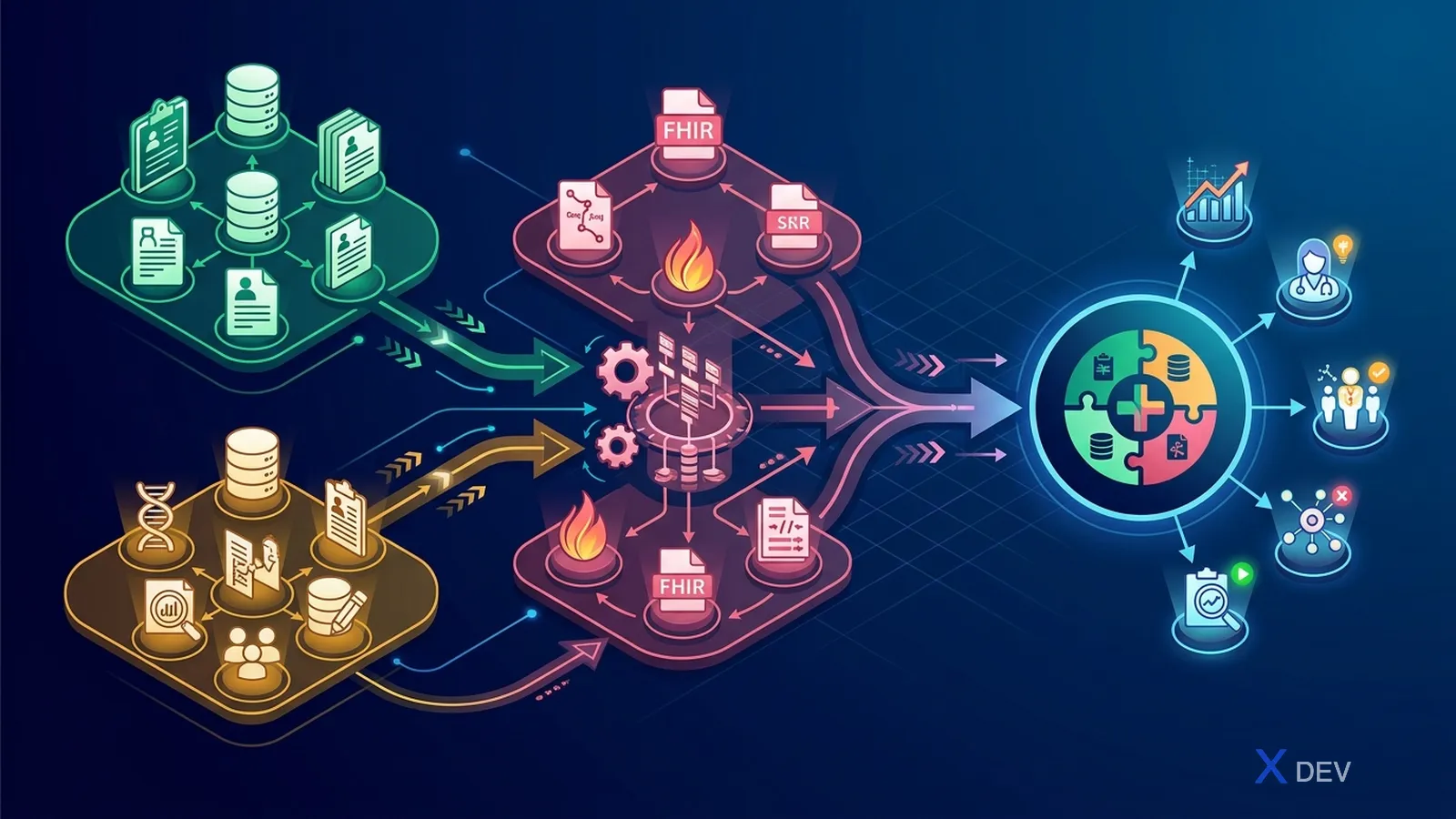
FHIR is strong for real-time, JSON, and REST. OMOP is strong for batch SQL, standardized vocabularies, and network studies. They each own a front — bridge them, don't replace one with the other.
2. Resource ↔ table mapping
The FHIR-OMOP-on-FHIR community (a joint HL7 + OHDSI working group) maintains the official mapping.
2.1 Core mapping table
| FHIR Resource | OMOP Table | Note |
|---|---|---|
| Patient | PERSON | identifier → person_source_value, gender → gender_concept_id |
| Encounter | VISIT_OCCURRENCE | class → visit_concept_id |
| Encounter (subVisit) | VISIT_DETAIL (CDM 5.4+) | hospital ward, dept |
| Condition | CONDITION_OCCURRENCE | code (SNOMED) → condition_concept_id |
| MedicationRequest / MedicationStatement / MedicationDispense | DRUG_EXPOSURE | code (RxNorm) → drug_concept_id |
| MedicationAdministration | DRUG_EXPOSURE | drug_type_concept_id = Inpatient admin |
| Procedure | PROCEDURE_OCCURRENCE | code → procedure_concept_id |
| Observation (lab) | MEASUREMENT | code (LOINC) + valueQuantity |
| Observation (vital) | MEASUREMENT | code + valueQuantity |
| Observation (social, family hx) | OBSERVATION | code → observation_concept_id |
| AllergyIntolerance | OBSERVATION | concept = "Allergy to" |
| Immunization | DRUG_EXPOSURE / PROCEDURE_OCCURRENCE | depends |
| Specimen | SPECIMEN | CDM 5.4 |
| DocumentReference / Composition | NOTE | text → note + NOTE_NLP |
| Coverage | PAYER_PLAN_PERIOD | BHYT, supplementary BHYT |
| Practitioner | PROVIDER | |
| Organization (provider) | CARE_SITE | |
| Location | LOCATION |
2.2 Detailed mapping: Encounter → Visit_Occurrence
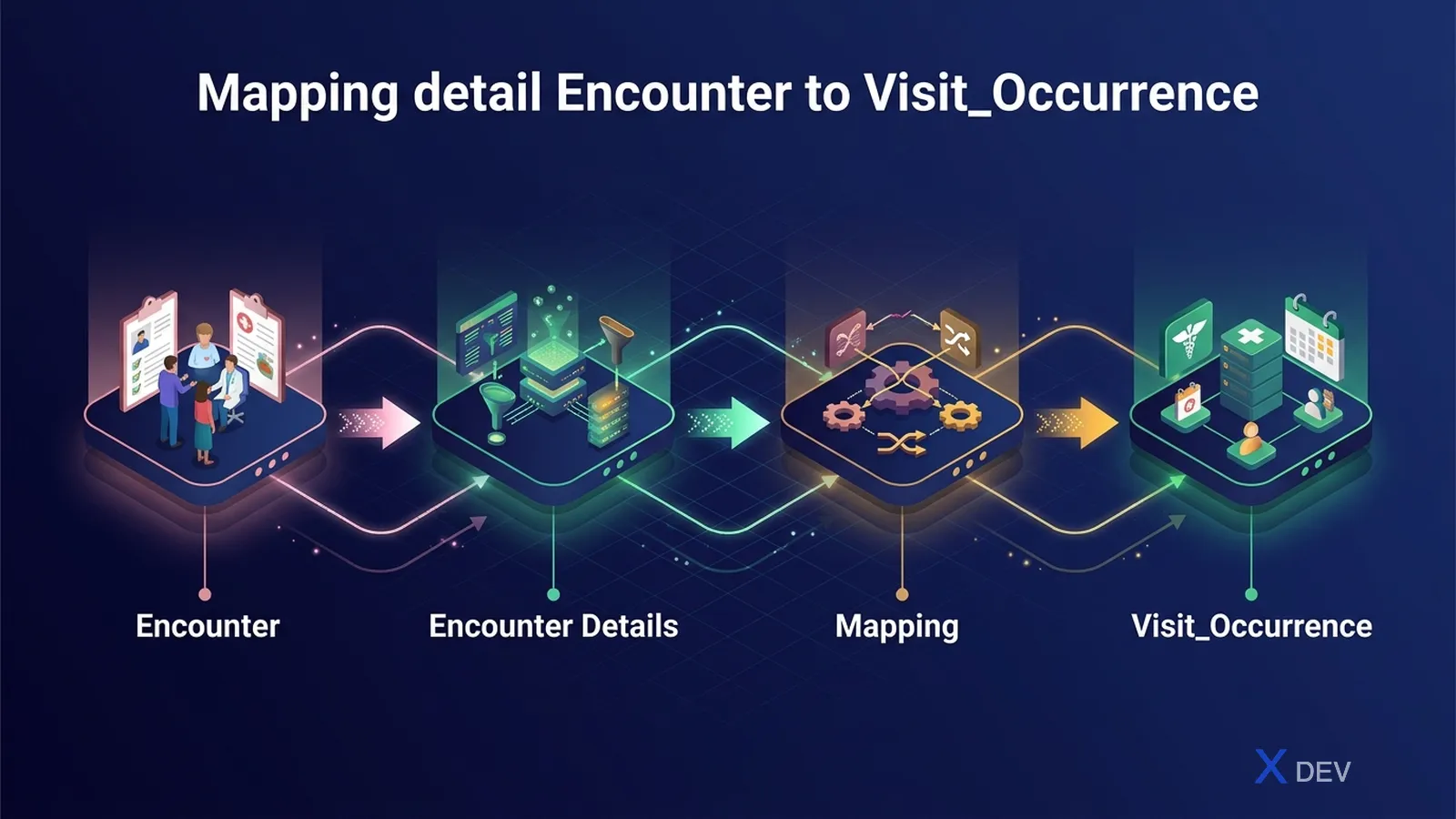
Code:
def encounter_to_visit(enc):
    return {
        'visit_occurrence_id': hash_to_bigint(enc['id']),
        'person_id': lookup_person(enc['subject']['reference']),
        'visit_concept_id': map_class(enc['class']['code']),
        'visit_start_date': enc['period']['start'][:10],
        'visit_start_datetime': enc['period']['start'],
        'visit_end_date': enc['period'].get('end', enc['period']['start'])[:10],
        'visit_type_concept_id': 32817,  # EHR encounter
        'care_site_id': lookup_care_site(enc.get('serviceProvider')),
        'visit_source_value': enc['id']
    }

def map_class(class_code):
    return {
        'IMP': 9201,  # Inpatient
        'AMB': 9202,  # Outpatient
        'EMER': 9203, # ER
        'HH': 581476, # Home health
        'VR': 5083    # Virtual / telehealth
    }.get(class_code, 0)
3. Coding system map FHIR ↔ OMOP
FHIR code system URL → OMOP vocabulary_id:
| FHIR System URL | OMOP vocabulary_id |
|---|---|
| http://snomed.info/sct | SNOMED |
| http://hl7.org/fhir/sid/icd-10-cm | ICD10CM |
| http://hl7.org/fhir/sid/icd-10 | ICD10 |
| http://www.nlm.nih.gov/research/umls/rxnorm | RxNorm |
| http://loinc.org | LOINC |
| http://www.ama-assn.org/go/cpt | CPT4 |
| urn:oid:2.16.840.1.113883.6.96 | SNOMED (OID) |
Vietnam:
| Vietnam FHIR System URL | OMOP vocabulary |
|---|---|
| https://terminology.kcb.vn/CodeSystem/icd10vn | Custom ICD10VN |
| https://terminology.kcb.vn/CodeSystem/danhmucthuoc | VN_DRUG (custom) |
4. Pipeline patterns
4.1 Bulk Export → ETL → CDM

Benefit: standard FHIR; you don't need the FHIR backend to support custom export. See FHIR Bulk Data Export & CDS Hooks.
4.2 Real-time CDC pattern

Pros: FHIR stays fresh; OMOP aggregates nightly.
5. Pathling — query FHIR like OMOP
Pathling (CSIRO Australia) lets you query FHIR data analytics-style:
-- Bulk Pathling query
SELECT
  patient.id,
  patient.gender,
  count(condition) AS n_conditions
FROM patient
LEFT JOIN condition ON condition.subject = patient
WHERE condition.code.subsumes('SNOMED|73211009')  -- Diabetes
GROUP BY patient.id, patient.gender;
Pathling stores FHIR in Parquet and queries with SparkSQL — analytics speed approaches OMOP. It can serve as a temporary bridge if you don't yet want to build a full OMOP CDM.
6. FHIR-OMOP-on-FHIR
Joint HL7 + OHDSI working group since 2020. 2026 deliverables:
- Official Implementation Guide (ig.fhir.org/...)
- Maintained mapping tables
- HAPI FHIR plugin → query OMOP CDM as FHIR
- OMOP-on-FHIR reference server (Georgia Tech)
→ A single server can serve OMOP data through a FHIR interface, or convert FHIR → OMOP automatically.
7. OHDSI Sql On FHIR (SOF)
Sql On FHIR (SOF) is a newer project (2024-2026) that exposes FHIR resources as SQL views. Similar to Pathling, but the spec is open:
- ViewDefinition resource (R4 / R5)
- Reference implementations: HAPI, Aidbox
- Output: flat tabular views → easy to load into OMOP
8. Deploying in Vietnam
8.1 Recommended pattern
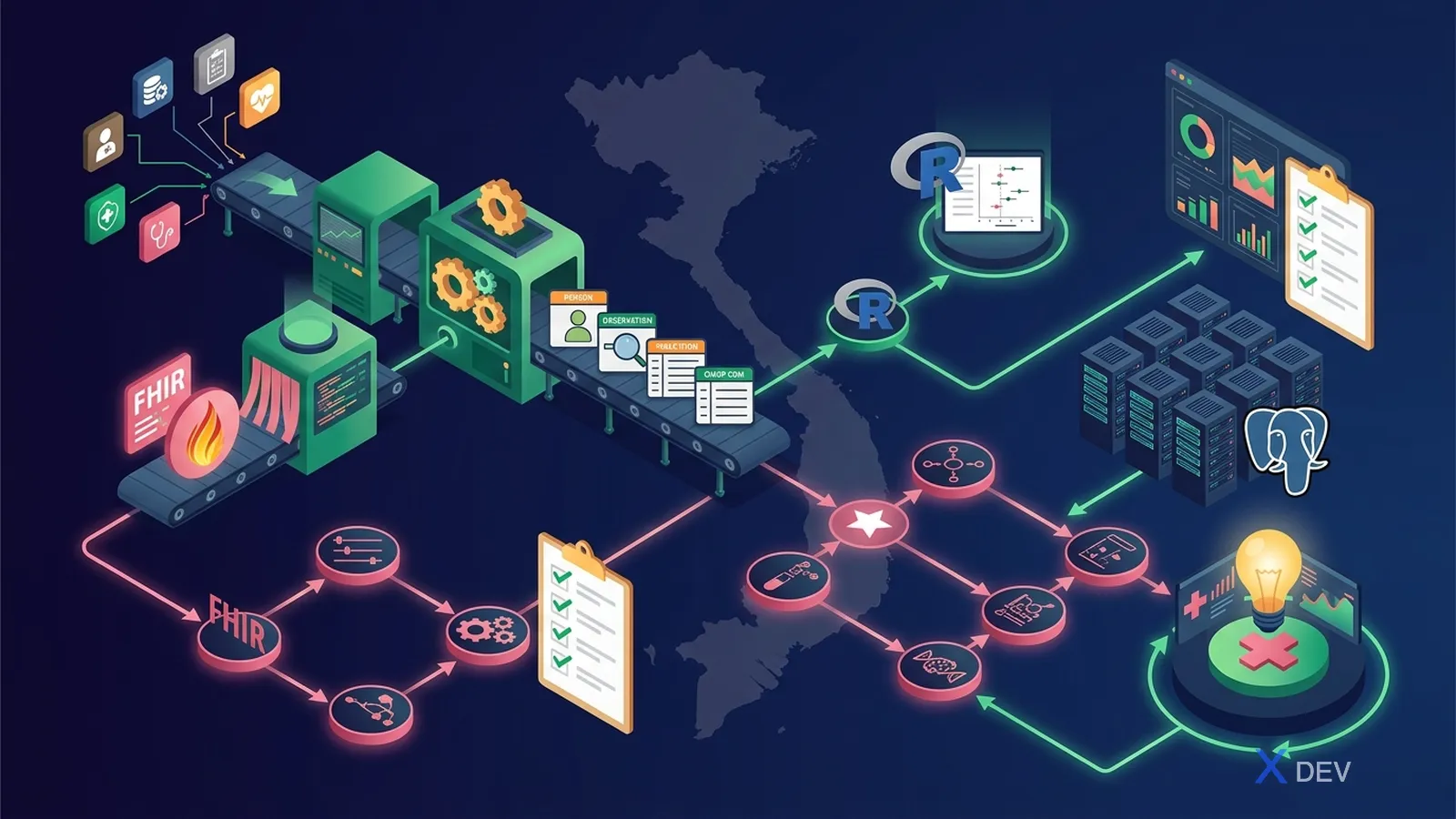
8.2 Adapters you need to build
- ICD-10 VN → SNOMED (USAGI with manual review)
- MoH drug catalog → RxNorm
- DVKT (medical service) catalog → SNOMED procedure
- 54 ethnicities → custom vocabulary
- BHYT type → Payer concept (custom)
See OMOP for Vietnam — BHYT, HSDT, ICD-10 VN, 54 ethnicities.
9. Mapping pitfalls
- ❌ A
MedicationRequestthat hasn't been filled → don't push it into DRUG_EXPOSURE (don't confuse with MedicationStatement = the patient actually took it) - ❌ Encounters with status
cancelled→ exclude from VISIT - ❌ Observations marked
not-done→ don't push into MEASUREMENT - ❌ FHIR Subscription notifications → DO NOT push into OMOP (operational only)
- ❌ Provenance / AuditEvent → don't map to OMOP
- ❌ Multiple
Patient.identifiervalues → pick one asperson_source_value(pseudonymized national ID) - ❌ Many-to-one mappings (e.g., 3 MedicationAdministrations in one day) → must be grouped by clinical logic
10. Validating the bridge
Checks to run:
-
patients in FHIR == # rows in PERSON
- Total Encounters == total VISIT_OCCURRENCE
- Total Conditions == total CONDITION_OCCURRENCE
- DQD passes on the new CDM
- Sample 100 patients: trace forward (FHIR → OMOP) and backward
11. Hybrid pattern

Start small and scale up. You don't have to build OMOP from day one — Pathling can carry phase 1.
12. Further reading
- HL7 FHIR-to-OMOP Implementation Guide
- Pathling docs: pathling.csiro.au
- OMOP-on-FHIR Georgia Tech: github.com/Georgia-Tech-CSE
- OHDSI Working Group "FHIR and OMOP"
- SOF (SQL on FHIR) spec
- Vietnam: community FHIR profiles and mappings (in progress)
Conclusion
FHIR + OMOP isn't a choice — it's the standard 2026 pattern. A solid bridge enables real-time operations and multi-source RWE analytics in the same organization. Vietnam has the opportunity to build an integrated stack from day one, with no legacy migration to worry about.
Next up: OMOP for Vietnam — BHYT, HSDT, ICD-10 VN, 54 ethnicities.