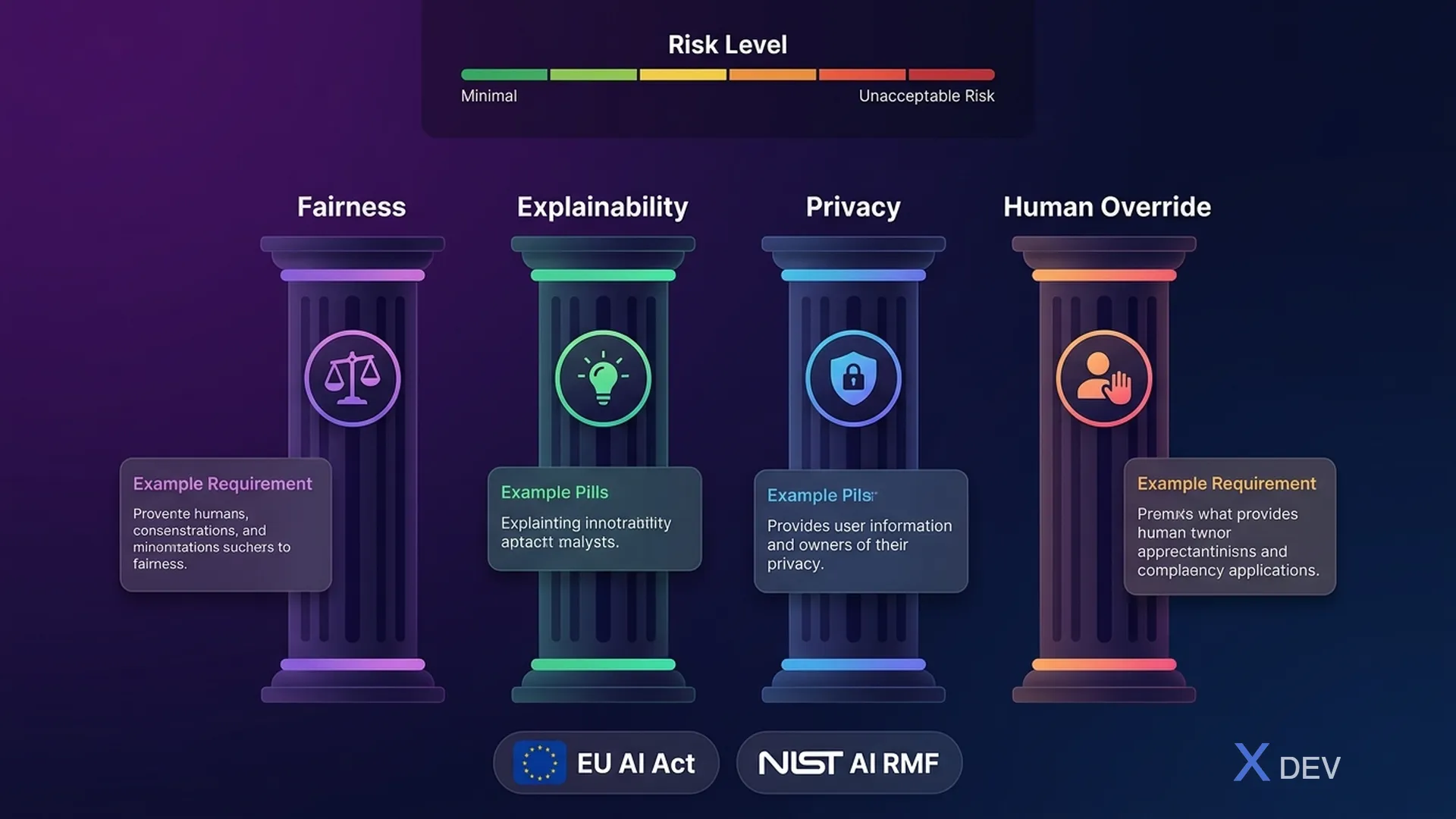
BA often think Responsible AI is the job of AI team or Legal. But reality: if BA doesn't capture these requirements in spec, dev won't build them either. And when production has problems, the first question will be: "Is this in requirements?"
This guide helps BA know what to write and capture — no need to understand algorithms.
1. Four Pillars of Responsible AI BA Must Capture
1.1 Fairness
AI must not favor or discriminate based on sensitive attributes: gender, ethnicity, age, income.
BA must capture:
- Protected attributes in domain (e.g., Fintech → no discrimination by region/income bracket)
- How to measure fairness: demographic parity, equal opportunity, equalized odds
- Bias testing plan: test with diverse representative data
Example requirement:
NFR-FAIR-01: Credit scoring model must achieve disparate impact ratio ≥ 0.8 across demographic groups when evaluated on test set. Results reported by Data Science team before go-live.
1.2 Explainability
Users and operators must understand why AI made that decision.
BA must capture:
- Do users have right to ask why? (Especially for high-stakes decisions)
- Explanation level: "AI recommends X because you previously..." vs "Your score is 720/1000"
- When full audit trail needed
Example requirement:
REQ-EXPL-01: When AI denies a loan application, screen displays ≥3 specific reasons in plain language (not technical scores). Reasons logged to audit trail with timestamp.
1.3 Privacy
User data can't be used to train models without clear consent.
BA must capture:
- Which data types does AI use? Is PII/PHI anonymized?
- Is conversation history used for fine-tuning? If yes, what's the consent flow?
- Data retention: how long is conversation log kept?
Example requirement:
REQ-PRIV-01: Conversation history only retained for product improvement after explicit user opt-in at onboarding. Default: opt-out. Logs deleted after 90 days unless opted-in.
1.4 Human Override
Users or operators must be able to override AI decisions in high-stakes situations.
BA must capture:
- Which AI decisions can happen automatically vs. require human approval
- Override mechanism: button, form, supervisor access
- Override logging: who, when, why
Example requirement:
REQ-HUMAN-01: AI CANNOT automatically block accounts. When fraud risk > 0.9, AI only flags for Fraud Team review. Block action requires human confirmation.
2. Risk Level → Responsible AI Requirements
Not every AI feature needs the same level of safeguard. NIST AI RMF and EU AI Act categorize by risk:
| Risk Level | Example | Required Requirements |
|---|---|---|
| Minimal | AI email autocomplete | Basic: Don't store unnecessary PII |
| Limited | AI customer service chatbot | Transparency (disclose it's AI), data privacy |
| High | AI credit scoring, hiring | Full: Fairness test, explainability, audit trail, human oversight |
| Unacceptable | AI social scoring | Cannot build (EU AI Act prohibition) |
Practice: Before writing requirements, do AI Risk Assessment. Simple template:
| Question | Answer | Risk Points |
|---|---|---|
| Does AI affect financial decisions? | Yes/No | +3 if Yes |
| Does AI use sensitive attributes? | Yes/No | +2 if Yes |
| Can AI decisions go unreviewed? | Yes/No | +2 if Yes |
| Can user be harmed if AI is wrong? | Yes/No | +3 if Yes |
Score ≥ 5 → High Risk → Full Responsible AI requirements needed.
3. Responsible AI Checklist for BA
FAIRNESS
☐ Identify protected attributes in domain
☐ Include bias testing in NFR section
☐ Define fairness metric (not just "fair")
☐ Who is responsible for bias testing?

EXPLAINABILITY
☐ Do users have right to know why?
☐ What explanation format? (technical or plain language)
☐ Audit trail requirements defined

PRIVACY
☐ Data minimization: AI only uses necessary data
☐ PII/PHI handling (anonymize, pseudonymize)
☐ Consent flow for AI training use
☐ Data retention period specified

HUMAN OVERRIDE
☐ List decisions requiring human approval
☐ Override mechanism designed
☐ Override logging requirements
☐ Escalation path defined

TRANSPARENCY
☐ Users know they're talking to AI (not person)
☐ AI limitations communicated clearly
4. Responsible AI Template for SRS
## 5. Non-Functional Requirements: Responsible AI

### 5.1 Fairness Requirements
**NFR-FAIR-01:** [Feature] must be tested for bias...
**Test criteria:** Disparate impact ratio ≥ [threshold] on test set...
**Owner:** Data Science team
**Timing:** Before go-live and quarterly post-launch

### 5.2 Explainability Requirements
**REQ-EXPL-01:** When AI makes [decision type], UI displays...
**Format:** [plain text / structured list / score breakdown]
**Audit:** Log retained [N] days

### 5.3 Privacy Requirements
**REQ-PRIV-01:** Conversation/interaction data retained [N] days max...
**REQ-PRIV-02:** PII [masked/anonymized] before...

### 5.4 Human Override Requirements
**REQ-HUMAN-01:** Decisions AI CANNOT auto-execute:
  - [Decision 1]
  - [Decision 2]
**Override mechanism:** [UI/workflow description]
5. Responsible AI in Stakeholder Conversations
Questions BA should ask stakeholders when kicking off AI feature:
- "If AI gets it wrong and user is harmed, how does business take responsibility?"
- "Do our users need to know they're talking to AI? Do they want to know?"
- "Are there user groups at particular risk if AI fails?"
- "Has Legal/Compliance reviewed this use case?"
- "When we upgrade to a new model, who re-validates fairness/safety?"
Summary
Responsible AI isn't the AI team's job — it's a set of requirements BA captures like any other. BA shouldn't skip this because it seems "technical."
Start with: risk assessment → identify required safeguards → write specific NFR with owner and test criteria. Don't write "system must be fair" — write "disparate impact ratio ≥ 0.8, tested by Data Science team before go-live".
This is the difference between a responsible BA and a negligent one.