Before writing a requirement, a strong BA must understand where the organization is now, where it wants to go, and what role AI plays in that journey. Strategy Analysis is the toolkit to do that.
1. Why Strategy Analysis Matters More Than Ever in the AI Era
Many organizations adopt AI because "other companies are doing it," not because they have a specific problem. BA is the one who asks the right questions: What problem does this AI feature solve? For whom? How will we measure it?
No clear answer to these 3 questions = AI project failure after 3 months.
2. SWOT for AI Initiatives
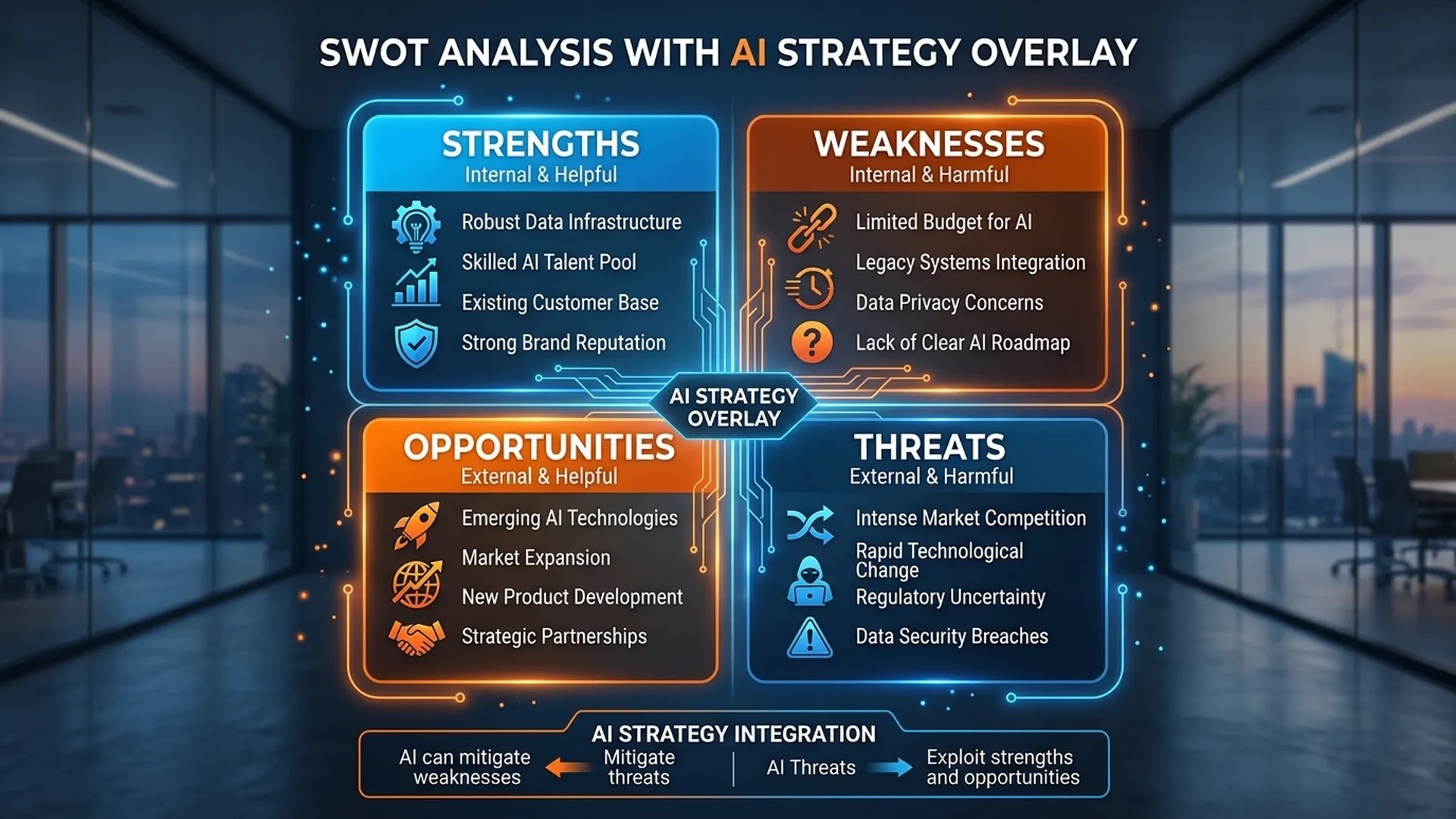
SWOT is not only for company-level strategy. BA can use SWOT to assess feasibility of an AI feature:
Example: AI Chatbot for Customer Support
| Positive | Negative | |
|---|---|---|
| Internal | Strengths: Rich historical ticket data, team has ML engineers, leadership support | Weaknesses: Knowledge base not standardized, no ground-truth labels, support team unfamiliar with AI |
| External | Opportunities: Customers expect 24/7 support, competitors lack AI | Threats: AI disclosure regulations, hallucination risk can damage brand |
How BA uses SWOT:
- Strengths -> Prioritize features based on existing data/capability
- Weaknesses -> Put into Assumption Log, resolve before go-live
- Opportunities -> Build arguments for stakeholder investment
- Threats -> Put into Risk Register, define mitigation
3. PESTLE for AI Context
PESTLE analyzes external forces affecting an AI initiative:
| Factor | Questions BA Should Ask | Example Impact |
|---|---|---|
| Political | What are national/industry AI policies? | AI regulations in finance, healthcare |
| Economic | Expected ROI? AI budget vs benefit? | Save X FTE = Y billion/year |
| Social | Do users trust AI? | Fear of job loss -> adoption resistance |
| Technology | Is current infrastructure enough? | Need GPU, cloud, data pipeline |
| Legal | How do GDPR, PCI, HIPAA apply? | Cannot use PII for training |
| Environmental | Carbon footprint of AI training? | ESG reporting requirements |
4. Impact Mapping: From Goal to Feature
Impact Mapping answers: why are we building this feature?
Goal (Business Outcome)
└── Who (Actors)
    └── Impact (Behavior Change)
        └── Deliverable (Feature / Requirement)
Practical Example:
Goal: Reduce claim processing time by 50%

├── Claims Adjuster
│   ├── Impact: Reduce manual review for routine cases
│   └── Deliverable: AI auto-approves claims < 5M, score > 0.92

├── Customer
│   ├── Impact: Receive faster results
│   └── Deliverable: Real-time status update via email/app

└── Compliance Officer
    ├── Impact: Complete audit trail for AI decisions
    └── Deliverable: Decision log with exportable reasoning
Impact Mapping prevents scope creep because every feature must trace back to an Impact and Goal.
5. Value Stream Mapping: Find Where AI Should Be Injected
Value Stream Mapping (VSM) maps the full value flow from input to output, including time per step.
How to read VSM for AI opportunities:
| Signal | Meaning | AI Approach |
|---|---|---|
| Step has high wait time | Manual bottleneck | Use AI automation at that step |
| Step has high error rate | Inconsistent human judgment | Use AI to standardize output |
| Step needs many handoffs | Communication overhead | AI auto-routing / assignment |
| Step has repetitive data | Predictable patterns | AI prediction instead of manual lookup |
6. Practical Strategy Analysis Process for AI Projects
1. PESTLE Scan (1-2 days)
   -> Identify legal/regulatory constraints
   -> These are hard boundaries for AI features

2. SWOT with AI lens (half-day workshop)
   -> Focus on data maturity and technical readiness
   -> Output: Go/No-go signal, pre-condition list

3. Value Stream Mapping (1 day)
   -> Find the right AI injection points (not everywhere)
   -> Prioritize by: impact x feasibility

4. Impact Mapping (half-day)
   -> Align feature list with business goals
   -> Output: Prioritized feature backlog
Conclusion
Strategy Analysis is not "analysis for the sake of analysis". It is the foundation that makes every requirement meaningful. BA who do this well help organizations avoid building AI features for the wrong problem, wrong audience, and wrong timing.
Next step: After strategic context is clear, read BA Planning & Monitoring to plan execution.