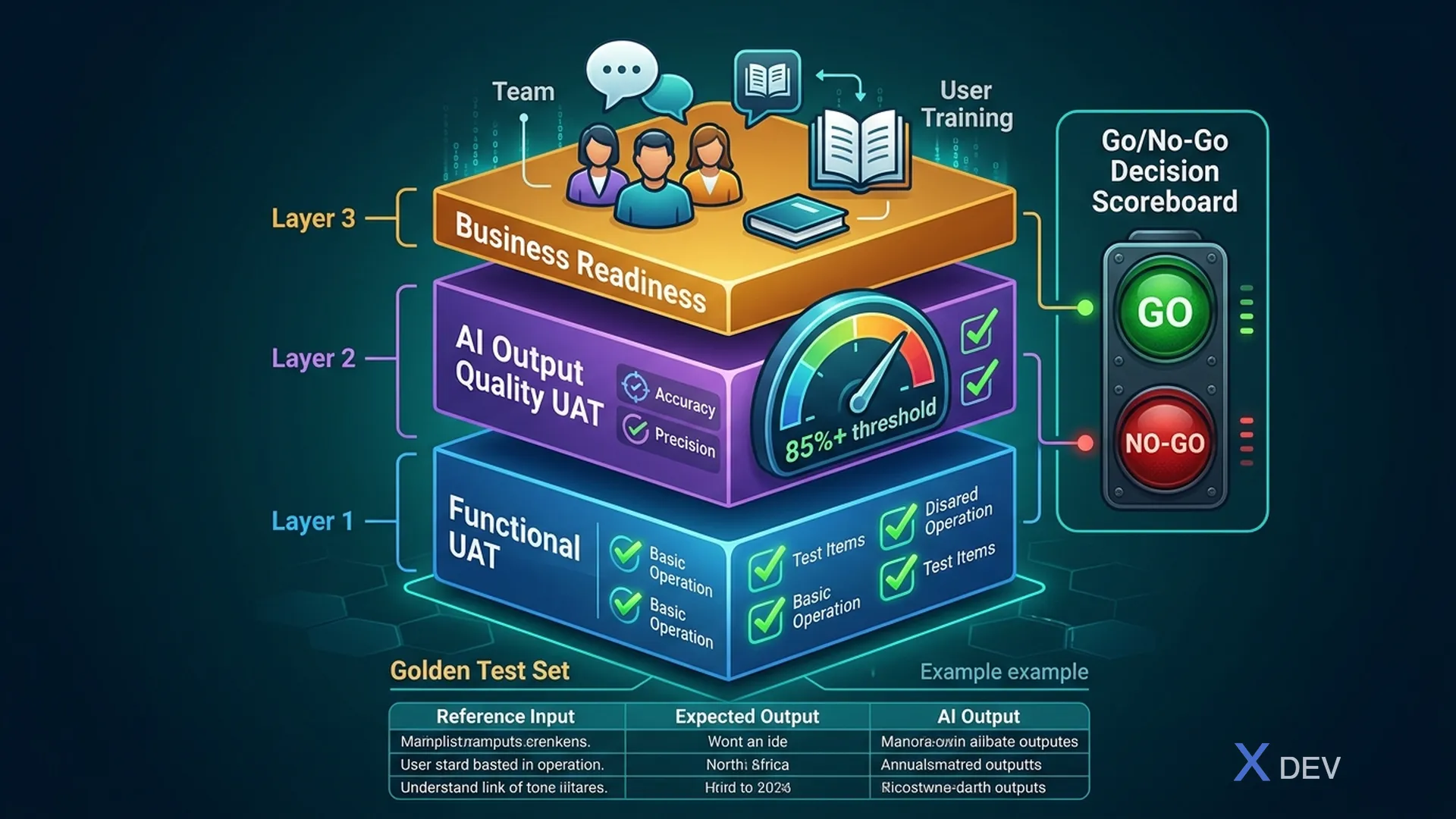
UAT (User Acceptance Testing) is not "QA test one more time". UAT is to check whether the solution meets business needs in a real usage context.
If UAT does it poorly, risks often appear after go-live:
- User doesn't know how to use it.
- The new process does not work properly.
- Data migration is missing.
- Report does not serve decision.
- Business rule is wrong but QA doesn't know because the spec is missing.
Software BA is usually the person who coordinates UAT with PO, QA and business users.
1. How is UAT different from QA testing?
| QA Testing | UAT |
|---|---|
| Check if the system is up to spec | Check if the solution can be used for business |
| Conducted by QA/technical team | Done by business user/key user |
| Focus on technical and functional defects | Focus on process, policy, outcome |
| Use detailed test cases | Use business scenarios |
| Can run continuously in sprint | Usually before release/go-live |
QA answers: "Does the system meet the requirements?"
UAT answers: "Does Business accept this solution?"
2. What does the UAT plan include?
Templates:
# UAT Plan

## 1. Objective
- UAT để xác nhận điều gì?

## 2. Scope
- In scope
- Out of scope

## 3. Participants
- Business users
- BA
- QA
- Product Owner
- Support/Operations

## 4. Entry Criteria
- Build deployed to UAT environment
- Critical QA defects closed
- Test data ready
- UAT scenarios approved

## 5. Test Scenarios

## 6. Defect Management
- Tool
- Severity/Priority rules
- SLA fix

## 7. Exit Criteria
- Must-have scenarios pass
- No open P0/P1 defects
- Business owner sign-off

## 8. Go/No-Go Criteria
3. Select UAT scenarios
Don't copy entire QA test cases. UAT should focus on the business journey.
Example scheduling feature:
| Scenario | Why is it important |
|---|---|
| Customer booked successfully | Core business flow |
| Guests reschedule | Popular Flow |
| Guest canceled close to time | Sensitive Policy |
| Admin handles duplicate schedules | Operational exception |
| Consultant views the day's schedule | Role other than customer |
| Report booking number | Business tracking |
Each scenario should have:
- Persona/role.
- Preconditions.
- Steps.
- Expected business outcomes.
- Data needed.
- Pass/fail criteria.
4. Test data
UAT fails a lot because the test data is not standard.
Checklist:
- There are users for each role.
- Has normal, edge, invalid data.
- There are different status data.
- Has large enough data if test report is needed.
- Data does not contain actual PII without permission.
- Data can be reset between test rounds.
For example:
| Data | Purpose |
|---|---|
| Customer A has a Confirmed | calendar Test cancel/change |
| Customer B has no schedule yet | New set test |
| Slot is full | Test empty/error |
| Admin user | Administration Test |
| Consultant user | Test view calendar |
5. Entry and exit criteria
Entry criteria
Only start UAT when:
- Build is stable.
- QA has passed the critical path.
- Known issues have been announced.
- UAT scenarios approved.
- Test data and account ready.
- Business users already know the testing schedule.
Exit criteria
UAT is complete when:
- 100% must-have scenarios pass.
- No more P0/P1 defect.
- P2 has a workaround and the business accepts it.
- Training/release notes are ready.
- Business owner sign-off.
6. How to handle defects in UAT?
When the user reports an error:
- THREE confirms the reproduction step.
- QA checks whether there is a technical bug or not.
- BA determines business impact.
- PO/Business owner decides priority.
- Team fix or defer.
- BA updates UAT status and release risks.
Classification:
| Type | Example | How to handle |
|---|---|---|
| Bugs | Cancel appointment but slot does not reopen | Fix |
| Requirement gap | Business wants to add cancellation reason | Change request |
| Usability issue | User does not see the reschedule button | UX adjustments |
| Training issue | User does not know filter report | Update guide |
7. Business readiness
UAT pass does not guarantee go-live. Business readiness includes:
- User training.
- New SOPs.
- Support scripts.
- FAQ.
- Rollback plan.
- Communication plan.
- Monitoring dashboard.
- Owner after go-live.
Go-live checklist:
☐ UAT sign-off
☐ Release note
☐ Training done
☐ Support team ready
☐ Monitoring/alert ready
☐ Rollback/fallback plan
☐ Business owner approves go-live
8. Go/No-Go decision
Go/No-Go should not be emotional. Use scorecards:
| Criteria | Status | Notes |
|---|---|---|
| Critical UAT scenarios | Pass | December 12 |
| P0/P1 defects | Pass | 0 open |
| P2 defects | At risk | 2 open, workaround exists |
| Training | Pass | 30 users trained |
| Support readiness | Pass | SOP updated |
| Monitoring | Pass | Dashboard live |
| Business approval | Pending | Waiting Head of Ops |
If there is "At risk", owner and mitigation must be recorded.
9. Full UAT script example
UAT scenario: Customer books and reschedules a consultation.
| Field | Value |
|---|---|
| Scenario ID | UAT-BOOK-002 |
| Personas | Existing customer |
| Objective | Confirm that guests can book and reschedule 4 hours before cutoff. |
| Preconditions | Customer active, consultant A has slots 09:00 and 10:00 tomorrow, email service enabled. |
| Test data | customer_id = CUS-1001, consultant_id = CON-2001, slot_09 = SLOT-0900, slot_10 = SLOT-1000. |
Steps:
| Step | Action | Expected result | Evidence |
|---|---|---|---|
| 1 | Customer opens the booking page. | The list of consultants and empty slots displays in less than 2 seconds. | Screenshot slot list. |
| 2 | Select consultant A, slot 09:00. | Confirmation button enabled, calendar information is correct. | Screenshot confirmation page. |
| 3 | Click confirm. | Appointment created with status Confirmed, with confirmation code. | Appointment ID. |
| 4 | Check email. | The confirmation email arrives within 1 minute, containing no sensitive data. | Email screenshot. |
| 5 | Reschedule to 10:00 slot. | Old slot reopened, new slot Confirmed, audit log records old/new slot. | Audit log ID. |
| 6 | Try rescheduling to another user's appointment. | Pay system 403. | Error screenshot. |
Exit criteria for this scenario:
- There is no High/Critical severity defect.
- Business users confirm that the wording is easy to understand.
- Customer service confirms exception handling SOP in under 4 hours.
- QA confirms regression for duplicate booking pass.
10. What should I add to the AI feature?
If the feature has AI, UAT needs to add:
- Golden test set.
- Output quality threshold.
- Hallucination/fallback scenarios.
- Human override flow.
- Bias/safety review if high impact.
- Monitoring after go-live.
But don't let the entire UAT revolve around AI. Business still needs to check the end-to-end journey.
Reference source
- IIBA BABOK Guide: https://www.iiba.org/standards-and-resources/babok/
- Scrum Guide 2020: https://scrumguides.org/scrum-guide.html
Conclusion
Good UAT is not about testing a lot, but testing the right business scenarios, the right users, the right data and making clear decisions. Software BA plays a bridge role: turning requirements into UAT plans, turning feedback into defects/changes, and helping businesses confidently go-live.