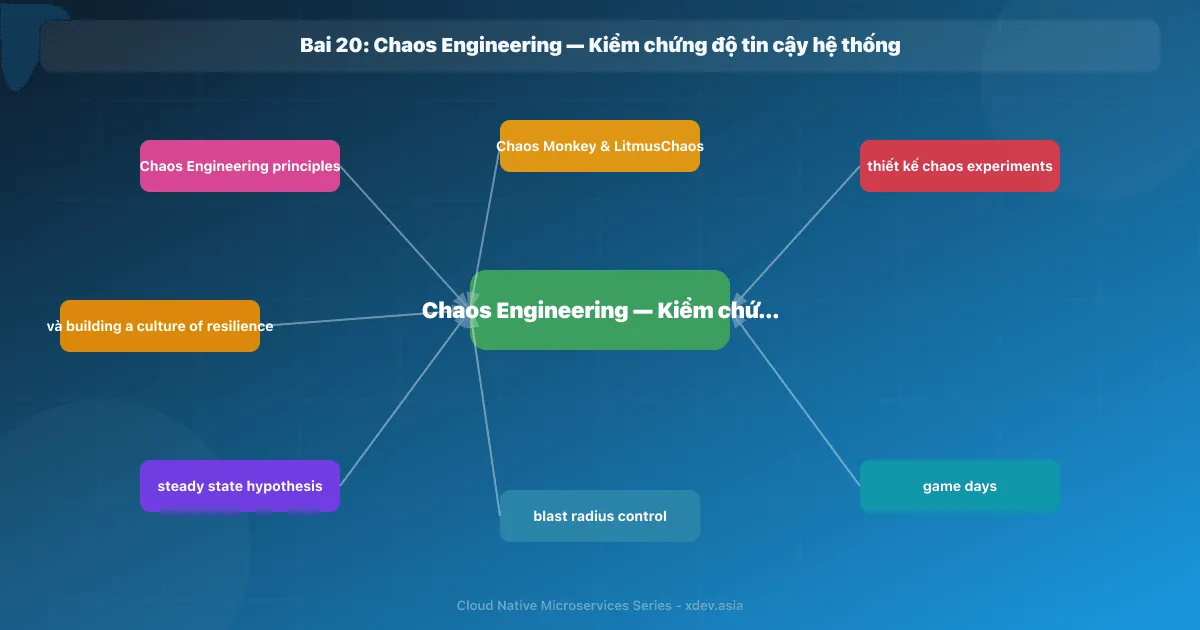
Introduction
You've implemented Circuit Breaker, Retry, Bulkhead... But how do you prove they actually work when production has problems?
Chaos Engineering is a discipline that validates system fault tolerance by *proactively causing problems in production or staging environments — before they happen unexpectedly.
"If you don't practice failure, you don't actually know how your system will behave during it." — Netflix
1. Chaos Engineering Principles
1.1 Definition
Chaos Engineering is not about "breaking the system for fun". This is a controlled scientific process:
1. Xác định Steady State (baseline bình thường)
2. Đặt ra Hypothesis ("nếu X xảy ra, hệ thống vẫn ổn vì...")
3. Thiết kế experiment với blast radius nhỏ
4. Chạy experiment
5. Quan sát kết quả
6. So sánh với hypothesis
7. Nếu sai → fix → verify
8. Nếu đúng → mở rộng scope
1.2 Steady State Hypothesis
# Ví dụ Steady State cho e-commerce:
steady_state:
  metrics:
    - name: "Order success rate"
      query: "rate(http_requests_total{service='order',status='201'}[5m])"
      threshold: "> 0.99"      # > 99% thành công

    - name: "p99 latency"
      query: "histogram_quantile(0.99, ...)"
      threshold: "< 500ms"

    - name: "Active orders being processed"
      query: "order_processing_active"
      threshold: "> 0"          # Vẫn đang xử lý orders
Chaos experiment only pass when steady state is maintained during and after the experiment.
1.3 Types of Chaos
Infrastructure Chaos:
  - Pod kill / crash loop
  - Node failure
  - Network partition
  - Resource starvation (CPU, memory)

Application Chaos:
  - Latency injection (làm service chậm giả)
  - Error injection (trả về 500 ngẫu nhiên)
  - Dependency failure mocking

Data Chaos:
  - Database failover
  - Cache eviction
  - Message queue backlog

Security Chaos:
  - Certificate expiry simulation
  - Auth service unavailability
2. Chaos Engineering Tools
2.1 LitmusChaos (Kubernetes-native)
LitmusChaos is CNCF project, cloud-native chaos engineering platform for Kubernetes:
# Cài đặt LitmusChaos
kubectl apply -f https://litmuschaos.github.io/litmus/litmus-operator-v3.x.yaml

# Cài ChaosCenterCLI
curl -O https://litmusctl-bucket.s3-website.us-east-2.amazonaws.com/litmusctl-linux-amd64-latest.tar.gz
2.2 Pod Kill Experiment
apiVersion: litmuschaos.io/v1alpha1
kind: ChaosEngine
metadata:
  name: pod-kill-experiment
  namespace: services-prod
spec:
  engineState: 'active'
  appinfo:
    appns: 'services-prod'
    applabel: 'app=payment-service'
    appkind: 'deployment'
  chaosServiceAccount: litmus-admin
  experiments:
    - name: pod-delete
      spec:
        components:
          env:
            - name: TOTAL_CHAOS_DURATION
              value: '60'       # Thử nghiệm 60 giây
            - name: CHAOS_INTERVAL
              value: '10'       # Kill pod mỗi 10 giây
            - name: FORCE
              value: 'false'    # Graceful delete
            - name: PODS_AFFECTED_PERC
              value: '50'       # Kill 50% pods
2.3 Network Latency Injection
# Inject 500ms latency vào 50% requests từ/đến payment-service
apiVersion: litmuschaos.io/v1alpha1
kind: ChaosEngine
metadata:
  name: network-latency-experiment
spec:
  experiments:
    - name: pod-network-latency
      spec:
        components:
          env:
            - name: NETWORK_INTERFACE
              value: 'eth0'
            - name: NETWORK_LATENCY
              value: '500'      # 500ms latency
            - name: JITTER
              value: '100'      # ± 100ms jitter
            - name: TOTAL_CHAOS_DURATION
              value: '120'
            - name: PODS_AFFECTED_PERC
              value: '50'       # Chỉ ảnh hưởng 50% pods
2.4 CPU Stress
- name: pod-cpu-hog
  spec:
    components:
      env:
        - name: CPU_CORES
          value: '1'          # Stress 1 CPU core toàn bộ
        - name: TOTAL_CHAOS_DURATION
          value: '60'
        - name: CPU_LOAD
          value: '100'        # 100% CPU usage
3. Design Chaos Experiments
3.1 Blast Radius Control
Always start with the smallest blast radius:
Tăng dần theo giai đoạn:

Stage 1: Dev environment, 1 pod
  → Xác nhận mechanism hoạt động

Stage 2: Staging, 25% pods
  → Xác nhận hành vi dưới partial failure

Stage 3: Production, giờ thấp điểm, 10% pods
  → Xác nhận dưới real traffic

Stage 4: Production, 50% pods
  → Xác nhận major failure handling

Stage 5: Production, node failure
  → Multi-availability zone resilience
3.2 Experiment Template
# chaos-experiment-template.yaml
experiment:
  name: "Payment Service Pod Kill"
  version: "1.0"
  hypothesis: >
    Khi 50% pods của payment-service bị kill,
    order success rate vẫn > 95% nhờ:
    (1) Kubernetes tự restart pods mới
    (2) Circuit Breaker chuyển sang Half-Open khi pods quay lại
    (3) Retry mechanism handle transient failures

  blast_radius:
    service: payment-service
    percentage: 50
    duration: 60s
    environment: staging

  steady_state_hypothesis:
    before:
      - metric: order_success_rate > 99%
      - metric: p99_latency < 300ms
    during:
      - metric: order_success_rate > 95%   # Cho phép degraded
      - metric: p99_latency < 800ms        # Latency có thể tăng
    after:
      - metric: order_success_rate > 99%   # Phải phục hồi
      - metric: p99_latency < 300ms        # Về baseline

  rollback:
    automatic: true
    trigger: order_success_rate < 90%
3.3 Abort Conditions
Tự động dừng experiment khi:
- Error rate > 10% (threshold)
- p99 latency > 2s
- Có manual intervention từ on-call engineer
- Business-critical metric vượt ngưỡng (orders failed > X)
4. Practice: Chaos Experiment End-to-End
4.1 Scenario: Payment Service Degradation
Step 1: Confirm Baseline
# Kiểm tra steady state trước khi bắt đầu
kubectl get pods -n services-prod -l app=payment-service
# NAME                        READY   STATUS    RESTARTS
# payment-service-abc123-1    1/1     Running   0
# payment-service-abc123-2    1/1     Running   0
# payment-service-abc123-3    1/1     Running   0

# Check metrics
curl -s prometheus:9090/api/v1/query?query=order_success_rate
Step 2: Inject Chaos
kubectl apply -f pod-delete-experiment.yaml

# Monitor trong real-time
watch kubectl get pods -n services-prod -l app=payment-service
Step 3: Observe
T+0s: Experiment bắt đầu, 1 pod bị kill
      → Pod restart (Kubernetes)
      → Circuit Breaker nhận một số errors
      → Retry mechanism kick in

T+10s: Pod mới lên, nhưng pod thứ 2 bị kill
       → Requests đến pod đang restart fail
       → Error rate: 2.3% (dưới threshold 5%)

T+30s: 2 pods healthy, 1 restarting
       → System degraded nhưng functional

T+60s: Experiment kết thúc, tất cả pods healthy
       → Error rate → 0%
       → Steady state phục hồi trong 15s
Step 4: Analyze results
Expected vs Actual:
                    Expected    Actual   Pass?
Error rate (peak)   < 5%        2.3%     ✅
Recovery time       < 30s       15s      ✅
Orders lost         0           0        ✅
Alert triggered     Yes         Yes      ✅

Kết luận: Payment service resilient trước pod kill scenario
5. Game Days
Game Day is an organized drill session — the engineering team comes together to test disaster recovery:
Game Day Schedule:
9:00  - Briefing: scenario được chọn, team assignments
9:30  - Inject chaos (ví dụ: Database failover)
9:30-11:00 - Team response, triage, mitigation
11:00 - Khôi phục hệ thống
11:30 - Post-mortem: what happened, what worked, what didn't
12:00 - Action items: fix findings, improve runbooks
Popular Game Day scenarios
Scenario 1: "Primary DB region gone"
→ Test: Database failover tự động
→ Verify: Read replicas promote, application reconnect

Scenario 2: "Kafka cluster unavailable"
→ Test: Event-driven services handle backpressure
→ Verify: Outbox pattern, dead letter queue, alerts

Scenario 3: "Auth service down"
→ Test: JWT caching cho validation
→ Verify: Graceful degradation, what percentage of traffic breaks

Scenario 4: "DDoS-like traffic spike"
→ Test: Rate limiting, auto-scaling
→ Verify: System scales, bad traffic rejected, good traffic served
6. Building Culture of Resilience
6.1 From reactive to proactive
Reactive culture:
"Sự cố xảy ra → Panic → Fix → Forget"

Proactive culture:
"Chủ động inject failure → Learn → Improve → Verify"
6.2 Checklist before chaos
□ Có monitoring/alerting đầy đủ
□ Team on-call biết về experiment
□ Runbook sẵn sàng cho rollback
□ Blast radius được giới hạn rõ ràng
□ Abort conditions được định nghĩa
□ Stakeholders đã được thông báo (nếu production)
□ Experiment có thể dừng ngay bằng một lệnh
6.3 Chaos Engineering Maturity Model
Level 1 — Manual (Beginner)
  Chạy chaos manually, thủ công trên dev/staging
  Không có automation

Level 2 — Automated experiments trong CI
  Chaos tests tự động chạy mỗi tuần
  Kết quả phải pass trước khi release

Level 3 — Continuous Chaos (Advanced)
  Chaos experiments chạy liên tục 24/7 ở production
  Netflix Chaos Monkey — kill random instances
  Luôn test khả năng tự phục hồi

Level 4 — Full Automation + GameDays
  Tất cả scenarios được automated
  Quarterly game days cho catastrophic scenarios
  SRE team chuyên về resilience
Summary
| Concept | Purpose |
|---|---|
| Steady State Hypothesis | Definition of baseline and expected behavior |
| Blast Radius | Limit the range of influence of the experiment |
| LitmusChaos | Kubernetes-native chaos tool |
| Pod Kill | Test auto-restart and circuit breaker |
| Network Latency Injection | Test timeout and retry behavior |
| Game Day | Rehearse disaster response as a team |
| Continuous Chaos | Always verify resilience 24/7 (Netflix level) |
Next article: CI/CD Pipeline for Microservices