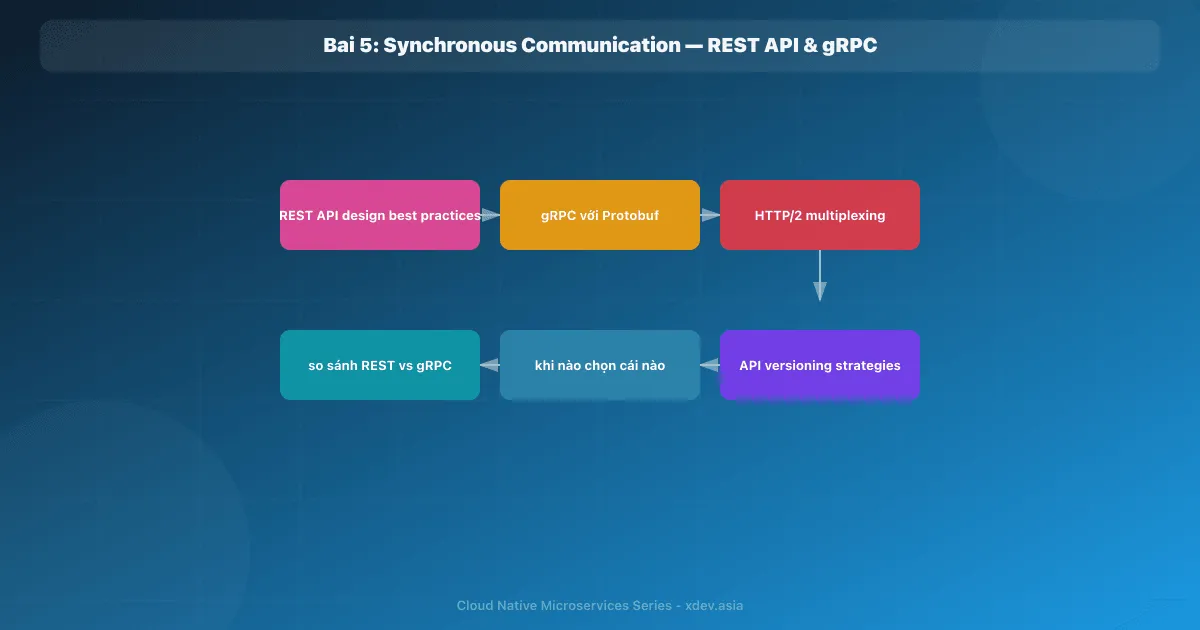
Introduction
Synchronous communication is a request-response model: the client sends a request, waiting for the server to respond. REST and gRPC are the two most popular choices for internal service-to-service communication.
1. REST API
1.1 RESTful Design Principles
REST (Representational State Transfer) uses HTTP methods to manipulate resources:
GET    /api/v1/orders          → Liệt kê đơn hàng
GET    /api/v1/orders/{id}     → Chi tiết đơn hàng
POST   /api/v1/orders          → Tạo đơn hàng mới
PUT    /api/v1/orders/{id}     → Cập nhật toàn bộ
PATCH  /api/v1/orders/{id}     → Cập nhật một phần
DELETE /api/v1/orders/{id}     → Xoá đơn hàng
1.2 Best Practices
Naming conventions:
✅ /api/v1/orders                    # Noun, plural
✅ /api/v1/orders/{id}/items         # Nested resource
✅ /api/v1/orders?status=pending     # Filtering via query params

❌ /api/v1/getOrders                 # Verb in URL
❌ /api/v1/order                     # Singular
❌ /api/v1/orders/getByStatus/pending # Logic in URL
HTTP Status Codes:
2xx Success:
  200 OK              — GET, PUT, PATCH thành công
  201 Created          — POST tạo resource mới
  204 No Content       — DELETE thành công

4xx Client Error:
  400 Bad Request      — Validation error
  401 Unauthorized     — Chưa xác thực
  403 Forbidden        — Không có quyền
  404 Not Found        — Resource không tồn tại
  409 Conflict         — Trùng lặp (duplicate)
  422 Unprocessable    — Business logic error
  429 Too Many Requests — Rate limit exceeded

5xx Server Error:
  500 Internal Server Error — Lỗi server
  502 Bad Gateway           — Upstream service error
  503 Service Unavailable   — Service đang quá tải
  504 Gateway Timeout       — Upstream timeout
Pagination:
GET /api/v1/orders?page=2&per_page=20&sort=-created_at

{
  "data": [...],
  "meta": {
    "current_page": 2,
    "per_page": 20,
    "total": 150,
    "total_pages": 8
  },
  "links": {
    "first": "/api/v1/orders?page=1&per_page=20",
    "prev": "/api/v1/orders?page=1&per_page=20",
    "next": "/api/v1/orders?page=3&per_page=20",
    "last": "/api/v1/orders?page=8&per_page=20"
  }
}
1.3 API Versioning
Strategy 1: URL Path (khuyến nghị)
  /api/v1/orders
  /api/v2/orders

Strategy 2: Header
  Accept: application/vnd.myapi.v2+json

Strategy 3: Query Parameter
  /api/orders?version=2
1.4 OpenAPI / Swagger
Define the previous contract API (API First):
openapi: 3.0.3
info:
  title: Order Service API
  version: 1.0.0
paths:
  /api/v1/orders:
    post:
      summary: Create a new order
      requestBody:
        required: true
        content:
          application/json:
            schema:
              $ref: '#/components/schemas/CreateOrderRequest'
      responses:
        '201':
          description: Order created
          content:
            application/json:
              schema:
                $ref: '#/components/schemas/Order'
        '400':
          description: Validation error
components:
  schemas:
    CreateOrderRequest:
      type: object
      required: [customer_id, items]
      properties:
        customer_id:
          type: string
          format: uuid
        items:
          type: array
          items:
            $ref: '#/components/schemas/OrderItem'
2. gRPC
2.1 Overview
gRPC is an RPC (Remote Procedure Call) framework developed by Google, using:
- Protocol Buffers (Protobuf) — binary serialization
- HTTP/2 — multiplexing, server push, header compression
Order Service                     Inventory Service
┌──────────────┐                  ┌──────────────┐
│              │  gRPC/HTTP2      │              │
│  gRPC Client │──────────────────▶  gRPC Server │
│  (generated) │  Protobuf binary │  (generated) │
│              │◀─────────────────│              │
└──────────────┘                  └──────────────┘
2.2 Protocol Buffers
Define service contract with .proto files:
syntax = "proto3";

package inventory;

option go_package = "github.com/myorg/inventory/proto";
option java_package = "com.myorg.inventory.grpc";

// Service definition
service InventoryService {
  // Unary RPC
  rpc CheckStock(StockRequest) returns (StockResponse);
  rpc ReserveItems(ReserveRequest) returns (ReserveResponse);

  // Server streaming
  rpc StreamStockUpdates(StockFilter) returns (stream StockUpdate);

  // Bidirectional streaming
  rpc SyncInventory(stream InventoryEvent) returns (stream SyncResult);
}

// Messages
message StockRequest {
  string product_id = 1;
  int32 quantity = 2;
}

message StockResponse {
  bool available = 1;
  int32 current_stock = 2;
  string warehouse_id = 3;
}

message ReserveRequest {
  string order_id = 1;
  repeated ReserveItem items = 2;
}

message ReserveItem {
  string product_id = 1;
  int32 quantity = 2;
}

message ReserveResponse {
  bool success = 1;
  string reservation_id = 2;
  google.protobuf.Timestamp expires_at = 3;
}
2.3 gRPC Communication Patterns
1. Unary RPC (Request-Response):
   Client ──request──▶ Server
   Client ◀─response── Server

2. Server Streaming:
   Client ──request──▶ Server
   Client ◀─stream 1── Server
   Client ◀─stream 2── Server
   Client ◀─stream N── Server

3. Client Streaming:
   Client ──stream 1──▶ Server
   Client ──stream 2──▶ Server
   Client ──stream N──▶ Server
   Client ◀──response── Server

4. Bidirectional Streaming:
   Client ──stream──▶ Server
   Client ◀──stream── Server
   (đồng thời, full-duplex)
2.4 Code Generation
From .proto file, automatically generate code for all languages:
# Go
protoc --go_out=. --go-grpc_out=. proto/inventory.proto

# Java
protoc --java_out=. --grpc-java_out=. proto/inventory.proto

# TypeScript
protoc --ts_out=. proto/inventory.proto
3. REST vs gRPC
| Criteria | REST | gRPC |
|---|---|---|
| Protocol | HTTP/1.1 (or 2) | HTTP/2 |
| Format | JSON (text) | Protobuf (binary) |
| Performance | Slower (~2-10x) | Faster |
| Payload size | Large (JSON verbose) | Small (~30% of JSON) |
| Streaming | Not native | Full support |
| Code generation | Manual / OpenAPI codegen | Built-in, mature |
| Browser support | Native | Need gRPC-Web proxy |
| Debugging | Human-readable | Difficult (binary) |
| Tooling | Postman, curl, ... | grpcurl, BloomRPC |
| Learning curve | Low | Average |
| Contract | Optional (OpenAPI) | Required (.proto) |
3.1 When to choose REST?
- External API for client/browser/mobile
- Public API for third-party integration
- Simple CRUD operations
- Team is not familiar with gRPC
3.2 When to choose gRPC?
- Internal service-to-service communication
- High performance requirements (low latency, high throughput)
- Streaming use cases (real-time updates, IoT)
- Polyglot environment (many languages, need code generation)
- Strict contract enforcement
3.3 Popular Pattern: REST outside, gRPC inside
┌──────────┐     REST/JSON     ┌──────────────┐     gRPC/Protobuf     ┌─────────────┐
│  Client  │──────────────────▶│ API Gateway  │─────────────────────▶│ Internal    │
│ (Browser)│◀──────────────────│              │◀─────────────────────│ Services    │
└──────────┘                   └──────────────┘                      └─────────────┘
4. Handling errors in Synchronous Communication
4.1 Timeout
Order Service ──request──▶ Payment Service
     │                           │
     │      (đợi response)       │
     │                           │
     │  timeout = 3 giây         │
     │                           │
     ├── Nếu < 3s: nhận response ✓
     └── Nếu > 3s: timeout error ✗
         → Retry? Circuit breaker? Fallback?
Rule: Always set a timeout for every outgoing request, never wait indefinitely.
4.2 Cascading Failure
❌ Synchronous chain dài:
Client → A → B → C → D → E
   │
   └── Nếu E chậm → D chậm → C chậm → B chậm → A chậm → Client timeout

Giải pháp:
1. Circuit Breaker (bài 18)
2. Timeout cho mỗi hop
3. Chuyển sang async khi có thể
4. Bulkhead pattern
5. API Contract Testing
Make sure the service provider and consumer agree on the API:
Consumer-Driven Contract Testing (Pact):

┌──────────────┐                    ┌──────────────┐
│ Order Service│   Pact Contract    │Payment Service│
│  (Consumer)  │◀──────────────────▶│  (Provider)  │
└──────────────┘                    └──────────────┘

1. Consumer viết test với expected request/response
2. Pact generate contract file
3. Provider verify contract
4. Nếu provider thay đổi API → contract test fail → phát hiện breaking change
6. Summary
| Pattern | Use Case |
|---|---|
| REST | External API, browser, simple CRUD |
| gRPC | Internal service comms, high performance, streaming |
| REST + gRPC | REST for external, gRPC for internal |
| Timeouts | Required for all sync calls |
| Contract Testing | Ensure API compatibility between services |
Next article: Asynchronous Communication — Message Queue, Event Streaming and when to use async instead of sync.