Introduction
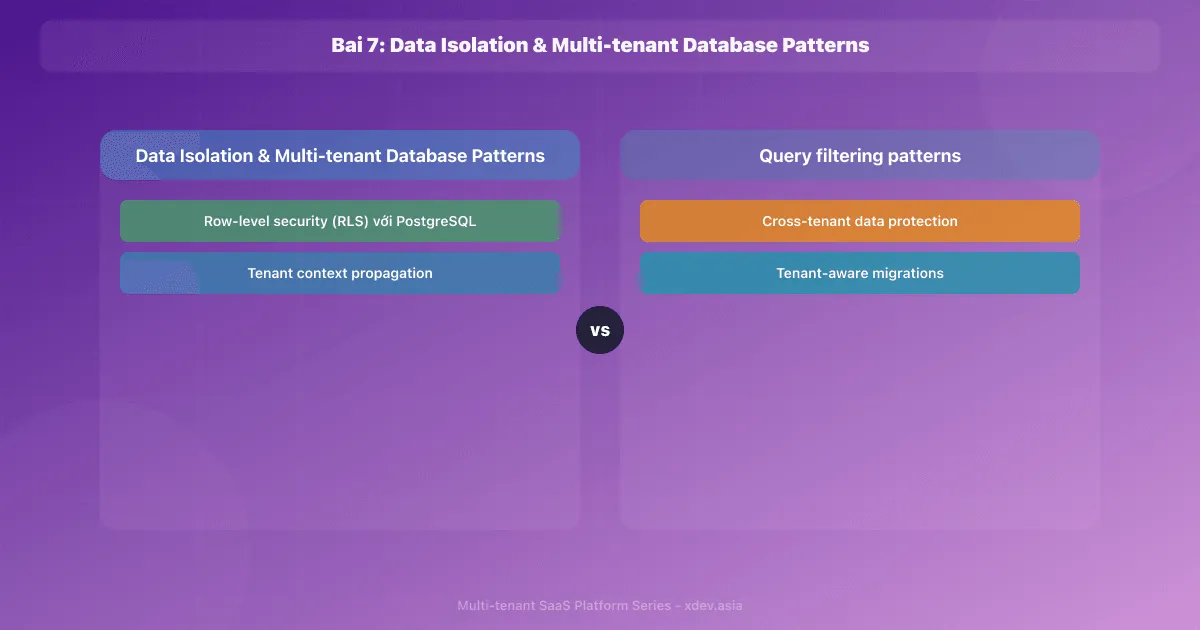
Row-level security (RLS) with PostgreSQL. Tenant context propagation. Query filtering patterns. Cross-tenant data protection. Tenant-aware migrations.
1. Row-level security (RLS) with PostgreSQL
1.1 Basic concepts
Row-level security (RLS) with PostgreSQL is one of the most important topics in this field. Understanding the core concepts will help you design the right system from the beginning.
Key Concepts:
├── Concept 1: Nền tảng lý thuyết
├── Concept 2: Áp dụng thực tế
├── Concept 3: Best practices
└── Concept 4: Anti-patterns cần tránh
1.2 Why is it important?
| Aspect | Not applicable | Correct application |
|---|---|---|
| Performance | Bottlenecks, high latency | Optimized, scalable |
| Reliability | Single point of failure | Fault-tolerant |
| Maintainability | Technical debt accumulated | Clean architecture |
| Security | Vulnerable | Defense in depth |
2. Tenant context propagation
2.1 General architecture
┌─────────────────────────────────────────────────────┐
│                  SYSTEM ARCHITECTURE                 │
│                                                      │
│  ┌──────────┐  ┌──────────┐  ┌──────────────────┐  │
│  │  Client   │  │  API     │  │  Core Service    │  │
│  │  Layer    │──│  Gateway │──│  Layer           │  │
│  └──────────┘  └──────────┘  └──────────────────┘  │
│                                      │               │
│                               ┌──────▼──────┐       │
│                               │  Data Layer │       │
│                               └─────────────┘       │
└─────────────────────────────────────────────────────┘
2.2 Component Design
Each component in the system needs to be designed with the following principles:
- Single Responsibility: Each component only takes on one responsibility
- Loose Coupling: Minimize dependencies between components
- High Cohesion: Related elements are in the same component
- Interface Segregation: Clear, separate API
3. Query filtering patterns
3.1 Design Patterns applied
Applied Patterns:
├── Strategy Pattern: Cho phép thay đổi algorithm at runtime
├── Observer Pattern: Event notification mechanism
├── Repository Pattern: Data access abstraction
└── Factory Pattern: Object creation flexibility
3.2 Code Example
// Example implementation
public interface Service {
    Result process(Request request);
    boolean supports(RequestType type);
}

@Component
public class CoreService implements Service {

    @Override
    public Result process(Request request) {
        // Validate input
        validator.validate(request);

        // Execute business logic
        var result = businessLogic.execute(request);

        // Publish domain event
        eventBus.publish(new ProcessedEvent(result));

        return result;
    }
}
4. Cross-tenant data protection
4.1 Monitoring & Observability
Observability Stack:
├── Metrics: Prometheus + Grafana
├── Logging: ELK / Loki
├── Tracing: OpenTelemetry + Jaeger
└── Alerting: PagerDuty
4.2 Performance Optimization
| Metrics | Target | Strategy |
|---|---|---|
| Latency p99 | < 100ms | Caching, async processing |
| Throughput | > 10K RPS | Horizontal scaling |
| Availability | 99.99% | Multi-region, failover |
| Error rate | < 0.01% | Circuit breaker, retry |
Summary
In this lesson, we learned about Data Isolation & Multi-tenant Database Patterns. Key takeaways:
- Understand core concepts and how to apply
- Design architecture in accordance with requirements
- Implementation patterns and best practices
- Production considerations: monitoring, performance, security
Next article: We will continue with the next topic in the series.