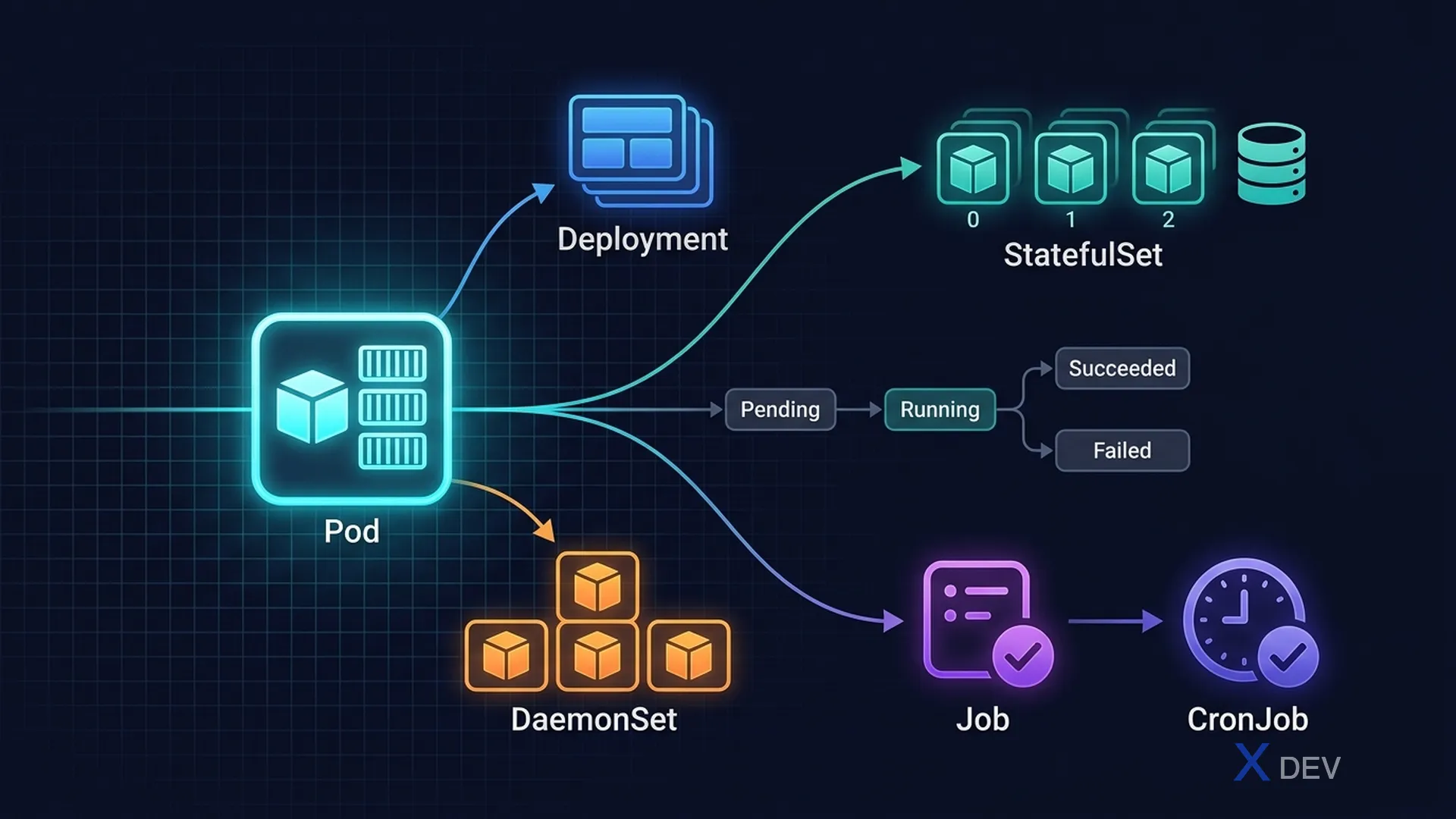
1. Pod — The Smallest Unit
A Pod is a group of one or more containers sharing the same network namespace (same IP, port space) and storage volumes. The Pod is the scheduling unit in Kubernetes.
┌─────────────────────────────────────┐
│              POD                    │
│  IP: 10.244.1.5                     │
│  ┌────────────┐  ┌───────────────┐  │
│  │  Container │  │  Sidecar      │  │
│  │   (app)    │  │  (log-agent)  │  │
│  └────────────┘  └───────────────┘  │
│       Shared Volume: /var/log       │
└─────────────────────────────────────┘
Pod Lifecycle
| Phase | Meaning | Debug hint |
|---|---|---|
| Pending | Not yet scheduled or image is being pulled | Check events: kubectl describe pod |
| Running | Running, at least 1 container is active | Normal state |
| Succeeded | All containers exited with code 0 | Job completed |
| Failed | At least 1 container exited with an error | kubectl logs --previous |
| Unknown | Cannot contact the node | Node network issue |
| CrashLoopBackOff | Container keeps crashing and restarting | kubectl logs -p |
Exam tip: CrashLoopBackOff is not an official Pod phase — it's a Container state under Waiting. Questions often ask "pod phase" vs "container state".
2. Workload Controllers
| Controller | Use when | Key characteristics |
|---|---|---|
| Deployment | Stateless apps (web server, API) | Rolling update, rollback, ReplicaSet management |
| ReplicaSet | Ensuring N replicas (usually used via Deployment) | Label selector, rarely used directly |
| StatefulSet | Stateful apps (database, Kafka, Elasticsearch) | Stable pod names (web-0, web-1), stable storage, ordered deployment |
| DaemonSet | Agent running on every node (logging, monitoring, network) | 1 Pod/node, auto-deploys when new node joins |
| Job | Batch task that runs to completion | completions, parallelism, backoffLimit |
| CronJob | Periodic batch tasks | cron syntax, concurrencyPolicy, schedule |
Deployment vs StatefulSet
DEPLOYMENT (Stateless)          STATEFULSET (Stateful)
─────────────────────           ────────────────────────
Pod names: web-a1b2c3            Pod names: web-0, web-1, web-2
Any order scale up/down          Ordered: web-0 first, then web-1...
Shared or no storage             Each Pod gets its own PVC
Pod replaced = new identity      Pod replaced = same identity
Examples: nginx, api-server      Examples: MySQL, MongoDB, Kafka
3. Labels, Selectors & Annotations
| Concept | Used for | Example |
|---|---|---|
| Labels | Tag resources for selection and grouping | app: frontend, env: prod |
| Selectors | Query resources by labels | selector: {app: frontend} |
| Annotations | Metadata not used for selection (build info, contact) | maintainer: [email protected] |
Exam tip: Services find Pods via selector matching Pod labels. If the selector doesn't match, the Service will have empty Endpoints → traffic can't reach Pods.
4. DaemonSet Use Cases
NODE 1         NODE 2         NODE 3
┌──────┐       ┌──────┐       ┌──────┐
│fluentd│      │fluentd│      │fluentd│  ← Log collector DaemonSet
│ Pod  │       │ Pod  │       │ Pod  │
├──────┤       ├──────┤       ├──────┤
│calico│       │calico│       │calico│  ← CNI network plugin DaemonSet
│ Pod  │       │ Pod  │       │ Pod  │
└──────┘       └──────┘       └──────┘
DaemonSets are commonly used for: Fluentd/Filebeat (log collection), Prometheus Node Exporter (metrics), kube-proxy (networking), CNI plugins (Calico, Cilium).
5. Cheat Sheet
| Exam question | Answer |
|---|---|
| Stateful app needing stable identity? | StatefulSet |
| 1 Pod per node (monitoring agent)? | DaemonSet |
| Stateless app with rolling update? | Deployment |
| One-time batch processing? | Job |
| Scheduled batch (nightly backup)? | CronJob |
| Pod naming pattern for StatefulSet? | name-0, name-1, name-2 |
6. Practice Questions
Q1: A company needs to deploy a MySQL database on Kubernetes with stable network identity and dedicated storage per replica. Which workload type should they use?
- A) Deployment with PersistentVolumeClaim
- B) StatefulSet ✓
- C) DaemonSet
- D) ReplicaSet
Explanation: StatefulSet provides stable Pod names (mysql-0, mysql-1), ordered deployment/scaling, and each Pod gets its own PVC via volumeClaimTemplates. These properties are essential for databases.
Q2: Which workload ensures exactly one Pod runs on every node in the cluster, including future nodes that join?
- A) Deployment with replicas matching node count
- B) ReplicaSet with nodeSelector
- C) DaemonSet ✓
- D) StatefulSet
Explanation: DaemonSet automatically deploys one Pod per node and watches cluster membership — when a new node joins, the DaemonSet controller immediately creates a Pod on it.
Q3: A Pod is in 'Pending' state. What is the MOST likely cause?
- A) The container application crashed
- B) No node satisfies the scheduling requirements ✓
- C) The liveness probe failed
- D) The container image is corrupted
Explanation: Pending means the Pod has been accepted but hasn't started. Most common reasons: insufficient CPU/memory on nodes, unsatisfied node affinity/taints, or PVC not bound. Check kubectl describe pod events.