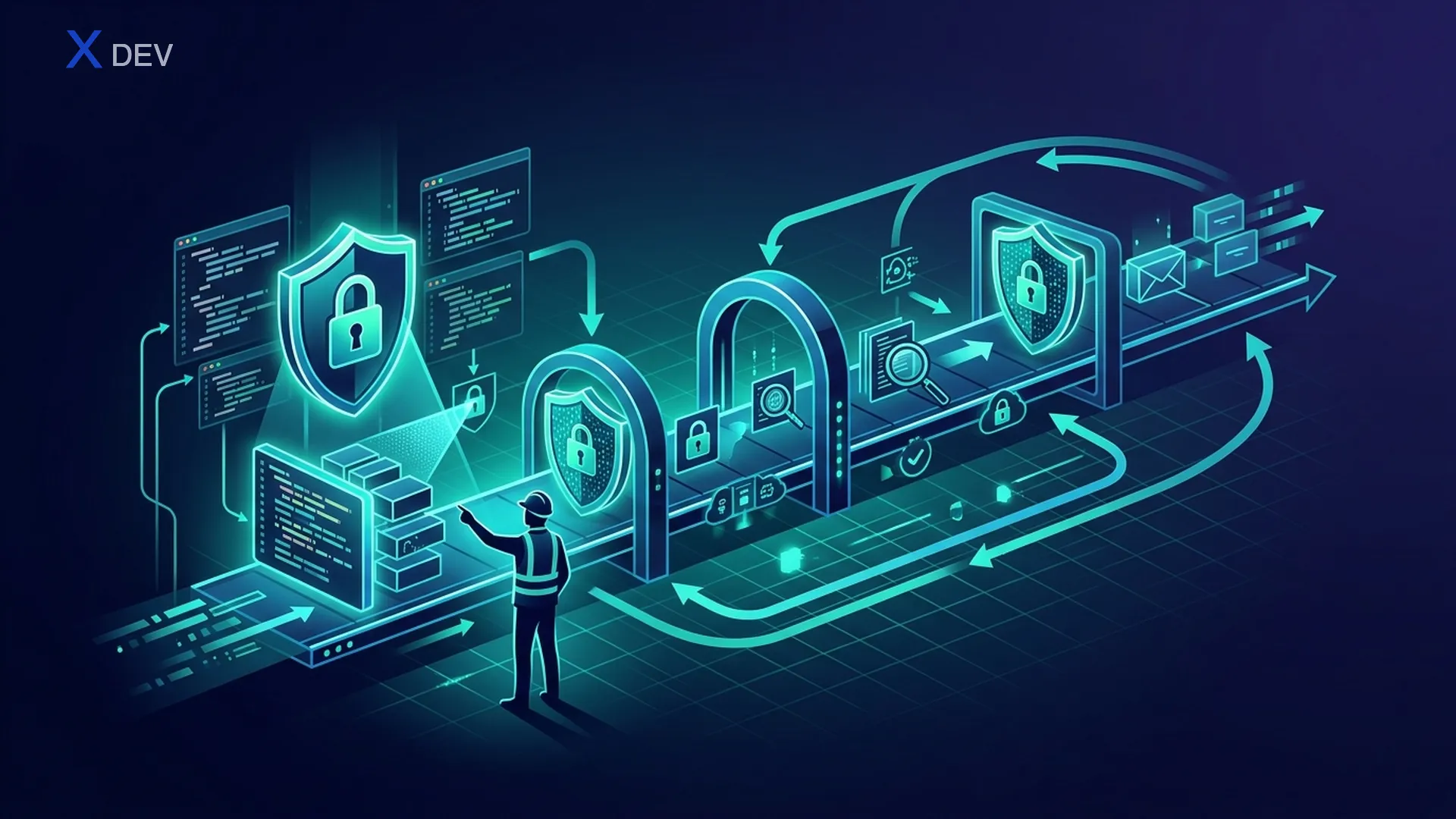
In many organisations, security review is still the last gate before go-live. By then, fixing a vulnerability is 30-100x more expensive than catching it in code review. Shift-left solves this — not by removing the final check, but by moving controls earlier in the lifecycle.
Why shift-left?
The "security as gate" model — a manual review at the end of the SDLC — does not scale with modern release cadence. When a CI/CD team ships multiple times a day, you cannot wait for one security engineer to review every pull request. The usual symptoms:
- Security becomes a bottleneck and dev teams find ways to bypass it.
- Defects discovered late, expensive to fix, sometimes requiring re-architecture.
- Audit reports look long but do not reflect the real state of the system.
Shift-left replaces final inspection with continuous guardrails: every SDLC stage has appropriate, automated security controls that give feedback right where the developer is working.
What shift-left is not
- It is not dumping all responsibility on developers. Devs write the code, but security provides tooling, rulesets, threat-model templates, and mentorship. The security champion model is how you scale knowledge.
- It does not remove final-stage pentest. Pentest, red team and bug bounty are still needed for logic bugs and 0-day. Shift-left simply reduces the number of basic findings reaching the pentester.
- It is not turning on every tool at once. Enabling SAST + DAST + SCA + secret scanning across 100 repos in one week creates alert fatigue and kills buy-in.
A control map across the SDLC
| Stage | Typical control | Example tool |
|---|---|---|
| Requirement | Lightweight threat model, abuse cases | OWASP Threat Dragon, Microsoft TMT |
| Design | Secure design review, data classification | Architecture Decision Record (ADR) |
| Code | Linter, SAST, pre-commit secret scan | Semgrep, Gitleaks, ESLint security plugin |
| Build | SCA, SBOM, container scan, sign | Trivy, Grype, Syft, Cosign |
| Deploy | IaC scan, admission policy | Checkov, Kyverno, OPA Gatekeeper |
| Runtime | WAF, runtime detection, audit log | Falco, Cilium Tetragon, SIEM |
| Operate | Periodic DAST, IR, post-mortem | OWASP ZAP, PagerDuty, Sigma |
Where to start if you have nothing yet
- Secret scanning in pre-commit and CI. Cheap, easy win, blocks the most expensive class of incidents.
- SCA + SBOM so you know what packages you ship. When a new CVE drops, you answer "are we affected?" in minutes, not days.
- Branch protection + signed commits + pinned action SHA. Defends against pipeline attacks at near-zero cost.
- One-page threat model for the most critical service. STRIDE on a simple DFD already prevents an entire class of design flaws.
- Then scale out to SAST, DAST, container and IaC scanning.
Connect to a maturity model
To know where you are and what to do next, score 5-15 important practices using OWASP SAMM 2.0 or BSIMM. The goal is not to reach Level 3 in every practice but to lift 2-3 priority areas from Level 1 to Level 2 each quarter. Pair it with metrics and OKRs (vuln MTTR, scan coverage, % services with a threat model) so leadership sees value and keeps investing.
Conclusion
Shift-left is a strategy, not a tool. The goal is to turn security into automated guardrails with metrics, owners and feedback at the moment of failure. Start with quick wins (secret, SCA, branch protection), then expand by maturity. Once it sticks, security stops being the gate that blocks releases and becomes a natural rhythm of the pipeline.