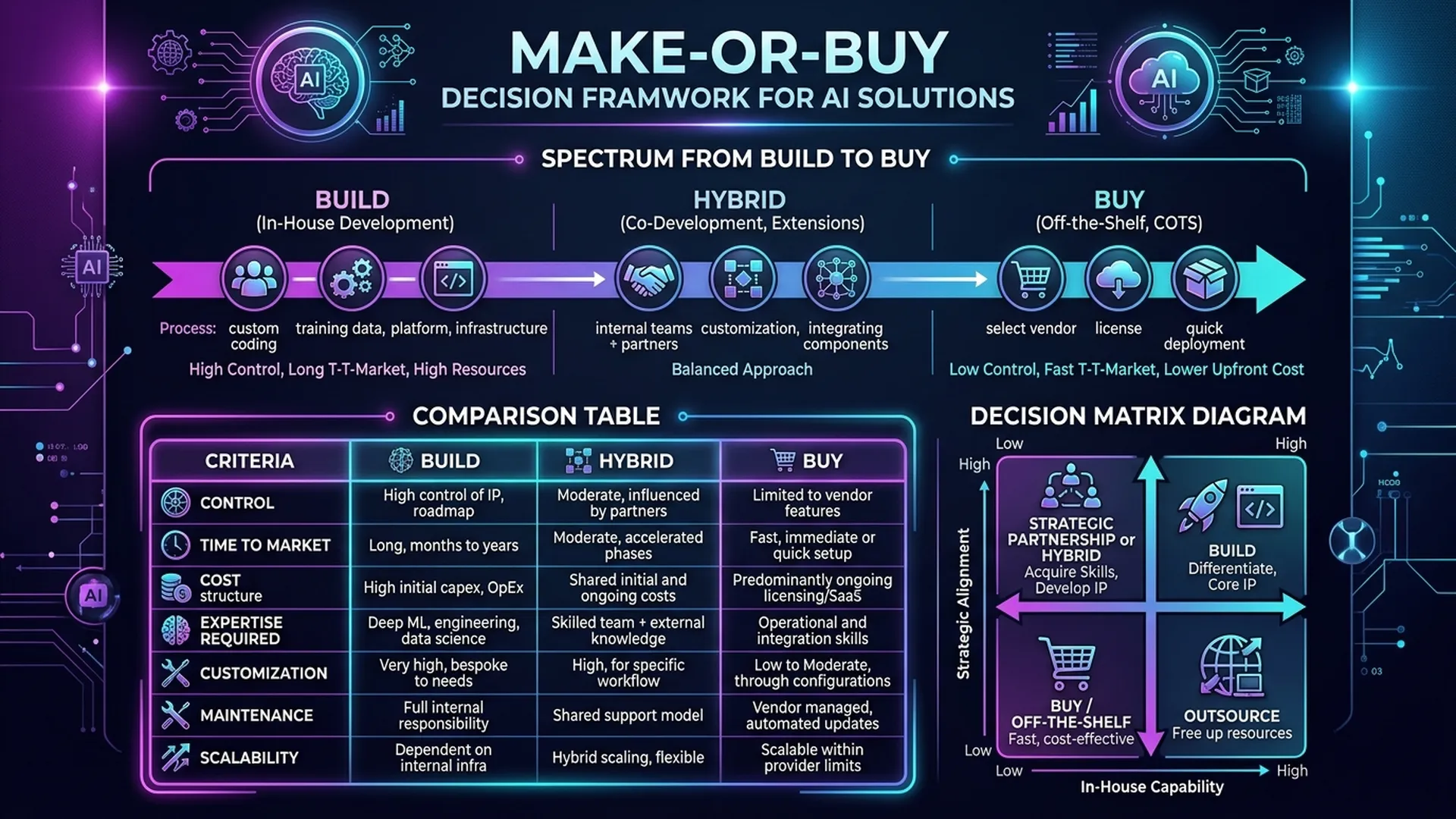
"Should we build AI ourselves or buy an existing solution?" - This is a question BA will face very often in AI projects. In 2026, the AI landscape is complex enough that this is no longer a simple "build vs buy" question, but a spectrum from fully custom to turnkey solution.
AI Solution Spectrum
FULL BUILD ←————————————————————————→ FULL BUY

[Train from Scratch] → [Fine-tune Open Source] → [Fine-tune Foundation Model] → [Prompt Engineering on API] → [SaaS AI Solution]

    Cao nhất                                                                                              Thấp nhất
    (Cost, Control, Flexibility, Data Privacy)

    Thấp nhất                                                                                             Cao nhất
    (Speed to Market, Ease of Use, Vendor Lock-in Risk)
There is no single "best" answer - each point on the spectrum fits a different use case.
5 Options for AI Solutions
Option 1: Train a Custom Model from scratch
- When: Highly specialized domain, proprietary data, strict privacy requirements
- Example: Medical imaging AI in a large hospital with proprietary scan data
- Cost: Very high ($500K-$5M+)
- Timeline: 6-18 months
- Team needed: ML Engineers, Data Scientists, MLOps
Option 2: Fine-tune an Open Source Model
- When: Need high customization but budget is limited, data is not overly sensitive
- Example: Fine-tune Llama 3 for customer support in a specific industry
- Cost: Medium ($50K-$200K)
- Timeline: 2-4 months
- Team needed: ML Engineer, Data Engineer
Option 3: Fine-tune / RAG on a Foundation Model
- When: Need customization but do not want to manage infrastructure
- Example: RAG with a company knowledge base on top of GPT-4o/Claude
- Cost: Low-Medium ($20K-$100K implementation + API cost)
- Timeline: 4-8 weeks
- Team needed: Backend Dev + BA (prompt engineering)
Option 4: Prompt Engineering on an AI API
- When: Use case already fits a foundation model, speed to market matters
- Example: AI-assisted email drafting, document summarization, classification
- Cost: Low (mostly API cost: $0.01-$0.10/1K tokens)
- Timeline: 1-4 weeks
- Team needed: Backend Dev + BA (prompt design)
Option 5: SaaS AI Solution
- When: Commodity use case, need turnkey delivery, team has no AI expertise
- Example: Salesforce Einstein, Zendesk AI, HubSpot AI
- Cost: Subscription ($30-$200/user/month)
- Timeline: Days to weeks
- Team needed: Implementation consultant + Admin
Make-or-Buy framework for BA
Dimension 1: Strategic Differentiation
Ask: "Is this AI capability a core business differentiator?"
                    HIGH
                Strategic Value
                    |
Competitors     |       Build Custom
can't replicate |       (Option 1-2)
                |
────────────────┼────────────────────
                |
Commodity       |       Buy/API
capability      |       (Option 3-5)
                |
                    LOW
         LOW ←— Uniqueness of your data/domain —→ HIGH
Examples:
- Amazon's recommendation engine -> Build (core competitive advantage)
- An SME's document categorization -> Buy/API (not a differentiator)
- A hospital's patient risk scoring -> Fine-tune (specialized domain + privacy)
- A startup's AI chatbot MVP -> API (speed to market matters more)
Dimension 2: Data Sensitivity
| Sensitivity level | Data type | Recommendation |
|---|---|---|
| Highly sensitive | PHI, financial, trade secrets | Option 1-2 (on-premise or private cloud) |
| Sensitive | PII, internal business data | Option 2-3 (with data anonymization or enterprise contract) |
| Non-sensitive | Public data, non-PII | Option 3-5 |
Note for AI API providers: OpenAI, Anthropic, and Google all offer enterprise plans with data privacy commitments. BA must verify:
- Do they use your data for training?
- What is the data retention policy?
- Do they comply with GDPR/local regulations?
Dimension 3: Maturity & Timeline
| Situation | Recommendation |
|---|---|
| MVP / Proof of Concept | Option 4-5: Fast, cheap, validate the hypothesis first |
| Growing product, proven value | Option 3: Fine-tune/RAG when customization becomes necessary |
| Enterprise scale, differentiated | Option 1-2: Invest in custom when ROI is proven |
Anti-pattern: Jump straight to Option 1 (train from scratch) without validating the business case -> waste of resources.
Dimension 4: Total Cost of Ownership (TCO)
BA often compare only initial cost - this is a mistake. You need a 3-year TCO view:
| Build Custom | API-based | SaaS | |
|---|---|---|---|
| Initial cost | $$$$ | $ | $$ |
| Annual maintenance | $$$$ | API cost | Subscription |
| Scaling cost | Linear with infra | Linear with usage | Per-seat |
| Update cost | Team effort | Provider handles | Provider handles |
| Lock-in risk | Low | Medium (API changes) | High |
| 3-year TCO example | $500K | $80K | $150K |
TCO depends heavily on scale and use case - this is only a reference example.
Dimension 5: Internal Capability
An honest assessment of the current team:
| What you have | Capability Level |
|---|---|
| ML Engineers, Data Scientists | ✅ Can consider Build |
| Backend Developers | ✅ Can do API/Fine-tune |
| Non-technical team | -> Choose no-code SaaS |
| Budget to hire | -> Build within 6-12 months |
| Outsource partner | -> Fine-tune with partner support |
Decision Matrix Template
BA can use a scoring matrix to present the decision objectively:
| Criterion | Weight | Build Custom | Fine-tune | API | SaaS |
|---|---|---|---|---|---|
| Strategic differentiation | 25% | 9 | 7 | 4 | 2 |
| Data privacy requirements | 20% | 9 | 8 | 5 | 4 |
| Speed to market | 20% | 2 | 5 | 9 | 10 |
| Cost efficiency (3yr) | 20% | 3 | 6 | 8 | 7 |
| Internal capability | 15% | 2 | 5 | 8 | 9 |
| Weighted Score | 100% | 5.5 | 6.3 | 6.7 | 6.1 |
Scores are 1-10; adjust weights and scores to fit the context.
Real example: Fintech Company
Scenario: A fintech company wants to implement AI fraud detection
Analysis:
- Strategic differentiation: HIGH - Fraud detection is a core risk function
- Data sensitivity: VERY HIGH - Transaction data, PII
- Team capability: Medium - There are Data Scientists, but not many
- Timeline: Urgent - Fraud is increasing
Options considered:
- Train custom -> 12 months, $800K - too slow
- Fine-tune open source LLM on fraud data -> 3 months, $150K - viable
- Fine-tune a specialized fraud detection model (Stripe Radar-like) -> 2 months, $100K - best
- API-based fraud detection service -> 2 weeks, $50K/year - fast but less specialized
- Turnkey fraud SaaS -> 1 week, $2/transaction - acceptable short-term
Recommendation:
- Immediate (Month 1-2): Option 5 (SaaS) to stop the bleeding right away
- Medium-term (Month 3-6): Option 3 (Fine-tune) to build differentiated capability
- Long-term (Month 6+): Combine both: SaaS for real-time, custom model for risk scoring
Hybrid Strategy: Best of Both Worlds
In practice, many companies use a hybrid approach:
Layer 1: Foundation Model API (GPT-4o, Claude)
  → General language tasks, summarization, draft generation

Layer 2: Fine-tuned model (company-specific)
  → Domain knowledge, terminology, custom logic

Layer 3: Rules engine (deterministic)
  → Compliance checks, hard business rules, safety filters

Layer 4: Human review
  → High-stakes decisions, edge cases, appeals
BA's role is to define which layer handles which type of request and the handoff logic between those layers.
Red Flags in Make-or-Buy proposals
🚩 "Let's build it ourselves because it will be cheaper in the long run" - Usually false without a dedicated ML team 🚩 "We must have a proprietary AI model" - Ask why; proprietary does not automatically mean better 🚩 "The SaaS vendor will use our data for training" - Verify the contract; do not assume 🚩 "Fine-tuning is quick, it only takes 2 weeks" - Real fine-tuning takes more than that 🚩 "GPT-4o is enough for every use case" - Not always true; evaluate per use case
Conclusion
Make-or-Buy in AI is not a binary choice - it is a spectrum with multiple stopping points. The role of BA is to:
- Clarify strategic intent - Where does the business want to differentiate?
- Assess constraints - Data privacy, budget, timeline, team capability
- Present options objectively - A scoring matrix with TCO analysis
- Recommend with rationale - Do not just say "I choose X"; explain WHY
The best Make-or-Buy decision is often: "Start small with Buy/API, validate value, then invest in Build when the business case is clear." This approach reduces risk and accelerates learning at the same time.