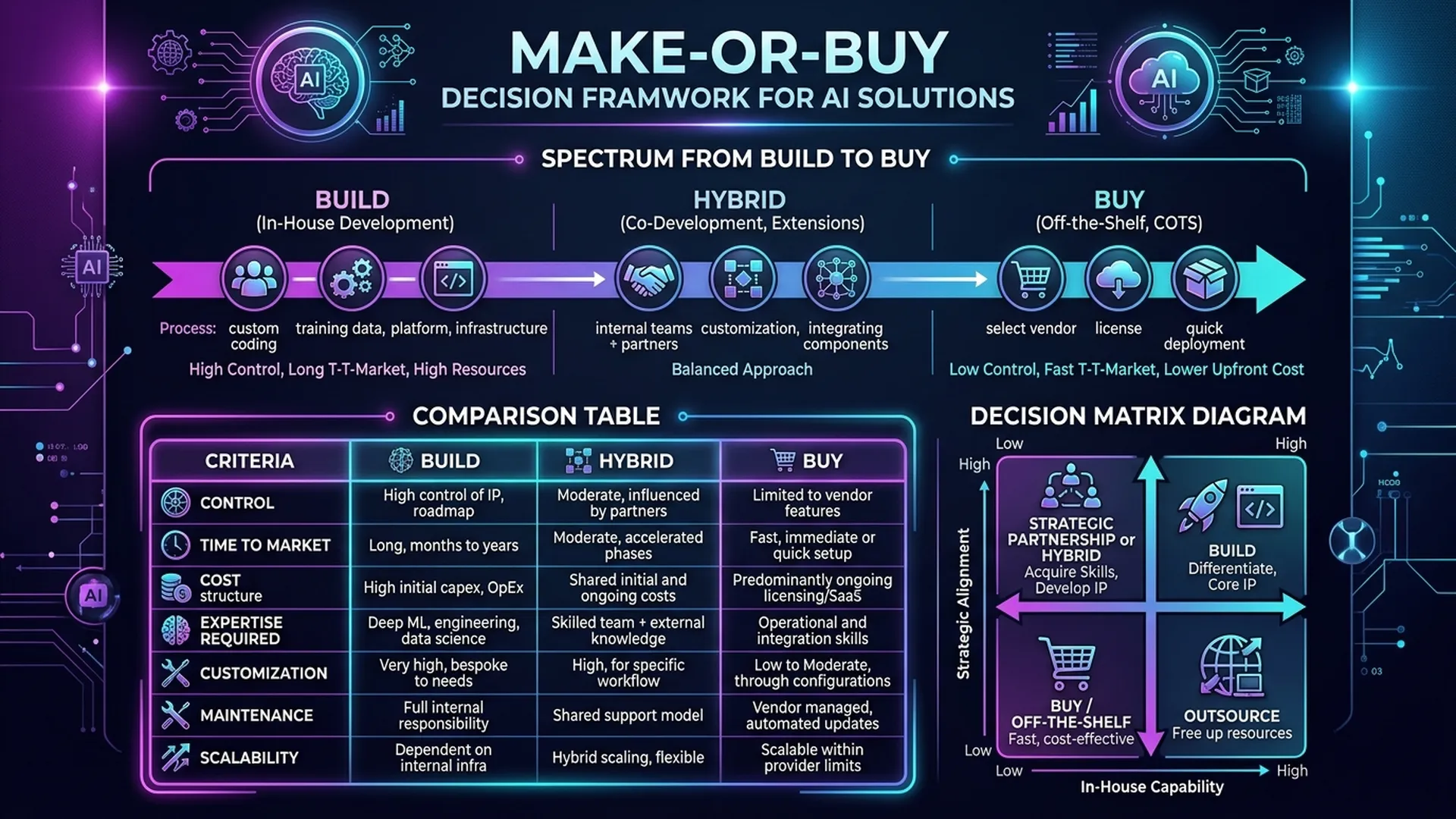
「我們應該自己 build AI,還是買現成 solution?」- 這是 BA 在 AI 專案中很常遇到的問題。到了 2026 年,AI landscape 已經複雜到這不再是單純的 "build vs buy" 問題,而是一條從 full custom 到 turnkey solution 的 spectrum。
AI Solution Spectrum
FULL BUILD ←————————————————————————→ FULL BUY

[Train from Scratch] → [Fine-tune Open Source] → [Fine-tune Foundation Model] → [Prompt Engineering on API] → [SaaS AI Solution]

    Cao nhất                                                                                              Thấp nhất
    (Cost, Control, Flexibility, Data Privacy)

    Thấp nhất                                                                                             Cao nhất
    (Speed to Market, Ease of Use, Vendor Lock-in Risk)
沒有唯一的「最佳答案」,spectrum 上每個位置都有各自適合的 use case。
AI Solution的5個Option
Option 1: 從零開始Train Custom Model
- 何時適用:Highly specialized domain、proprietary data、需要極高 privacy
- 範例:大型醫院使用 proprietary scan data 建 medical imaging AI
- Cost:非常高($500K-$5M+)
- Timeline:6-18 個月
- 需要的 team:ML Engineers、Data Scientists、MLOps
Option 2: Fine-tune Open Source Model
- 何時適用:需要高度 customization,但 budget 有限,且 data 不算極度敏感
- 範例:為特定 industry 的 customer support fine-tune Llama 3
- Cost:中等($50K-$200K)
- Timeline:2-4 個月
- 需要的 team:ML Engineer、Data Engineer
Option 3: 在Foundation Model上做Fine-tune / RAG
- 何時適用:需要 customization,但不想自行管理 infrastructure
- 範例:在 GPT-4o / Claude 上用 company knowledge base 建 RAG
- Cost:低到中($20K-$100K implementation + API cost)
- Timeline:4-8 週
- 需要的 team:Backend Dev + BA(prompt engineering)
Option 4: 在AI API上做Prompt Engineering
- 何時適用:Use case 本身就適合 foundation model,且 speed to market 很重要
- 範例:AI-assisted email drafting、document summarization、classification
- Cost:低(主要是 API cost:$0.01-$0.10/1K tokens)
- Timeline:1-4 週
- 需要的 team:Backend Dev + BA(prompt design)
Option 5: SaaS AI Solution
- 何時適用:Commodity use case、需要 turnkey、team 沒有 AI expertise
- 範例:Salesforce Einstein、Zendesk AI、HubSpot AI
- Cost:Subscription($30-$200/user/month)
- Timeline:數天到數週
- 需要的 team:Implementation consultant + Admin
BA用的Make-or-Buy Framework
Dimension 1: Strategic Differentiation
問自己:「這個 AI capability 是 business 的核心 differentiator 嗎?」
                    HIGH
                Strategic Value
                    |
Competitors     |       Build Custom
can't replicate |       (Option 1-2)
                |
────────────────┼────────────────────
                |
Commodity       |       Buy/API
capability      |       (Option 3-5)
                |
                    LOW
         LOW ←— Uniqueness of your data/domain —→ HIGH
分析例子:
- Amazon 的 recommendation engine -> Build(核心競爭優勢)
- SME 的 document categorization -> Buy/API(不是 differentiator)
- Hospital 的 patient risk scoring -> Fine-tune(specialized domain + privacy)
- Startup 的 AI chatbot MVP -> API(speed to market 更重要)
Dimension 2: Data Sensitivity
| 敏感程度 | Data 類型 | Recommendation |
|---|---|---|
| Highly sensitive | PHI、financial、trade secrets | Option 1-2(on-premise 或 private cloud) |
| Sensitive | PII、internal business data | Option 2-3(搭配 data anonymization 或 enterprise contract) |
| Non-sensitive | Public data、non-PII | Option 3-5 |
關於 AI API providers 的注意事項:OpenAI、Anthropic、Google 都有附帶 data privacy commitments 的 enterprise plans。BA 需要 verify:
- 他們會不會把你的 data 用來 training?
- Data retention policy 是什麼?
- 是否符合 GDPR / local regulations?
Dimension 3: Maturity & Timeline
| Situation | Recommendation |
|---|---|
| MVP / Proof of Concept | Option 4-5:快速、便宜,先驗證 hypothesis |
| Growing product、proven value | Option 3:當需要 customization 時使用 Fine-tune / RAG |
| Enterprise scale、differentiated | Option 1-2:在 ROI 被證明後投資 custom |
Anti-pattern:還沒驗證 business case 就直接跳到 Option 1(train from scratch)-> 很容易浪費 resources。
Dimension 4: Total Cost of Ownership(TCO)
BA 常常只比較 initial cost,這是錯的。你應該看 3 年期 TCO:
| Build Custom | API-based | SaaS | |
|---|---|---|---|
| Initial cost | $$$$ | $ | $$ |
| Annual maintenance | $$$$ | API cost | Subscription |
| Scaling cost | 與 infra 線性增加 | 與 usage 線性增加 | Per-seat |
| Update cost | Team effort | Provider handles | Provider handles |
| Lock-in risk | Low | Medium(API changes) | High |
| 3-year TCO example | $500K | $80K | $150K |
TCO 會高度依賴 scale 與 use case,這裡只是參考範例。
Dimension 5: Internal Capability
誠實評估 current team:
| 你目前擁有 | Capability Level |
|---|---|
| ML Engineers、Data Scientists | ✅ 可以考慮 Build |
| Backend Developers | ✅ 可以處理 API / Fine-tune |
| Non-technical team | -> 選擇 no-code SaaS |
| 有 budget 招聘 | -> 6-12 個月內 Build |
| 有 outsource partner | -> 在 partner 支援下 Fine-tune |
Decision Matrix Template
BA 可以使用 scoring matrix,用更客觀的方式呈現 decision:
| Criterion | Weight | Build Custom | Fine-tune | API | SaaS |
|---|---|---|---|---|---|
| Strategic differentiation | 25% | 9 | 7 | 4 | 2 |
| Data privacy requirements | 20% | 9 | 8 | 5 | 4 |
| Speed to market | 20% | 2 | 5 | 9 | 10 |
| Cost efficiency (3yr) | 20% | 3 | 6 | 8 | 7 |
| Internal capability | 15% | 2 | 5 | 8 | 9 |
| Weighted Score | 100% | 5.5 | 6.3 | 6.7 | 6.1 |
Scores 為 1-10,請依 context 調整 weights 與 scores。
實例:Fintech Company
Scenario:Fintech 想導入 AI fraud detection
Analysis:
- Strategic differentiation:HIGH - Fraud detection 是核心 risk function
- Data sensitivity:VERY HIGH - Transaction data、PII
- Team capability:Medium - 有 Data Scientists,但數量不多
- Timeline:Urgent - Fraud 正在增加
Options considered:
- Train custom -> 12 個月、$800K - 太慢
- Fine-tune open source LLM on fraud data -> 3 個月、$150K - 可行
- Fine-tune a specialized fraud detection model(Stripe Radar-like)-> 2 個月、$100K - 最佳
- API-based fraud detection service -> 2 週、$50K/year - 很快但較不 specialized
- Turnkey fraud SaaS -> 1 週、$2/transaction - 短期可接受
Recommendation:
- Immediate(Month 1-2):先上 Option 5(SaaS)止血
- Medium-term(Month 3-6):接著做 Option 3(Fine-tune),建立 differentiated capability
- Long-term(Month 6+):採混合策略,real-time 用 SaaS,risk scoring 用 custom model
Hybrid Strategy:Best of Both Worlds
在實務中,很多 company 會採用 hybrid approach:
Layer 1: Foundation Model API (GPT-4o, Claude)
  → General language tasks, summarization, draft generation

Layer 2: Fine-tuned model (company-specific)
  → Domain knowledge, terminology, custom logic

Layer 3: Rules engine (deterministic)
  → Compliance checks, hard business rules, safety filters

Layer 4: Human review
  → High-stakes decisions, edge cases, appeals
BA 的角色,就是定義 哪一層 處理哪一種 request,以及各 layers 之間的 handoff logic。
Make-or-Buy提案中的Red Flags
🚩 「自己 build 長期一定更便宜」- 如果沒有 dedicated ML team,通常不成立 🚩 「我們一定要有 proprietary AI model」- 先問為什麼,proprietary 不等於 better 🚩 「SaaS vendor 一定會拿我們的 data 去 training」- 不要 assume,請 verify contract 🚩 「Fine-tune 很快,2 週就做完」- 真正的 fine-tuning 通常不只這麼短 🚩 「GPT-4o 對所有 use case 都夠用」- 不一定,必須逐個 use case 評估
結論
AI 的 Make-or-Buy 不是 binary choice,而是一條有多個停靠點的 spectrum。BA 的角色是:
- Clarify strategic intent - Business 想在哪裡做 differentiation?
- Assess constraints - Data privacy、budget、timeline、team capability
- Present options objectively - 用 scoring matrix 與 TCO analysis 客觀呈現
- Recommend with rationale - 不只是說「我選 X」,而是清楚說明 WHY
最好的 Make-or-Buy decision,通常是「先用 Buy/API 小步開始,驗證 value,等 business case 清楚後再投資 Build。」這種 approach 同時能降低 risk,也能加速 learning。