Introduction
Many teams fail not because the model is weak, but because prompts lack clear contracts. When prompts change, output drifts and the app silently breaks.
1. What Is a Prompt Contract?
A prompt contract consists of 4 parts:
- Role and task scope
- Input format
- Output format
- Failure behavior when data is insufficient
Example failure behavior: return an exact phrase like "insufficient data" instead of making things up.
2. JSON Schema for Output
Example schema for extracting action items:
{
  "type": "object",
  "required": ["summary", "items"],
  "properties": {
    "summary": {"type": "string"},
    "items": {
      "type": "array",
      "items": {
        "type": "object",
        "required": ["task", "owner"],
        "properties": {
          "task": {"type": "string"},
          "owner": {"type": "string"},
          "deadline": {"type": "string"}
        }
      }
    }
  }
}
Validate the schema immediately after receiving model output.
3. Designing Golden Tests
Create a test file containing:
- Input prompt
- Must include
- Must not include
- Schema pass/fail
Every time you change a prompt or model, re-run the entire test suite.
4. Error Classification
- Format error: doesn't match schema
- Grounding error: doesn't stick to context
- Safety error: returns sensitive data
- Instruction error: ignores system constraints
Clear error codes help track trends over time.
5. Prompt Versioning
Apply these rules:
- Every prompt has a version code
- Brief changelog for each change
- Quick rollback if quality drops
Never edit prompts directly in production without saving the version.
Demo Code
Prompt contract test results — 6/6 passed:
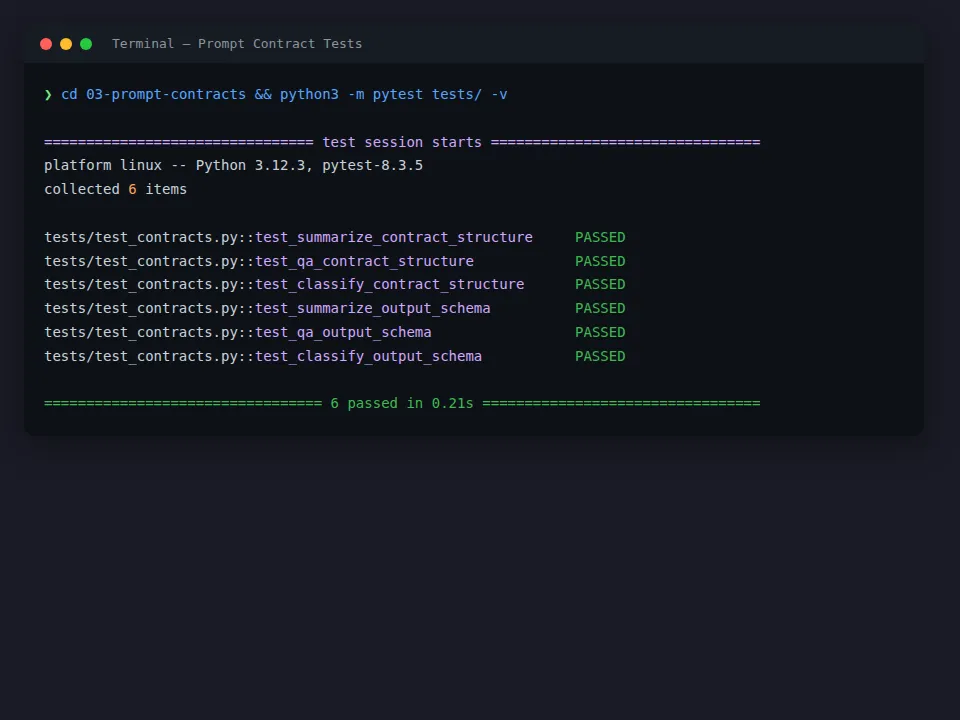
Source code: 03-prompt-contracts