Introduction
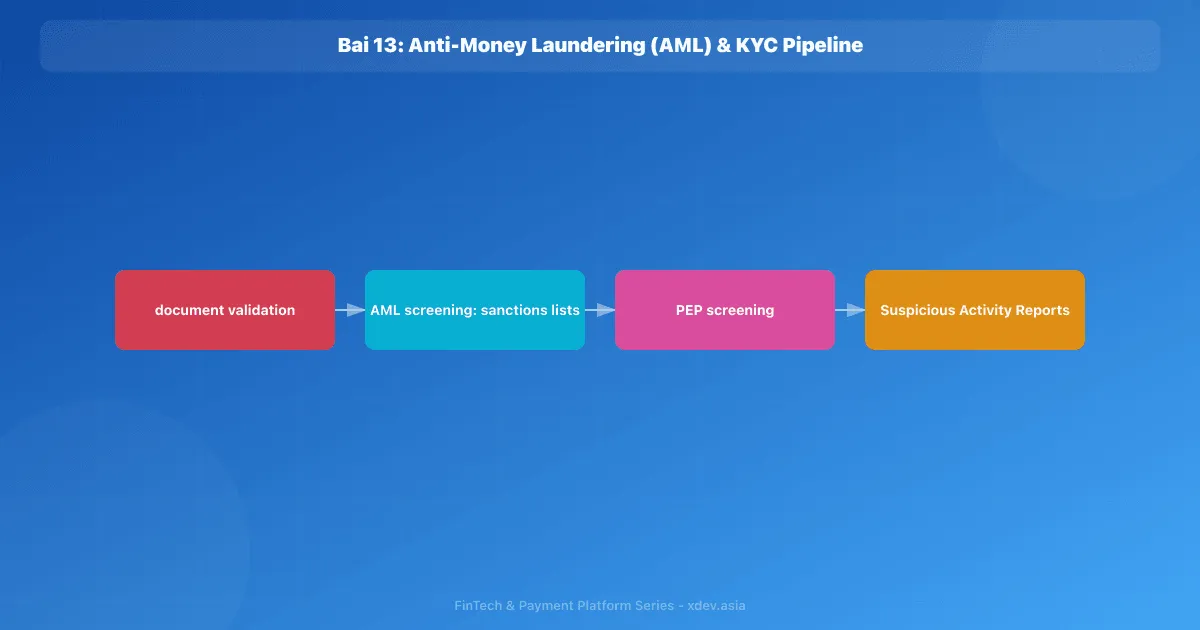
KYC pipeline design: identity verification, document validation. AML screening: sanctions lists, PEP screening. Suspicious Activity Reports.
1. Design KYC pipeline: identity verification, document validation
1.1 Basic concepts
KYC pipeline design: identity verification, document validation is one of the most important topics in this field. Understanding the core concepts will help you design the right system from the beginning.
Key Concepts:
├── Concept 1: Nền tảng lý thuyết
├── Concept 2: Áp dụng thực tế
├── Concept 3: Best practices
└── Concept 4: Anti-patterns cần tránh
1.2 Why is it important?
| Aspect | Not applicable | Correct application |
|---|---|---|
| Performance | Bottlenecks, high latency | Optimized, scalable |
| Reliability | Single point of failure | Fault-tolerant |
| Maintainability | Technical debt accumulated | Clean architecture |
| Security | Vulnerable | Defense in depth |
2. AML screening: sanctions lists, PEP screening
2.1 General architecture
┌─────────────────────────────────────────────────────┐
│                  SYSTEM ARCHITECTURE                 │
│                                                      │
│  ┌──────────┐  ┌──────────┐  ┌──────────────────┐  │
│  │  Client   │  │  API     │  │  Core Service    │  │
│  │  Layer    │──│  Gateway │──│  Layer           │  │
│  └──────────┘  └──────────┘  └──────────────────┘  │
│                                      │               │
│                               ┌──────▼──────┐       │
│                               │  Data Layer │       │
│                               └─────────────┘       │
└─────────────────────────────────────────────────────┘
2.2 Component Design
Each component in the system needs to be designed with the following principles:
- Single Responsibility: Each component only takes on one responsibility
- Loose Coupling: Minimize dependencies between components
- High Cohesion: Related elements are in the same component
- Interface Segregation: Clear, separate API
3. Suspicious Activity Reports.
3.1 Design Patterns applied
Applied Patterns:
├── Strategy Pattern: Cho phép thay đổi algorithm at runtime
├── Observer Pattern: Event notification mechanism
├── Repository Pattern: Data access abstraction
└── Factory Pattern: Object creation flexibility
3.2 Code Example
// Example implementation
public interface Service {
    Result process(Request request);
    boolean supports(RequestType type);
}

@Component
public class CoreService implements Service {

    @Override
    public Result process(Request request) {
        // Validate input
        validator.validate(request);

        // Execute business logic
        var result = businessLogic.execute(request);

        // Publish domain event
        eventBus.publish(new ProcessedEvent(result));

        return result;
    }
}
4. Production Considerations
4.1 Monitoring & Observability
Observability Stack:
├── Metrics: Prometheus + Grafana
├── Logging: ELK / Loki
├── Tracing: OpenTelemetry + Jaeger
└── Alerting: PagerDuty
4.2 Performance Optimization
| Metrics | Target | Strategy |
|---|---|---|
| Latency p99 | < 100ms | Caching, async processing |
| Throughput | > 10K RPS | Horizontal scaling |
| Availability | 99.99% | Multi-region, failover |
| Error rate | < 0.01% | Circuit breaker, retry |
Summary
In this lesson, we learned about Anti-Money Laundering (AML) & KYC Pipeline. Key takeaways:
- Understand core concepts and how to apply
- Design architecture in accordance with requirements
- Implementation patterns and best practices
- Production considerations: monitoring, performance, security
Next article: We will continue with the next topic in the series.