Introduction
Global health data is a huge treasure trove — billions of records from hospitals, clinics, health insurance. But each system is stored in a separate form: Hospital A's HIS (Hospital Information System) is completely different from hospital B, ICD-10 disease codes are not consistent with SNOMED CT, prescriptions are stored by trade name instead of international active ingredients.
OHDSI (Observational Health Data Sciences and Informatics — pronounced "Odyssey") was created to solve this problem.
1. What is OHDSI?
1.1 Definition
OHDSI is an international, open-source research program that aims to:
- Standardize observational health data into a common data model
- Develop reliable, reproducible analytical methods
- Allow multicenter studies WITHOUT sharing patient data
1.2 History
2008: OMOP (Observational Medical Outcomes Partnership)
      → Dự án FDA nghiên cứu tác dụng phụ thuốc trên dữ liệu thực tế
      → Phát triển Common Data Model (CDM)

2013: OMOP kết thúc → OHDSI ra đời
      → Kế thừa OMOP CDM, mở rộng thành cộng đồng mã nguồn mở
      → Mục tiêu: evidence-based medicine trên quy mô toàn cầu

2024: 800+ tổ chức, 100+ quốc gia
      → 1+ tỷ bản ghi bệnh nhân được chuẩn hóa
      → Hàng nghìn nghiên cứu được publish

2026: OHDSI tiếp tục mở rộng
      → OMOP CDM v5.4, v6.0 đang phát triển
      → Tích hợp AI/ML, genomics, wearable data
1.3 Three pillars of OHDSI
┌─────────────────────────────────────────────────────────┐
│                    OHDSI Mission                        │
│                                                         │
│  ┌─────────────┐ ┌──────────────┐ ┌──────────────────┐ │
│  │  Open       │ │  Open        │ │  Open            │ │
│  │  Science    │ │  Source      │ │  Community       │ │
│  │             │ │              │ │                  │ │
│  │ Transparent │ │ Free tools   │ │ Collaborative    │ │
│  │ Reproducible│ │ Peer-reviewed│ │ 800+ orgs        │ │
│  │ Published   │ │ GitHub       │ │ Global network   │ │
│  └─────────────┘ └──────────────┘ └──────────────────┘ │
└─────────────────────────────────────────────────────────┘
2. OHDSI problem solved
2.1 Fragmentation — Data fragmentation
Bệnh viện A (HIS: eHospital)     Bệnh viện B (HIS: Telehealth)
┌─────────────────────────┐       ┌─────────────────────────┐
│ Patient: MA_BN_001      │       │ Patient: BN-2024-00123  │
│ Diagnosis: I10 (ICD-10) │       │ Diagnosis: 401.1 (ICD-9)│
│ Drug: Amlor 5mg         │       │ Drug: Amlodipine 5mg    │
│ Lab: Glucose: 126 mg/dL │       │ Lab: Đường huyết: 7.0   │
│ Date: 01/03/2024        │       │ Date: 2024-03-01        │
└─────────────────────────┘       └─────────────────────────┘

→ Cùng 1 bệnh nhân, cùng 1 bệnh (tăng huyết áp), cùng 1 thuốc
→ Nhưng KHÔNG THỂ truy vấn chung vì format khác nhau hoàn toàn
2.2 Solution: OMOP CDM
                    ETL (Extract - Transform - Load)
Bệnh viện A ─────┐                    ┌──────────────────────┐
                  ├─── Transform ───→  │   OMOP CDM Database  │
Bệnh viện B ─────┘                    │                      │
                                       │ person_id: 12345     │
                                       │ condition: 320128    │
                                       │   (Essential HTN)    │
                                       │ drug: 1332419        │
                                       │   (Amlodipine 5mg)   │
                                       │ measurement: 3004410 │
                                       │   (Glucose 126 mg/dL)│
                                       └──────────────────────┘

→ Cùng concept IDs cho cùng ý nghĩa y khoa
→ Cùng cấu trúc bảng → cùng SQL query
→ Có thể phân tích đa trung tâm
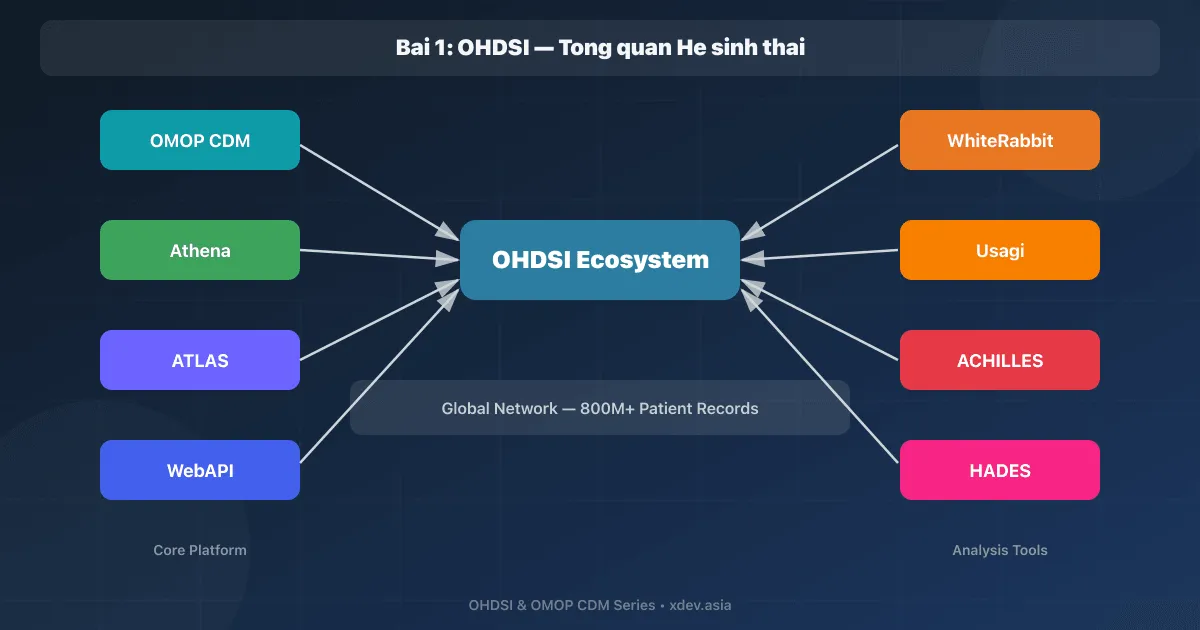
3. OHDSI Ecosystem Architecture
┌─────────────────────────────────────────────────────────────────┐
│                     OHDSI Ecosystem                             │
│                                                                 │
│  ┌──── Data Standardization ─────────────────────────────────┐ │
│  │                                                           │ │
│  │  [Athena]          → Standardized Vocabularies            │ │
│  │  [WhiteRabbit]     → Scan source data                     │ │
│  │  [Rabbit-in-a-Hat] → Design ETL mapping                   │ │
│  │  [Usagi]           → Map source codes → standard concepts │ │
│  │                                                           │ │
│  └───────────────────────────────────────────────────────────┘ │
│                           │ ETL                                │
│                           ▼                                    │
│  ┌──── OMOP CDM Database ────────────────────────────────────┐ │
│  │  PostgreSQL / SQL Server / Oracle / Spark                 │ │
│  └───────────────────────────────────────────────────────────┘ │
│                           │                                    │
│                           ▼                                    │
│  ┌──── Data Quality ────────────────────────────────────────┐  │
│  │  [ACHILLES]              → Data characterization          │  │
│  │  [Data Quality Dashboard]→ 1,500+ quality checks          │  │
│  └───────────────────────────────────────────────────────────┘ │
│                           │                                    │
│                           ▼                                    │
│  ┌──── Analytics Platform ──────────────────────────────────┐  │
│  │  [WebAPI]  → REST API backend (Spring Boot / Java)        │  │
│  │  [ATLAS]   → Web UI (JavaScript) cho phân tích            │  │
│  │  [HADES]   → R packages cho advanced analytics            │  │
│  └───────────────────────────────────────────────────────────┘ │
└─────────────────────────────────────────────────────────────────┘
3.1 Main tools
| Tools | Purpose | Language |
|---|---|---|
| Athena | Look up & download Standardized Vocabularies | Web app |
| WhiteRabbit | Scan source data, create profile report | Java |
| Rabbit-in-a-Hat | ETL mapping design (GUI) | Java |
| Usagi | Map source codes → OMOP concepts | Java |
| WebAPI | Backend REST API for ATLAS | Java/Spring Boot |
| ATLAS | Web-based analytics platform | JavaScript |
| ACHILLES | Data characterization & profiling | R |
| DQD | Data Quality Dashboard — 1,500+ checks | R |
| HADES | R packages for observational research | R |
4. End-to-End OHDSI Workflow
Step 1: Vocabulary Preparation
  Athena → Download vocabularies (ICD-10, SNOMED, RxNorm, LOINC...)
                    │
Step 2: Source Data Profiling
  WhiteRabbit → Scan source database → Generate scan report
                    │
Step 3: ETL Design
  Rabbit-in-a-Hat → Design table & field mappings
  Usagi → Map source codes → Standard Concepts
                    │
Step 4: ETL Execution
  Custom ETL scripts (Python/SQL) → Load data into OMOP CDM
                    │
Step 5: Data Quality
  ACHILLES → Characterize CDM data
  DQD → Run 1,500+ quality checks
                    │
Step 6: Analytics
  WebAPI + ATLAS → Cohort Definitions, Characterization,
                   Incidence Rates, Estimation, Prediction
  HADES → Advanced R-based analytics
                    │
Step 7: Network Study
  Package study → Distribute to sites → Collect aggregate results
5. OHDSI Network — Distributed Research
What's special about OHDSI: patient data NEVER leaves the site.
┌──────────────┐    ┌──────────────┐    ┌──────────────┐
│   Site A     │    │   Site B     │    │   Site C     │
│ (500K pts)   │    │ (1M pts)     │    │ (200K pts)   │
│              │    │              │    │              │
│ OMOP CDM     │    │ OMOP CDM     │    │ OMOP CDM     │
│ WebAPI+ATLAS │    │ WebAPI+ATLAS │    │ WebAPI+ATLAS │
│              │    │              │    │              │
│ Run Study    │    │ Run Study    │    │ Run Study    │
│ Package ───┐ │    │ Package ───┐ │    │ Package ───┐ │
└────────────│─┘    └────────────│─┘    └────────────│─┘
             │                   │                    │
             └───── Aggregate ───┴──── Results ───────┘
                        │
                        ▼
              ┌─────────────────┐
              │ Central Analysis│
              │ (chỉ aggregate  │
              │  không có PII)  │
              └─────────────────┘
Why is it important?
- Comply with privacy regulations (HIPAA, GDPR, Vietnam Information Security Law)
- Each site retains full control over data
- Research on millions of multinational patients is still possible
6. Practical application
6.1 COVID-19 (OHDSI COVID-19 Study-a-thon)
Timeline:
- Tháng 3/2020: Đại dịch bùng phát
- Tháng 3/2020: OHDSI tổ chức Study-a-thon online
- 96 giờ: 300+ nhà nghiên cứu từ 30+ quốc gia
- Kết quả: Phân tích đặc điểm bệnh nhân COVID-19
  trên 5+ triệu bệnh nhân từ nhiều quốc gia
  → Published trong PNAS (top-tier journal)
6.2 Drug Safety Surveillance
- Detect drug side effects on real data (RWD)
- Compare the drug group with the control group
- Example: Analyzing risk of myocarditis after vaccination
6.3 Application in Vietnam
- Standardize hospital HIS data into OMOP CDM
- Mapping ICD-10 Vietnam → SNOMED CT
- Epidemiological research on social insurance data
- Evaluate the effectiveness of multicenter treatment regimens
Summary
| Concept | Explanation |
|---|---|
| OHDSI | Global open source medical research community |
| OMOP CDM | Generic data model for observational medical data |
| Standardized Vocabularies | Standard vocabulary set (SNOMED, RxNorm, LOINC...) |
| Distributed Research | Multi-center analysis without data leaving the site |
| ETL | Source data conversion process → OMOP CDM |
Next article: OMOP Common Data Model — Structure, principles & Domain