Introduction
Backend for Frontend (BFF) is a pattern that places a separate backend layer for each frontend client. BFF aggregates data from multiple microservices, transforming it into a format suitable for the specific frontend.
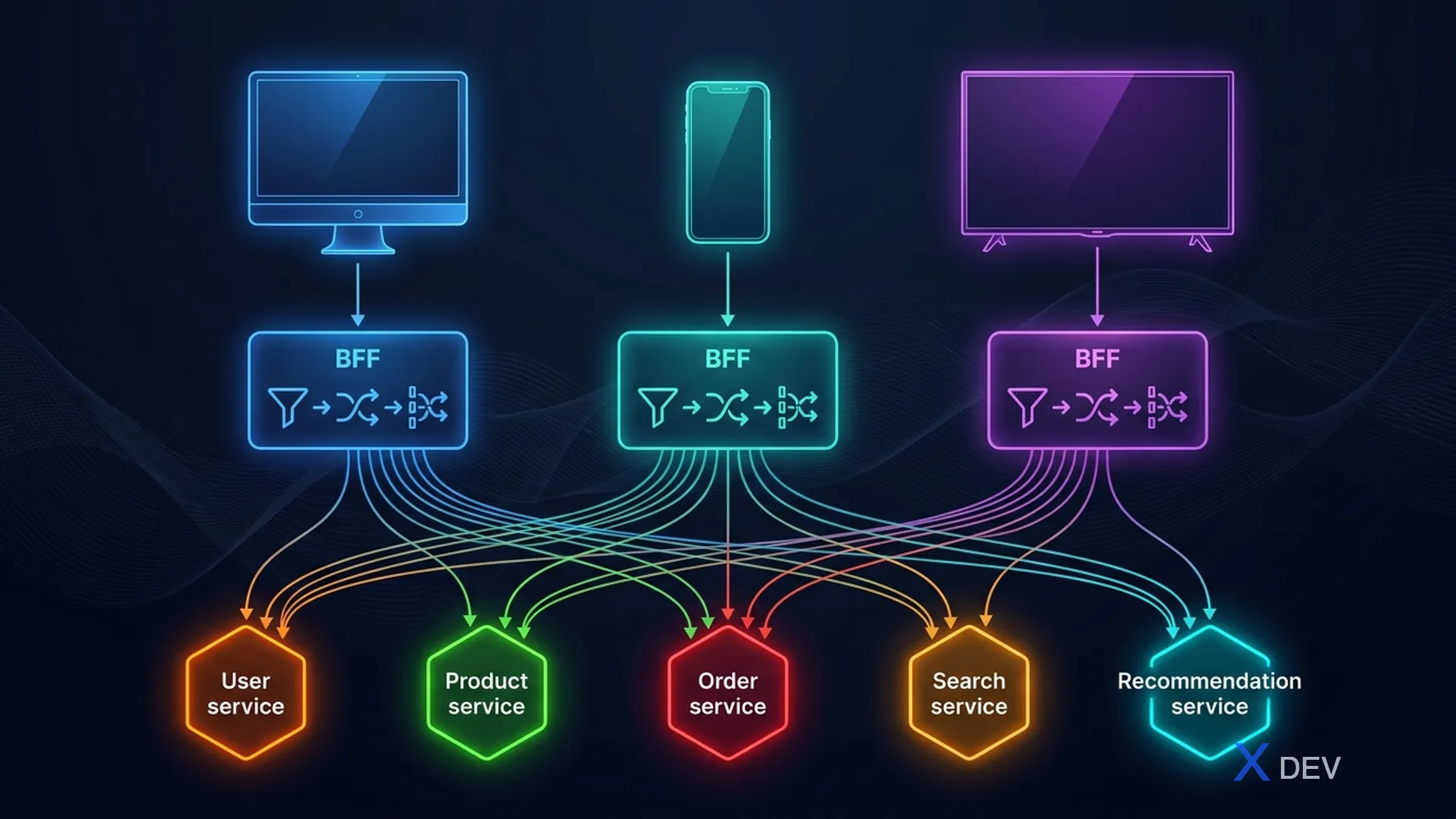
1. Why do you need a BFF?
1.1 The problem of not having a BFF
❌ Mỗi MFE gọi trực tiếp nhiều microservices:

Product MFE ──► Product Service
            ──► Review Service
            ──► Inventory Service
            ──► Pricing Service

→ 4 API calls cho 1 product page
→ Frontend phải aggregate data
→ Over-fetching (mỗi API trả về nhiều hơn cần)
→ Latency: waterfall requests
1.2 With BFF
✅ BFF aggregates cho frontend:

Product MFE ──► Web BFF ──► Product Service
                        ──► Review Service
                        ──► Inventory Service

→ 1 API call cho 1 product page
→ BFF aggregate và transform data
→ Frontend nhận đúng data cần
→ Parallel calls tại BFF layer
2. BFF Architecture
┌─────────────┐  ┌─────────────┐  ┌─────────────┐
│  Web App    │  │ Mobile App  │  │  Admin App  │
│  (MFE)     │  │  (React     │  │  (MFE)      │
│            │  │   Native)   │  │             │
└──────┬──────┘  └──────┬──────┘  └──────┬──────┘
       │                │                │
       ▼                ▼                ▼
┌──────────────┐ ┌──────────────┐ ┌──────────────┐
│   Web BFF    │ │  Mobile BFF  │ │  Admin BFF   │
│  (Node.js)   │ │  (Node.js)   │ │  (Node.js)   │
│  Full data   │ │  Compact data│ │  All CRUD    │
└──────┬───────┘ └──────┬───────┘ └──────┬───────┘
       │                │                │
       └────────────────┼────────────────┘
                        ▼
              ┌─────────────────┐
              │  Microservices  │
              │  (gRPC / REST)  │
              └─────────────────┘
3. BFF Design Principles
3.1 One BFF per Frontend Type
| Frontend | BFF | Optimized for |
|---|---|---|
| Web (Desktop) | Web BFF | Full data, rich UI |
| Mobile | Mobile BFF | Compact data, bandwidth |
| Admin Panel | Admin BFF | CRUD operations |
| Third-party | Public API (not BFF) | Stable, versioned |
3.2 BFF Responsibilities
BFF SHOULD:
✅ Aggregate data từ multiple services
✅ Transform data cho frontend format
✅ Handle authentication (validate tokens)
✅ Caching (Redis) cho frequently accessed data
✅ Rate limiting per client

BFF SHOULD NOT:
❌ Contain business logic (belongs to services)
❌ Have its own database (stateless!)
❌ Become a "smart proxy" monolith
❌ Be shared across different frontends
4. BFF Implementation (Node.js/Fastify)
// Web BFF - Product Page Aggregation
app.get('/api/bff/product/:id', async (req, reply) => {
  const { id } = req.params;

  // Parallel calls to microservices
  const [product, reviews, inventory] = await Promise.all([
    productService.getProduct(id),
    reviewService.getReviews(id, { limit: 5 }),
    inventoryService.getStock(id),
  ]);

  // Transform for web frontend
  return {
    ...product,
    rating: reviews.averageRating,
    topReviews: reviews.items.slice(0, 3),
    inStock: inventory.quantity > 0,
    stockLevel: inventory.quantity > 10 ? 'high' : 'low',
  };
});
5. BFF vs API Gateway
| Features | API Gateway | BFF |
|---|---|---|
| Purpose | Cross-cutting concerns | Frontend-specific aggregation |
| Logic | Routing, auth, rate limit | Data transformation |
| Per client | One for all | One per frontend type |
| Maintained by | Platform team | Frontend team |
In practice, use both:
Frontend → API Gateway → BFF → Microservices
           (routing,      (aggregation,
            auth,          transformation)
            rate limit)
Summary
- BFF = separate backend for each frontend type
- Aggregates data, transforms format, reduces frontend complexity
- Stateless, does not contain business logic
- One BFF per frontend type (Web, Mobile, Admin)
- Often combined with API Gateway
Next article: Lesson 18: API Gateway — Kong, APISIX & Envoy