Introduction
Deploying microservices to production is the riskiest time. Deployment strategy decides blast radius when there is a bug — affects 100% of users or only 5%? This article compares strategies and provides guidance on choosing the right one.
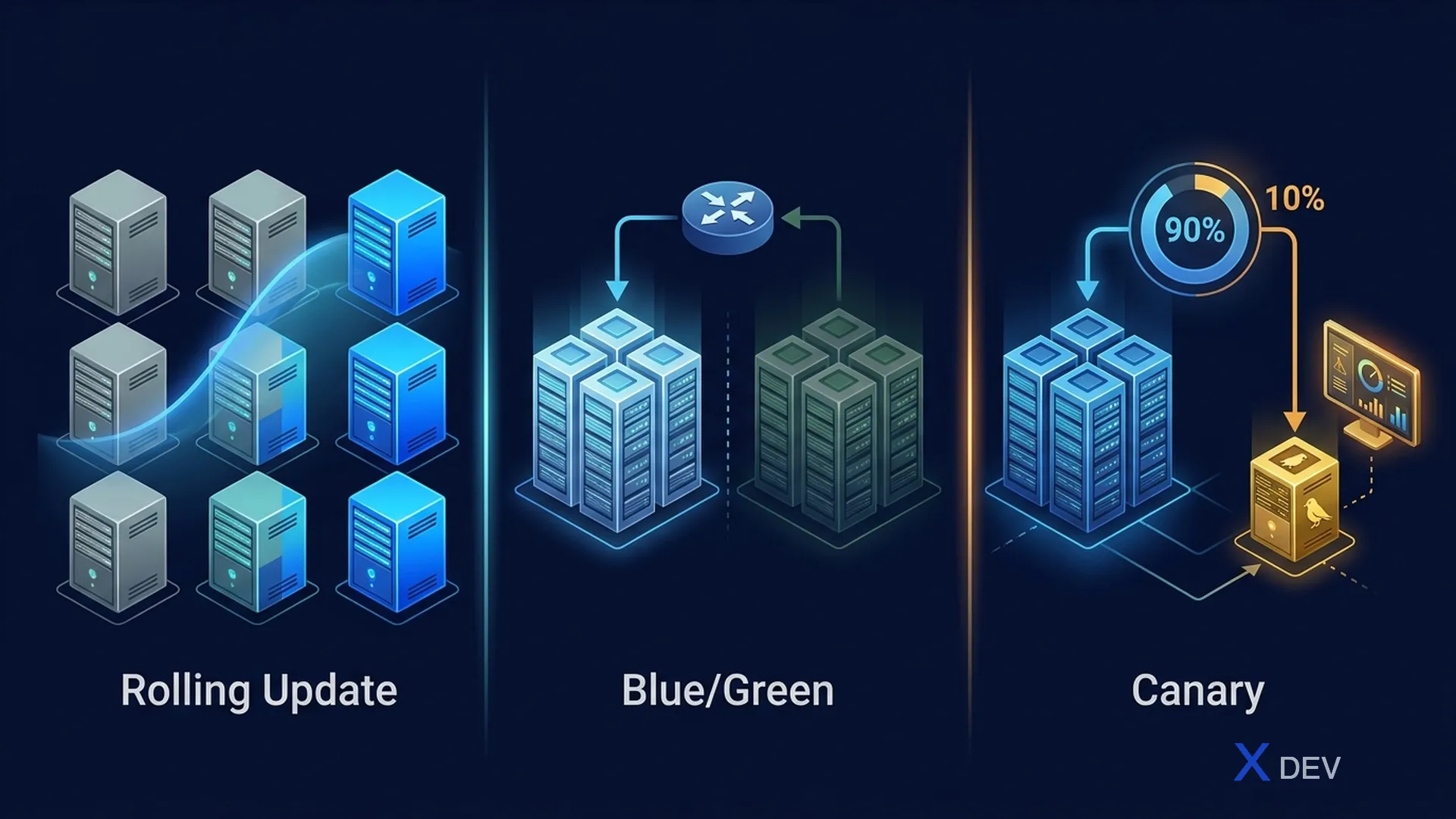
1. Rolling Update
Kubernetes mặc định:

Pod v1 ●●●●●  (5 replicas)

Deploy v2:
Step 1: ●●●●● + ○     (1 new pod v2 starting)
Step 2: ●●●● + ○○      (2 v2 ready, 1 v1 terminated)
Step 3: ●●● + ○○○      (3 v2 ready)
Step 4: ●● + ○○○○
Step 5: ○○○○○           (all v2)

● = v1, ○ = v2
Advantages: Zero downtime, gradual, K8s native Disadvantages: Mixed versions during rollout, rollback slow Use case: Low-risk changes, stateless services
2. Blue/Green Deployment
Blue (current, live):  ●●●●●  ← traffic
Green (new, staging):  ○○○○○  ← no traffic

Test Green thoroughly, then switch:

Blue:  ●●●●●  ← no traffic (standby)
Green: ○○○○○  ← ALL traffic switched instantly
Advantages: Instant rollback (switch back to blue), full testing before live Disadvantages: 2x resources needed, database migration must be backward compatible Use case: Critical services, when instant rollback is needed
3. Canary Deployment ⭐
Step 1: ●●●●● (100% v1)
Step 2: ●●●●○ (90% v1, 10% v2) ← canary
Step 3: Monitor metrics (error rate, latency, CPU)
Step 4a: Metrics OK → ●●●○○ → ●●○○○ → ○○○○○ (promote)
Step 4b: Metrics BAD → ●●●●● (rollback, remove canary)
Advantages: Smallest blast radius, data-driven promotion Disadvantages: Complex setup, needs good monitoring Use case: Most production deployments — recommended default
4. Argo Rollouts (Progressive Delivery)
# rollout.yaml
apiVersion: argoproj.io/v1alpha1
kind: Rollout
metadata:
  name: product-service
spec:
  replicas: 5
  strategy:
    canary:
      canaryService: product-service-canary
      stableService: product-service-stable
      steps:
        - setWeight: 5
        - pause: { duration: 5m }
        - setWeight: 20
        - pause: { duration: 10m }
        - setWeight: 50
        - pause: { duration: 15m }
        - setWeight: 100
      analysis:
        templates:
          - templateName: success-rate
        startingStep: 2
        args:
          - name: service-name
            value: product-service

---
apiVersion: argoproj.io/v1alpha1
kind: AnalysisTemplate
metadata:
  name: success-rate
spec:
  metrics:
    - name: success-rate
      interval: 1m
      successCondition: result[0] >= 0.99
      provider:
        prometheus:
          address: http://prometheus:9090
          query: |
            sum(rate(http_requests_total{service="{{args.service-name}}",code=~"2.."}[5m]))
            /
            sum(rate(http_requests_total{service="{{args.service-name}}"}[5m]))
5. Feature Flags
Deploy code to production without enabling for users:
// Feature flag check
const unleash = require('unleash-client');

app.get('/api/products', (req, res) => {
  const products = getProducts();

  if (unleash.isEnabled('new-recommendation-engine', {
    userId: req.user.id
  })) {
    // New feature, enabled for specific users
    products.forEach(p => {
      p.recommendations = newEngine.getRecommendations(p.id);
    });
  }

  res.json(products);
});
Feature Flags + Canary
1. Deploy v2 with feature flag OFF → 100% users get old behavior
2. Enable flag for 5% users → monitor
3. Gradually increase → 20% → 50% → 100%
4. Remove flag from code after full rollout
6. Decision Matrix
| Strategy | Risk | Speed | Cost | Rollback | Best For |
|---|---|---|---|---|---|
| Rolling | Medium | Slow | Low | Slow | Low-risk changes |
| Blue/Green | Low | Fast | High (2x) | Instant | Critical services |
| Canary | Very Low | Medium | Low | Fast | Default choice |
| Feature Flags | Very Low | Instant | Low | Instant | UX changes |
Recommended
E-Commerce Platform:
├── Backend services: Canary (Argo Rollouts) + Auto analysis
├── Micro Frontends: Canary via CDN traffic splitting
├── Database changes: Blue/Green (backward compatible)
└── UI features: Feature flags (Unleash)
7. Rollback Strategy
| Components | Rollback Method |
|---|---|
| K8s Deployment | kubectl rollout undo |
| Argo Rollout | Auto-rollback on failed analysis |
| MFE on CDN | Point to previous version |
| Database | Forward migration (never rollback schema) |
| Feature Flag | Disable flag instantly |
Summary
- Rolling Update: K8s default, simple, good for low-risk
- Blue/Green: instant rollback, 2x cost
- Canary: smallest blast radius — recommended default
- Argo Rollouts: automated progressive delivery with analysis
- Feature Flags: deploy ≠ release, instant enable/disable
Next article: Lesson 26: Full-Stack Observability — Logs, Metrics & Traces