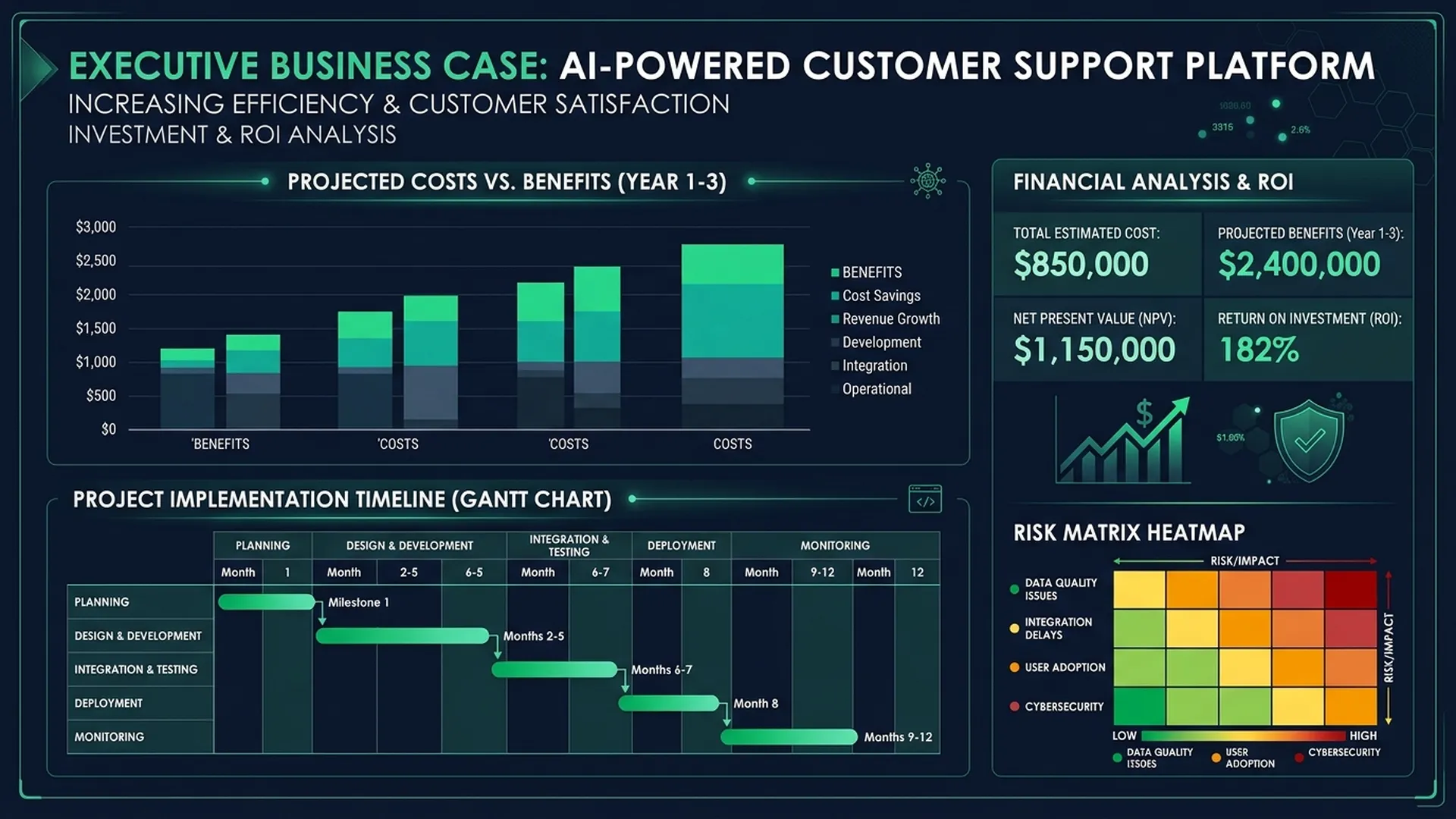
Business Case は、AI project を提案するときに BA が書くべき最重要 document です。Management と stakeholders に対して「この project への投資は正しい判断である」と説得するための文書です。優れた Business Case は、project の approval、funding、priority の適正化につながります。
Business Caseとは何か?
Business Case は、organization が特定の initiative に投資すべき理由を正当化する document で、次を含みます。
- Problem/Opportunity: 解決すべき問題、あるいは捉えるべき機会
- Proposed Solution: 提案 solution(および他の options)
- Expected Benefits: 期待される benefits(tangible / intangible の両方)
- Costs & Timeline: Deliver に必要な cost と timeline
- Risks: 想定される risks と mitigation 方法
- Recommendation: 最終 recommendation
Business Case vs Project Charter vs PRD
| Document | Purpose | Audience | When |
|---|---|---|---|
| Business Case | Justify investment | Executives、Finance | Before approval |
| Project Charter | Authorize project | PMO、Sponsor | After approval |
| PRD | Define product requirements | Dev、Design、QA | After project start |
BA は Business Case を書くことが多く、Project Charter においても重要な役割を担います。PRD は、その後の BA phase における主要 output です。
AI Project向けBusiness Case Template
Section 1: Executive Summary(1ページ)
多くの executives が読むのはこの section だけです。短く、簡潔に、impact を持って書きます。
EXECUTIVE SUMMARY

Problem: [2-3 câu mô tả vấn đề hiện tại và business impact]

Proposed Solution: [1-2 câu mô tả solution]

Expected Benefits:
• [Benefit 1 với con số cụ thể]
• [Benefit 2 với con số cụ thể]
• [Benefit 3 định tính]

Investment Required: [Tổng cost]
Expected ROI: [ROI % hoặc payback period]
Timeline: [Thời gian để achieve key benefits]

Recommendation: APPROVE / DEFER / REJECT
Section 2: Problem Statement
2.1 Current State Analysis
AS-IS を客観的に説明します。
- Current process はどのように行われているか?
- Pain points と bottlenecks は何か?
- どの data / metrics が問題の存在を示しているか?
AI Customer Support project の例:
Customer support team hiện nhận 2,400 tickets/ngày. 65% là repetitive questions (order status, return policy, product info). Average response time là 8 giờ. CSAT score là 3.2/5. Team đang spend 70% thời gian cho repetitive queries thay vì complex issues.
2.2 Current stateのBusiness Impact
Money または metrics で impact を定量化します。
- 現在の problem による cost(labor cost、revenue loss、churn)
- Opportunity cost(解決できれば他に何ができるか)
- 何もしない risk(competitors の前進、market share の低下など)
2.3 Strategic Alignment
この solution が company strategy にどう align するかを説明します。
- どの OKR を support するか?
- どの strategic initiative を前に進めるか?
- どの executive sponsor が endorse しているか?
Section 3: Proposed Solution
3.1 Solution Overview
Solution を high level で説明します。
- AI solution は何か?(chatbot、recommendation engine、automation など)
- どう機能するか?(シンプルな user flow)
- 誰が使うのか?
3.2 Options Analysis
BA は due diligence を示すため、少なくとも 3 つの options を提示すべきです。
| Option A: Do Nothing | Option B: Manual Process Improvement | Option C: AI Solution (Recommended) | |
|---|---|---|---|
| Description | 現状維持 | 人を増やし、SOP を改善 | AI chatbot + automation を導入 |
| Cost | $0 capex | $120K/year (2 FTE) | $80K implementation + $20K/year |
| Benefits | - | response time を 20% 短縮 | response time を 70% 短縮 |
| Risks | CSAT が悪化し続ける | 拡張性に限界 | Implementation risk |
| Recommendation | ❌ | ❌ | ✅ |
3.3 Solution Details(Option C)
- Components: [solution を構成する要素]
- Integrations: [どの systems と統合するか]
- Implementation approach: [Build vs Buy vs Partner]
- Key dependencies: [実装に必要なもの]
Section 4: Benefits Analysis
4.1 Quantitative Benefits
| Benefit | Current State | Future State | Annual Value |
|---|---|---|---|
| Labor cost reduction | 5 FTE support | 3 FTE support | $80K/year |
| Ticket resolution time | 8h average | 2h average | - |
| CSAT improvement | 3.2/5 | 4.5/5 | churn 減少 ~= $50K/year |
| Revenue from upsell | $0 | AI suggests upsell | $30K/year |
| Total Annual Benefit | $160K/year |
4.2 Qualitative Benefits
- Employee satisfaction の向上(support agents が意味のある仕事に時間を使える)
- Customer experience と brand perception の改善
- Headcount を比例的に増やさずに scalability を得られる
- Customer interactions からの data insights
4.3 Benefits Realization Timeline
Month 1-3:  Implementation & Training
Month 4:    Soft launch (20% traffic)
Month 5-6:  Full launch - achieve 50% của projected benefits
Month 7-12: Optimization - achieve 100% của projected benefits
Year 2+:    Full ROI realized
Section 5: Cost Analysis
5.1 Implementation Costs(One-time)
| Item | Cost |
|---|---|
| Software license / API costs | $X |
| Implementation & integration | $X |
| Data preparation & training | $X |
| Testing & QA | $X |
| Training & change management | $X |
| Total Implementation | $X |
5.2 Ongoing Costs(Annual)
| Item | Annual Cost |
|---|---|
| Software subscription | $X |
| Maintenance & support | $X |
| Model retraining | $X |
| Infrastructure | $X |
| Total Annual Ongoing | $X |
5.3 ROI Calculation
Total Investment (Year 1) = Implementation + Annual Ongoing
                          = $80K + $20K = $100K

Annual Benefit = $160K

ROI = (Annual Benefit - Annual Ongoing) / Total Investment × 100
    = ($160K - $20K) / $100K × 100
    = 140%

Payback Period = Total Investment / Net Annual Benefit
               = $100K / $140K = ~8.6 months
Section 6: Risk Assessment
6.1 Risk Register
| Risk | Likelihood | Impact | Mitigation |
|---|---|---|---|
| AI model accuracy below threshold | Medium | High | Extensive testing + human review fallback |
| Low user adoption | Low | High | UX research + change management program |
| Data quality issues | High | Medium | Data audit trước implementation |
| Integration failures | Medium | Medium | Phased rollout + rollback plan |
| Regulatory compliance issue | Low | High | Legal review trước launch |
6.2 Critical Success Factors
- Executive sponsorship と visible support
- Dedicated project team(part-time ではないこと)
- Model を train できる十分な data quality
- Support team 向けの change management
- AI が fail したときの clear escalation path
6.3 Exit Criteria / Kill Switch
Project を止める条件を明確に定義します。
- Production 2か月後も accuracy が X% を下回る場合
- CSAT が上がるどころか下がった場合
- Cost が budget X% を超えた場合
Section 7: Implementation Plan
7.1 High-level Timeline
Phase 1: Discovery & Design (6 weeks)
  - Detailed requirements gathering
  - Solution architecture
  - Vendor selection (nếu Buy)
  - Data audit

Phase 2: Implementation (8 weeks)
  - Development / configuration
  - Data integration
  - Testing (unit, integration, UAT)
  - Staff training

Phase 3: Rollout (4 weeks)
  - Soft launch (10% traffic)
  - Monitor & adjust
  - Full launch
  - Hypercare support

Phase 4: Optimization (ongoing)
  - Performance monitoring
  - Model retraining schedule
  - Continuous improvement
7.2 Resource Requirements
| Role | Commitment | Duration |
|---|---|---|
| BA (あなた) | 100% | Phase 1-3 |
| Tech Lead | 80% | Phase 2-3 |
| Data Engineer | 60% | Phase 1-2 |
| UX Designer | 40% | Phase 1 |
| QA | 100% | Phase 2-3 |
| Project Manager | 50% | All phases |
Section 8: Recommendation
Business Case は、明確な recommendation で締めくくります。
RECOMMENDATION: APPROVE

Tôi recommend approve Option C (AI Solution) vì:

1. ROI 140% với payback period < 9 tháng
2. Align với OKR Q3: "Improve Customer Experience"
3. Scalable solution — benefit tăng khi volume tăng
4. Risk được mitigate bởi phased approach

Requested approvals:
□ Budget approval: $100K (FY2026)
□ Resource allocation: 6-person project team
□ Timeline approval: Q2 2026 kick-off
説得力のあるBusiness Caseを書くコツ
- 数字から入る - Executives は Executive Summary でまず ROI を見ます。
- 可能な限り定量化する - 根拠ある estimate は、数字がないよりはるかに良いです。
- Risks を隠さない - Risks を隠すと credibility が下がります。mitigation と一緒に書きましょう。
- 簡潔に保つ - Business Case は encyclopedia ではありません。10〜15 ページで十分です。
- Audience に合わせる - CEO、CFO、CTO では必要な detail level が違います。
- Visuals を使う - ROI、timeline、risk matrix は純テキストより chart の方が伝わります。
- Stakeholder input を取る - 書く前に key stakeholders に interview し、expectations を align します。
BAがBusiness Case作成に使えるAI tools
- ChatGPT/Claude: 初期構成の draft、risk brainstorming、文章改善
- Excel/Google Sheets: Financial modeling と ROI calculation
- PowerPoint/Canva: C-suite presentation 向けの visual 化
- Miro/FigJam: Stakeholders workshop で inputs を集める
まとめ
優れた Business Case は、project approval を得るだけではありません。何をなぜ deliver するのかについて、BA と stakeholders のあいだの contract にもなります。Project が困難に直面したときや scope creep が起きたとき、team を realign するために戻る document です。
AI projects では、とくに Risk Assessment と Benefits Realization Timeline が重要になることが多いです。AI の value は一度にではなく徐々に現れ、多くの executives はまだこの特性に慣れていないからです。