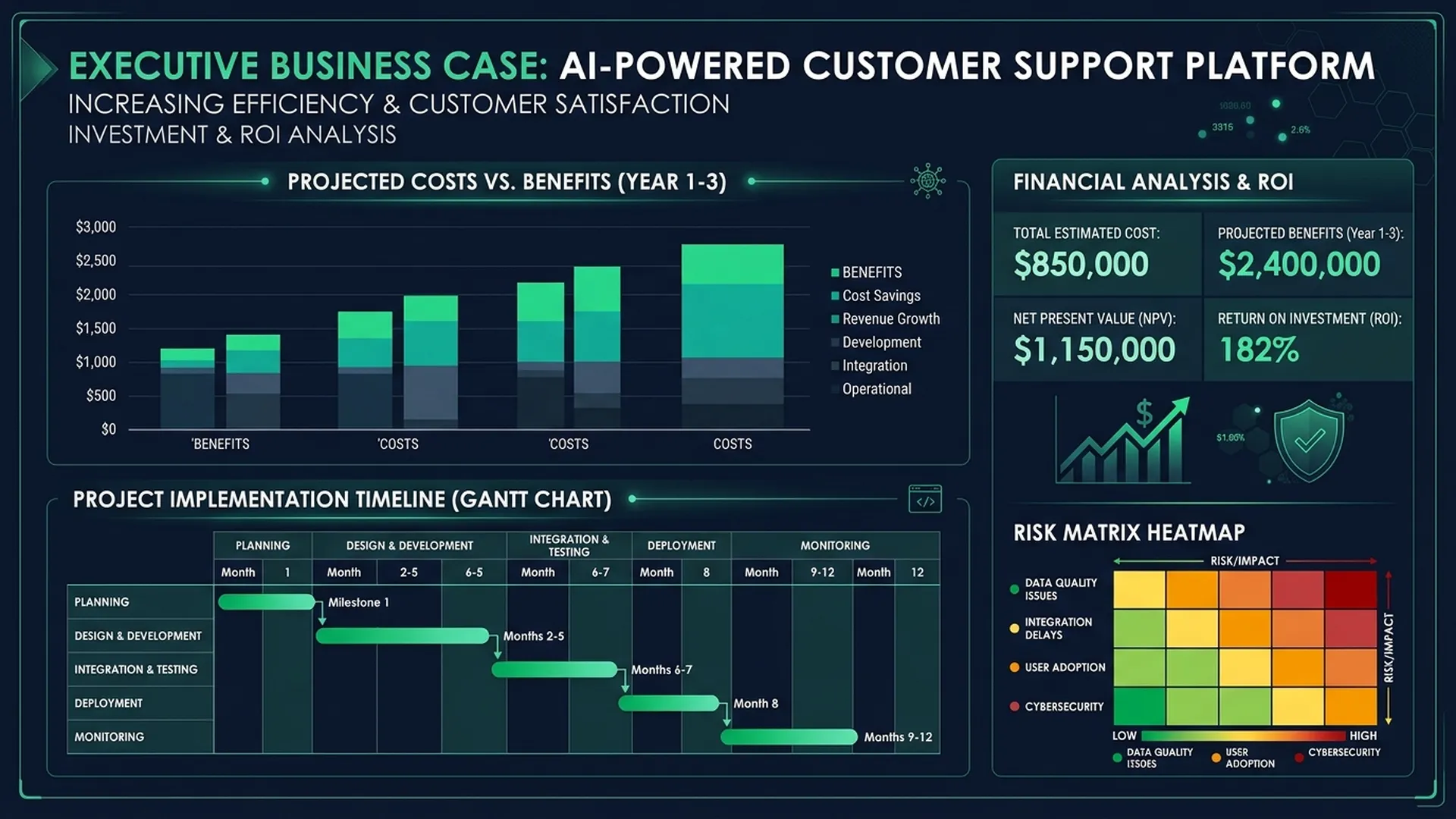
Business Case 是 BA 在提案 AI project 時最重要的 document。它的作用是說服 management 與 stakeholders:「投資這個 project 是正確的決定。」一份好的 Business Case,能幫助 project 獲得 approval、funding,以及正確的 priority。
Business Case 是什麼?
Business Case 是一份用來 justify 為何 organization 應投資某個 initiative 的文件,通常包含:
- Problem/Opportunity:需要解決的問題,或需要把握的機會
- Proposed Solution:建議 solution(以及其他 options)
- Expected Benefits:預期 benefits(包含 tangible 與 intangible)
- Costs & Timeline:交付所需的 cost 與 timeline
- Risks:相關 risks 與 mitigation 方式
- Recommendation:最終 recommendation
Business Case vs Project Charter vs PRD
| Document | Purpose | Audience | When |
|---|---|---|---|
| Business Case | Justify investment | Executives、Finance | Before approval |
| Project Charter | Authorize project | PMO、Sponsor | After approval |
| PRD | Define product requirements | Dev、Design、QA | After project start |
BA 經常負責撰寫 Business Case,也常在 Project Charter 中扮演重要角色。PRD 則是後續 BA phase 的主要 output。
AI Project用的Business Case Template
Section 1: Executive Summary(1 頁)
很多 executives 只會看這一段,所以要寫得簡潔、有重點、能直接產生 impact:
EXECUTIVE SUMMARY

Problem: [2-3 câu mô tả vấn đề hiện tại và business impact]

Proposed Solution: [1-2 câu mô tả solution]

Expected Benefits:
• [Benefit 1 với con số cụ thể]
• [Benefit 2 với con số cụ thể]
• [Benefit 3 định tính]

Investment Required: [Tổng cost]
Expected ROI: [ROI % hoặc payback period]
Timeline: [Thời gian để achieve key benefits]

Recommendation: APPROVE / DEFER / REJECT
Section 2: Problem Statement
2.1 Current State Analysis
以客觀方式描述 AS-IS:
- Current process 現在是如何執行?
- Pain points 與 bottlenecks 是什麼?
- 有哪些 data / metrics 證明問題存在?
AI Customer Support project 範例:
Customer support team hiện nhận 2,400 tickets/ngày. 65% là repetitive questions (order status, return policy, product info). Average response time là 8 giờ. CSAT score là 3.2/5. Team đang spend 70% thời gian cho repetitive queries thay vì complex issues.
2.2 Current state 的 Business Impact
用金額或 metrics 量化 impact:
- 當前問題帶來的 cost(labor cost、revenue loss、churn)
- Opportunity cost(若解決此問題,可以騰出什麼空間)
- 什麼都不做的 risk(competitors 正在前進、market share 流失等)
2.3 Strategic Alignment
說明這個 solution 為何符合 company strategy:
- 支援哪個 OKR?
- 推進哪個 strategic initiative?
- 哪位 executive sponsor 已 endorse?
Section 3: Proposed Solution
3.1 Solution Overview
從 high level 說明 solution:
- AI solution 是什麼?(chatbot、recommendation engine、automation...)
- 它如何運作?(簡單 user flow)
- 誰會使用?
3.2 Options Analysis
BA 應該至少提出 3 個 options,以展現 due diligence:
| Option A: Do Nothing | Option B: Manual Process Improvement | Option C: AI Solution (Recommended) | |
|---|---|---|---|
| Description | 維持現況 | 多聘人力並改善 SOP | 部署 AI chatbot + automation |
| Cost | $0 capex | $120K/year (2 FTE) | $80K implementation + $20K/year |
| Benefits | - | response time 降低 20% | response time 降低 70% |
| Risks | CSAT 持續惡化 | Scalability 有限 | Implementation risk |
| Recommendation | ❌ | ❌ | ✅ |
3.3 Solution Details(Option C)
- Components:[solution 組成項目]
- Integrations:[會與哪些 systems 整合]
- Implementation approach:[Build vs Buy vs Partner]
- Key dependencies:[實作所需前提]
Section 4: Benefits Analysis
4.1 Quantitative Benefits
| Benefit | Current State | Future State | Annual Value |
|---|---|---|---|
| Labor cost reduction | 5 FTE support | 3 FTE support | $80K/year |
| Ticket resolution time | 8h average | 2h average | - |
| CSAT improvement | 3.2/5 | 4.5/5 | churn 減少 ~= $50K/year |
| Revenue from upsell | $0 | AI suggests upsell | $30K/year |
| Total Annual Benefit | $160K/year |
4.2 Qualitative Benefits
- 提升 employee satisfaction(support agents 可以把時間花在更有價值的工作上)
- 改善 customer experience 與 brand perception
- 不需按比例增加 headcount 也能擴展規模
- 從 customer interactions 中獲得 data insights
4.3 Benefits Realization Timeline
Month 1-3:  Implementation & Training
Month 4:    Soft launch (20% traffic)
Month 5-6:  Full launch - achieve 50% của projected benefits
Month 7-12: Optimization - achieve 100% của projected benefits
Year 2+:    Full ROI realized
Section 5: Cost Analysis
5.1 Implementation Costs(One-time)
| Item | Cost |
|---|---|
| Software license / API costs | $X |
| Implementation & integration | $X |
| Data preparation & training | $X |
| Testing & QA | $X |
| Training & change management | $X |
| Total Implementation | $X |
5.2 Ongoing Costs(Annual)
| Item | Annual Cost |
|---|---|
| Software subscription | $X |
| Maintenance & support | $X |
| Model retraining | $X |
| Infrastructure | $X |
| Total Annual Ongoing | $X |
5.3 ROI Calculation
Total Investment (Year 1) = Implementation + Annual Ongoing
                          = $80K + $20K = $100K

Annual Benefit = $160K

ROI = (Annual Benefit - Annual Ongoing) / Total Investment × 100
    = ($160K - $20K) / $100K × 100
    = 140%

Payback Period = Total Investment / Net Annual Benefit
               = $100K / $140K = ~8.6 months
Section 6: Risk Assessment
6.1 Risk Register
| Risk | Likelihood | Impact | Mitigation |
|---|---|---|---|
| AI model accuracy below threshold | Medium | High | Extensive testing + human review fallback |
| Low user adoption | Low | High | UX research + change management program |
| Data quality issues | High | Medium | Data audit trước implementation |
| Integration failures | Medium | Medium | Phased rollout + rollback plan |
| Regulatory compliance issue | Low | High | Legal review trước launch |
6.2 Critical Success Factors
- Executive sponsorship 與 visible support
- Dedicated project team(不是 part-time)
- 足夠支撐 model training 的 data quality
- 給 support team 的 change management
- AI fail 時的 clear escalation path
6.3 Exit Criteria / Kill Switch
清楚定義什麼情況下要停止 project:
- 若 production 2 個月後 accuracy 仍低於 X%
- 若 CSAT 不升反降
- 若 cost 超出 budget X%
Section 7: Implementation Plan
7.1 High-level Timeline
Phase 1: Discovery & Design (6 weeks)
  - Detailed requirements gathering
  - Solution architecture
  - Vendor selection (nếu Buy)
  - Data audit

Phase 2: Implementation (8 weeks)
  - Development / configuration
  - Data integration
  - Testing (unit, integration, UAT)
  - Staff training

Phase 3: Rollout (4 weeks)
  - Soft launch (10% traffic)
  - Monitor & adjust
  - Full launch
  - Hypercare support

Phase 4: Optimization (ongoing)
  - Performance monitoring
  - Model retraining schedule
  - Continuous improvement
7.2 Resource Requirements
| Role | Commitment | Duration |
|---|---|---|
| BA(你) | 100% | Phase 1-3 |
| Tech Lead | 80% | Phase 2-3 |
| Data Engineer | 60% | Phase 1-2 |
| UX Designer | 40% | Phase 1 |
| QA | 100% | Phase 2-3 |
| Project Manager | 50% | All phases |
Section 8: Recommendation
Business Case 最後要以清楚的 recommendation 收尾:
RECOMMENDATION: APPROVE

Tôi recommend approve Option C (AI Solution) vì:

1. ROI 140% với payback period < 9 tháng
2. Align với OKR Q3: "Improve Customer Experience"
3. Scalable solution — benefit tăng khi volume tăng
4. Risk được mitigate bởi phased approach

Requested approvals:
□ Budget approval: $100K (FY2026)
□ Resource allocation: 6-person project team
□ Timeline approval: Q2 2026 kick-off
寫出有說服力Business Case的技巧
- 先講數字 - Executives 會先在 Executive Summary 看 ROI。
- 能量化就量化 - 有根據的 estimate,永遠比沒有數字更好。
- 承認 risks - 隱藏 risks 會降低 credibility,不如搭配 mitigation 一起寫出來。
- 保持精簡 - Business Case 不是 encyclopedia,10-15 頁已經足夠。
- 依 audience 調整 - CEO、CFO、CTO 需要的 detail level 不同。
- 使用 visuals - ROI、timeline、risk matrix 用圖表通常比純文字更有效。
- 先取得 stakeholder input - 在撰寫前先 interview key stakeholders,先把 expectations 對齊。
可協助BA撰寫Business Case的AI tools
- ChatGPT/Claude:起草初版結構、brainstorm risks、優化語句
- Excel/Google Sheets:financial modeling 與 ROI calculation
- PowerPoint/Canva:為 C-suite presentation 做 visual 化
- Miro/FigJam:與 stakeholders workshop 收集 inputs
結論
好的 Business Case 不只幫助 project 獲得 approval,它同時也是 BA 與 stakeholders 之間關於「要交付什麼、為什麼要交付」的 contract。當 project 遇到困難或 scope creep 發生時,Business Case 就是讓 team 重新對齊的依據。
對 AI projects 來說,通常最重要的部分是 Risk Assessment 與 Benefits Realization Timeline,因為 AI 的 value 往往是逐步釋放,而不是立刻全部呈現,很多 executives 也還不完全熟悉這個特性。