1. Agent 抽象層 — LLM + 記憶 + 工具 + 規劃
1.1. 什麼是 Agent?
第 8 課介紹了簡單的 ReAct agent — 一個選擇工具然後回答的 LLM。第 9 課擴展到 Agentic AI:LLM 作為中央大腦的系統 — 自主規劃、選擇工具、回應結果,並與其他代理協調。
一個 Agent 由 4 個核心元件組成:
- LLM(大腦) — 推理、決策、文字生成
- 記憶 — 短期(對話緩衝區)與長期(向量儲存、資料庫)
- 工具 — 代理可呼叫的函式:搜尋、計算器、API、程式碼執行
- 規劃 — 建立計畫、分解任務、發生錯誤時反思
Agent Abstraction — Core Components
══════════════════════════════════════════════════════════════

                    ┌──────────────────────┐
                    │       USER           │
                    │   (Task / Query)     │
                    └──────────┬───────────┘
                               │
                               ▼
  ┌────────────────────────────────────────────────────────┐
  │                      AGENT                             │
  │  ┌──────────┐  ┌───────────┐  ┌──────────────────┐    │
  │  │ Planning │  │  LLM Core │  │     Memory       │    │
  │  │          │◄─┤  (Brain)  ├─►│ Short-term: chat │    │
  │  │ Decompose│  │ Reasoning │  │ Long-term: VDB   │    │
  │  │ Reflect  │  │ Decisions │  │ Episodic: logs   │    │
  │  └──────────┘  └─────┬─────┘  └──────────────────┘    │
  │                       │                                │
  │              ┌────────┼────────┐                       │
  │              ▼        ▼        ▼                       │
  │         ┌────────┐┌───────┐┌────────┐                  │
  │         │Search  ││ Code  ││  API   │  ◄── Tools      │
  │         │Engine  ││ Exec  ││ Calls  │                  │
  │         └────────┘└───────┘└────────┘                  │
  └────────────────────────────────────────────────────────┘
1.2. 感知 → 推理 → 行動 → 觀察迴圈
每個代理都在一個基本迴圈上運行:
- 感知 — 接收輸入(使用者查詢、工具輸出、環境回饋)
- 推理 — LLM 推理:「接下來該做什麼?用哪個工具?資訊夠了嗎?」
- 行動 — 執行動作:呼叫工具、生成文字、回答使用者
- 觀察 — 接收行動的結果,回饋至感知 → 重複
Agent Loop — Perception → Reasoning → Action → Observation
═══════════════════════════════════════════════════════════

  ┌──────────────┐     ┌───────────────┐     ┌──────────────┐
  │  PERCEPTION  │────►│   REASONING   │────►│    ACTION     │
  │              │     │               │     │               │
  │ User query   │     │ "Which tool?" │     │ Call tool     │
  │ Tool output  │     │ "Enough info?"│     │ Generate text │
  │ Error msg    │     │ "Need retry?" │     │ Return answer │
  └──────┬───────┘     └───────────────┘     └───────┬───────┘
         ▲                                           │
         │           ┌───────────────┐               │
         └───────────│  OBSERVATION  │◄──────────────┘
                     │               │
                     │ Tool result   │
                     │ Error / OK    │
                     └───────────────┘
         Loop continues until Final Answer
1.3. 代理能力等級
並非每個 LLM 應用都需要完整的代理。NVIDIA DLI 區分了不同的代理能力等級:
| 等級 | 模式 | LLM 角色 | 範例 |
|---|---|---|---|
| L0 — 無代理能力 | 簡單提示 → 回應 | 文字生成器 | FAQ 聊天機器人 |
| L1 — 工具使用 | LLM 選擇 1 個工具 | 路由器 | Function calling API |
| L2 — 單一代理 | ReAct 迴圈、多步驟 | 規劃者 + 執行者 | RAG Agent(第 8 課) |
| L3 — 多代理 | 多個代理協調 | 協調者 | 監督者 + 工作者 |
| L4 — 自主式 | 自我改進、長時間運行 | 自主系統 | AI Scientist、Devin |
考試提示:「LLM 自主分解任務、呼叫多個工具、根據需要重試」→ Agent(L2+)。「多個 LLM 協調,每個專精一項任務」→ Multi-Agent(L3)。DLI 考試常問:「Agent 與 Chain 有何不同?」→ Agent 具有動態控制流(LLM 決定下一步),Chain 具有固定控制流。
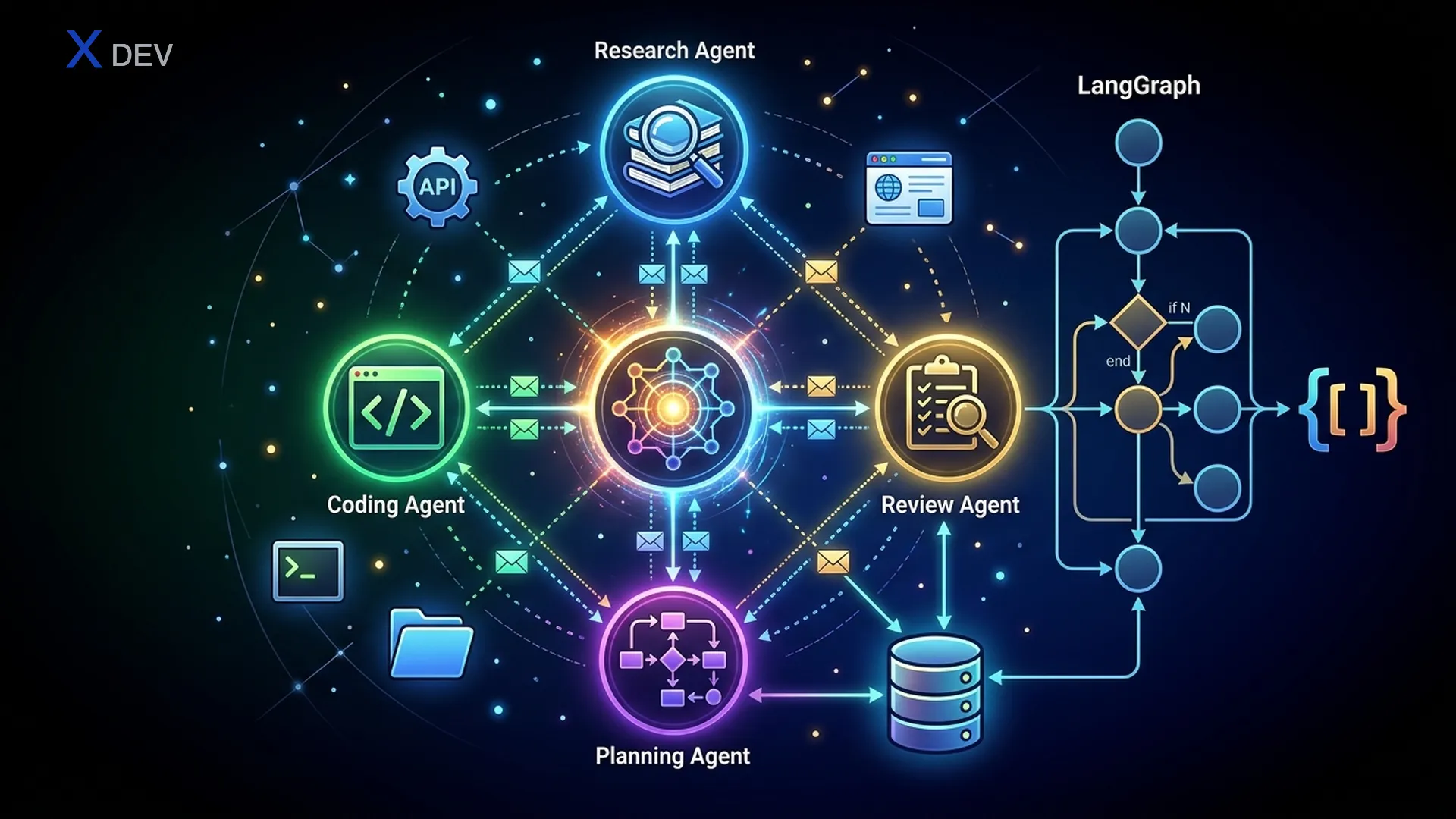
2. LLM Agent 的認知架構
2.1. ReAct — 推理 + 行動
ReAct(第 8 課介紹)交替進行思考(推理)與行動(執行)。優點:簡單、透明。缺點:沒有長期規劃 — 代理只思考下一步,而非全局。
2.2. Plan-and-Execute
Plan-and-Execute 明確分離兩個階段:(1) Planner LLM 預先建立完整計畫,(2) Executor LLM 執行每個步驟。每個步驟之後,Planner 可以重新規劃(調整計畫)。
Plan-and-Execute Architecture
══════════════════════════════════════════════════════════

  User: "Analyze Q3 revenue, compare with Q2, write a report"
       │
       ▼
  ┌─────────────────────────────────────────────┐
  │  PLANNER LLM                                │
  │  Plan:                                      │
  │    Step 1: Retrieve Q3 revenue data         │
  │    Step 2: Retrieve Q2 revenue data         │
  │    Step 3: Calculate Q2→Q3 change           │
  │    Step 4: Write comparison report          │
  └─────────────────────┬───────────────────────┘
                        │
          ┌─────────────┼─────────────┐
          ▼             ▼             ▼
     Execute S1    Execute S2    Execute S3 ...
     (retriever)   (retriever)   (calculator)
          │             │             │
          └─────────────┼─────────────┘
                        │
                        ▼
                ┌───────────────┐
                │ REPLAN?       │──► If step fails → adjust plan
                │ All done?     │──► If done → Step 4: report
                └───────────────┘
2.3. LATS — Language Agent Tree Search
LATS 結合了蒙特卡羅樹搜尋(MCTS)與 LLM 推理。不同於 ReAct 只走一條路徑,LATS 探索多個解決方案分支,使用 LLM 評估每個分支,然後選擇最佳路徑。就像 LLM 下棋一樣 — 提前思考好幾步。
2.4. Reflexion — 從錯誤中學習
Reflexion 增加了自我反思步驟:完成任務後,代理自我評估結果 → 如果錯誤,將「經驗教訓」寫入記憶 → 帶著前次嘗試的經驗重試。這是一種透過自我回饋的上下文學習形式。
2.5. 認知架構比較
| 架構 | 規劃 | 執行 | 優勢 | 劣勢 |
|---|---|---|---|---|
| ReAct | 逐步(近視的) | 交替思考+行動 | 簡單、透明 | 無全局規劃,可能迴圈 |
| Plan-and-Execute | 預先完整規劃 | 循序執行 | 全局視角,LLM 呼叫較少 | 執行步驟後計畫可能過時 |
| LATS | 樹搜尋(探索) | 最佳優先搜尋 | 探索替代方案,穩健 | 非常昂貴(大量 LLM 呼叫) |
| Reflexion | 試錯 + 記憶 | 執行 → 反思 → 重試 | 從錯誤中學習 | 收斂速度慢,需要評估器 |
考試提示:「代理需要在執行前先想好完整計畫」→ Plan-and-Execute。「代理嘗試多條解決路徑,選擇最佳」→ LATS。「代理自我評估結果並改進」→ Reflexion。「代理交替思考與行動」→ ReAct。DLI 考試通常聚焦於 ReAct 和 Plan-and-Execute 作為兩種最廣泛使用的架構。
3. LangGraph — 有狀態的圖形化代理編排
3.1. 為什麼選擇 LangGraph?
LangChain 中的 AgentExecutor(第 8 課)是「黑盒子」— 難以自訂控制流。LangGraph 是一個 LangChain 函式庫,讓你將代理建構為有向圖:每個節點是一個處理步驟,邊定義流程,條件邊允許根據狀態進行分支。
| 特性 | AgentExecutor | LangGraph |
|---|---|---|
| 控制流 | 固定 ReAct 迴圈 | 自訂圖形 — 你設計流程 |
| 狀態管理 | 隱藏的內部狀態 | 明確的 TypedDict 狀態 |
| 多代理 | 無原生支援 | 一等支援:每個代理 = 子圖 |
| Human-in-the-loop | 有限 | 內建:中斷、批准、編輯 |
| 持久化 | 無內建 | Checkpointer:儲存/恢復狀態 |
| 串流 | 基本 | 逐事件串流 |
| 除錯 | 透過 LangSmith 追蹤 | 圖形視覺化 + LangSmith |
3.2. 核心概念 — StateGraph、節點、邊
LangGraph 建立在 3 個概念之上:
- State — 一個 TypedDict,保存所有在節點間傳遞的資料。每個節點讀取/寫入狀態。
- Nodes — Python 函式。輸入:state → 輸出:部分狀態更新(僅需要更新的欄位)。
- Edges — 節點間的連接。
add_edge(A, B)= 永遠走 A→B。add_conditional_edges(A, func)= func 決定走向。
LangGraph Concepts
══════════════════════════════════════════════════════════

  State = TypedDict(messages, plan, results, ...)
  ────────────────────────────────────────────────

  START ──► [Node: agent]  ──conditional──► [Node: tools]
                 │                              │
                 │  (if done)                   │ (tool result)
                 ▼                              │
               END ◄───────────────────────────┘

  Nodes: Python functions that read/write State
  Edges: Static (always) or Conditional (function decides)
3.3. 程式碼:基本 LangGraph Agent
from typing import TypedDict, Annotated, Sequence
from langchain_core.messages import BaseMessage, HumanMessage, AIMessage
from langchain_nvidia_ai_endpoints import ChatNVIDIA
from langchain_core.tools import tool
from langgraph.graph import StateGraph, END
from langgraph.prebuilt import ToolNode
import operator

# === 1. Define State ===
class AgentState(TypedDict):
    messages: Annotated[Sequence[BaseMessage], operator.add]

# === 2. Define Tools ===
@tool
def search_docs(query: str) -> str:
    """Search internal documents for company information."""
    # Simulate retrieval
    docs = {
        "leave": "Employees get 12 days annual leave per year.",
        "refund": "Refund within 30 days with original receipt.",
    }
    for key, val in docs.items():
        if key in query.lower():
            return val
    return "No relevant documents found."

@tool
def calculator(expression: str) -> str:
    """Calculate mathematical expressions."""
    try:
        return str(eval(expression))  # production: use safe eval
    except Exception as e:
        return f"Error: {e}"

tools = [search_docs, calculator]

# === 3. Define LLM with tools ===
llm = ChatNVIDIA(
    model="meta/llama-3.1-70b-instruct",
    temperature=0.1
).bind_tools(tools)

# === 4. Define Nodes ===
def agent_node(state: AgentState) -> dict:
    """LLM decides: call tool or respond."""
    response = llm.invoke(state["messages"])
    return {"messages": [response]}

tool_node = ToolNode(tools)

# === 5. Define Routing ===
def should_continue(state: AgentState) -> str:
    last_message = state["messages"][-1]
    if last_message.tool_calls:
        return "tools"    # LLM wants to call a tool
    return "end"          # LLM is done, return answer

# === 6. Build Graph ===
graph = StateGraph(AgentState)

graph.add_node("agent", agent_node)
graph.add_node("tools", tool_node)

graph.set_entry_point("agent")
graph.add_conditional_edges("agent", should_continue, {
    "tools": "tools",
    "end": END,
})
graph.add_edge("tools", "agent")  # after tool → back to agent

app = graph.compile()

# === 7. Run ===
result = app.invoke({
    "messages": [HumanMessage(content="What is the leave policy?")]
})
print(result["messages"][-1].content)
3.4. Human-in-the-Loop
LangGraph 支援在執行危險操作前中斷 — 例如發送電子郵件、刪除資料、執行程式碼。代理暫停,等待使用者批准,然後繼續。
from langgraph.checkpoint.memory import MemorySaver

# Compile with checkpointer for interruption + resume
checkpointer = MemorySaver()
app = graph.compile(
    checkpointer=checkpointer,
    interrupt_before=["tools"]   # pause BEFORE executing tools
)

# Run — will pause before the "tools" node
config = {"configurable": {"thread_id": "user-123"}}
result = app.invoke(
    {"messages": [HumanMessage(content="Delete file report.pdf")]},
    config=config,
)

# Inspect pending tool call
pending = result["messages"][-1].tool_calls
print(f"Agent wants to: {pending}")
# → Agent wants to: [{'name': 'delete_file', 'args': {'path': 'report.pdf'}}]

# Human approves → continue
final = app.invoke(None, config=config)  # resume from checkpoint
3.5. Checkpointing — 儲存與恢復狀態
Checkpointer 在每個節點後儲存狀態,提供以下功能:
- 恢復 — 代理執行中途崩潰 → 載入檢查點 → 繼續
- 時間旅行 — 回到任何檢查點 → 以不同輸入重試
- Human-in-the-loop — 暫停、等待使用者、恢復(如上所示)
- 多輪對話 — 跨多輪維護對話歷史
考試提示:「建構具有自訂控制流、條件分支的代理」→ LangGraph(而非 AgentExecutor)。「暫停代理執行以等待人工批准」→ interrupt_before + checkpointer。「儲存代理狀態,稍後恢復」→ LangGraph checkpointing。DLI C-FX-25 常問:「為什麼用 LangGraph 而不是 AgentExecutor?」→ 自訂流程、多代理、持久化、Human-in-the-loop。
4. 多代理模式
4.1. 為什麼需要多代理?
單一代理配備 20+ 工具會面臨問題:工具選擇混淆(工具太多,LLM 選錯),提示過長(必須包含所有指令),難以除錯(不清楚代理在哪裡失敗)。多代理透過分解來解決:每個代理專精一項任務,配備較少的工具。
4.2. 監督者模式
一個監督者代理(LLM)從使用者接收任務,委派給工作者代理,收集結果,並綜合最終答案。
Supervisor Pattern
══════════════════════════════════════════════════════════

                    ┌──────────────┐
                    │     USER     │
                    └──────┬───────┘
                           │
                           ▼
              ┌────────────────────────┐
              │   SUPERVISOR AGENT     │
              │   (Orchestrator LLM)   │
              │                        │
              │   Decides:             │
              │   • Which worker next? │
              │   • All done?          │
              │   • Need to re-route?  │
              └────┬──────┬──────┬─────┘
                   │      │      │
          ┌────────┘      │      └────────┐
          ▼               ▼               ▼
   ┌─────────────┐┌─────────────┐┌─────────────┐
   │ Researcher  ││   Coder     ││  Reporter   │
   │ Agent       ││   Agent     ││  Agent      │
   │             ││             ││             │
   │ Tools:      ││ Tools:      ││ Tools:      │
   │ • web_search││ • python    ││ • write_doc │
   │ • doc_search││ • shell     ││ • format    │
   └─────────────┘└─────────────┘└─────────────┘
4.3. 階層式模式
階層式擴展了監督者模式:每個工作者本身可以是子工作者的監督者。適合複雜的組織結構 — 例如 CEO 代理 → 經理代理 → 專家代理。
Hierarchical Multi-Agent
══════════════════════════════════════════════════════════

              ┌──────────────────────┐
              │   TOP SUPERVISOR     │
              │   (Project Manager)  │
              └───┬─────────────┬────┘
                  │             │
         ┌────────┘             └────────┐
         ▼                               ▼
  ┌──────────────┐                ┌──────────────┐
  │ RESEARCH     │                │ ENGINEERING  │
  │ SUPERVISOR   │                │ SUPERVISOR   │
  └──┬───────┬───┘                └──┬───────┬───┘
     │       │                       │       │
     ▼       ▼                       ▼       ▼
  [Web    [Paper                 [Backend [Frontend
  Searcher] Analyzer]             Dev]     Dev]
4.4. 群集模式
Swarm(OpenAI Swarm 概念)— 無監督者。代理根據上下文互相移交。Agent A 意識到「這個任務屬於 Agent B 的專長」→ 自動移交。
4.5. 辯論模式
Debate — 兩個或多個代理就一個問題進行辯論。每個代理提出觀點並反駁對方。最後由 Judge 代理選擇最佳結論。此模式提升了複雜問題的推理品質。
4.6. 多代理模式比較
| 模式 | 控制流 | 通訊方式 | 最適用場景 |
|---|---|---|---|
| 監督者 | 集中式 — 監督者路由 | 星形拓撲 | 明確的任務委派,中等複雜度 |
| 階層式 | 多層級監督 | 樹狀結構 | 複雜組織,多個專業化子團隊 |
| 群集 | 去中心化 — 代理互相移交 | 對等網路 | 客戶服務、路由、彈性流程 |
| 辯論 | 輪流論證 | 廣播 + 裁判 | 複雜推理、事實驗證 |
考試提示:「一個 LLM 將任務路由給專業化代理」→ 監督者。「代理在無中央控制的情況下互相移交」→ Swarm。「多個代理辯論,裁判做決定」→ 辯論。「巢狀監督者管理子團隊」→ 階層式。DLI 考試通常聚焦於監督者模式,因為它在生產環境中最常見。
4.7. 程式碼:使用 LangGraph 的監督者多代理系統
from typing import TypedDict, Annotated, Literal, Sequence
from langchain_core.messages import BaseMessage, HumanMessage, SystemMessage
from langchain_nvidia_ai_endpoints import ChatNVIDIA
from langchain_core.tools import tool
from langgraph.graph import StateGraph, END
from langgraph.prebuilt import ToolNode
import operator

# === State ===
class MultiAgentState(TypedDict):
    messages: Annotated[Sequence[BaseMessage], operator.add]
    next_agent: str

# === Worker Tools ===
@tool
def web_search(query: str) -> str:
    """Search the web for current information."""
    return f"[Web Result] Top findings for '{query}': ..."

@tool
def run_python(code: str) -> str:
    """Execute Python code and return output."""
    try:
        exec_globals = {}
        exec(code, exec_globals)
        return str(exec_globals.get("result", "Code executed successfully."))
    except Exception as e:
        return f"Error: {e}"

@tool
def write_report(content: str) -> str:
    """Format content into a professional report."""
    return f"=== REPORT ===\n{content}\n=== END ==="

# === Worker Agents ===
researcher_llm = ChatNVIDIA(
    model="meta/llama-3.1-70b-instruct", temperature=0.1
).bind_tools([web_search])

coder_llm = ChatNVIDIA(
    model="meta/llama-3.1-70b-instruct", temperature=0.0
).bind_tools([run_python])

reporter_llm = ChatNVIDIA(
    model="meta/llama-3.1-70b-instruct", temperature=0.3
).bind_tools([write_report])

# === Supervisor ===
supervisor_llm = ChatNVIDIA(
    model="meta/llama-3.1-70b-instruct", temperature=0.0
)

WORKERS = ["researcher", "coder", "reporter"]

def supervisor_node(state: MultiAgentState) -> dict:
    """Supervisor decides which worker to route to next."""
    system_prompt = f"""You are a supervisor managing these workers: {WORKERS}.
Given the conversation, decide which worker should act next,
or if the task is complete respond with FINISH.
Respond with ONLY the worker name or FINISH."""

    messages = [SystemMessage(content=system_prompt)] + state["messages"]
    response = supervisor_llm.invoke(messages)
    next_agent = response.content.strip().lower()

    if next_agent not in WORKERS:
        next_agent = "FINISH"
    return {"next_agent": next_agent}

def researcher_node(state: MultiAgentState) -> dict:
    system = SystemMessage(content="You are a research specialist. "
        "Use web_search to find information. Be thorough.")
    response = researcher_llm.invoke([system] + state["messages"])
    return {"messages": [response]}

def coder_node(state: MultiAgentState) -> dict:
    system = SystemMessage(content="You are a Python coding specialist. "
        "Use run_python to execute code for analysis and calculations.")
    response = coder_llm.invoke([system] + state["messages"])
    return {"messages": [response]}

def reporter_node(state: MultiAgentState) -> dict:
    system = SystemMessage(content="You are a report writer. "
        "Use write_report to create formatted reports from gathered info.")
    response = reporter_llm.invoke([system] + state["messages"])
    return {"messages": [response]}

# === Routing ===
def route_supervisor(state: MultiAgentState) -> str:
    next_agent = state.get("next_agent", "FINISH")
    if next_agent == "FINISH":
        return "end"
    return next_agent

# === Build Graph ===
graph = StateGraph(MultiAgentState)

graph.add_node("supervisor", supervisor_node)
graph.add_node("researcher", researcher_node)
graph.add_node("coder", coder_node)
graph.add_node("reporter", reporter_node)
graph.add_node("researcher_tools", ToolNode([web_search]))
graph.add_node("coder_tools", ToolNode([run_python]))
graph.add_node("reporter_tools", ToolNode([write_report]))

graph.set_entry_point("supervisor")

# Supervisor routes to workers
graph.add_conditional_edges("supervisor", route_supervisor, {
    "researcher": "researcher",
    "coder": "coder",
    "reporter": "reporter",
    "end": END,
})

# Workers → tool nodes → back to supervisor
for worker in WORKERS:
    def make_router(w):
        def router(state):
            last = state["messages"][-1]
            if hasattr(last, "tool_calls") and last.tool_calls:
                return f"{w}_tools"
            return "supervisor"
        return router
    graph.add_conditional_edges(worker, make_router(worker), {
        f"{worker}_tools": f"{worker}_tools",
        "supervisor": "supervisor",
    })
    graph.add_edge(f"{worker}_tools", worker)

app = graph.compile()

# === Run ===
result = app.invoke({
    "messages": [HumanMessage(
        content="Research NVIDIA H100 GPU specs, calculate price-performance "
                "ratio vs A100, and write a comparison report."
    )],
    "next_agent": "",
})

for msg in result["messages"]:
    print(f"[{msg.type}] {msg.content[:200]}...")
5. 建構生產環境的多代理應用程式
5.1. 研究助手 — 完整範例
建構一個完整的研究助手,包含 3 個代理:研究者(尋找資訊)、程式設計師(分析資料)、報告撰寫者(撰寫報告)。包含錯誤處理、重試邏輯和結構化輸出。
from typing import TypedDict, Annotated, Sequence, Optional
from langchain_core.messages import BaseMessage, HumanMessage, SystemMessage, AIMessage
from langchain_nvidia_ai_endpoints import ChatNVIDIA
from langchain_core.tools import tool
from langgraph.graph import StateGraph, END
from langgraph.checkpoint.memory import MemorySaver
import operator
import json

# === Enhanced State ===
class ResearchState(TypedDict):
    messages: Annotated[Sequence[BaseMessage], operator.add]
    research_data: Optional[str]       # collected research
    analysis_result: Optional[str]     # code analysis output
    final_report: Optional[str]        # formatted report
    current_agent: str
    iteration: int                     # track iterations to prevent loops

MAX_ITERATIONS = 10

# === Tools ===
@tool
def search_arxiv(query: str) -> str:
    """Search academic papers on arxiv for research topics."""
    return json.dumps({
        "papers": [
            {"title": f"Paper on {query}", "abstract": f"Study of {query}...",
             "year": 2025, "citations": 42},
        ]
    })

@tool
def search_web(query: str) -> str:
    """Search the web for current news, blog posts, documentation."""
    return json.dumps({
        "results": [
            {"title": f"Latest news: {query}", "snippet": f"Updated info on {query}..."},
        ]
    })

@tool
def execute_analysis(code: str) -> str:
    """Run Python code for data analysis. Variable 'result' will be returned."""
    exec_globals = {}
    try:
        exec(code, exec_globals)
        return str(exec_globals.get("result", "Executed OK, no 'result' variable."))
    except Exception as e:
        return f"Error: {e}"

@tool
def generate_report(title: str, sections: str) -> str:
    """Generate a formatted markdown report from title and section content."""
    return f"# {title}\n\n{sections}\n\n---\nGenerated by Research Assistant"

# === Agent Nodes ===
base_llm = ChatNVIDIA(model="meta/llama-3.1-70b-instruct")

def researcher_node(state: ResearchState) -> dict:
    llm = base_llm.bind_tools([search_arxiv, search_web])
    system = SystemMessage(content=(
        "You are a research specialist. Search for papers and web results "
        "to gather comprehensive information. Summarize findings clearly."
    ))
    response = llm.invoke([system] + list(state["messages"]))

    # If no tool calls, research is done — extract data
    if not response.tool_calls:
        return {
            "messages": [response],
            "research_data": response.content,
            "current_agent": "supervisor",
        }
    return {"messages": [response], "current_agent": "researcher_tools"}

def coder_node(state: ResearchState) -> dict:
    llm = base_llm.bind_tools([execute_analysis])
    context = state.get("research_data", "No research data yet.")
    system = SystemMessage(content=(
        f"You are a data analyst. Use the research data below to perform "
        f"analysis with Python code.\n\nResearch Data:\n{context}"
    ))
    response = llm.invoke([system] + list(state["messages"]))

    if not response.tool_calls:
        return {
            "messages": [response],
            "analysis_result": response.content,
            "current_agent": "supervisor",
        }
    return {"messages": [response], "current_agent": "coder_tools"}

def reporter_node(state: ResearchState) -> dict:
    llm = base_llm.bind_tools([generate_report])
    research = state.get("research_data", "N/A")
    analysis = state.get("analysis_result", "N/A")
    system = SystemMessage(content=(
        f"You are a report writer. Create a professional report.\n"
        f"Research:\n{research}\n\nAnalysis:\n{analysis}"
    ))
    response = llm.invoke([system] + list(state["messages"]))

    if not response.tool_calls:
        return {
            "messages": [response],
            "final_report": response.content,
            "current_agent": "supervisor",
        }
    return {"messages": [response], "current_agent": "reporter_tools"}

def supervisor_node(state: ResearchState) -> dict:
    iteration = state.get("iteration", 0) + 1
    if iteration > MAX_ITERATIONS:
        return {
            "messages": [AIMessage(content="Max iterations reached. Returning results.")],
            "current_agent": "FINISH",
            "iteration": iteration,
        }

    system = SystemMessage(content="""You are a project supervisor. Based on the current state:
- If no research data → route to "researcher"
- If research done but no analysis → route to "coder"
- If analysis done but no report → route to "reporter"
- If report is ready → respond "FINISH"
Respond with ONLY one of: researcher, coder, reporter, FINISH""")

    response = base_llm.invoke([system] + list(state["messages"]))
    next_agent = response.content.strip().lower()

    valid = ["researcher", "coder", "reporter", "finish"]
    if next_agent not in valid:
        next_agent = "researcher"  # default fallback

    return {"current_agent": next_agent, "iteration": iteration}

# === Routing ===
def route_from_supervisor(state: ResearchState) -> str:
    agent = state.get("current_agent", "FINISH")
    if agent in ["researcher", "coder", "reporter"]:
        return agent
    return "end"

def route_from_worker(worker_name: str):
    def router(state: ResearchState) -> str:
        current = state.get("current_agent", "supervisor")
        if current == f"{worker_name}_tools":
            return f"{worker_name}_tools"
        return "supervisor"
    return router

# === Build Graph ===
from langgraph.prebuilt import ToolNode

graph = StateGraph(ResearchState)

graph.add_node("supervisor", supervisor_node)
graph.add_node("researcher", researcher_node)
graph.add_node("coder", coder_node)
graph.add_node("reporter", reporter_node)
graph.add_node("researcher_tools", ToolNode([search_arxiv, search_web]))
graph.add_node("coder_tools", ToolNode([execute_analysis]))
graph.add_node("reporter_tools", ToolNode([generate_report]))

graph.set_entry_point("supervisor")

graph.add_conditional_edges("supervisor", route_from_supervisor, {
    "researcher": "researcher",
    "coder": "coder",
    "reporter": "reporter",
    "end": END,
})

for worker in ["researcher", "coder", "reporter"]:
    graph.add_conditional_edges(worker, route_from_worker(worker), {
        f"{worker}_tools": f"{worker}_tools",
        "supervisor": "supervisor",
    })
    graph.add_edge(f"{worker}_tools", worker)

# Compile with checkpointing
checkpointer = MemorySaver()
app = graph.compile(checkpointer=checkpointer)

# === Execute ===
config = {"configurable": {"thread_id": "research-001"}}
result = app.invoke(
    {
        "messages": [HumanMessage(
            content="Research the latest advances in mixture-of-experts (MoE) "
                    "models, analyze their parameter efficiency compared to "
                    "dense models, and write a summary report."
        )],
        "current_agent": "",
        "iteration": 0,
    },
    config=config,
)

# Print final report
print(result.get("final_report", result["messages"][-1].content))
5.2. 生產環境最佳實踐
| 實踐 | 原因 | 實作方式 |
|---|---|---|
| 最大迭代次數 | 防止無限迴圈 | 在狀態中設置 iteration 計數器,在監督者處檢查 |
| 錯誤處理 | 工具失敗不應導致代理崩潰 | 工具中使用 try/except,回傳錯誤訊息 |
| 檢查點 | 崩潰後恢復 | MemorySaver(開發)/ SqliteSaver(生產) |
| 結構化輸出 | 可靠的路由決策 | 限制監督者輸出為有效選項 |
| 可觀測性 | 多代理除錯困難 | LangSmith 追蹤,記錄每個節點進出 |
| 每節點超時 | 單一節點不應阻塞 | 對 LLM 呼叫和工具執行設定超時 |
| Human-in-the-loop | 關鍵操作需要批准 | 在危險的工具節點使用 interrupt_before |
考試提示:「如何防止代理無限迴圈?」→ max_iterations + 迭代計數器。「如何除錯多代理系統?」→ LangSmith 追蹤 + 日誌記錄。「代理崩潰恢復?」→ 使用持久化儲存的 Checkpointing。生產部署 → LangGraph Platform(託管)或 LangServe(自行部署)。
6. DLI C-FX-25 — Agentic AI 課程總覽
6.1. 課程結構
課程 C-FX-25:「Building Agentic AI Applications」是 DLI 的進階模組,專注於建構生產環境的 Agentic AI 系統。它補充了 S-FX-15,深入探討代理架構。
| 模組 | 主題 | 實作練習 |
|---|---|---|
| 模組 1 | Agent 基礎、ReAct、工具呼叫 | 使用 NVIDIA NIM 建構單一代理 |
| 模組 2 | LangGraph 入門、StateGraph | 實作自訂代理圖 |
| 模組 3 | 多代理架構 | 建構監督者多代理系統 |
| 模組 4 | 進階:記憶、規劃、評估 | 生產部署練習 |
6.2. 評量重點領域
C-FX-25 評量聚焦於實作:
- LangGraph StateGraph — 定義狀態、節點、條件邊
- 工具整合 — 將工具綁定到 LLM、處理工具呼叫
- 監督者路由 — 實作監督者邏輯、路由至工作者
- 檢查點 — 儲存/恢復代理狀態
- Human-in-the-loop — interrupt_before、批准、恢復
6.3. 需要記住的關鍵 API
| API / 概念 | 用途 |
|---|---|
StateGraph(State) | 建立帶有型別狀態的圖 |
graph.add_node(name, func) | 新增處理節點 |
graph.add_edge(A, B) | 永遠路由 A → B |
graph.add_conditional_edges(A, func, map) | 根據函式輸出路由 |
graph.set_entry_point(name) | 設定起始節點 |
graph.compile(checkpointer=...) | 編譯圖,可選檢查點 |
ToolNode(tools) | LangGraph 預建節點,用於執行工具呼叫 |
MemorySaver() | 記憶體內檢查點(僅限開發) |
interrupt_before=[node] | 在執行節點前暫停 |
llm.bind_tools(tools) | 將工具附加到 LLM 以進行 function calling |
考試提示:C-FX-25 評量要求從零開始撰寫 LangGraph 程式碼。記住這個模式:(1) 定義 State TypedDict,(2) 定義節點為函式,(3) 新增節點 + 邊,(4) 編譯 + 執行。你不需要背誦 API,但必須理解流程:狀態在節點間傳遞,條件邊動態路由。
7. 速查表
| 概念 | 重點 |
|---|---|
| Agent 元件 | LLM + 記憶 + 工具 + 規劃 |
| Agent 迴圈 | 感知 → 推理 → 行動 → 觀察 |
| Agent vs Chain | Agent = 動態流程(LLM 決定);Chain = 固定流程 |
| ReAct | 交替思考 + 行動 + 觀察。簡單,近視的 |
| Plan-and-Execute | 預先規劃 → 執行步驟 → 需要時重新規劃 |
| LATS | 推理路徑的樹搜尋。昂貴但穩健 |
| Reflexion | 執行 → 自我反思 → 帶著經驗重試 |
| LangGraph | StateGraph:節點 + 邊 + 條件路由 |
| LangGraph State | 所有節點共享的 TypedDict |
| 條件邊 | 路由函式決定下一個節點 |
| 檢查點 | MemorySaver(開發)、SqliteSaver(生產)。啟用恢復 |
| Human-in-the-loop | interrupt_before=[node] + 使用 checkpointer 編譯 |
| 監督者模式 | 中央 LLM 路由至專業化工作者代理 |
| 階層式 | 巢狀監督者 — 代理樹 |
| 群集 | 去中心化移交,無中央監督者 |
| 辯論 | 代理辯論,裁判決定。更好的推理 |
| 最大迭代次數 | 始終設定以防止代理無限迴圈 |
| ToolNode | LangGraph 預建節點,用於執行工具呼叫 |
| C-FX-25 重點 | LangGraph 程式碼、多代理、檢查點、HITL |
8. 練習題 — 程式碼
Q1:建構基本的 LangGraph ReAct 代理
建構一個簡單的 LangGraph 代理,包含 2 個工具:search_docs(搜尋文件)和 calculator(執行計算)。實作完整流程:State、agent 節點、tool 節點、條件邊路由、編譯並執行。
顯示答案 Q1
from typing import TypedDict, Annotated, Sequence
from langchain_core.messages import BaseMessage, HumanMessage
from langchain_nvidia_ai_endpoints import ChatNVIDIA
from langchain_core.tools import tool
from langgraph.graph import StateGraph, END
from langgraph.prebuilt import ToolNode
import operator

# 1. State
class AgentState(TypedDict):
    messages: Annotated[Sequence[BaseMessage], operator.add]

# 2. Tools
@tool
def search_docs(query: str) -> str:
    """Search internal knowledge base for relevant documents."""
    return f"Found: Documentation about {query} — key facts here."

@tool
def calculator(expression: str) -> str:
    """Calculate a mathematical expression."""
    return str(eval(expression))

tools = [search_docs, calculator]

# 3. LLM with tools
llm = ChatNVIDIA(model="meta/llama-3.1-70b-instruct", temperature=0.0)
llm_with_tools = llm.bind_tools(tools)

# 4. Nodes
def agent_node(state: AgentState) -> dict:
    response = llm_with_tools.invoke(state["messages"])
    return {"messages": [response]}

tool_node = ToolNode(tools)

# 5. Router
def should_continue(state: AgentState) -> str:
    last = state["messages"][-1]
    if hasattr(last, "tool_calls") and last.tool_calls:
        return "tools"
    return "end"

# 6. Build graph
graph = StateGraph(AgentState)
graph.add_node("agent", agent_node)
graph.add_node("tools", tool_node)
graph.set_entry_point("agent")
graph.add_conditional_edges("agent", should_continue, {
    "tools": "tools",
    "end": END,
})
graph.add_edge("tools", "agent")

app = graph.compile()

# 7. Run
result = app.invoke({
    "messages": [HumanMessage(content="What is 25 * 4 + 100?")]
})
print(result["messages"][-1].content)
Q2:使用 LangGraph 檢查點實作 Human-in-the-loop
修改 Q1 的代理以新增 Human-in-the-loop:代理在執行工具前暫停,使用者可以批准或拒絕。示範:(1) 使用 checkpointer + interrupt_before 編譯,(2) 執行並看到代理暫停,(3) 恢復執行。
顯示答案 Q2
from langgraph.checkpoint.memory import MemorySaver

# Reuse graph from Q1, compile with HITL
checkpointer = MemorySaver()
app_hitl = graph.compile(
    checkpointer=checkpointer,
    interrupt_before=["tools"]  # Pause BEFORE tool execution
)

# Run — agent will pause before calling tools
config = {"configurable": {"thread_id": "hitl-demo-001"}}
result = app_hitl.invoke(
    {"messages": [HumanMessage(content="Calculate 1000 / 4")]},
    config=config,
)

# Agent paused — inspect what it wants to do
last_msg = result["messages"][-1]
print("Agent wants to call:")
for tc in last_msg.tool_calls:
    print(f"  Tool: {tc['name']}, Args: {tc['args']}")

# User approves → resume (pass None to continue from checkpoint)
final_result = app_hitl.invoke(None, config=config)
print("\nFinal answer:", final_result["messages"][-1].content)

# If user REJECTS → could modify state or stop here
# To reject: simply don't call invoke(None, config)
Q3:建構監督者多代理系統
實作一個監督者模式,包含 2 個工作者:researcher(使用 web_search 工具)和 writer(使用 write_report 工具)。監督者從使用者接收任務,路由至適當的工作者,並收集結果。使用條件邊實作路由邏輯。
顯示答案 Q3
from typing import TypedDict, Annotated, Sequence
from langchain_core.messages import BaseMessage, HumanMessage, SystemMessage
from langchain_nvidia_ai_endpoints import ChatNVIDIA
from langchain_core.tools import tool
from langgraph.graph import StateGraph, END
from langgraph.prebuilt import ToolNode
import operator

class SupervisorState(TypedDict):
    messages: Annotated[Sequence[BaseMessage], operator.add]
    next: str

@tool
def web_search(query: str) -> str:
    """Search the internet for information."""
    return f"Search results for '{query}': ..."

@tool
def write_report(content: str) -> str:
    """Write and format a professional report."""
    return f"=== Report ===\n{content}\n=== End ==="

llm = ChatNVIDIA(model="meta/llama-3.1-70b-instruct", temperature=0.0)

def supervisor(state: SupervisorState) -> dict:
    sys = SystemMessage(content=(
        "You are a supervisor. Workers: researcher, writer. "
        "Route to appropriate worker or say FINISH if task complete. "
        "Respond with ONLY: researcher, writer, or FINISH."
    ))
    resp = llm.invoke([sys] + list(state["messages"]))
    next_val = resp.content.strip().lower()
    if next_val not in ["researcher", "writer"]:
        next_val = "FINISH"
    return {"next": next_val}

def researcher(state: SupervisorState) -> dict:
    r_llm = llm.bind_tools([web_search])
    sys = SystemMessage(content="You are a researcher. Use web_search.")
    resp = r_llm.invoke([sys] + list(state["messages"]))
    return {"messages": [resp]}

def writer(state: SupervisorState) -> dict:
    w_llm = llm.bind_tools([write_report])
    sys = SystemMessage(content="You are a report writer. Use write_report.")
    resp = w_llm.invoke([sys] + list(state["messages"]))
    return {"messages": [resp]}

def route(state: SupervisorState) -> str:
    n = state.get("next", "FINISH")
    return n if n in ["researcher", "writer"] else "end"

# Build
g = StateGraph(SupervisorState)
g.add_node("supervisor", supervisor)
g.add_node("researcher", researcher)
g.add_node("writer", writer)
g.add_node("research_tools", ToolNode([web_search]))
g.add_node("writer_tools", ToolNode([write_report]))

g.set_entry_point("supervisor")
g.add_conditional_edges("supervisor", route, {
    "researcher": "researcher",
    "writer": "writer",
    "end": END,
})

# Researcher flow
def route_researcher(state):
    last = state["messages"][-1]
    if hasattr(last, "tool_calls") and last.tool_calls:
        return "research_tools"
    return "supervisor"

g.add_conditional_edges("researcher", route_researcher, {
    "research_tools": "research_tools",
    "supervisor": "supervisor",
})
g.add_edge("research_tools", "researcher")

# Writer flow
def route_writer(state):
    last = state["messages"][-1]
    if hasattr(last, "tool_calls") and last.tool_calls:
        return "writer_tools"
    return "supervisor"

g.add_conditional_edges("writer", route_writer, {
    "writer_tools": "writer_tools",
    "supervisor": "supervisor",
})
g.add_edge("writer_tools", "writer")

app = g.compile()

result = app.invoke({
    "messages": [HumanMessage(content="Research AI trends 2025 and write a report")],
    "next": "",
})
print(result["messages"][-1].content)
Q4:為 LangGraph 代理新增 Plan-and-Execute
實作 Plan-and-Execute 模式:(1) Planner 節點從使用者查詢建立步驟列表,(2) Executor 節點執行每個步驟,(3) Replanner 節點檢查進度並在需要時調整計畫。將計畫儲存在狀態中。
顯示答案 Q4
from typing import TypedDict, Annotated, Sequence, List, Optional
from langchain_core.messages import BaseMessage, HumanMessage, SystemMessage
from langchain_nvidia_ai_endpoints import ChatNVIDIA
from langgraph.graph import StateGraph, END
import operator, json

class PlanExecState(TypedDict):
    messages: Annotated[Sequence[BaseMessage], operator.add]
    plan: List[str]          # list of steps
    current_step: int        # index of current step
    step_results: List[str]  # results of each step
    done: bool

llm = ChatNVIDIA(model="meta/llama-3.1-70b-instruct", temperature=0.0)

def planner_node(state: PlanExecState) -> dict:
    """Create a plan from user request."""
    sys = SystemMessage(content=(
        "You are a planner. Break the user's request into 3-5 concrete steps. "
        "Return ONLY a JSON array of strings, e.g. [\"step1\", \"step2\"]."
    ))
    resp = llm.invoke([sys] + list(state["messages"]))
    try:
        plan = json.loads(resp.content)
    except json.JSONDecodeError:
        plan = [resp.content]
    return {"plan": plan, "current_step": 0, "step_results": []}

def executor_node(state: PlanExecState) -> dict:
    """Execute the current step of the plan."""
    step_idx = state["current_step"]
    plan = state["plan"]
    if step_idx >= len(plan):
        return {"done": True}

    current = plan[step_idx]
    sys = SystemMessage(content=(
        f"Execute this step: {current}\n"
        f"Previous results: {state['step_results']}\n"
        "Provide a concise result."
    ))
    resp = llm.invoke([sys] + list(state["messages"]))
    new_results = list(state["step_results"]) + [resp.content]
    return {
        "step_results": new_results,
        "current_step": step_idx + 1,
        "messages": [resp],
    }

def replanner_node(state: PlanExecState) -> dict:
    """Check progress, adjust plan if needed."""
    if state["current_step"] >= len(state["plan"]):
        return {"done": True}

    sys = SystemMessage(content=(
        f"Plan: {state['plan']}\n"
        f"Completed: {state['current_step']}/{len(state['plan'])}\n"
        f"Results so far: {state['step_results']}\n"
        "Should the remaining plan continue as-is? "
        "Reply 'CONTINUE' or provide updated remaining steps as JSON array."
    ))
    resp = llm.invoke([sys])
    if "CONTINUE" in resp.content.upper():
        return {"done": False}
    try:
        remaining = json.loads(resp.content)
        new_plan = state["plan"][:state["current_step"]] + remaining
        return {"plan": new_plan, "done": False}
    except json.JSONDecodeError:
        return {"done": False}

def route_after_exec(state: PlanExecState) -> str:
    if state.get("done", False):
        return "end"
    return "replanner"

def route_after_replan(state: PlanExecState) -> str:
    if state.get("done", False):
        return "end"
    return "executor"

# Build graph
g = StateGraph(PlanExecState)
g.add_node("planner", planner_node)
g.add_node("executor", executor_node)
g.add_node("replanner", replanner_node)

g.set_entry_point("planner")
g.add_edge("planner", "executor")
g.add_conditional_edges("executor", route_after_exec, {
    "replanner": "replanner",
    "end": END,
})
g.add_conditional_edges("replanner", route_after_replan, {
    "executor": "executor",
    "end": END,
})

app = g.compile()

result = app.invoke({
    "messages": [HumanMessage(
        content="Analyze the pros and cons of microservices architecture "
                "and recommend when to use it vs monolith."
    )],
    "plan": [],
    "current_step": 0,
    "step_results": [],
    "done": False,
})

for i, res in enumerate(result["step_results"]):
    print(f"Step {i+1}: {res[:150]}...")
Q5:在多代理系統中實作錯誤處理和重試邏輯
為多代理系統新增錯誤處理:(1) 工具失敗回傳錯誤訊息而非崩潰,(2) 代理收到錯誤 → 以不同策略重試(最多 2 次重試),(3) 代理狀態追蹤重試次數。實作節點包裝器模式。
顯示答案 Q5
from typing import TypedDict, Annotated, Sequence, Dict
from langchain_core.messages import BaseMessage, HumanMessage, AIMessage
from langchain_nvidia_ai_endpoints import ChatNVIDIA
from langchain_core.tools import tool
from langgraph.graph import StateGraph, END
from langgraph.prebuilt import ToolNode
import operator

class RobustState(TypedDict):
    messages: Annotated[Sequence[BaseMessage], operator.add]
    error_count: int
    max_retries: int

# Tools with error handling built-in
@tool
def risky_api_call(endpoint: str) -> str:
    """Call an external API that might fail."""
    import random
    if random.random() < 0.5:
        raise ConnectionError(f"API {endpoint} unreachable")
    return f"API response from {endpoint}: success data"

@tool
def safe_search(query: str) -> str:
    """Search with built-in error handling."""
    return f"Results for {query}: ..."

# Wrap tools with error handling
def safe_tool_node(tools):
    """ToolNode wrapper that catches errors and returns error messages."""
    base_node = ToolNode(tools)
    def wrapper(state: RobustState) -> dict:
        try:
            return base_node.invoke(state)
        except Exception as e:
            error_msg = AIMessage(content=f"Tool error: {str(e)}. Try different approach.")
            return {
                "messages": [error_msg],
                "error_count": state.get("error_count", 0) + 1,
            }
    return wrapper

tools = [risky_api_call, safe_search]
llm = ChatNVIDIA(model="meta/llama-3.1-70b-instruct", temperature=0.0)
llm_with_tools = llm.bind_tools(tools)

def agent_node(state: RobustState) -> dict:
    error_count = state.get("error_count", 0)
    max_retries = state.get("max_retries", 2)

    # If too many errors, give up gracefully
    if error_count >= max_retries:
        return {"messages": [AIMessage(
            content="I encountered multiple errors. Here's what I could gather "
                    "from successful attempts: " +
                    " | ".join(m.content for m in state["messages"][-3:])
        )]}

    # Add retry context if there were errors
    msgs = list(state["messages"])
    if error_count > 0:
        msgs.append(HumanMessage(
            content=f"Previous attempt failed ({error_count}/{max_retries} retries). "
                    "Try a different tool or approach."
        ))

    response = llm_with_tools.invoke(msgs)
    return {"messages": [response]}

def should_continue(state: RobustState) -> str:
    last = state["messages"][-1]
    error_count = state.get("error_count", 0)
    max_retries = state.get("max_retries", 2)

    # Stop if max retries exceeded
    if error_count >= max_retries and not (
        hasattr(last, "tool_calls") and last.tool_calls
    ):
        return "end"

    if hasattr(last, "tool_calls") and last.tool_calls:
        return "tools"
    return "end"

# Build
g = StateGraph(RobustState)
g.add_node("agent", agent_node)
g.add_node("tools", safe_tool_node(tools))
g.set_entry_point("agent")
g.add_conditional_edges("agent", should_continue, {
    "tools": "tools",
    "end": END,
})
g.add_edge("tools", "agent")  # tool result → back to agent

app = g.compile()

result = app.invoke({
    "messages": [HumanMessage(content="Call the user-data API endpoint")],
    "error_count": 0,
    "max_retries": 2,
})
print(result["messages"][-1].content)