簡介
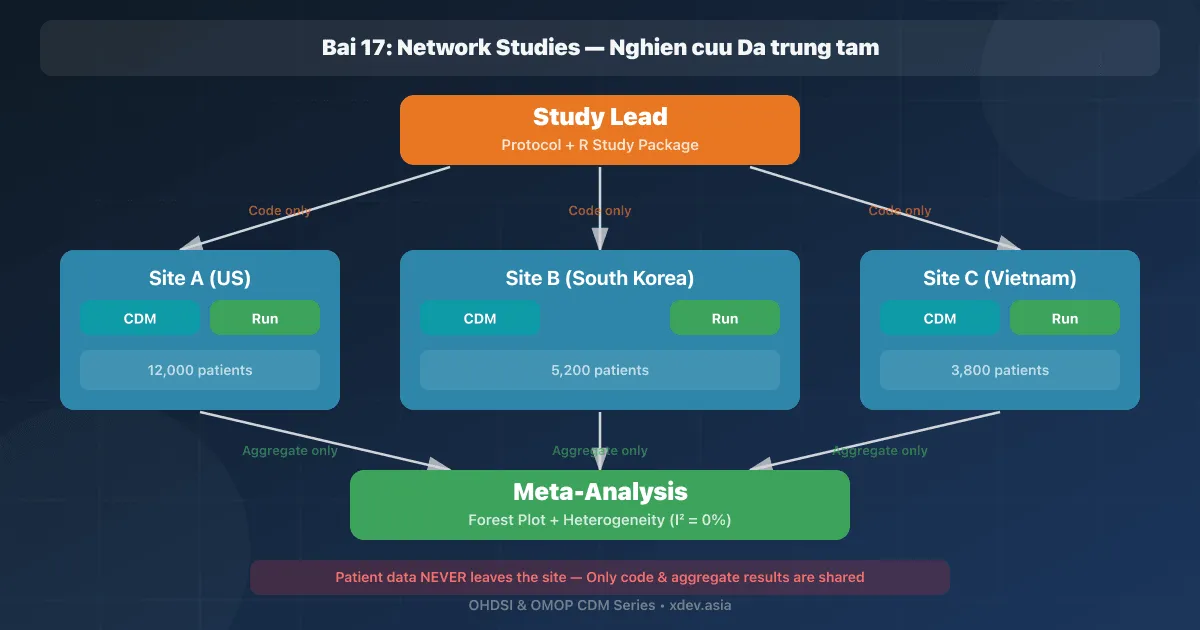
OHDSI 的真正力量在於其多中心研究(網絡研究) — 來自多個國家的數十個資料庫同時回答同一研究問題,無需共享患者資料。
OHDSI Network Research Model:

                  ┌─────────────┐
                  │  Study Lead │
                  │  (Protocol  │
                  │   + R Pkg)  │
                  └──────┬──────┘
                         │
              Study Package (code only)
                         │
          ┌──────────────┼──────────────┐
          ▼              ▼              ▼
   ┌─────────────┐┌─────────────┐┌─────────────┐
   │  Site A     ││  Site B     ││  Site C     │
   │  (US)       ││  (Korea)    ││  (Vietnam)  │
   │             ││             ││             │
   │  CDM ──→    ││  CDM ──→    ││  CDM ──→    │
   │  Run study  ││  Run study  ││  Run study  │
   │  ──→ Results││  ──→ Results││  ──→ Results│
   └──────┬──────┘└──────┬──────┘└──────┬──────┘
          │              │              │
          └──── Aggregate results only ─┘
                         │
                  ┌──────▼──────┐
                  │  Study Lead │
                  │  Meta-      │
                  │  analysis   │
                  └─────────────┘

→ Dữ liệu BN KHÔNG BAO GIỜ rời site
→ Chỉ chia sẻ code (study package) và aggregate results
1. 網路研究工作流程
1.1 實作步驟
Phase 1: Protocol Design
─────────────────────────
1. Đặt câu hỏi nghiên cứu (PICO)
   P: Population (Target cohort)
   I: Intervention/Exposure
   C: Comparator
   O: Outcome

2. Viết study protocol
   - Background & rationale
   - Study design (cohort, case-control, etc.)
   - Cohort definitions (JSON)
   - Analysis plan
   - Statistical methods

3. Đăng ký protocol (EU PAS Register, preprint)

Phase 2: Study Package Development
────────────────────────────────────
4. Tạo study package trong ATLAS hoặc viết R code
5. Test trên Eunomia (synthetic data)
6. Peer review code & cohort definitions
7. Chạy CohortDiagnostics trên ≥1 site

Phase 3: Execution
──────────────────
8. Gửi study package đến participating sites
9. Mỗi site: install, configure, execute
10. Sites gửi aggregate results về study lead

Phase 4: Analysis & Publication
────────────────────────────────
11. Meta-analysis kết quả từ nhiều sites
12. Viết manuscript / technical report
13. Publish & share trên OHDSI forums
1.2 網路研究範例
LEGEND Study (Large-scale Evidence Generation
            and Evaluation in a Network of Databases)

Câu hỏi: So sánh hiệu quả & an toàn của thuốc hạ áp
         (ACEi vs ARB vs thiazide vs CCB)

Sites tham gia: 12 databases, 6 triệu BN
  - CPRD (UK)
  - Optum (US)
  - MDCD (US Medicaid)
  - CCAE (US Commercial)
  - JMDC (Japan)
  - AUSOM (South Korea)
  - ...

Kết quả:
  - 3,000+ hazard ratios cho các cặp thuốc-outcome
  - Xác nhận CCB/thiazide first-line cho HTN chưa biến chứng
  - ACEi/ARB preferred nếu có DM hoặc CKD
  - Phát hiện signals an toàn mới

Published: The Lancet, 2019
2. 研究包結構
2.1 標準學習包
my-network-study/
├── DESCRIPTION                  # R package metadata
├── NAMESPACE                    # Exports
├── R/
│   ├── Main.R                   # Entry point
│   ├── CohortConstruction.R     # Build cohorts
│   ├── RunDiagnostics.R         # CohortDiagnostics
│   ├── RunEstimation.R          # CohortMethod analysis
│   ├── RunPrediction.R          # PLP analysis (if applicable)
│   └── Export.R                 # Package results for sharing
├── inst/
│   ├── settings/
│   │   ├── cohortDefinitionSet.csv
│   │   ├── negativeControlOutcomes.csv
│   │   └── analysisSpecifications.json
│   ├── cohorts/
│   │   ├── targetCohort.json
│   │   ├── comparatorCohort.json
│   │   └── outcomeCohort.json
│   └── sql/
│       └── CreateCohorts.sql
├── extras/
│   ├── CodeToRun.R              # Site-specific execution script
│   └── PackageMaintenance.R     # Developer utilities
├── tests/
│   └── testthat/
│       └── test-cohorts.R
└── README.md                    # Hướng dẫn cho sites
2.2 每個站點的 CodeToRun.R
# extras/CodeToRun.R
# ═══════════════════════════════════════════
# Mỗi site EDIT file này cho phù hợp local
# ═══════════════════════════════════════════

library(MyNetworkStudy)

# ── 1. Connection Details ──
connectionDetails <- DatabaseConnector::createConnectionDetails(
  dbms = "postgresql",          # Sửa theo site
  server = "localhost/ohdsi",   # Sửa theo site
  user = "ohdsi_app",           # Sửa theo site
  password = keyring::key_get("ohdsi"),
  port = 5432
)

# ── 2. Schema Config ──
cdmDatabaseSchema <- "cdm"
cohortDatabaseSchema <- "results"
cohortTable <- "network_study_cohort"
databaseId <- "Hospital_VN_2024"  # Tên site (unique)
databaseName <- "Hospital Vietnam 2024"
databaseDescription <- "Hospital system EHR data 2015-2024"

# ── 3. Output ──
outputFolder <- file.path(getwd(), "output", databaseId)
dir.create(outputFolder, recursive = TRUE)

# ── 4. Execute ──
execute(
  connectionDetails = connectionDetails,
  cdmDatabaseSchema = cdmDatabaseSchema,
  cohortDatabaseSchema = cohortDatabaseSchema,
  cohortTable = cohortTable,
  outputFolder = outputFolder,
  databaseId = databaseId,
  databaseName = databaseName,
  databaseDescription = databaseDescription,
  createCohorts = TRUE,
  runDiagnostics = TRUE,
  runAnalyses = TRUE,
  minCellCount = 5,         # Privacy: ẩn cells < 5
  maxCores = 4
)

# ── 5. Export Results ──
# Gửi thư mục output/ đến study lead
# KHÔNG gửi patient-level data!
3. 資料治理與隱私
3.1 隱私原則
┌──────────────────────────────────────────────────────┐
│         OHDSI Data Governance Principles             │
│                                                      │
│  1. DATA STAYS LOCAL                                 │
│     Dữ liệu BN không rời site                       │
│     Chỉ share code + aggregate results               │
│                                                      │
│  2. MINIMUM CELL COUNT                               │
│     Ẩn counts < 5 (configurable)                     │
│     Tránh re-identification                          │
│                                                      │
│  3. NO PATIENT-LEVEL EXPORT                          │
│     Results chỉ có aggregate statistics              │
│     Hazard ratios, counts, proportions               │
│                                                      │
│  4. IRB/ETHICS APPROVAL                              │
│     Mỗi site cần approval riêng                      │
│     Study protocol phải được review                  │
│                                                      │
│  5. DATA USE AGREEMENT                               │
│     Giữa study lead và mỗi site                     │
│     Quy định rõ mục đích sử dụng                    │
└──────────────────────────────────────────────────────┘
3.2 最小細胞數
# Trong study package:
minCellCount <- 5

# Khi export results:
exportResults <- function(outputFolder, minCellCount = 5) {
  results <- readRDS(file.path(outputFolder, "results.rds"))

  # Censor cells nhỏ
  results$cohortCount[results$cohortCount > 0 &
                      results$cohortCount < minCellCount] <- paste0("<", minCellCount)

  # Remove individual-level data
  results$patientLevelData <- NULL

  saveRDS(results, file.path(outputFolder, "results_censored.rds"))
}
3.3 審批流程
Site muốn tham gia network study:

1. Nhận study protocol từ study lead
2. Nộp IRB/Ethics review tại site
3. Ký Data Use Agreement (DUA)
4. Cài study package
5. Chạy CohortDiagnostics → review
6. Chạy full analysis
7. Review results trước khi gửi
8. Gửi aggregate results (censored)
4.薈萃分析
4.1 多站點結果總結
library(EvidenceSynthesis)

# Collect results từ các sites
siteResults <- list()
sites <- c("Site_US", "Site_KR", "Site_VN", "Site_JP")

for (site in sites) {
  siteResults[[site]] <- readRDS(
    file.path("results", site, "estimationResults.rds")
  )
}

# Fixed-effects meta-analysis
metaResult <- computeFixedEffectMetaAnalysis(
  logRr = sapply(siteResults, function(x) x$logRr),
  logLb95Ci = sapply(siteResults, function(x) x$logLb95Ci),
  logUb95Ci = sapply(siteResults, function(x) x$logUb95Ci),
  seLogRr = sapply(siteResults, function(x) x$seLogRr)
)

# Kết quả
cat("Meta-analysis HR:", exp(metaResult$logRr), "\n")
cat("95% CI:", exp(metaResult$logLb95Ci), "-",
    exp(metaResult$logUb95Ci), "\n")
cat("P-value:", metaResult$p, "\n")
4.2 森林圖
Forest Plot: Metformin vs SU → MI Risk

Study              HR [95% CI]         Weight
────────────────────────────────────────────────
Site US (N=12,000)  0.58 [0.35-0.96]   ──●──   35%
Site KR (N=5,200)   0.71 [0.38-1.33]    ──●──  20%
Site VN (N=3,800)   0.55 [0.28-1.08]   ──●──   18%
Site JP (N=6,500)   0.65 [0.40-1.06]    ──●──  27%
────────────────────────────────────────────────
Meta (Fixed)        0.62 [0.47-0.82]    ◆      100%
                                    │
                    0.25  0.5   1.0  2.0
                    ← Favors Met   Favors SU →

I² = 0% → Không có heterogeneity đáng kể
Q-test p = 0.85 → Kết quả nhất quán giữa sites
5.OHDSI 社區
5.1 加入社區
Kênh tham gia:

1. OHDSI Forums (forums.ohdsi.org)
   - Hỏi đáp kỹ thuật
   - Thảo luận study design
   - Announcements

2. OHDSI Workgroups
   - Vocabulary WG
   - CDM WG
   - Patient-Level Prediction WG
   - Population-Level Estimation WG
   - Data Quality WG

3. OHDSI Symposium (hàng năm)
   - Presentations, workshops, tutorials
   - Networking

4. OHDSI Studies
   - Tham gia network studies đang mở
   - Đề xuất study mới

5. GitHub (github.com/OHDSI)
   - Contribute code
   - Report issues
   - Feature requests
5.2 學習資源
1. The Book of OHDSI (ohdsi.github.io/TheBookOfOhdsi/)
   → Sách tham khảo chính thức (free, open-source)

2. EHDEN Academy (academy.ehden.eu)
   → Khóa học online CDM, ETL, Vocabularies

3. OHDSI Tutorials
   → Video workshops trên YouTube

4. Forums Q&A
   → Cộng đồng trả lời câu hỏi kỹ thuật
6. 在越南實施 OHDSI 的最佳實踐
6.1 挑戰
Thách thức đặc thù Việt Nam:

1. Dữ liệu EMR/HIS
   - Nhiều hệ thống HIS khác nhau (VietIS, Sáng, FPT.eHospital...)
   - Format dữ liệu không chuẩn hóa
   - Mã ICD-10 hay bị sử dụng sai

2. Vocabulary mapping
   - Tên thuốc tiếng Việt → RxNorm mapping
   - Mã BHYT → OMOP concept mapping
   - Local lab codes → LOINC mapping

3. Nhân lực
   - Ít chuyên gia OHDSI/OMOP
   - Cần đào tạo ETL engineers
   - Cần clinical informaticists

4. Pháp lý
   - Quy định về chia sẻ dữ liệu y tế
   - HIPAA không áp dụng → dùng Luật ATTT VN
   - IRB/Ethics board processing time
6.2 實作路線圖
Phase 1: Pilot (3-6 tháng)
──────────────────────────
☐ Chọn 1 bệnh viện pilot
☐ Cài OHDSI stack (Docker Compose)
☐ ETL 1-2 năm dữ liệu
☐ Chạy ACHILLES + DQD
☐ Đào tạo team (2-3 người)

Phase 2: Validate (3-6 tháng)
─────────────────────────────
☐ Cải thiện ETL dựa trên DQD
☐ Mapping vocabularies (Usagi)
☐ Tạo cohort definitions đầu tiên
☐ Chạy 1 replication study
☐ Kiểm tra kết quả với clinical experts

Phase 3: Expand (6-12 tháng)
────────────────────────────
☐ Thêm 2-3 bệnh viện
☐ Chuẩn hóa ETL pipeline
☐ Tham gia 1 OHDSI network study
☐ Kubernetes production deployment
☐ Monitoring & alerting

Phase 4: Network (ongoing)
──────────────────────────
☐ OHDSI Vietnam node chính thức
☐ Propose original studies
☐ Contribute Vietnamese vocabulary mappings
☐ Training & community building
☐ Publish research papers
6.3 越南資料的 ETL
Nguồn dữ liệu phổ biến:

HIS Database → Staging → OMOP CDM
    │                        │
    ├─ benh_nhan            → person
    ├─ kham_benh            → visit_occurrence
    ├─ chan_doan (ICD-10)   → condition_occurrence
    ├─ don_thuoc            → drug_exposure
    ├─ xet_nghiem           → measurement
    ├─ thu_thuat            → procedure_occurrence
    └─ vien_phi (BHYT)      → cost

Mapping challenges:
┌────────────────────────────┬────────────────────────────┐
│ Vietnamese Source          │ OMOP Standard              │
├────────────────────────────┼────────────────────────────┤
│ Giới tính: Nam/Nữ         │ 8507 (Male) / 8532 (Female)│
│ ICD-10: E11.9             │ 201826 (Type 2 DM)         │
│ Thuốc: "Metformin 500mg"  │ RxNorm: 860975             │
│ XN: "HbA1c"               │ LOINC: 4548-4              │
│ BHYT: mã DV "XN001"       │ Custom mapping required    │
└────────────────────────────┴────────────────────────────┘
課程總結
Bạn đã hoàn thành 17 bài học OHDSI & OMOP CDM:

Phần 1: Tổng quan (Bài 1-3)
  ✓ OHDSI ecosystem, OMOP CDM, Athena vocabularies

Phần 2: ETL (Bài 4-6)
  ✓ WhiteRabbit, Usagi, ETL pipeline

Phần 3: Platform (Bài 7-9)
  ✓ PostgreSQL CDM, WebAPI, ATLAS

Phần 4: Analysis (Bài 10-12)
  ✓ Concept Sets, Cohorts, Characterization,
    Incidence Rates, Pathways, Estimation, Prediction

Phần 5: Data Quality (Bài 13-15)
  ✓ ACHILLES, DQD, HADES R packages

Phần 6: Production (Bài 16-17)
  ✓ Docker/K8s deployment, Network Studies

Bước tiếp theo:
  1. Cài đặt OHDSI stack local (Docker Compose)
  2. Tải Eunomia synthetic data → thực hành
  3. ETL dữ liệu thực từ HIS
  4. Tham gia OHDSI community
  5. Propose & contribute studies