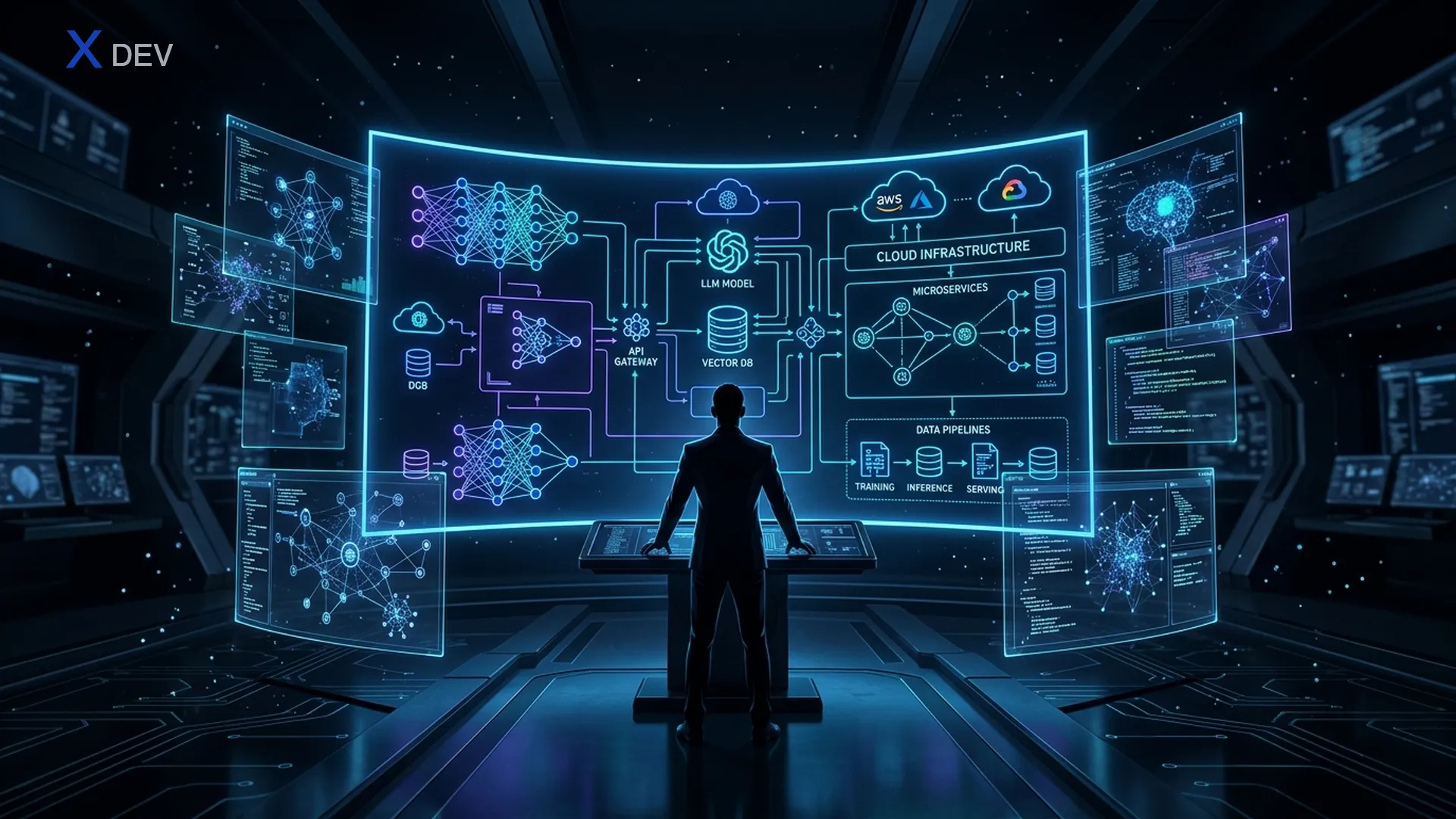
Over the past two years, AI Solution Architect has become one of the most sought-after positions in the tech industry. With the explosion of GenAI, LLMs, and the demand to integrate AI into every product, companies no longer just need people who can train models — they need people who can design entire AI systems from concept to production.
But the path to this role is not simple. It requires a rare combination of deep technical skills, systems thinking, and business communication ability. This article shares a practical roadmap — not empty theory.
1. What Is an AI Solution Architect?
An AI Solution Architect is someone who designs the overall architecture for AI/ML solutions within an organization. They serve as the bridge between business stakeholders, data scientists, ML engineers, and platform teams.
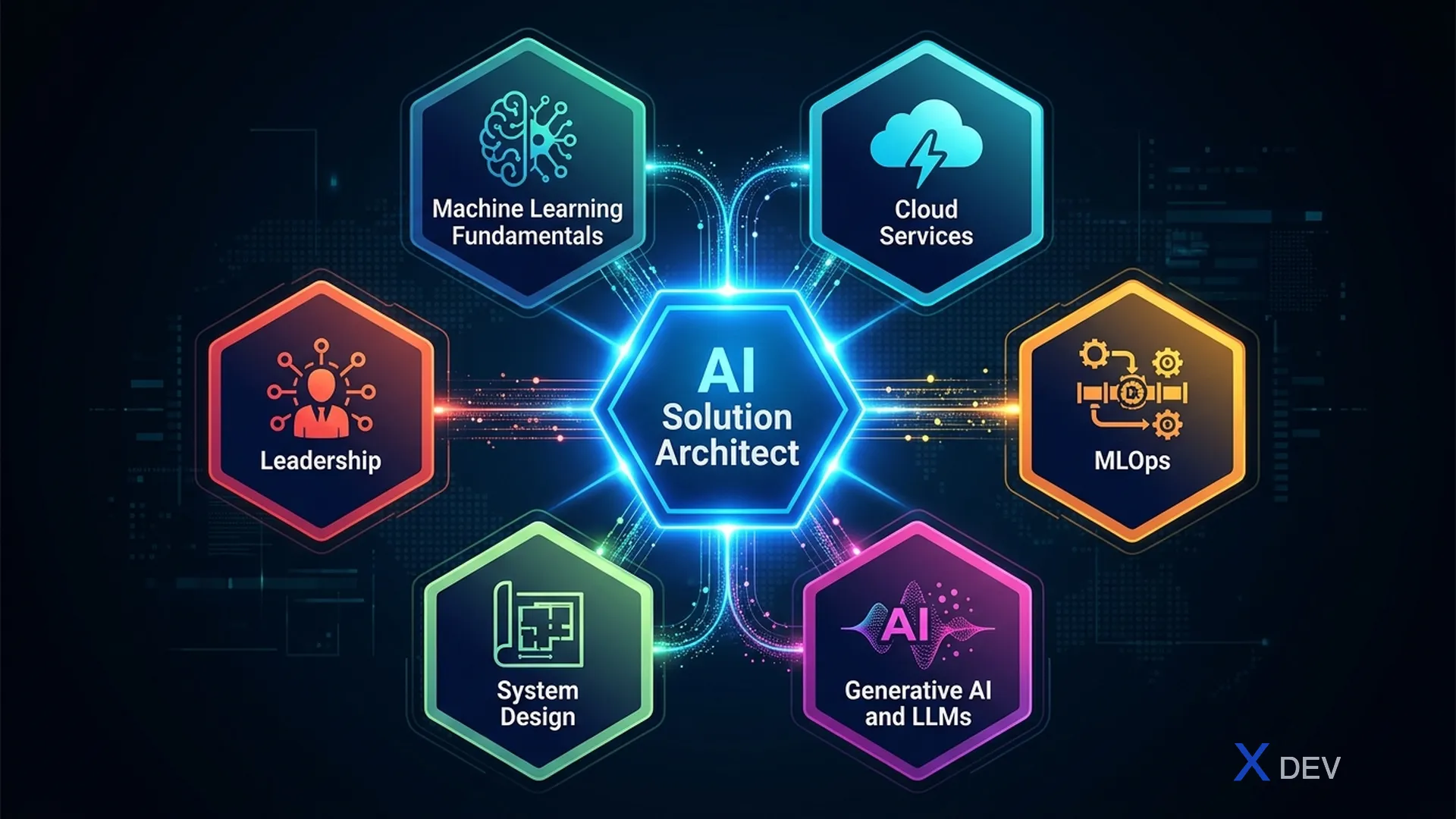
Core Responsibilities
| Domain | Specific Work |
|---|---|
| Discovery | Assess business problems, determine whether AI is the right solution, estimate ROI |
| Architecture Design | Design end-to-end pipeline: data ingestion → feature engineering → training → serving → monitoring |
| Technology Selection | Choose cloud services, frameworks, model types, vector databases, orchestration tools |
| Governance | Establish MLOps, model registry, A/B testing, compliance (GDPR, AI Act) |
| Stakeholder Communication | Present technical decisions to C-level, train teams, write RFC/ADR documents |
Comparison with Other Roles
One important thing to understand upfront: an AI Solution Architect does not replace Data Scientists or ML Engineers — they work together in a synergistic triangle.
| Role | Core Focus | Deliverables | Time Horizon |
|---|---|---|---|
| Data Scientist | Research, experimentation, prototyping | Trained model, research report, experiment results | 1–4 weeks |
| ML Engineer | Productionize models, build pipelines, APIs | Deployed endpoint, CI/CD pipeline, feature store | 1–3 months |
| AI Solution Architect | System design, technology selection, bridge teams | Architecture blueprint, ADR, cost model | 3–12 months |
| Platform / Cloud Engineer | Infrastructure, K8s, security, networking | Kubernetes cluster, VPC, IAM policy | Ongoing |
Data Scientists dive deep into modeling and experimentation — they need freedom to experiment. ML Engineers handle productionizing and scaling — they need reliability. AI Solution Architects see the full picture — from data strategy, model selection, and infrastructure design to deployment and cost governance. No AI team functions well without this role.
When Does a Business Need an AI Solution Architect?
Warning signs to watch for:
- The Data Science team can build models but nobody knows how to deploy them to production
- Multiple AI initiatives exist but each team follows their own approach, with no common standards
- Cloud AI costs exceed the budget with no clear explanation why
- Leadership wants to scale AI from 1–2 projects to the entire enterprise
- Starting to encounter issues with compliance, model bias, and data governance
2. Why This Role Is Booming
2025–2026 Market Data
- 80% of Fortune 500 companies have or are building AI teams (McKinsey 2025)
- Demand for AI Architects increased 340% from 2023 to 2026 on LinkedIn
- GenAI creates new demand: RAG architecture, multi-agent systems, LLMOps, AI gateway
- 130,000+ open positions for AI architect/AI engineer globally (Indeed, Q1 2026)
- In Vietnam: FPT, VNG, MoMo, MB Bank, TPBank, VinAI, VinBigdata are all hiring aggressively
Why Is There a Talent Shortage?
This is an extremely rare T-shaped role: it needs breadth (knowing many things) and depth (mastering several areas). In practice:
- Data Scientists are great at modeling but weak in system design and cloud
- Backend Engineers are great at system design but don't know ML
- DevOps Engineers are great at infrastructure but don't understand ML workflows
- AI Architects need all three — plus business skills
Salary Reference (2026)
| Region | Junior (0–2 years) | Mid (3–5 years) | Senior (5+ years) |
|---|---|---|---|
| Vietnam | $25K–40K/year | $45K–70K/year | $80K–120K+/year |
| Singapore | $80K–110K/year | $120K–160K/year | $180K–250K+/year |
| US (remote) | $130K–170K/year | $180K–240K/year | $250K–350K+/year |
Note: Salary depends on company, industry (fintech/healthtech pays more), and portfolio. Real experience with production AI systems matters more than years of experience.
3. The 4-Phase Roadmap
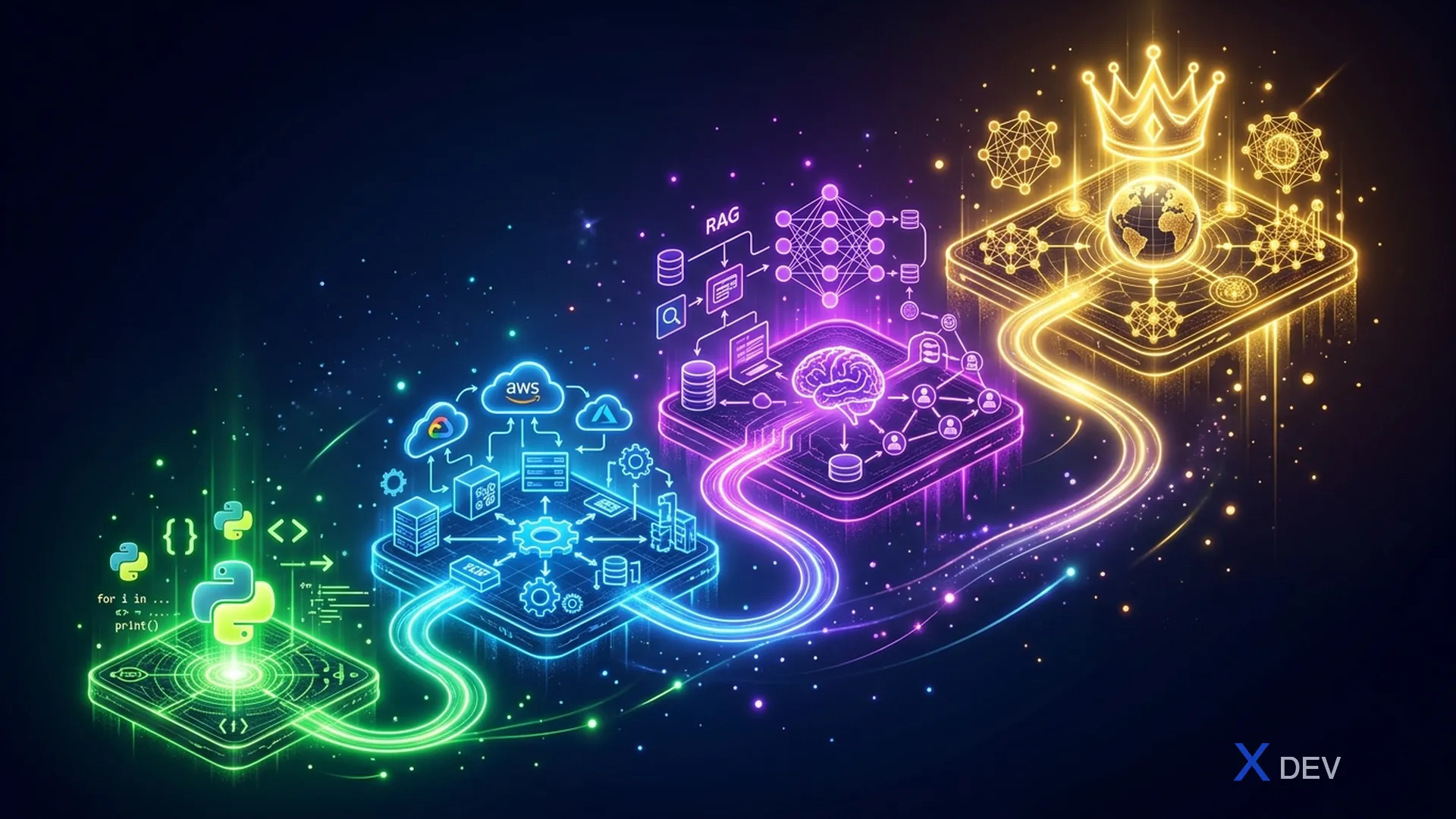
Phase 1: Technical Foundation (6–12 months)
You don't need a PhD, but you need a solid foundation that won't crumble every time technology changes.
Programming & Software Engineering
- Python proficiency: list comprehension, generators, decorators, async/await, type hints
- Design patterns: Factory, Observer, Strategy, Repository — not memorized but knowing when to use them
- Clean architecture, separation of concerns, dependency injection
- REST API with FastAPI or Flask, gRPC for internal services
- Git flow, conventional commits, code review etiquette
- Docker: optimized Dockerfiles, multi-stage builds, .dockerignore
- Testing: unit tests with pytest, mocking, integration tests
Milestone check: Can you build a complete Python REST API (auth, CRUD, tests, Docker) in one day?
Machine Learning Fundamentals
Don't just use scikit-learn as a black box. You need to understand what's inside:
- Supervised Learning: Linear/Logistic Regression (understand why cross-entropy is the loss function), Decision Trees (know what information gain is), Ensemble methods (Random Forest, Gradient Boosting — understand why boosting beats bagging for many problems)
- Unsupervised Learning: K-Means (know inertia and the elbow method), PCA (understand eigenvalues and variance explained), DBSCAN (know how epsilon and min_samples affect clustering)
- Model evaluation: precision/recall/F1 for imbalanced data, AUC-ROC vs AUC-PR, RMSE vs MAE — know when to use each metric
- Feature engineering: scaling (standard vs minmax — when to use each), encoding (one-hot vs ordinal vs target encoding — trade-offs), feature selection (correlation analysis, mutual information, recursive feature elimination)
- Validation: proper train/validation/test split, cross-validation, stratified sampling, time-series split (never random shuffle for time series!)
- Overfitting/Underfitting: be able to read learning curves and diagnose problems
Deep Learning
- Neural networks: forward pass, backpropagation, gradient flow — no need to derive by hand, but must understand why vanishing gradients occur
- CNNs: convolution, pooling, receptive field — why better than MLP for images
- RNNs, LSTMs: sequence modeling, forget gate — why LSTMs solve vanishing gradient better than vanilla RNNs
- Transformers: mandatory in 2026. Self-attention mechanism, multi-head attention, positional encoding, why transformers are more parallelizable than RNNs
- Transfer learning: feature extraction vs fine-tuning — know when to unfreeze how many layers
- Frameworks: PyTorch (prioritize — production-friendly, research standard), TensorFlow/Keras (still need to know for legacy systems)
Math & Statistics
- Linear algebra: matrix multiplication (understand that attention is matrix multiplication), SVD (foundation of PCA and matrix factorization), eigenvalues (foundation of PCA)
- Calculus: chain rule (backpropagation), what is a gradient, Jacobian matrix
- Probability & Statistics: Bayes theorem, MLE vs MAP, common distributions (Normal, Bernoulli, Poisson — know real-world applications), hypothesis testing (p-value, Type I/II errors — important for A/B testing)
- Optimization: SGD, Adam, learning rate scheduling — know why Adam typically converges faster than SGD
Recommended resources:
- fast.ai — Practical Deep Learning, free and very hands-on
- Andrew Ng's ML Specialization on Coursera
- Designing Machine Learning Systems — Chip Huyen (read alongside studying)
- The Elements of Statistical Learning (free PDF) for the math sections
Phase 2: Cloud + MLOps + System Design (6–12 months)
This is the phase that differentiates Data Scientists from Solution Architects. Many skip this phase because they "just want to do AI" — that's the biggest mistake.
Cloud AI Services (choose 1–2 clouds, go deep)
AWS — largest market share:
- SageMaker: Training Jobs (pre-built & custom containers), Endpoints (real-time & async), Pipelines (MLOps), Feature Store (online/offline), Model Registry, Clarify (bias detection)
- Bedrock: Foundation Model API, Knowledge Bases (managed RAG), Agents (function calling), Guardrails (safety)
- Infrastructure: Step Functions for ML orchestration, Lambda for lightweight inference, ECS/EKS for containerized workloads, S3 for data lake
- Networking: VPC design for ML workloads, VPC Endpoints for private access, PrivateLink
Google Cloud — best for ML:
- Vertex AI: AutoML (tabular/image/text/video), Custom Training (custom containers, distributed), Pipelines (Kubeflow-based), Model Registry, Experiments, TensorBoard, Feature Store, Matching Engine (vector search)
- BigQuery ML: CREATE MODEL SQL syntax, supported algorithms (logistic_reg, kmeans, arima_plus, boosted_tree, neural_net)
- Data: Dataflow (Apache Beam — batch/streaming), Pub/Sub, Dataproc (Spark), Cloud Composer (Airflow)
Azure — popular in enterprise:
- Azure ML Studio: designer, automated ML, pipelines, model registry
- Azure OpenAI Service: GPT-4o, DALL-E, Whisper — enterprise-grade
- Azure AI Search: hybrid search (vector + keyword) — popular for RAG
- Cognitive Services: Vision, Speech, Language, Translator
MLOps
MLOps is the DNA of an AI Architect. Not knowing MLOps = not an architect.
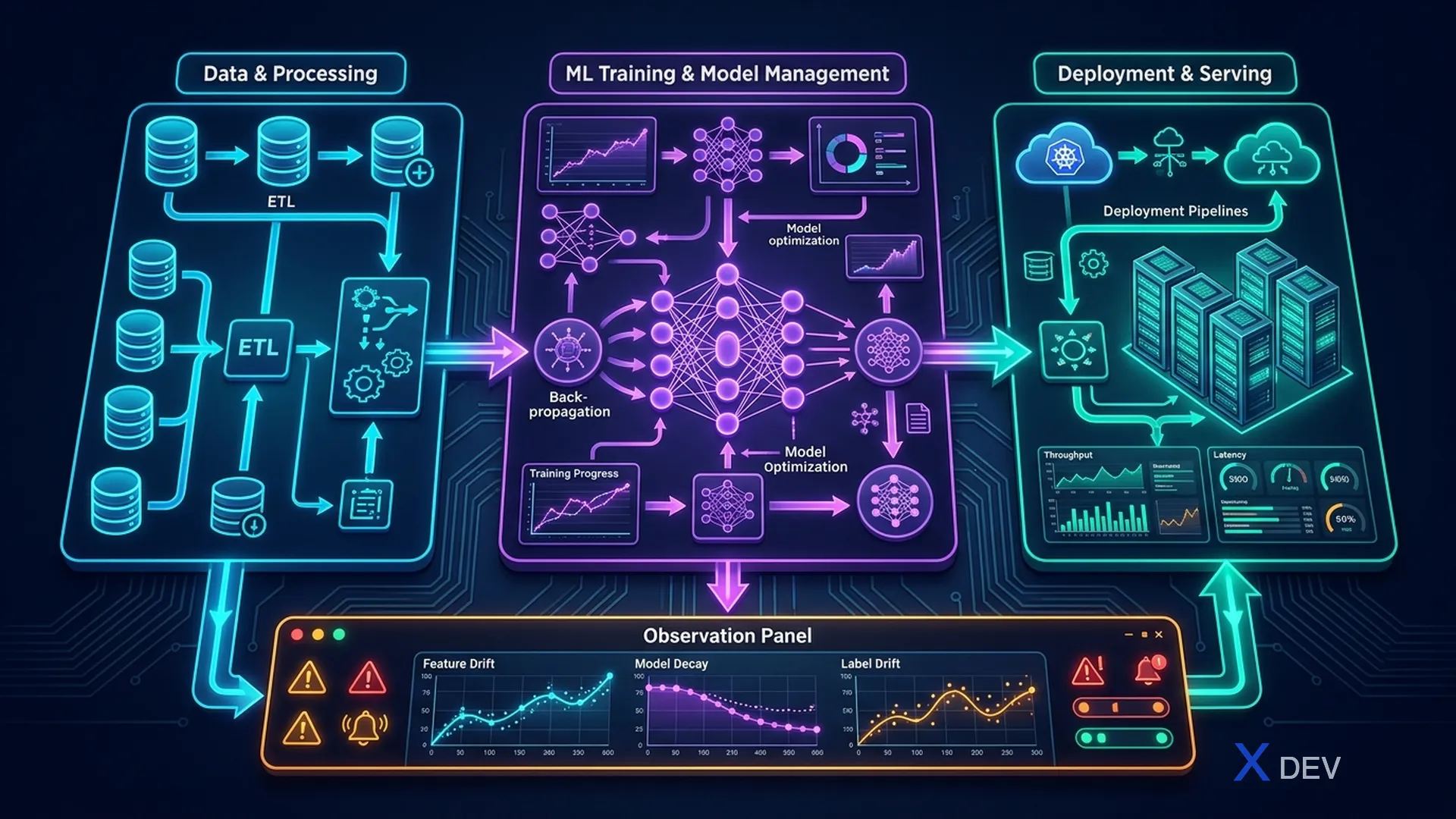
Data Pipeline:
- Ingestion: how to ingest from databases, APIs, streaming sources into a data lake
- Validation: Great Expectations, TFX ExampleValidator — automatically check schema, distributions, missing values
- Transform: why use tf.Transform instead of pandas (saved transform graph for consistency)
- Feature Store: online serving (low-latency Redis-backed) vs offline serving (BigQuery/S3-backed)
Model Pipeline:
- Experiment tracking: MLflow Tracking, W&B Runs — log hyperparameters, metrics, artifacts for every run
- Versioning: DVC for data versioning, Git for code, MLflow Model Registry for model versioning
- Hyperparameter tuning: Optuna, Ray Tune, Vertex AI Vizier — Bayesian optimization is more efficient than grid search
- Evaluation: TFMA (TensorFlow Model Analysis) for sliced evaluation (model performance by segment)
Deployment Pipeline:
- Serving patterns: real-time endpoint vs async endpoint vs batch prediction — when to use each
- Blue-Green deployment: zero-downtime deployment by switching traffic between two environments
- Canary deployment: gradually roll from 0% → 5% → 25% → 100% traffic to the new model
- Shadow mode: run new model in parallel with old model, compare predictions without affecting users
Observability:
- Data drift: monitor input feature distributions (PSI — Population Stability Index, KS test)
- Prediction drift: monitor how output label distributions change over time
- Model performance: ground truth delay is normal — need a strategy to collect delayed labels
- Infrastructure: latency percentiles (p50/p95/p99), throughput, error rate, GPU utilization
Specific tools:
- MLflow — open source, easy to use, self-hosted or managed (Databricks)
- Weights & Biases (W&B) — best for experiment tracking visualization
- Kubeflow Pipelines — Kubernetes-native, steep learning curve but flexible
- Airflow — mature, huge ecosystem, use when the team already has Airflow skills
- Evidently AI — data drift monitoring, easy to integrate
- Grafana + Prometheus — infrastructure monitoring
System Design for AI
This is the core skill of an architect. You must be able to answer these questions in 5 minutes:
Serving architecture decisions:
- Real-time vs Batch: latency requirement < 200ms → real-time; can wait 1+ hours → batch; 1–10 minutes → async/streaming
- Model size vs latency: large model (7B+ params) on GPU = fast but $2–5/hour; small distilled model on CPU = slower but $0.05/hour
- Caching: should cache predictions for high-frequency identical inputs (e.g., product descriptions rarely change)
Data architecture decisions:
- Lambda architecture (batch + streaming) vs Kappa architecture (pure streaming) — trade-offs between complexity and latency
- Online vs Offline features: user's real-time clickstream (online) vs user's 30-day purchase history (offline/precomputed)
- Data versioning strategy: snapshot vs event sourcing vs time-travel queries (Delta Lake/Iceberg)
Scalability decisions:
- Horizontal scaling of inference: stateless serving → easy to scale with K8s HPA
- GPU sharing: time-slicing vs MIG (Multi-Instance GPU) vs multi-process service
- Model compression before deployment: quantization (INT8 reduces 4x memory), pruning, knowledge distillation
Must-read books:
- Designing Machine Learning Systems — Chip Huyen (the bible of the profession)
- Machine Learning Engineering — Andriy Burkov
- Fundamentals of Data Engineering — Joe Reis & Matt Housley
Phase 3: GenAI Architecture & Specialization (6–12 months)
In 2026, an AI Solution Architect must master GenAI architecture. This is no longer a "nice to have."
LLMs & Foundation Models
Understand deeply enough to make informed decisions:
- Transformer architecture: self-attention O(n²) complexity explains why context window matters and is expensive, positional encoding (RoPE, ALiBi), what is KV cache and why it's critical for inference efficiency
- Model tiers (2026):
- Frontier: GPT-4.5, Claude 4 Opus, Gemini 2.5 Ultra — use for complex reasoning, high-stakes tasks
- Workhorse: Claude 4 Sonnet, GPT-4o, Gemini 2.5 Pro — best price-performance for 80% of use cases
- Fast/Cheap: Claude 4 Haiku, Gemini 2.5 Flash, GPT-4o mini — simple classification, extraction, formatting
- Open Source: Llama 4, Qwen 3, Mistral Large — self-host to control cost and privacy
- Tokenization: need to know how token count affects cost (GPT-4o = $2.5/M input tokens, Gemini Flash = $0.075/M)
- Context window strategy: long context isn't always needed — retrieval is often better than stuffing context
- Structured output: JSON mode, function calling, Pydantic validation — apply to production pipelines
RAG (Retrieval-Augmented Generation)
RAG is the most common pattern and also where most teams make the most mistakes. The architect must know how to design it correctly from the start:
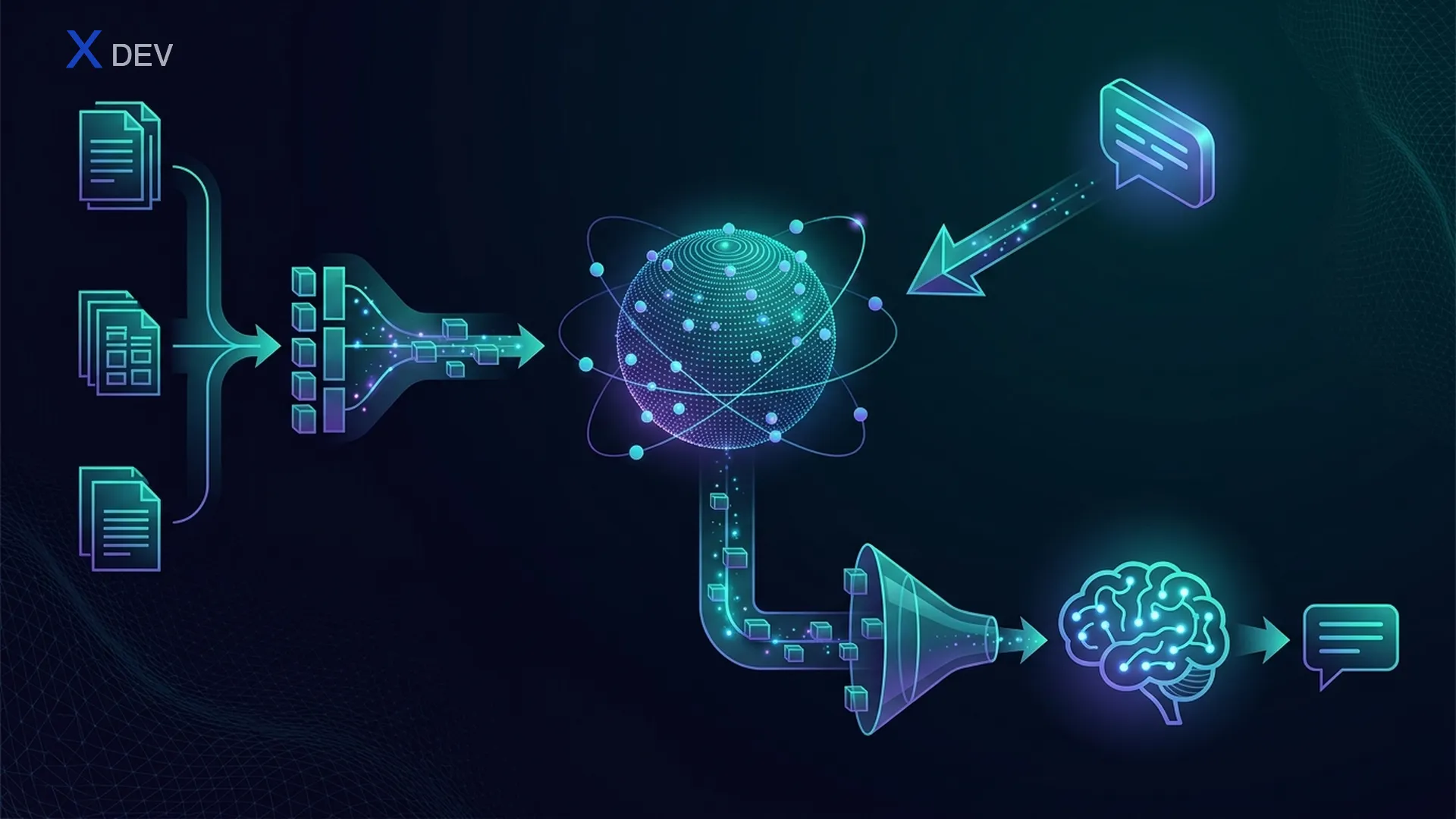
Indexing Pipeline:
- Document loading: PDF (unstructured.io, PyMuPDF), HTML (BeautifulSoup), Confluence, Notion, SharePoint
- Chunking strategies:
- Fixed-size: simplest, doesn't understand semantics → poor quality
- Recursive character: split by headers → paragraphs → sentences (LangChain RecursiveCharacterTextSplitter)
- Semantic: use embedding similarity to find natural split points
- Document-aware: understand document structure (PDF headings, markdown headers, tables)
- Small-to-big: index small chunks but retrieve a larger context window (parent chunk)
- Embedding: text-embedding-3-large (OpenAI), text-embedding-004 (Google), multilingual-e5-large (open source)
- Vector store: Pinecone (managed, fast), Weaviate (open source, hybrid search), Qdrant (Rust-based, performant), pgvector (PostgreSQL extension — use when you already have Postgres), Redis (for caching + vector search), Elasticsearch/OpenSearch (use when you already have ES)
Retrieval Pipeline:
- Query preprocessing: spell correction, query expansion (generate multiple query versions), query decomposition (break complex queries into sub-queries)
- Search types:
- Dense retrieval: embedding similarity (cosine/dot product) — good for semantic search
- Sparse retrieval: BM25/TF-IDF — good for keyword matching (product names, codes)
- Hybrid search: combine both with Reciprocal Rank Fusion → best in most cases
- Re-ranking: BAAI/bge-reranker, Cohere Rerank — cross-encoder re-score top-K chunks → only send top-N to LLM
- Metadata filtering: filter by date, document type, department — reduce search space, increase precision
Generation Pipeline:
- Context window management: optimal context = quality retrieved chunks + clear system prompt + user query
- Prompt templates: consistent system prompt, document citation instruction, hallucination reduction prompts
- Streaming: stream response tokens → better UX
- Post-processing: fact extraction, source attribution, confidence scoring
Evaluation — often neglected but critically important:
- Faithfulness: is the response grounded in the retrieved chunks? (scale 0–1)
- Answer relevance: does the response actually answer the question? (scale 0–1)
- Context recall: do the retrieved chunks contain enough information to answer? (scale 0–1)
- Tools: RAGAS, TruLens, DeepEval — automated evaluation pipelines
- Regression testing: every time you change RAG config, run the eval set before deploying
AI Agent Architecture
Multi-agent systems are the biggest trend of 2026. Many companies are moving from simple RAG to agent systems.
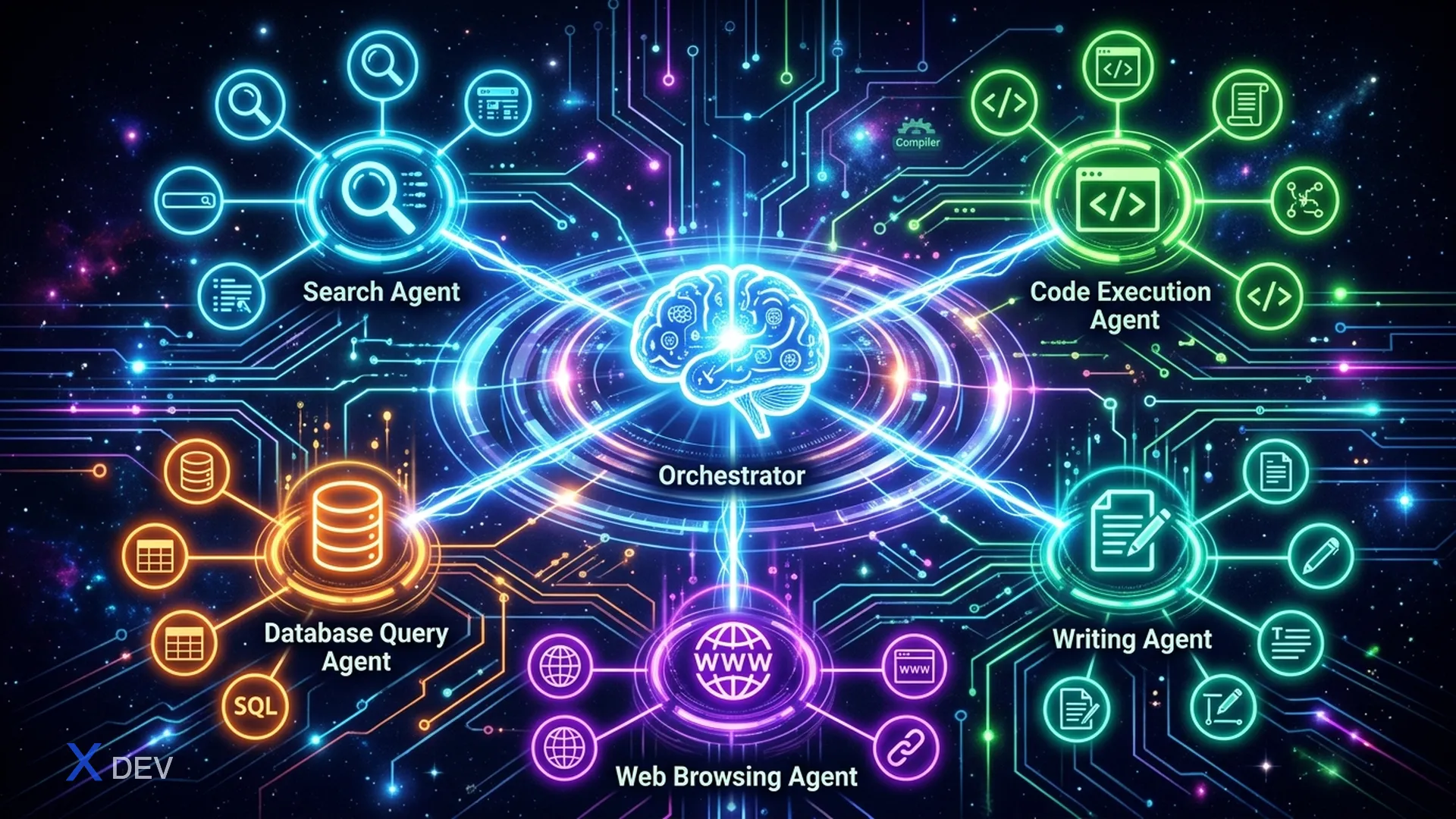
Anatomy of an AI Agent:
- Brain (LLM): reasoning, planning, decision making
- Memory:
- Short-term: conversation history in context window
- Long-term: vector store, database — persist across sessions
- Episodic: log of past actions and outcomes
- Semantic: knowledge base about the domain
- Tools: APIs, databases, code executors, web browsers, file systems
- Perception: input processors (text, images, audio, structured data)
- Action: text generation, API calls, code execution, file operations
Multi-Agent Patterns:
- Sequential: Agent A → Agent B → Agent C (pipeline, predictable, simple)
- Parallel: Multiple agents run simultaneously, aggregator compiles results (faster for independent tasks)
- Hierarchical: Orchestrator assigns to specialist agents, collects results (most common in enterprise)
- Debate/Critique: One agent generates, another critiques and improves (good for quality-critical outputs)
Frameworks (2026):
- LangGraph — graph-based agent orchestration, precise flow control, production-ready
- CrewAI — role-based agents, easy to define, good for business workflows
- AutoGen — conversation-based multi-agent, research-friendly
- Amazon Bedrock Agents — managed, integrated with AWS services
- Vertex AI Agent Builder — managed, integrated with Google Cloud
Safety considerations:
- Prompt injection: user's input may contain instructions that override system prompt → validate and sanitize
- Tool permissions: agents should not have rights to delete or write to production data
- Human-in-the-loop: for high-stakes actions (send email, make payment, deploy code), require human approval
- Sandboxing: code execution in isolated container, with timeout and resource limits
- Audit logging: log all tool calls and decisions for debugging and compliance
AI Gateway & LLMOps
When scaling from 1 model to many models, you need an infrastructure layer:
AI Gateway responsibilities:
- Routing: send simple queries to cheap model (Haiku), complex queries to powerful model (Sonnet/Opus)
- Rate limiting: ensure provider rate limits aren't exceeded, distribute requests
- Caching: semantic caching — if a query is semantically similar to a previous one, return cached response (reduces 30–70% costs)
- Fallback: if primary model goes down, failover to secondary model
- Load balancing: distribute across multiple API keys/accounts
- Cost tracking: per-team, per-feature, per-user cost attribution
LLMOps — not MLOps:
- Prompt versioning: treat prompts like code — version control, review process, rollback capability
- Prompt testing: automated test suite for prompt changes (don't just "feel like it's better")
- Latency monitoring: TTFT (Time To First Token), TBT (Time Between Tokens), p95/p99 latency
- Quality monitoring: automated eval scores on production traffic samples
- Cost optimization: batching requests, prompt caching (Anthropic/OpenAI), choosing the right model tier
Tools ecosystem:
- LiteLLM — unified API for 100+ LLM providers, self-hosted gateway
- Portkey — managed AI gateway, advanced routing, guardrails
- LangSmith — LangChain's observability platform (traces, evaluations, datasets)
- Langfuse — open-source LLM observability, self-hostable
- Helicone — lightweight observability, easy integration
Phase 4: Leadership & Business Impact (ongoing)
This phase distinguishes an architect from a senior engineer. Technical skills are necessary but not sufficient.
Stakeholder Communication Skills
Talking with C-level executives:
Don't say: "We'll fine-tune an LLM with QLoRA on 8x A100s, then deploy to K8s with vLLM serving..."
Instead say: "We'll build an AI system that automatically handles 80% of customer support questions — reducing response time from 4 hours to 3 seconds, saving an estimated $2M/year in headcount. Investment: $500K build + $150K/year operations. ROI positive in 8 months."
Writing Architecture Decision Records (ADR):
ADRs are the most important documents an architect creates. Standard format:
# ADR-042: Choose RAG over Fine-tuning for Customer Support Bot

## Context
The team needs to build a chatbot that answers questions from a 50K document knowledge base,
updated with 200 documents per week.

## Decision
Use RAG with pgvector + GPT-4o Turbo instead of fine-tuning.

## Alternatives Considered
1. Fine-tuning GPT-3.5: $30K training + retraining with every KB update → rejected
2. Full RAG with Pinecone: $8K/month operational cost → rejected (too expensive)
3. RAG with pgvector (chosen): leverage existing PostgreSQL → $800/month

## Consequences
+ Knowledge base updates immediately, no retraining required
+ 10x lower cost than alternative B
- Need to maintain embedding pipeline
- Context window limit of 128K tokens (sufficient for this use case)
Estimating AI Costs:
This is a non-negotiable skill. Quick calculation example:
- 100K API calls/day × $0.001/call (GPT-4o mini) = $100/day = $3K/month
- 1M tokens/day × $0.002/1K tokens = $2/day = $60/month
- GPU inference (1x A10G): $1.006/hour × 24h × 30 = $724/month
Identifying and Managing Risks:
| Risk | Severity | Mitigation |
|---|---|---|
| LLM provider outage | High | Multi-provider fallback (OpenAI → Anthropic → Azure OpenAI) |
| Hallucination in critical domain | Very High | Ground with RAG, human review workflow, confidence threshold |
| Data leakage via API | High | Private deployment, data anonymization, legal review |
| Model bias causing discrimination | High | Regular bias audits, diverse eval sets, human oversight |
| Cost overrun | Medium | Budget alerts, model routing, caching strategy |
Professional Architecture Thinking
Build vs Buy vs Rent framework:
- Build: when this is the company's competitive advantage, the team has expertise, need full control
- Buy: when the market has a mature solution, TCO build > buy, time-to-market is critical
- Rent (managed services): when you need to scale up/down quickly, don't want to manage infrastructure, compliance isn't a blocker
Practical example: Vector database
- Build: deploy Qdrant on K8s — full control, custom tuning, but DevOps needed for maintenance
- Buy (license): Elasticsearch with ANN plugin — familiar if the team already has ES
- Rent: Pinecone/Weaviate Cloud — zero infrastructure, but vendor lock-in, price rises with scale
Evolutionary Architecture:
Design for change, not for perfection:
- Start simple: SQLite → PostgreSQL → distributed DB only when truly needed
- Fitness functions: automated metrics measuring architecture "health" (test coverage, response time, cost per query)
- Strangler Fig Pattern: gradually migrate from legacy to new, don't rewrite everything at once
Governance & Compliance (mandatory from 2026)
EU AI Act (fully in effect 2026):
- High-risk AI systems (HR, credit scoring, medical, law enforcement): need conformity assessment, human oversight, transparency
- Limited risk (chatbots): need disclosure that the user is talking to an AI
- Minimal risk (spam filters): no additional requirements
- Architects must know how to classify an AI system into the right category before designing it
Model Cards & Datasheets:
- Model Card: intended use, performance metrics (especially on subgroups), limitations, out-of-scope uses, ethical considerations
- Datasheet for Datasets: motivations, composition, collection process, preprocessing, uses, distribution, maintenance
- Not just for compliance — helps the team understand their model better
4. Useful Certifications
Certifications aren't everything, but they help demonstrate systematic knowledge and pass CV screening.
High Priority (should have at least 2)
| Certification | Focus | Study Time | Price (USD) |
|---|---|---|---|
| AWS Solutions Architect – Professional | Cloud architecture patterns, cost optimization, security | 2–3 months | $300 |
| AWS Certified AI Practitioner (AIF-C01) | AI/ML on AWS, Bedrock, SageMaker, Responsible AI | 1–2 months | $150 |
| Google Cloud Pro ML Engineer | Vertex AI, MLOps, BigQuery ML, data engineering | 2–3 months | $200 |
| CKA – Certified Kubernetes Administrator | Container orchestration for ML workloads | 1–2 months | $395 |
Supplementary
| Certification | Focus |
|---|---|
| AWS ML Specialty | SageMaker deep dive, ML algorithm selection |
| Azure AI Engineer Associate | Azure OpenAI, Cognitive Services |
| KCNA | Kubernetes fundamentals, Cloud Native ecosystem |
| HashiCorp Terraform Associate | IaC for ML infrastructure |
| DeepLearning.AI MLOps Specialization | MLOps best practices (Coursera, not an exam) |
Practical tip: Practice at xDev.asia — Certification Practice with 50+ questions close to the real exam, with detailed explanations for every answer.
5. Real Portfolio > Degrees
An AI Solution Architect needs a portfolio that demonstrates system design capability, not just Kaggle notebooks.
5 Projects to Have in Your Portfolio
1. Production-grade RAG System
Goal: build a complete RAG system for a specific domain (law, finance, internal docs)
- Document processing pipeline: PDF/Word → chunks → embeddings → vector store
- Hybrid search: dense (embedding) + sparse (BM25) with Reciprocal Rank Fusion
- Re-ranking with cross-encoder
- Evaluation pipeline: RAGAS metrics automated
- Streaming API with FastAPI, WebSocket
- Monitoring dashboard: latency, token usage, answer quality scores
- Tech: LangChain/LlamaIndex, pgvector/Qdrant, FastAPI, Grafana
2. End-to-end MLOps Pipeline
Goal: demonstrate ability to automate the entire ML lifecycle
- Data validation: automated Great Expectations checks
- Feature engineering with saved transform graph (no training-serving skew)
- Training job with experiment tracking (MLflow + W&B)
- Automated evaluation gate: model only deploys if it beats baseline
- Canary deployment: 10% → 50% → 100% traffic shift
- Drift monitoring: alert when feature distribution changes >15%
- Tech: Kubeflow Pipelines or Vertex AI Pipelines, MLflow, Docker, Kubernetes
3. Multi-Agent System for business workflow
Goal: demonstrate agent architecture for a real use case
Example: Research Assistant — receives a research request, automatically searches the web (Tavily/Serper), reads papers (Arxiv API), writes a report, self-critiques and improves
- Orchestrator agent with LangGraph StateGraph
- Specialized agents: researcher, writer, critic, fact-checker
- Tool integrations: search, code execution (E2B sandbox), document reading
- Memory: conversation history summarization for long sessions
- Human-in-the-loop: confirm before publishing/sending
- Tech: LangGraph, Anthropic Claude API, Tavily, E2B, FastAPI
4. Real-time ML Serving with custom infrastructure
Goal: demonstrate understanding of serving infrastructure
- Model export: ONNX or TorchScript for framework-agnostic serving
- Triton Inference Server: model ensemble, dynamic batching, concurrent model execution
- Feature store: Redis for online features (< 5ms lookup)
- Auto-scaling: K8s HPA based on GPU utilization / request queue depth
- A/B testing: traffic split between 2 model versions, statistical significance testing
- Tech: Triton, Redis, Kubernetes, Prometheus + Grafana
5. Architecture Decision Documentation
Goal: demonstrate communication skills and trade-off thinking
- Choose a real AI problem (self-proposed)
- Write a complete ADR: context → options → decision → trade-offs → cost model
- Create architecture diagram (C4 model: Context → Container → Component)
- Risk assessment matrix
- Scalability analysis: estimations for 10x, 100x load
- Format: Markdown with mermaid diagrams, published on GitHub/blog
6. Transition Paths — From Where to AI Architect?
Nobody starts as an AI Architect. Each background has its own path:
From Data Scientist
You have: Deep ML knowledge, experiment design, statistics You lack: System design, cloud architecture, production engineering
Roadmap:
- Learn Docker + Kubernetes (1–2 months)
- Build an MLOps pipeline for a model you already have (2–3 months)
- Get cloud certification (AWS or GCP — 2–3 months)
- Start participating in architecture discussions on the team
- Volunteer to design the solution for a new project
From Backend/Software Engineer
You have: System design, API development, databases, production experience You lack: ML fundamentals, AI-specific patterns (RAG, agents, serving)
Roadmap:
- Fast.ai course + Andrew Ng ML Specialization (3–4 months)
- Build a simple end-to-end RAG application (1–2 months)
- Integrate ML serving into a project you already have
- Study MLOps patterns and apply them to infrastructure you already know
- AWS AI Practitioner certification to validate knowledge
From DevOps/Cloud Engineer
You have: Infrastructure, K8s, networking, CI/CD, security You lack: ML concepts, AI-specific tooling (MLflow, feature stores, serving)
Roadmap:
- ML fundamentals — fast.ai or Coursera (2–3 months)
- Set up MLflow on your existing cluster (2–4 weeks)
- Deploy an LLM API (vLLM or Ollama) with proper monitoring
- Build out Kubeflow Pipelines or Vertex AI Pipelines
- Focus on MLOps tooling — this is your DevOps background's advantage
7. Common Mistakes
❌ Focusing only on modeling
"I trained a SOTA model" — great, but an architect needs to know how to deploy, scale, monitor, and maintain it over 3 years. 90% of effort in production AI is in data engineering, MLOps, and infrastructure. Model accuracy is only about 10% of total effort in a production ML system.
❌ Ignoring data engineering
"AI is about models" — wrong. Even the best model is useless with a poor data pipeline. Garbage in, garbage out. Good AI Architects know how to design a data platform before thinking about the model.
❌ Not understanding business context
The best technical solution that doesn't solve the business problem = wasted time and money. Before every project, ask: "What business metrics measure success? If this model works well, how does the business change?"
❌ Over-engineering from the start
"We need a distributed training cluster with Ray on multi-region K8s" — for a model with 10K rows of training data. Good architects know how to choose the simplest solution that works and evolve it when truly needed.
❌ Ignoring cost from the beginning
GPU inference is expensive. Claude 3.5 Opus = $75/M output tokens. An architecture that sends the entire document (20K tokens) to an LLM for every request instead of using RAG, at 100K requests/day = $150K/month. Architects must build cost models when choosing architectures.
❌ Not testing before presenting
Presenting an architecture proposal without running a PoC = high risk. Always build a small PoC to validate critical assumptions before committing the entire team.
❌ Learning tools instead of concepts
LangChain version 0.3 is very different from 0.2. If you only know how to use tools without understanding the underlying concepts (embeddings, attention, vector similarity), you'll be lost when tools change.
8. A Typical Workday
08:30   Standup with ML Engineering team
        → Review model performance dashboard
        → Discuss yesterday's latency spike (root cause: cold start delay)
        → Align priorities for the week

09:00   Deep work: Design RAG architecture for Customer Support Bot v2
        → Current issue: low precision (55%), looking for improvements
        → Research: hybrid search vs pure dense → test both
        → Estimate: hybrid search could improve to 78% per RAGAS benchmarks
        → Draft ADR for the decision

10:30   Meeting with Product Manager & CPO (30 minutes)
        → Present 3 options: RAG v2, Fine-tuning, Agent-based
        → Explain trade-offs in business language:
          "Fine-tuning is more powerful but takes 3 weeks and $15K, can't update
          in real-time. RAG v2 is done in 1 week, $2K, updates instantly."
        → CPO chooses RAG v2 + schedules review in 3 months

11:30   Code review: ML pipeline PR from senior engineer
        → Feedback: missing data validation step (Great Expectations)
        → Model evaluation threshold too loose (F1 > 0.6, should be > 0.75)
        → Suggest: add sliced evaluation by user segments

13:30   PoC: Test GPT-4o mini vs Gemini 2.5 Flash for
        document classification task
        → Criteria: accuracy, latency, cost
        → GPT-4o mini: 89% acc, 450ms, $0.0003/call
        → Gemini Flash: 87% acc, 380ms, $0.00015/call
        → Decision: Gemini Flash for high-volume tasks (2x cheaper, slightly faster)

15:00   Incident post-mortem: last week's serving latency spike
        → Root cause analysis: feature store Redis timeout cascade
        → Action items:
          1. Add circuit breaker with fallback to offline features
          2. Increase Redis connection pool size
          3. Add p99 latency SLA alert
        → Assign owners, deadlines

16:30   1:1 with junior architect
        → Review their RAG implementation
        → Explain hybrid search indexing
        → Recommend: read Matryoshka Representation Learning paper
        → Career development: suggest presenting at internal ML guild

17:00   Personal learning
        → Read: "Scaling LLM Test-Time Compute" paper (30 minutes)
        → Bookmark for discussion at team reading club
9. Learning Resources
Books (in reading order)
| Book | When to Read | Why |
|---|---|---|
| Designing Machine Learning Systems — Chip Huyen | Right from the start | The bible of ML system design. Read 2–3 times |
| Fundamentals of Data Engineering — Joe Reis | Phase 2 | Data platform is the foundation of AI |
| Machine Learning Engineering — Andriy Burkov | Phase 2 | Production ML from A–Z |
| Building LLM Apps — Valentina Alto | Phase 3 | RAG, agents, LLMOps in practice |
| Software Architecture: The Hard Parts — Neal Ford | Phase 3 | Trade-off analysis framework |
| Staff Engineer — Will Larson | Phase 4 | Technical leadership, influence without authority |
| The Staff Engineer's Path — Tanya Reilly | Phase 4 | Widely used at Big Tech |
Blogs & Newsletters
- Chip Huyen's Blog (huyenchip.com) — ML engineering insights from Stanford/NVIDIA
- Eugene Yan's Blog (eugeneyan.com) — Applied ML, RecSys, practical advice
- Sebastian Raschka's Newsletter (magazine.sebastianraschka.com) — LLM engineering deep dives
- The Batch (deeplearning.ai/the-batch) — AI news curated by Andrew Ng
- Latent Space (latent.space) — AI engineering podcast + newsletter
Communities
- MLOps Community (mlops.community) — Slack with 20K+ members, very active
- Weights & Biases Discord — ML practitioners, research discussions
- r/MachineLearning, r/LLMDevs — Reddit communities
- Hacker News — Show HN often has interesting AI projects
Podcasts
- Latent Space — State of AI Engineering, builder interviews
- The TWIML AI Podcast — Academic + industry AI research
- Practical AI — Applied ML use cases
- The Gradient Dissent (W&B) — ML practitioners and researchers
Conferences
- NeurIPS, ICML, ICLR — Research (follow papers, attending not strictly necessary)
- MLOps World — Practitioners conference, very practical
- Weights & Biases Fully Connected — Annual ML engineering summit
- Google Cloud Next, AWS re:Invent, Microsoft Build — Cloud AI platforms
10. The Vietnamese Market: Real Opportunities
So this doesn't feel like "all of this only applies to US companies":
Companies Hiring AI Architects in Vietnam (2026)
Product Companies:
- VinAI, VinBigdata — AI research + products, world-class team
- MoMo, ZaloPay — Fintech AI (fraud detection, credit scoring, recommendation)
- Tiki, Shopee VN, Lazada — E-commerce AI (personalization, demand forecasting)
- VNG, Garena — Gaming AI, content moderation
Banks & Fintech:
- MB Bank, TPBank, VPBank — Strong AI transformation, hiring AI architects
- FE Credit, HD Saison — Credit AI, customer analytics
Healthcare:
- VinMec, Medlatec — Medical AI, diagnostic imaging
- Various healthtech startups — Remote monitoring, diagnosis support
Outsourcing & Consulting:
- FPT Software, TMA Solutions — AI practice for clients
- Bosch VN, LG Electronics VN — Industrial AI
- Consulting companies — Deloitte VN, PwC VN are building AI practices
A Realistic Path in Vietnam
- Start as Data Scientist or ML Engineer at a product company
- Build MLOps skills, participate in architecture decisions
- Lead one AI project from start to finish (6–12 months)
- Certify at least 2 cloud certifications
- Transition to an AI Architect title — or move to a larger company
- Scale to remote roles (Singapore/US) with a solid portfolio
11. Conclusion
The path to becoming an AI Solution Architect has no shortcut. It requires:
- Strong technical foundation — ML, DL, cloud, system design
- Hands-on MLOps skills — pipeline, monitoring, CI/CD
- GenAI architecture mastery — RAG, agents, LLMOps
- Business thinking — cost modeling, ROI, stakeholder communication
- Continuous learning — this field changes every 3–6 months
The good news: you don't need to master everything at once. Start from the foundation, build a portfolio through side projects, and gradually expand to system design and leadership. A portfolio with 2–3 production-grade projects is typically more valuable than 5 years of experience with nothing to show.
The world is short on people who can design AI systems for production. If you start today, in 2 years you'll be in a very different position.
Where are you on this path right now? Comment below and let's discuss — I'll try to reply to every comment.