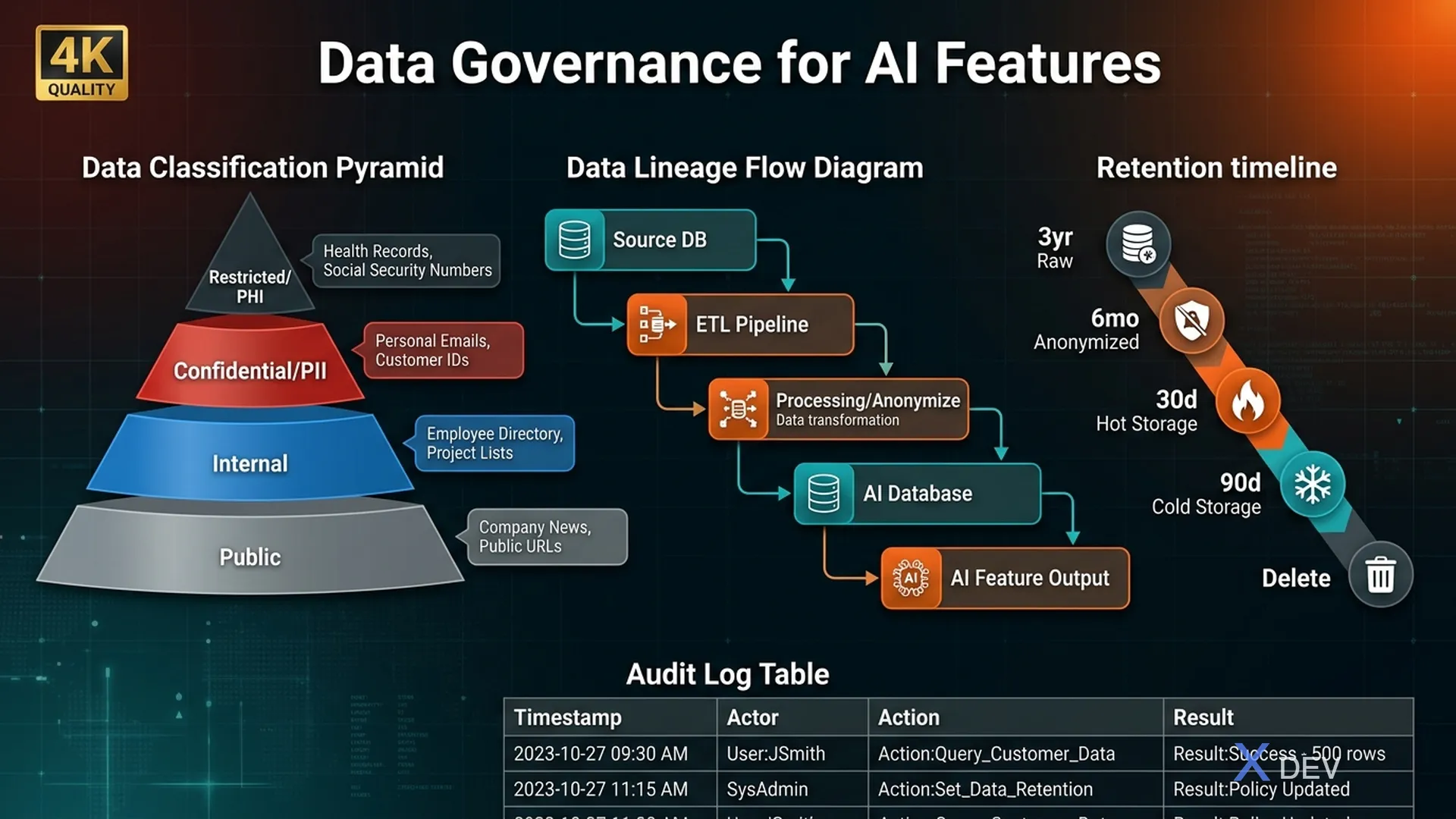
"Can this data be used to train AI?" "How long do we keep customer data?" "Who can access production data?" — Without a data governance policy, BA has no clear answers.
This guide teaches BA how to build a data governance framework for AI features.
1. Data Governance vs Data Security
| Aspect | Data Governance | Data Security |
|---|---|---|
| Focus | Which data? From where? Used for what? | Who accesses? How is it protected? |
| Owner | BA, Data Steward | Security team, DevOps |
| Scope | Lineage, lifecycle, quality | Encryption, audit logs, access control |
| Question | "Can we use this data?" | "Who can access this data?" |
BA focuses on governance; security team implements controls.
2. Data Lineage — Trace Data from Source
Data Lineage = Documented path of data from source → processing → AI → output
Example: AI chatbot suggests product recommendations

Source Data:
  ├─ Production DB: user_transactions table
  ├─ Third-party: product_catalog API
  └─ User input: chat message

Processing:
  ├─ ETL pipeline extracts user_transactions daily
  ├─ Join with product_catalog
  ├─ Anonymize user_id → user_hash
  └─ Load to AI feature database

AI Processing:
  ├─ Embedding model consumes user_hash + product features
  ├─ Similarity search + ranking
  └─ Top 5 recommendations output

Output:
  └─ Frontend displays recommendations
      ├─ Track: user saw which recommendation
      ├─ Track: user clicked which one
      └─ Feedback loop back to training data?
BA must document:
- Source system + extraction frequency
- Data transformation rules (anonymization? aggregation?)
- Database/table where AI data is stored
- Who has access (read-only? write?)
- Retention: How long to keep source data after processing?
3. Data Classification — PII / PHI / Public
Classify data by sensitivity level:
| Level | Definition | Examples | Handling |
|---|---|---|---|
| Public | Non-sensitive, can be shared | Product catalog, generic feedback | No restriction |
| Internal | Company only, not customer-facing | Sales metrics, internal emails | Restricted access |
| Confidential (PII/PHI) | Customer personal / health data | Name, email, phone, medical records | Encrypt, anonymize, audit log |
| Restricted | Regulatory requirement | Credit card, biometric data | Compliance team must approve |
Examples:
User table fields:
- user_id (numeric) → INTERNAL (can help identify)
- email → CONFIDENTIAL (PII, GDPR)
- age → CONFIDENTIAL (PII, discrimination risk)
- purchase_history → INTERNAL + tracking
- medical_history → RESTRICTED (PHI under HIPAA)

Policy per field:
- Which features CAN be in AI training data?
- Which features MUST be anonymized?
- Which CANNOT be used for AI at all?
4. Retention Policy — How Long to Keep?
Policy: Customer transaction data retention

Raw data (source):
  ├─ Keep in production DB: 3 years (per finance audit requirement)
  ├─ Move to cold storage after 1 year
  └─ Delete after 3 years (unless legal hold)

AI training data (processed):
  ├─ Keep anonymized snapshot: 6 months for model version control
  ├─ Delete immediately when user opts out
  └─ Delete on user account deletion (GDPR right to be forgotten)

Chat history (user interaction):
  ├─ Keep for 30 days in hot storage (for escalation handling)
  ├─ Archive after 30 days (60 days in cold storage)
  └─ Delete after 90 days total UNLESS user opts in for training
Triggers for deletion:
- User requests deletion (right to be forgotten)
- User opts out from AI training
- Retention period expires
- Data quality check fails
- Regulatory requirement changes
5. Provenance Tracking — Who Uses Data? When?
Track every access / usage:
Audit log example:

Timestamp         | Actor       | Action                | Data Accessed          | Result
2026-05-05 10:15 | david@co    | Download data export  | user_transactions.csv  | ✅ Success
2026-05-05 10:20 | ai_pipeline | Read user_features    | anonymized_user_*.db   | ✅ 50K records
2026-05-05 10:25 | sarah@qa    | Execute unit test     | test_dataset.json      | ✅ All pass
2026-05-05 10:30 | external_ai | Attempted read PII    | email_addresses.csv    | ❌ Blocked
What to audit:
- Who accessed data (user/service account)
- When (timestamp)
- What data (table/field level)
- Action (read/write/delete/export)
- Result (success/blocked/error)
- Context (from which IP, which system)
6. Data Governance Policy Template
# Data Governance Policy: [AI Feature Name]

## 1. Data Classification

| Data Source | Classification | PII? | Sensitivity | Usage |
|-------------|-----------------|------|-------------|-------|
| user_id | Internal | No | Medium | Train, serve |
| email | Confidential | YES | High | Serve only, no train |
| age | Confidential | YES | High | Train after anonymize |

## 2. Data Lineage

- **Source**: production.user_transactions (MySQL)
- **Extraction**: daily 2 AM (UTC) via Airflow DAG
- **Processing**:
  - Anonymize PII (hash email, remove phone)
  - Aggregate age to 5-year buckets
- **Storage**: warehouse.ai_features (BigQuery)
- **Retention**: 6 months for model versions

## 3. Access Control

| Role | Data | Permission | Context |
|------|------|-----------|---------|
| Data Scientist | anonymized_features | Read | For model training only |
| ML Engineer | model_artifacts | Read/Write | Prod deployment |
| BA | Usage metrics | Read | Monthly review |
| External AI vendor | None | - | No direct access |

## 4. Retention Schedule

- Raw data: Keep 3 years
- Anonymized data: Keep 6 months
- Chat logs: Keep 30 days (hot) → 90 days (cold) → Delete
- Delete triggers: User opt-out, account deletion, retention expires

## 5. User Rights

- User can request: What data do we hold about them?
- User can request: Delete all my data (GDPR)
- User can request: Export my data
- User can opt-out: "Don't use my conversation to train AI"

## 6. Compliance Requirements

- GDPR: Personal data must have consent + right to delete
- CCPA: California residents can opt-out of data sale
- HIPAA: Health data must be de-identified before AI use
- Local law: [Add jurisdiction-specific]
7. Implementation Checklist for BA
BEFORE DEVELOPMENT
☐ Define data classification for every source
☐ Identify PII/PHI fields
☐ Decide: anonymize or exclude?
☐ Set retention policy
☐ Document lineage
☐ Get compliance review

DURING DEVELOPMENT
☐ Implement data masking for confidential fields
☐ Add audit logging
☐ Test data deletion (retention expires)
☐ Test user opt-out trigger
☐ QA verifies correct data flows

AFTER LAUNCH
☐ Monthly audit log review
☐ Quarterly retention policy review
☐ Monitor: Any unauthorized access?
☐ Track: Any user deletion requests?
☐ Update policy if regulations change
8. Common Violations BA Should Prevent
❌ "We'll anonymize data later" → Data stays PII forever ✅ Anonymize AT SOURCE, before AI processing
❌ "We keep user chat for 5 years for model improvement" → GDPR violation ✅ Keep 30 days by default, delete on user opt-out or right-to-be-forgotten
❌ "AI vendor needs access to production database" → Security nightmare ✅ Export anonymized dataset monthly, vendor works with that only
❌ "No audit trail needed, it's internal" → Can't prove compliance later ✅ Always log: who, what, when, why for every data access
Summary
Data Governance for AI = Classify (PII?) + Lineage (from where?) + Retention (how long?) + Access (who sees?) + Provenance (audit trail).
BA doesn't need to build systems, but must define clear policies before dev builds. When compliance questions arise later, BA has concrete policy to reference.