"Dữ liệu này có thể dùng để train AI không?" "Dữ liệu của khách hàng được giữ bao lâu?" "Ai access được production data?" — Nếu không có data governance policy, BA không có câu trả lời rõ ràng.
Bài này dạy BA xây dựng data governance framework cho AI feature.
1. Data Governance vs Data Security
| Khía cạnh | Data Governance | Data Security |
|---|---|---|
| Focus | Nào dữ liệu? từ đâu? dùng cho gì? | Ai access? Bảo vệ như thế nào? |
| Owner | BA, Data Steward | Security team, DevOps |
| Scope | Lineage, lifecycle, quality | Encryption, audit logs, access control |
| Question | "Can we use this data?" | "Who can access this data?" |
BA cần focus vào governance; security team implement controls.
2. Data Lineage — Trace dữ liệu từ nguồn
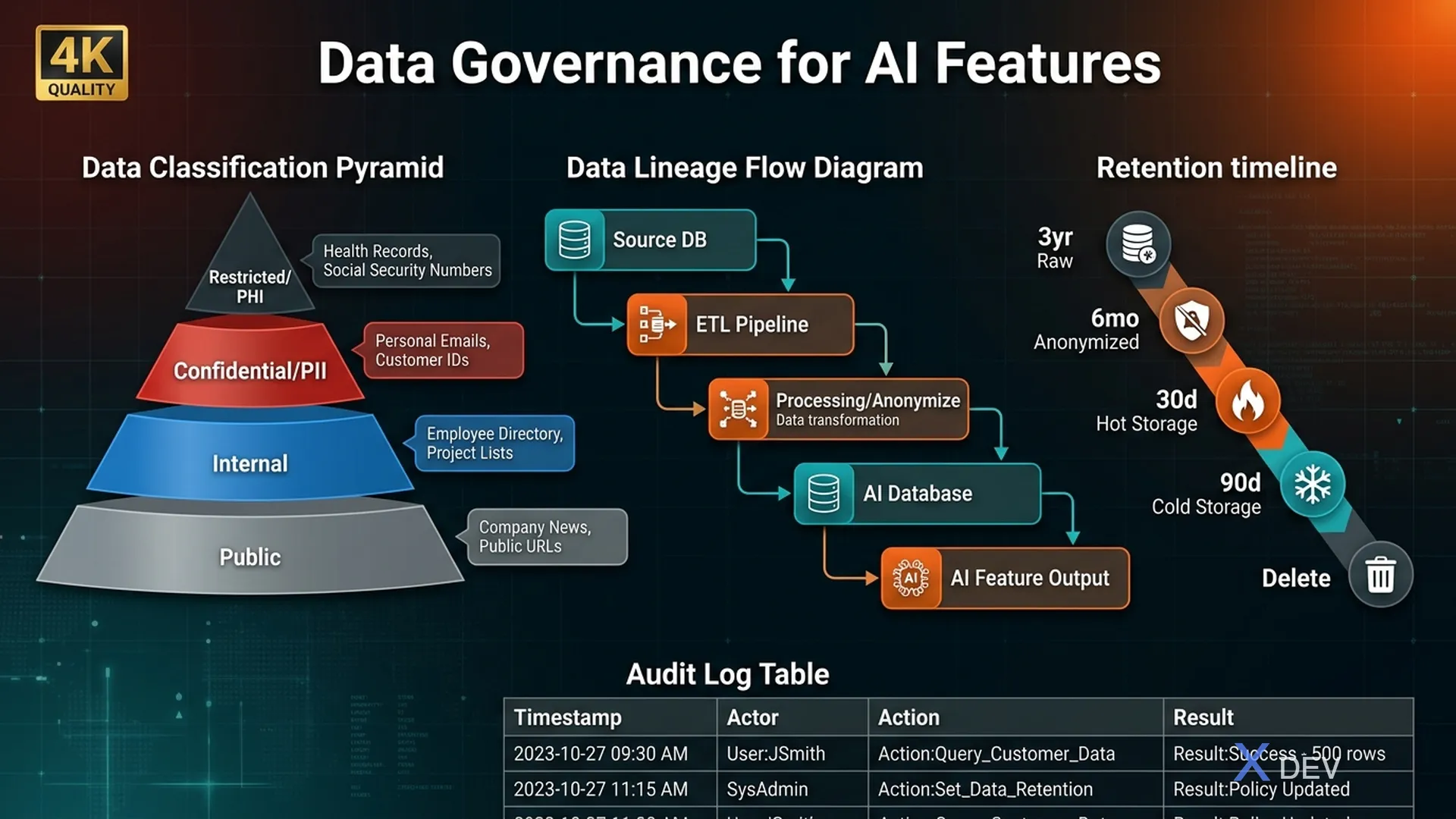
Data Lineage = Documented path của data từ source → processing → AI → output
Example: AI chatbot suggests product recommendations

Source Data:
  ├─ Production DB: user_transactions table
  ├─ Third-party: product_catalog API
  └─ User input: chat message

Processing:
  ├─ ETL pipeline extracts user_transactions daily
  ├─ Join with product_catalog
  ├─ Anonymize user_id → user_hash
  └─ Load to AI feature database

AI Processing:
  ├─ Embedding model consumes user_hash + product features
  ├─ Similarity search + ranking
  └─ Top 5 recommendations output

Output:
  └─ Frontend displays recommendations
      ├─ Track: user saw which recommendation
      ├─ Track: user clicked which one
      └─ Feedback loop back to training data?
BA cần document:
- Source system + extraction frequency
- Data transformation rules (anonymization? aggregation?)
- Database/table where AI data stored
- Who has access (read-only? write?)
- Retention: Bao lâu xóa source data sau khi process?
3. Data Classification — PII / PHI / Public
Phân loại data by sensitivity level:
| Level | Definition | Examples | Handling |
|---|---|---|---|
| Public | Non-sensitive, can be shared | Product catalog, generic feedback | No restriction |
| Internal | Company only, not customer-facing | Sales metrics, internal emails | Restricted access |
| Confidential (PII/PHI) | Customer personal / health data | Name, email, phone, medical records | Encrypt, anonymize, audit log |
| Restricted | Regulatory requirement | Credit card, biometric data | Compliance team approve |
Examples:
User table fields:
- user_id (numeric) → INTERNAL (can help identify)
- email → CONFIDENTIAL (PII, GDPR)
- age → CONFIDENTIAL (PII, discrimination risk)
- purchase_history → INTERNAL + tracking
- medical_history → RESTRICTED (PHI under HIPAA)

Policy per field:
- Which features CAN be in AI training data?
- Which features MUST be anonymized?
- Which CANNOT be used for AI at all?
4. Retention Policy — Giữ bao lâu?
Policy: Customer transaction data retention

Raw data (source):
  ├─ Keep in production DB: 3 years (per finance audit requirement)
  ├─ Move to cold storage after 1 year
  └─ Delete after 3 years (unless legal hold)

AI training data (processed):
  ├─ Keep anonymized snapshot: 6 months for model version control
  ├─ Delete immediately when user opt-out
  └─ Delete on user account deletion (GDPR right to be forgotten)

Chat history (user interaction):
  ├─ Keep for 30 days in hot storage (for escalation handling)
  ├─ Archive after 30 days (60 days cold storage)
  └─ Delete after 90 days total UNLESS user opt-in for training
Triggers for deletion:
- User requests deletion (right to be forgotten)
- User opt-out from AI training
- Retention period expires
- Data quality check fails
- Regulatory requirement changes
5. Provenance Tracking — Ai dùng data? Khi nào?
Track every access / usage:
Audit log example:

Timestamp         | Actor       | Action                | Data Accessed          | Result
2026-05-05 10:15 | david@co    | Download data export  | user_transactions.csv  | ✅ Success
2026-05-05 10:20 | ai_pipeline | Read user_features    | anonymized_user_*.db   | ✅ 50K records
2026-05-05 10:25 | sarah@qa    | Execute unit test     | test_dataset.json      | ✅ All pass
2026-05-05 10:30 | external_ai | Attempted read PII    | email_addresses.csv    | ❌ Blocked
What to audit:
- Who accessed data (user/service account)
- When (timestamp)
- What data (table/field level)
- Action (read/write/delete/export)
- Result (success/blocked/error)
- Context (from which IP, which system)
6. Data Governance Policy Template
# Data Governance Policy: [AI Feature Name]

## 1. Data Classification

| Data Source | Classification | PII? | Sensitivity | Usage |
|-------------|-----------------|------|-------------|-------|
| user_id | Internal | No | Medium | Train, serve |
| email | Confidential | YES | High | Serve only, no train |
| age | Confidential | YES | High | Train after anonymize |

## 2. Data Lineage

- **Source**: production.user_transactions (MySQL)
- **Extraction**: daily 2 AM (UTC) via Airflow DAG
- **Processing**:
  - Anonymize PII (hash email, remove phone)
  - Aggregate age to 5-year buckets
- **Storage**: warehouse.ai_features (BigQuery)
- **Retention**: 6 months for model versions

## 3. Access Control

| Role | Data | Permission | Context |
|------|------|-----------|---------|
| Data Scientist | anonymized_features | Read | For model training only |
| ML Engineer | model_artifacts | Read/Write | Prod deployment |
| BA | Usage metrics | Read | Monthly review |
| External AI vendor | None | - | No direct access |

## 4. Retention Schedule

- Raw data: Keep 3 years
- Anonymized data: Keep 6 months
- Chat logs: Keep 30 days (hot) → 90 days (cold) → Delete
- Delete triggers: User opt-out, account deletion, retention expire

## 5. User Rights

- User can request: What data we hold about them?
- User can request: Delete all data about me (GDPR)
- User can request: Export data
- User can opt-out: "Don't use my conversation to train AI"

## 6. Compliance Requirement

- GDPR: Personal data must have consent + right to delete
- CCPA: California residents can opt-out of data sale
- HIPAA: Health data must be de-identified before AI use
- Local law: [Add jurisdiction-specific]
7. Implementation Checklist for BA
BEFORE DEVELOPMENT
☐ Define data classification for every source
☐ Identify PII/PHI fields
☐ Decide: anonymize or exclude?
☐ Set retention policy
☐ Document lineage
☐ Get compliance review

DURING DEVELOPMENT
☐ Implement data masking for confidential fields
☐ Add audit logging
☐ Test data deletion (retention expire)
☐ Test user opt-out trigger
☐ QA verify correct data flows

AFTER LAUNCH
☐ Monthly audit log review
☐ Quarterly retention policy review
☐ Monitor: Any unauthorized access?
☐ Track: Any user deletion requests?
☐ Update policy if regulation changes
8. Common violations BA should prevent
❌ "We'll anonymize data later" → Data stays PII forever ✅ Anonymize AT SOURCE, before AI processing
❌ "We keep user chat for 5 years for model improvement" → GDPR violation ✅ Keep 30 days default, delete on user opt-out or right-to-be-forgotten
❌ "AI vendor needs access to production database" → Security nightmare ✅ Export anonymized dataset monthly, vendor works with that only
❌ "No audit trail needed, it's internal" → Can't prove compliance later ✅ Always log: who, what, when, why for every data access
Tổng kết
Data Governance cho AI = Classify (PII?) + Lineage (từ đâu?) + Retention (giữ bao lâu?) + Access (ai xem?) + Provenance (audit trail).
BA không cần build systems, nhưng phải define policies rõ ràng trước khi dev build. Khi có compliance question sau, BA có concrete policy để refer tới.