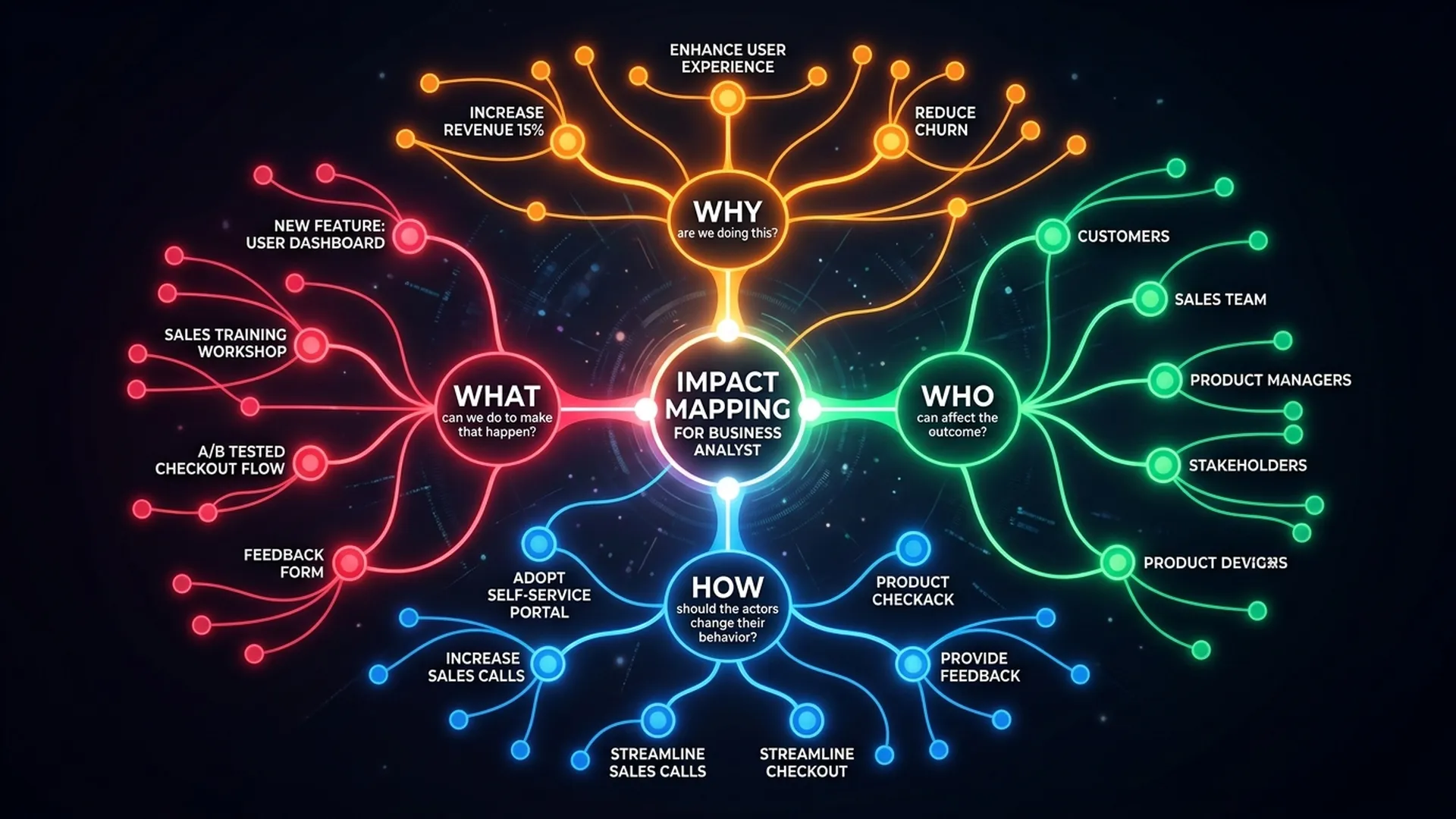
One of the most common anti-patterns in product development is the feature factory - teams keep building features without understanding how those features affect business goals. Impact Mapping is the technique that helps BA and teams break out of that loop.
What is Impact Mapping?
Impact Mapping is a strategic planning technique created by Gojko Adzic. It creates a visual map structured as WHY -> WHO -> HOW -> WHAT:
                    [GOAL]
                       |
        ┌──────────────┼──────────────┐
        ↓              ↓              ↓
    [Actor 1]      [Actor 2]      [Actor 3]
        |              |              |
    ┌───┴───┐      ┌───┴───┐      ┌───┴───┐
    ↓       ↓      ↓       ↓      ↓       ↓
[Impact] [Impact] [Impact][Impact][Impact][Impact]
    |       |
┌───┴┐  ┌───┴┐
↓    ↓  ↓    ↓
[Del][Del][Del][Del]
| Level | Question | Example |
|---|---|---|
| Goal (WHY) | Why are we doing this? | Increase Q3 revenue by 20% |
| Actors (WHO) | Who influences the goal? | Customer, Sales team, Support |
| Impacts (HOW) | How do their behaviors need to change? | Customers self-serve more |
| Deliverables (WHAT) | What do we need to build to create that impact? | AI chatbot, Self-service portal |
Why is Impact Mapping important for BA?
Traditional problem:
- Stakeholder requests a feature -> BA documents it -> Dev builds it -> Feature is delivered but... the business goal is still not met
- The team does not know why it is building this
- Prioritization is driven by the "squeaky wheel" instead of business value
What Impact Mapping solves:
- Traceability: Every deliverable can be traced back to a business goal
- Scope management: Easier to cut scope without hurting the goal
- Alignment: Everyone on the team understands the WHY
- Out-of-scope decisions: Easier to say "no" to features that cannot be mapped back to a goal
How to create an Impact Map for AI projects
Step 1: Define the Goal (WHY)
The goal must be a business outcome, not an output:
❌ Not good: "Launch an AI chatbot" ✅ Good: "Reduce support tickets by 40% within 6 months"
❌ Not good: "Implement a recommendation engine" ✅ Good: "Increase average order value by 15%"
Goal formula: [Metric] [Direction] [Value] [Timeframe]
Step 2: Identify Actors (WHO)
List all people/systems that can influence the goal:
Primary Actors (directly achieve the goal):
- End users (customers, employees)
- Business stakeholders
Secondary Actors (support primary actors):
- Internal teams (support, sales, ops)
- External partners
Off-stage Actors (indirect influence):
- Regulators
- Competitors
- External systems/APIs
Step 3: Define Impacts (HOW)
For each actor, ask: "What do they need to do DIFFERENTLY for the goal to be achieved?"
An impact must be a behavior change, not a feature:
❌ "Use the chatbot" (an action, not a behavior change) ✅ "Resolve problems independently without calling the hotline"
❌ "Receive recommendation email" ✅ "Buy additional products they previously did not know about"
Impact template: "[Actor] will [verb] [behavior change]"
Step 4: Brainstorm Deliverables (WHAT)
For each impact, ask: "What could we build to create that impact?"
This is the brainstorming step - list many options, do not filter yet:
- AI features
- UX improvements
- Process changes
- Content/documentation
- Integrations
AI-specific deliverables to consider:
- Conversational AI (chatbot, voice assistant)
- Recommendation engine
- Predictive analytics dashboard
- Automated classification/routing
- AI-assisted search
- Personalization engine
Step 5: Prioritize using the Impact Map
Once the map is complete:
- Identify the critical path: Which deliverable creates the largest impact on the goal?
- Estimate confidence: How confident are we that this deliverable will create that impact?
- Consider effort: Is this high impact / low effort?
- Slice it: Can we deliver a smaller part that still tests the hypothesis?
Real example: AI Customer Support
Scenario: An e-commerce company wants to improve customer experience
Impact Map:
GOAL: Tăng CSAT từ 3.2 → 4.5 trong Q3 2026

WHO: Customer
HOW:
  - Nhận câu trả lời trong < 2 phút (không phải 24h)
  - Tự track order status mà không cần chat
  - Hiểu chính sách return rõ ràng ngay lần đầu
WHAT:
  - AI chatbot với instant response
  - Order tracking self-service
  - AI-powered FAQ with clear policy explanations

WHO: Support Agent
HOW:
  - Dành thời gian cho complex cases thay vì repetitive Q&A
  - Có context đầy đủ khi escalation xảy ra
WHAT:
  - AI triage & routing system
  - AI-generated conversation summary cho escalations
  - Suggested response templates

WHO: Product Manager
HOW:
  - Biết pain points thực sự của customer
  - Prioritize roadmap dựa trên impact
WHAT:
  - AI analytics dashboard từ chat data
  - Automated pattern detection từ negative feedback
Impact Mapping in Agile Sprints
Impact Mapping is often done once at the beginning of a project, but BA should:
- Review quarterly - Has the business goal changed?
- Update after each release - Did the map deliver the expected impacts?
- Use it as a backlog filter - Every new story must map to an impact in the map
- Present it in sprint reviews - Show stakeholders: "Which impact did this sprint achieve?"
Impact Mapping vs User Story Mapping
| Impact Mapping | User Story Mapping | |
|---|---|---|
| Focus | Business outcomes | User journey/workflow |
| Level | Strategic | Tactical |
| When | Early planning, quarterly review | Sprint planning |
| Output | Prioritized impacts & deliverables | Prioritized story backlog |
| Used by | BA + Product + Business | BA + Dev + QA |
Best practice: Use Impact Mapping to define scope and priority, and use User Story Mapping to plan delivery.
Tools for creating an Impact Map
| Tool | How to use it |
|---|---|
| Miro | Digital whiteboard with ready-made templates |
| Mermaid diagram | Code-based, versionable in Git |
| FigJam | Collaborative tool for Figma teams |
| Draw.io / Lucidchart | Formal diagrams |
| Sticky notes | Workshops with stakeholders |
Mermaid template:
mindmap
  root((Tăng CSAT 4.5))
    Customer
      Self-serve order tracking
        Real-time tracking page
        SMS/email notifications
      Instant answers
        AI chatbot
        Smart FAQ
    Support Agent
      Handle complex cases only
        AI triage system
        Auto-routing
Common mistakes in Impact Mapping
- Goal is too vague: "Improve customer experience" -> not measurable
- Ignoring secondary actors: Forgetting that internal teams also need behavior change
- Jumping straight to WHAT: Missing the HOW step -> deliverables have no narrative
- Not reviewing after launch: Build the map once and leave it there -> it loses value
- Too much detail in WHAT: Impact Map is a strategic view; user stories hold the details
Conclusion
Impact Mapping is especially powerful for BA in the AI era because AI features often have unclear ROI and are easy to build because of "trend pressure" rather than business need. When you map every AI feature to a specific business goal with measurable impact, you can:
- Justify AI investment to executives
- Cut features that have no business case
- Align data science and product teams on priorities
- Measure success in a meaningful way
Start with one goal and 2-3 actors - do not try to build the perfect map from day one.