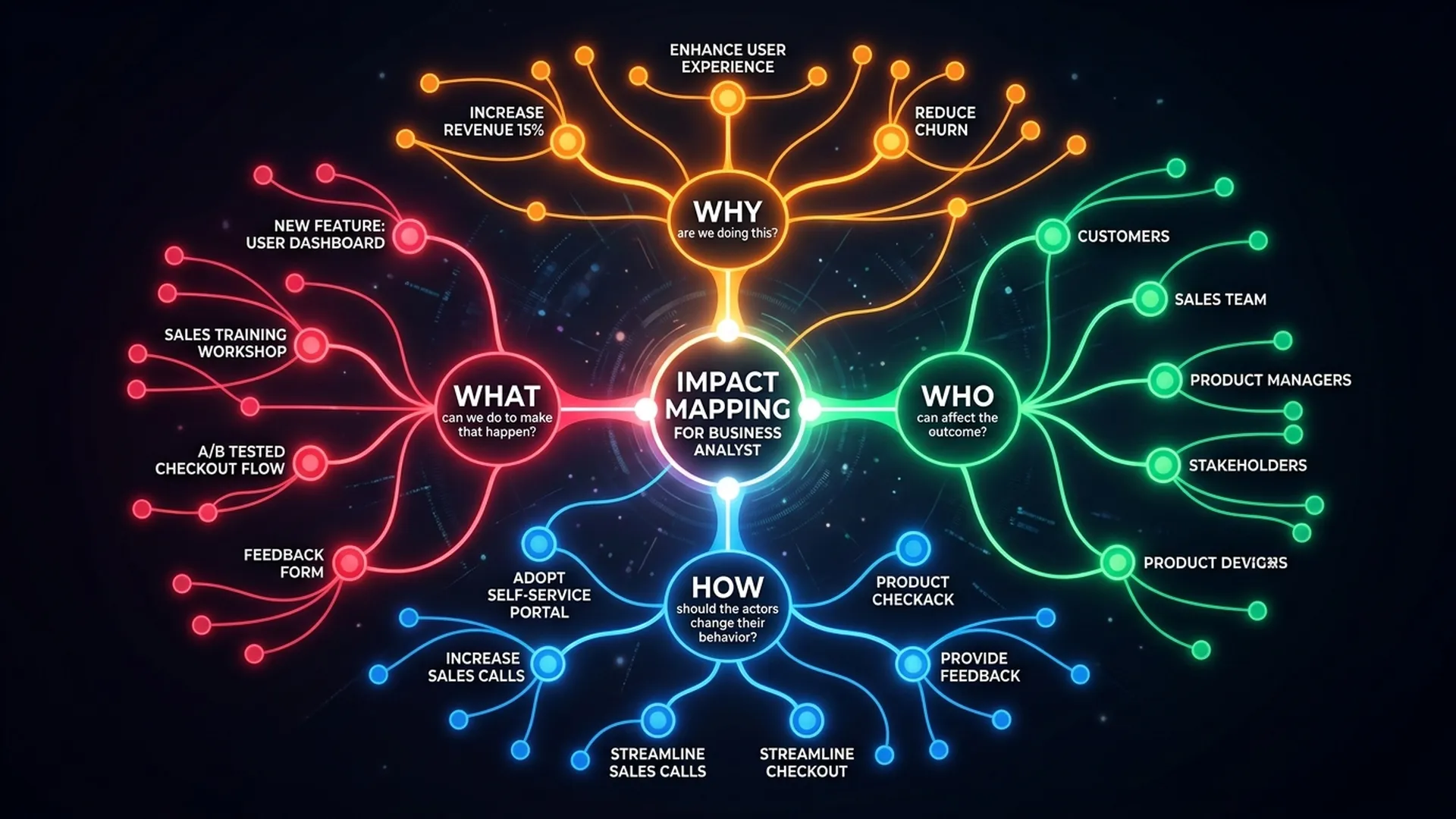
產品開發中最常見的 anti-pattern 之一,就是 feature factory。team 一直在 build features,卻不清楚這些 feature 對 business goal 有什麼影響。Impact Mapping 就是幫助 BA 與 team 擺脫這種循環的 technique。
Impact Mapping 是什麼?
Impact Mapping 是 Gojko Adzic 提出的 strategic planning technique,會建立一張依照 WHY -> WHO -> HOW -> WHAT 結構呈現的 visual map:
                    [GOAL]
                       |
        ┌──────────────┼──────────────┐
        ↓              ↓              ↓
    [Actor 1]      [Actor 2]      [Actor 3]
        |              |              |
    ┌───┴───┐      ┌───┴───┐      ┌───┴───┐
    ↓       ↓      ↓       ↓      ↓       ↓
[Impact] [Impact] [Impact][Impact][Impact][Impact]
    |       |
┌───┴┐  ┌───┴┐
↓    ↓  ↓    ↓
[Del][Del][Del][Del]
| Level | 問題 | 範例 |
|---|---|---|
| Goal (WHY) | 我們為什麼要做這件事? | Q3 revenue 提高 20% |
| Actors (WHO) | 誰會影響這個 goal? | Customer、Sales team、Support |
| Impacts (HOW) | 他們的 behavior 要如何改變? | Customer 更常自助完成流程 |
| Deliverables (WHAT) | 我們要 build 什麼來產生這個 impact? | AI chatbot、Self-service portal |
為什麼 Impact Mapping 對 BA 很重要?
傳統問題:
- Stakeholder 提出 feature request -> BA document -> Dev build -> Feature delivered,但 business goal 沒有達成
- Team 不知道自己為什麼要 build 這個功能
- Prioritization 依賴 "squeaky wheel",而不是 business value
Impact Mapping 解決:
- Traceability:每個 deliverable 都能 trace 回 business goal
- Scope management:更容易 cut scope,卻不傷害 goal
- Alignment:team 每個人都理解 WHY
- Out-of-scope decisions:對無法 map 回 goal 的 feature,更容易說「不」
如何為AI專案建立Impact Map
Step 1: 定義 Goal(WHY)
Goal 必須是 business outcome,而不是 output:
❌ 不理想:"Launch an AI chatbot" ✅ 理想:"6 個月內將 support tickets 降低 40%"
❌ 不理想:"Implement recommendation engine" ✅ 理想:"平均訂單金額提高 15%"
Goal 寫法公式:[Metric] [Direction] [Value] [Timeframe]
Step 2: Identify Actors(WHO)
列出所有可能影響 goal 的人或系統:
Primary Actors(直接達成 goal 的角色):
- End users(customers、employees)
- Business stakeholders
Secondary Actors(支援 primary actors 的角色):
- Internal teams(support、sales、ops)
- External partners
Off-stage Actors(間接影響者):
- Regulators
- Competitors
- External systems/APIs
Step 3: Define Impacts(HOW)
對每個 actor 問:「要讓 goal 達成,他們必須做出什麼不同的行為?」
Impact 必須是 behavior change,不是 feature:
❌ "使用 chatbot"(這是 action,不是 behavior change) ✅ "不用打 hotline 也能自行解決問題"
❌ "收到 recommendation email" ✅ "購買原本不知道的額外商品"
Impact 寫法:"[Actor] will [verb] [behavior change]"
Step 4: Brainstorm Deliverables(WHAT)
對每個 impact 問:「我們可以 build 什麼來產生這個 impact?」
這是 brainstorming 階段,先列出多種選項,不先過濾:
- AI features
- UX improvements
- Process changes
- Content/documentation
- Integrations
值得考慮的 AI-specific deliverables:
- Conversational AI(chatbot、voice assistant)
- Recommendation engine
- Predictive analytics dashboard
- Automated classification/routing
- AI-assisted search
- Personalization engine
Step 5: 用Impact Map做Prioritize
Map 完成之後:
- 找出 critical path:哪個 deliverable 對 goal 影響最大?
- 估算 confidence:我們有多大把握它真的會產生那個 impact?
- 考量 effort:這是不是 high impact / low effort?
- 切小驗證:能不能先 deliver 一個更小的 slice 來驗證 hypothesis?
實例:AI Customer Support
Scenario:E-commerce 想改善 customer experience
Impact Map:
GOAL: Tăng CSAT từ 3.2 → 4.5 trong Q3 2026

WHO: Customer
HOW:
  - Nhận câu trả lời trong < 2 phút (không phải 24h)
  - Tự track order status mà không cần chat
  - Hiểu chính sách return rõ ràng ngay lần đầu
WHAT:
  - AI chatbot với instant response
  - Order tracking self-service
  - AI-powered FAQ with clear policy explanations

WHO: Support Agent
HOW:
  - Dành thời gian cho complex cases thay vì repetitive Q&A
  - Có context đầy đủ khi escalation xảy ra
WHAT:
  - AI triage & routing system
  - AI-generated conversation summary cho escalations
  - Suggested response templates

WHO: Product Manager
HOW:
  - Biết pain points thực sự của customer
  - Prioritize roadmap dựa trên impact
WHAT:
  - AI analytics dashboard từ chat data
  - Automated pattern detection từ negative feedback
Impact Mapping 在 Agile Sprints 中的用法
Impact Mapping 通常在 project 一開始 做一次,但 BA 應該:
- 每季 review - business goal 有沒有變?
- 每次 release 後更新 - Map 是否真的 deliver 了預期 impacts?
- 拿來做 backlog filter - 每個新 story 都應該 map 到 map 裡的某個 impact
- 在 sprint review 中展示 - 告訴 stakeholders:「這個 sprint 達成了哪個 impact?」
Impact Mapping vs User Story Mapping
| Impact Mapping | User Story Mapping | |
|---|---|---|
| Focus | Business outcomes | User journey/workflow |
| Level | Strategic | Tactical |
| When | Early planning、quarterly review | Sprint planning |
| Output | Prioritized impacts & deliverables | Prioritized story backlog |
| Used by | BA + Product + Business | BA + Dev + QA |
Best practice:用 Impact Mapping 定義 scope 與 priority,再用 User Story Mapping 規劃 delivery。
建立Impact Map的工具
| Tool | 使用方式 |
|---|---|
| Miro | 附 template 的 digital whiteboard |
| Mermaid diagram | Code-based,可用 Git 版本管理 |
| FigJam | 適合 Figma team 協作 |
| Draw.io / Lucidchart | 正式 diagram 工具 |
| Sticky notes | 用於 stakeholder workshop |
Mermaid template:
mindmap
  root((Tăng CSAT 4.5))
    Customer
      Self-serve order tracking
        Real-time tracking page
        SMS/email notifications
      Instant answers
        AI chatbot
        Smart FAQ
    Support Agent
      Handle complex cases only
        AI triage system
        Auto-routing
做Impact Mapping常見的錯誤
- Goal 太模糊:"Improve customer experience" -> 無法衡量
- 忽略 secondary actors:忘記 internal teams 也需要改變 behavior
- 直接跳到 WHAT:少了 HOW,deliverables 就沒有清楚 narrative
- Launch 後不 review:做一次就放著,價值會快速消失
- WHAT 太細:Impact Map 是 strategic view,細節應留給 user stories
結論
Impact Mapping 對 AI 時代的 BA 特別有力,因為 AI features 常常 ROI 不明確,也很容易因為「趨勢」而 build,而不是因為 business need。當你把每個 AI feature 都 map 到一個具體且可衡量 impact 的 business goal 時,你就可以:
- 向 executives justify AI investment
- Cut 掉沒有 business case 的 features
- 讓 data science 與 product teams 在 priorities 上 align
- 用更有意義的方式衡量 success
先從一個 goal 和 2-3 個 actors 開始,不要一開始就追求 perfect map。