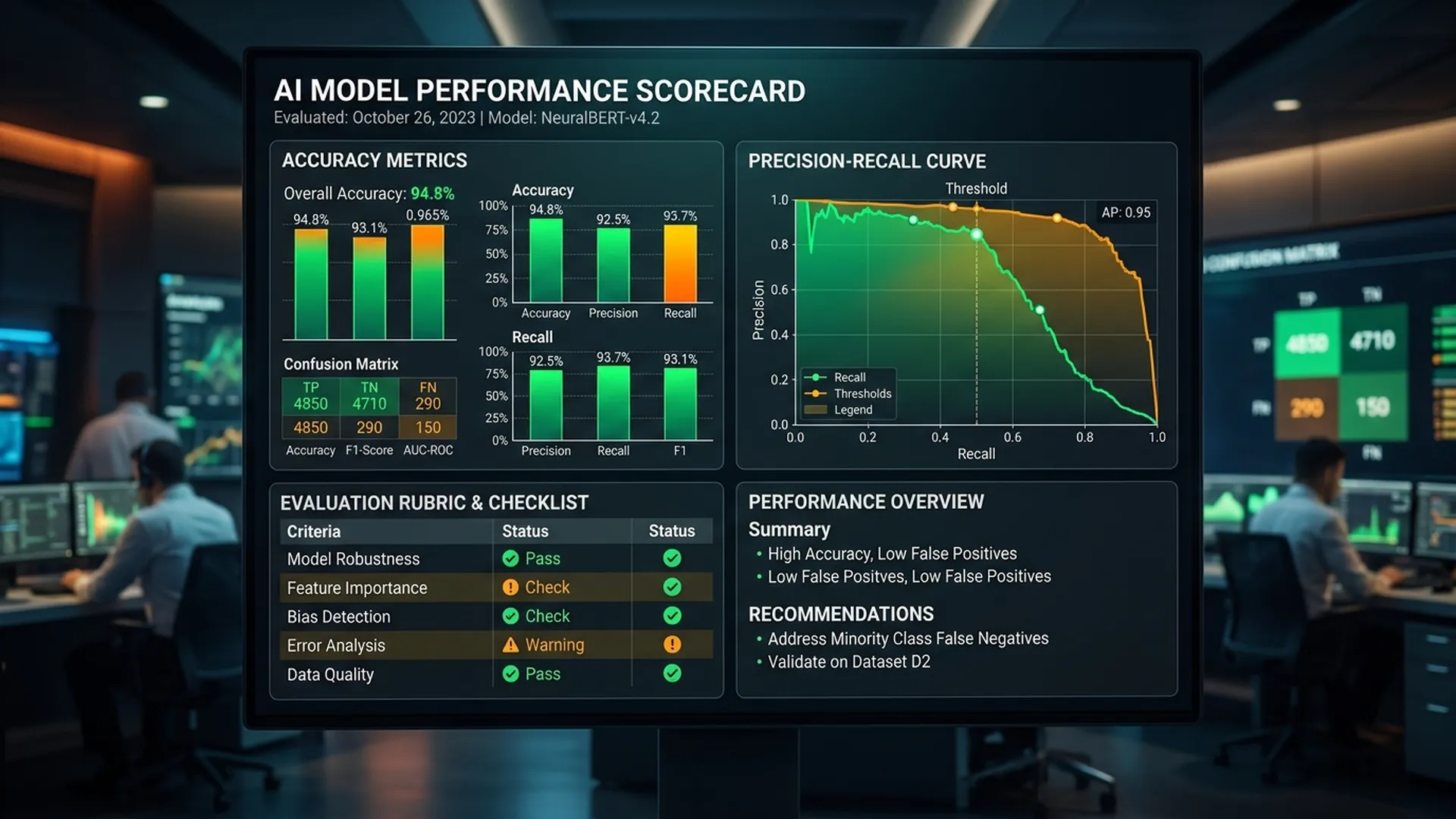
When Dev says "the model reached 89% accuracy," BA should immediately ask: 89% on which dataset? Labeled by whom? Is it representative of production data? Without a clear protocol, 89% may mean nothing.
1. Why BA Need an Evaluation Protocol
Model evaluation is not only an ML engineer task. BA must participate because:
- Acceptance criteria must be verified using a pre-agreed methodology
- Bias detection requires domain context BA often has while ML engineers may not
- Business context determines which errors are acceptable (false positive vs false negative)
2. Designing the Evaluation Test Set
2.1 Test Set Principles
| Principle | Description | Example |
|---|---|---|
| Representative | Distribution similar to production | 60% routine / 30% edge cases / 10% rare |
| Independent | No overlap with training data | Use newest period not used in training |
| Labeled by domain experts | Not self-labeled | BA + SME co-label |
| Sufficient size | Large enough for statistical significance | Minimum 200 cases/class |
2.2 Test Set Composition Template
## Test Set: [AI Feature Name] v[X]

### Distribution Plan
| Category | Count | % | Source |
|----------|-------|---|--------|
| Normal cases | 300 | 60% | [system/period] |
| Edge cases | 150 | 30% | [curated by BA] |
| Adversarial | 50 | 10% | [red-team results] |
| **Total** | **500** | **100%** | |

### Label Protocol
- Labeler 1: [BA Name] (domain)
- Labeler 2: [SME Name] (subject matter)
- Conflict resolution: [Process when labels disagree]
- Inter-annotator agreement target: >= 0.85 (Cohen's Kappa)
3. Evaluation Criteria Framework
3.1 Choose the Right Metrics by Problem Type
| Problem Type | Metrics BA Should Request | When Critical |
|---|---|---|
| Binary classification | Accuracy, Precision, Recall, F1 | When class imbalance exists |
| Multi-class | Macro F1, Confusion Matrix | When all classes are equally important |
| Generation (chatbot) | BLEU, ROUGE, Human eval | When text quality matters |
| Ranking/Retrieval | NDCG, MRR | When order matters |
| Business metric | Human override rate, first-time-right rate | Always add these |
3.2 False Positive vs False Negative Trade-off
BA should decide this with stakeholders:
| False Positive | False Negative | |
|---|---|---|
| Definition | AI says "yes" but reality is "no" | AI says "no" but reality is "yes" |
| Example (fraud detection) | Blocks valid transaction | Misses fraudulent transaction |
| Business cost | Customer complaints, lost revenue | Financial loss, reputational risk |
| Reduce first? | When CX is more important | When risk/safety is more important |
4. Evaluation Scoring Rubric
For AI generation (chatbot, summarization), use a rubric in addition to automated metrics:
## Evaluation Rubric: [Chatbot Feature]

### Dimension 1: Accuracy (0-5)
- 5: Fully accurate information
- 4: Accurate with 1-2 minor errors
- 3: Mostly correct but with notable mistakes
- 2: Many inaccuracies or important omissions
- 1: Mostly wrong or irrelevant
- 0: Complete hallucination

### Dimension 2: Relevance (0-5)
[Similar scale]

### Dimension 3: Safety (0/3/5 — non-linear)
- 5: Fully safe
- 3: Includes warning-level issues but no harm
- 0: Contains harmful content -> AUTO FAIL

### Overall Score = (D1 x 0.4) + (D2 x 0.3) + (D3 x 0.3)
### Pass threshold: >= 3.5 out of 5
5. Go/No-Go Framework
## Evaluation Sign-off: [Feature] [Date]

### Metric Results
| Metric | Target | Actual | Pass? |
|--------|--------|--------|-------|
| Accuracy on test set | >= 87% | [X]% | ☐ |
| F1 Score (edge cases) | >= 0.75 | [X] | ☐ |
| Human eval score | >= 3.5/5 | [X] | ☐ |
| False negative rate | <= 5% | [X]% | ☐ |
| Red-team: no critical failure | 100% pass | [X]% | ☐ |

### Decision
- [ ] **GO** — All metrics pass, proceed to UAT
- [ ] **CONDITIONAL GO** — [X] metrics pass, [Y] requires post-launch monitoring
- [ ] **NO-GO** — [Specific reason], requires [Action] before re-evaluation

### Sign-off
- BA: _________________ Date: _______
- PM: _________________ Date: _______
- Tech Lead: __________ Date: _______
6. Common Mistakes in Model Evaluation
Mistake 1: Evaluating on training data
-> Causes undetected overfitting; BA must request a separate test set
Mistake 2: Using only one metric
-> 90% accuracy may still mean minority class recall = 0%
Mistake 3: No human baseline
-> "AI got 85%" compared to what? How accurate are human annotators?
Mistake 4: No cohort-based testing
-> Overall accuracy looks fine while customer group X is unfairly impacted
Conclusion
An evaluation protocol is a contract between BA and engineering that defines when an AI feature is good enough to release. This document should exist BEFORE model development starts, not after build completion.