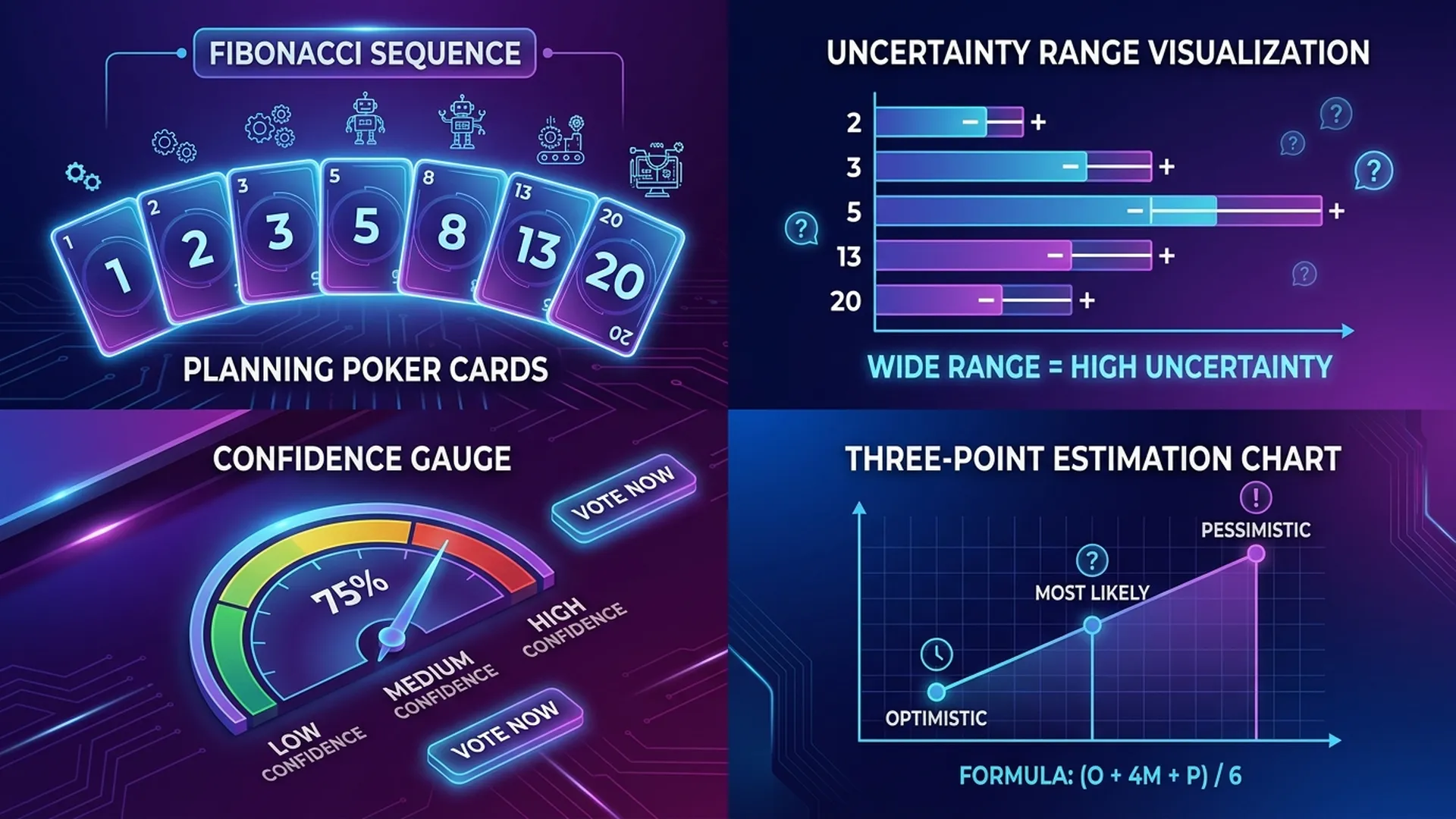
"How many points should we estimate for this story?" — Easy for a standard CRUD feature. But for an AI feature, the answer is usually "it depends" — and that's not what stakeholders want to hear.
1. Why Are AI Stories Harder to Estimate?
AI work has 3 sources of uncertainty that regular features don't:
| Source of Uncertainty | Example | Impact |
|---|---|---|
| Data readiness | Data pipeline isn't ready yet | Blocks the entire story |
| Model performance | Will accuracy meet the threshold? | Requires more iteration |
| Experiment branching | Approach A fails, have to redo with approach B | Sprint scope changes |
2. Story Types in an AI Project
Distinguish 3 types of stories to estimate correctly:
Type 1: Standard Implementation Story
Feature is well-defined, AI role is already designed:
"As an agent, I want to see AI suggestion in review UI
 [UI already designed, API spec available]"
→ Estimate normally using Planning Poker
Type 2: Spike Story (Research Story)
Approach unknown, needs investigation first:
"Spike: Evaluate 3 embedding models for customer query classification.
 Timebox: 2 days. Output: Recommendation doc."
→ Do not estimate story points — fixed timebox
→ Output of Spike = input to estimate the Implementation story
Type 3: Experiment Story
Needs to run experiments; outcome is uncertain:
"Experiment: Test GPT-4o-mini vs Claude Haiku for ticket categorization.
 Success criterion: Either model reaches 87% accuracy.
 Timebox: 3 days. If neither passes → escalate to team."
→ Timebox + success criterion, not story points
3. Adapted Planning Poker for AI Stories
3.1 Add an "Uncertainty Dimension" to the Estimate
Traditional Planning Poker: 1 number (effort)
AI Adapted: 2 numbers (effort × confidence)
Estimate format: [Points] / [Confidence: H/M/L]

Example:
- Dev 1: "8 / M" — 8 points but medium confidence
- Dev 2: "13 / L" — 13 points with low confidence (many unknowns)
- BA: "5 / H" — 5 points, high confidence (requirements are clear)
When there's a large divergence → discuss the source of uncertainty before re-estimating.
3.2 Uncertainty Breakdown Discussion
When confidence is low, ask the team:
1. "Which part of this story is unclear?"
2. "What unknowns need to be resolved before we can estimate?"
3. "Do we need a Spike, or can we estimate with a buffer?"
4. Three-Point Estimation (PERT)
When uncertainty is high but you don't want a Spike, use 3-point estimation:
O = Optimistic (everything goes right)
M = Most Likely (normal conditions)
P = Pessimistic (things go wrong)

E (Expected) = (O + 4M + P) / 6

Example: AI model integration story
O = 3 days (API works as documented)
M = 5 days (1 round of debugging)
P = 10 days (API has bugs, need workaround)

E = (3 + 4×5 + 10) / 6 = (3 + 20 + 10) / 6 = 5.5 days
Report to stakeholder: "Expected 5–6 days, range 3–10 days depending on API stability"
5. Communicating Uncertainty to Stakeholders
Principle: Commit to a range, not a precise point
Avoid:
"This feature will be done in sprint 3" (unsubstantiated)
Say instead:
"This feature has 3 parts:
1. UI implementation: High confidence, sprint 3 ✅
2. API integration: Medium confidence, sprint 3–4
3. Model accuracy validation: Low confidence — need Spike sprint 3,
   re-estimate after Spike"
Uncertainty Communication Template
## Feature Estimate: [Feature Name]

### Confident Scope (commit)
- [Component 1]: X points — clear requirements ✅
- [Component 2]: Y points — proven tech ✅

### Uncertain Scope (indicative)
- [Component 3]: ~Z points — pending data validation
- [Component 4]: Need Spike first (2 days timebox)

### Dependencies / Blockers
- [ ] Data pipeline from [team] needed by [date]
- [ ] Model threshold confirmed by [stakeholder]

### Recommended Approach
Sprint N: Spike + Confident scope
Sprint N+1: Uncertain scope (estimate after Spike)
6. Definition of Ready for AI Stories
A story is ready to estimate when:
- Data dependency identified and confirmed available (or spike planned)
- AI/model approach confirmed (or spike planned for approach)
- Acceptance threshold agreed with stakeholder
- Fallback behavior defined
Conclusion
Estimation accuracy matters less than estimation honesty. The BA's role in AI estimation is to structure uncertainty, propose Spikes when needed, and set realistic expectations with stakeholders — not to force a precise number out of thin air.
An AI team's sprint velocity is typically 20–30% lower than a traditional feature team due to Spike work. Build this into capacity planning from the start.