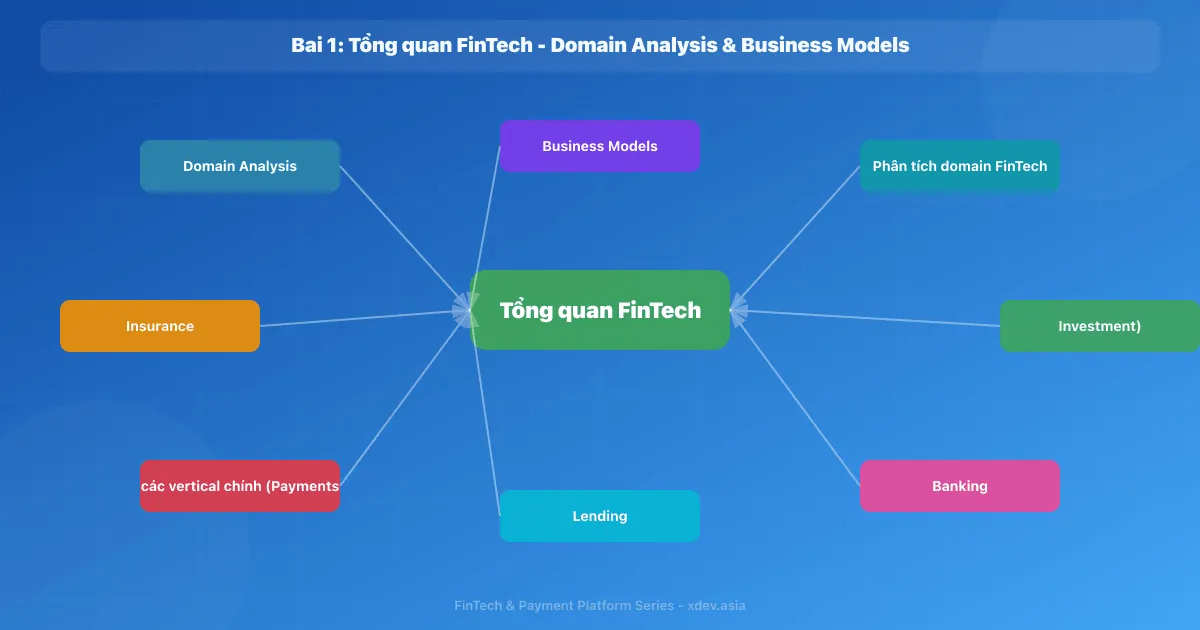
Introduction
FinTech (Financial Technology) has completely changed the way we interact with financial services. From paying by QR code at a coffee shop to borrowing money online in 5 minutes — all are operated by behind-the-scenes FinTech systems.
In this first lesson, we will comprehensively analyze the FinTech domain, understanding the main verticals, business models, and regulatory landscape — especially in the Vietnamese market.
1. What is FinTech?
1.1 Definition
FinTech is the combination of Finance and Technology — using technology to improve, automate, and disrupt traditional financial services.
FinTech = Financial Services + Modern Technology
        = Traditional Banking Problems + Software Solutions
1.2 Evolution of FinTech
| Phase | Period | Features |
|---|---|---|
| FinTech 1.0 | 1866-1967 | Telegraph, transatlantic cables, Telex |
| FinTech 2.0 | 1967-2008 | ATMs, SWIFT, online banking |
| FinTech 3.0 | 2008-2020 | Mobile payments, P2P lending, neobanks |
| FinTech 4.0 | 2020-present | Embedded finance, DeFi, AI-powered, super apps |
1.3 Why is FinTech important for Software Engineers?
- Huge market: Global FinTech market reaches $340B by 2026
- Vietnam market: 50+ million e-wallet users, 80% of the population has smartphones
- High salary: FinTech engineers have top salaries in the market
- Technical challenges: High-throughput, consistency, security, compliance
2. Main Verticals in FinTech
2.1 Payments — Payments
Largest and most popular Vertical:
┌─────────────────────────────────────────────┐
│              PAYMENTS ECOSYSTEM              │
├─────────────┬──────────────┬────────────────┤
│   Online    │   In-store   │    P2P/P2M     │
│  Payments   │  (POS/QR)    │   Transfer     │
├─────────────┼──────────────┼────────────────┤
│ Payment     │ Merchant     │ Cross-border   │
│ Gateway     │ Acquiring    │ Remittance     │
├─────────────┼──────────────┼────────────────┤
│ E-wallet    │ Buy Now      │ Subscription   │
│             │ Pay Later    │ Billing        │
└─────────────┴──────────────┴────────────────┘
Examples in Vietnam: VNPay, MoMo, ZaloPay, ShopeePay, VietQR
2.2 Lending — Lending
Consumer Lending          Business Lending
├── Personal loans        ├── SME loans
├── Buy Now Pay Later     ├── Invoice financing
├── Microloans            ├── Supply chain finance
└── Student loans         └── Revenue-based financing
Example: MoMo (consumer loans), Tima, Fiin Credit
2.3 Digital Banking — Digital banking
- Neobanks: Completely digital bank (no branches)
- Challenger banks: Traditional bank + digital transformation
- Banking-as-a-Service (BaaS): API-first banking infrastructure
Examples in Vietnam: Timo, TNEX, Cake by VPBank
2.4 InsurTech — Technology insurance
- On-demand insurance, parametric insurance
- Claims automation with AI
- Telematics-based pricing
2.5 WealthTech & Investment
- Robo-advisors, fractional investing
- Social trading, copy trading
- Crypto exchanges and DeFi
3. Business Models in FinTech
3.1 Revenue Models
| Model | Description | Example |
|---|---|---|
| Transaction fees | % or fixed fee per transaction | Stripe (2.9% + $0.30) |
| Interchange fee | Fee from network card | Visa, Mastercard |
| Subscription | Monthly/annual fee | Banking apps premium |
| Interest spread | Interest rate differential | Lending platforms |
| FX markup | Spread on exchange rate | Wise, cross-border |
| Freemium | Free basic + paid premium | MoMo, ZaloPay |
| Data monetization | Analytics, insights | Credit scoring data |
3.2 Platform Business Model
┌──────────────────────────────────────────────┐
│              FINTECH PLATFORM                 │
│                                               │
│  ┌─────────┐    ┌──────────┐    ┌─────────┐ │
│  │Consumers│◄──►│ Platform │◄──►│Merchants│ │
│  │(Payers) │    │          │    │(Payees) │ │
│  └─────────┘    └────┬─────┘    └─────────┘ │
│                      │                        │
│              ┌───────┴───────┐                │
│              │  Value-added  │                │
│              │   Services    │                │
│              ├───────────────┤                │
│              │ Analytics     │                │
│              │ Lending       │                │
│              │ Insurance     │                │
│              │ Loyalty       │                │
│              └───────────────┘                │
└──────────────────────────────────────────────┘
4. FinTech Ecosystem in Vietnam
4.1 Main Players
┌─────────────────────────────────────────────────┐
│            VIETNAM FINTECH LANDSCAPE             │
├──────────────┬──────────────────────────────────┤
│ E-Wallets    │ MoMo, ZaloPay, ShopeePay, VNPay │
│ Payment GW   │ VNPay, OnePay, PayOS, 2C2P      │
│ Digital Bank │ Timo, TNEX, Cake, KakaoBank VN   │
│ Lending      │ MoMo, Tima, Fiin, Home Credit    │
│ QR Payment   │ VietQR (NAPAS), VNPay-QR         │
│ Remittance   │ Wise, Remitly, Ria               │
│ InsurTech    │ Papaya, Manulife (digital)        │
└──────────────┴──────────────────────────────────┘
4.2 Market Statistics (2026)
- 55+ million e-wallet users
- VNPay: processes ~30 million transactions/day
- MoMo: 40+ million users, super app strategy
- VietQR: >500 million transactions/year
- Digital payment: accounts for 45% of total payment
4.3 National payment system
┌─────────────────────────────────────────┐
│         NATIONAL PAYMENT SYSTEMS         │
├─────────────────────────────────────────┤
│                                          │
│  NAPAS (National Payment Corp of VN)     │
│  ├── Interbank transfer (IBFT)           │
│  ├── VietQR standard                     │
│  ├── Card switching network              │
│  └── Real-time gross settlement          │
│                                          │
│  SWIFT (International transfers)         │
│  ├── Cross-border payments               │
│  └── Correspondent banking               │
│                                          │
│  SBV (State Bank of Vietnam)             │
│  ├── Licensing & regulation              │
│  ├── Monetary policy                     │
│  └── Payment system oversight            │
│                                          │
└─────────────────────────────────────────┘
5. Regulatory Landscape
5.1 Regulations in Vietnam
| Regulations | Content | Applies to |
|---|---|---|
| Decree 101/2012 | Non-cash payment | Payment intermediaries |
| Circular 39/2014 | Activities providing payment intermediary services | E-wallets, payment gateways |
| Decree 35/2023 | Amendments to non-cash payments | All payment services |
| Electronic Transaction Law 2023 | Digital signatures, electronic contracts | Digital contracts |
| FinTech Sandbox | Regulatory sandbox for FinTech | New FinTech products |
5.2 International regulations
- PCI-DSS: Payment Card Industry Data Security Standard
- PSD2/PSD3: Payment Services Directive (EU)
- SOX: Sarbanes-Oxley Act (financial reporting)
- GDPR/PDPA: Data protection regulations
- Basel III: Banking capital requirements
6. FinTech Trends 2026
6.1 Embedded Finance
Integrating financial services into non-financial platforms:
E-commerce ──► Embedded Payments + BNPL
Ride-hailing ──► Embedded Wallet + Insurance
SaaS ──► Embedded Billing + Lending
Social Media ──► Embedded Tipping + P2P Transfer
6.2 AI-Powered FinTech
- AI Credit Scoring: Alternative data, real-time assessment
- AI Fraud Detection: Behavioral biometrics, anomaly detection
- AI Customer Service: Conversational banking, AI advisors
- Generative AI: Automated financial reports, personalized advice
6.3 Open Banking & API Economy
┌──────────┐     API      ┌──────────┐
│   Bank   │◄────────────►│  FinTech │
│   Core   │              │   App    │
└──────────┘              └──────────┘
     │                         │
     └────────┬────────────────┘
              │
      ┌───────▼───────┐
      │  Open Banking  │
      │   Platform     │
      │  (API Gateway) │
      └───────────────┘
6.4 Real-time Payments
- Instant payment networks (VietQR, UPI, FedNow, PIX)
- ISO 20022 migration
- Request-to-Pay (R2P)
7. Technical Challenges in FinTech
7.1 Key challenges
| Challenge | Description | Solution |
|---|---|---|
| Consistency | Don't lose money | ACID, Saga, Idempotency |
| Availability | 99.99%+ uptime | Multi-region, failover |
| Throughput | Millions TPS peak | Horizontal scaling |
| Latency | < 100ms response | Caching, async processing |
| Security | PCI-DSS, encryption | HSM, tokenization, WAF |
| Compliance | Regulatory reporting | Audit trail, immutable logs |
| Reconciliation | Exact matching | Double-entry ledger |
7.2 FinTech System Characteristics
Financial System Requirements:
├── Correctness > Performance (money can't be lost)
├── Auditability (every transaction must be traceable)
├── Idempotency (duplicate requests must be safe)
├── Consistency (balances must always be correct)
├── Security (defense in depth)
└── Compliance (regulatory requirements must be met)
8. Series Roadmap
8.1 Learning path
Lesson 1-3: Foundation ──► Domain, Architecture, Compliance
Lesson 4-7: Payment ──► Gateway, Processing, Multi-PSP
Lesson 8-11: Wallet ──► E-Wallet, Ledger, Transactions
Lesson 12-14: Risk ──► Fraud Detection, AML/KYC
Lesson 15-18: Banking ──► Core Banking, Lending, Credit
Lesson 19-21: Data ──► Pipeline, Reporting, Analytics
Lesson 22-25: Production ──► Security, HA, Performance, Cases
8.2 Required background knowledge
- Basic understanding of distributed systems
- Experience with at least one backend framework (Spring Boot, Node.js, Go)
- Basic knowledge of databases (SQL, transactions)
- Understanding of REST API and message queues
Summary
FinTech is a complex domain, requiring a combination of deep technical knowledge and understanding of financial operations. In this series, we will go from foundation to production-ready, with a focus on the Vietnamese market and international standards.
Next article: We will design an overall Platform Architecture using Microservices and Domain-Driven Design — defining Bounded Contexts, service boundaries, and communication patterns for FinTech Platform.