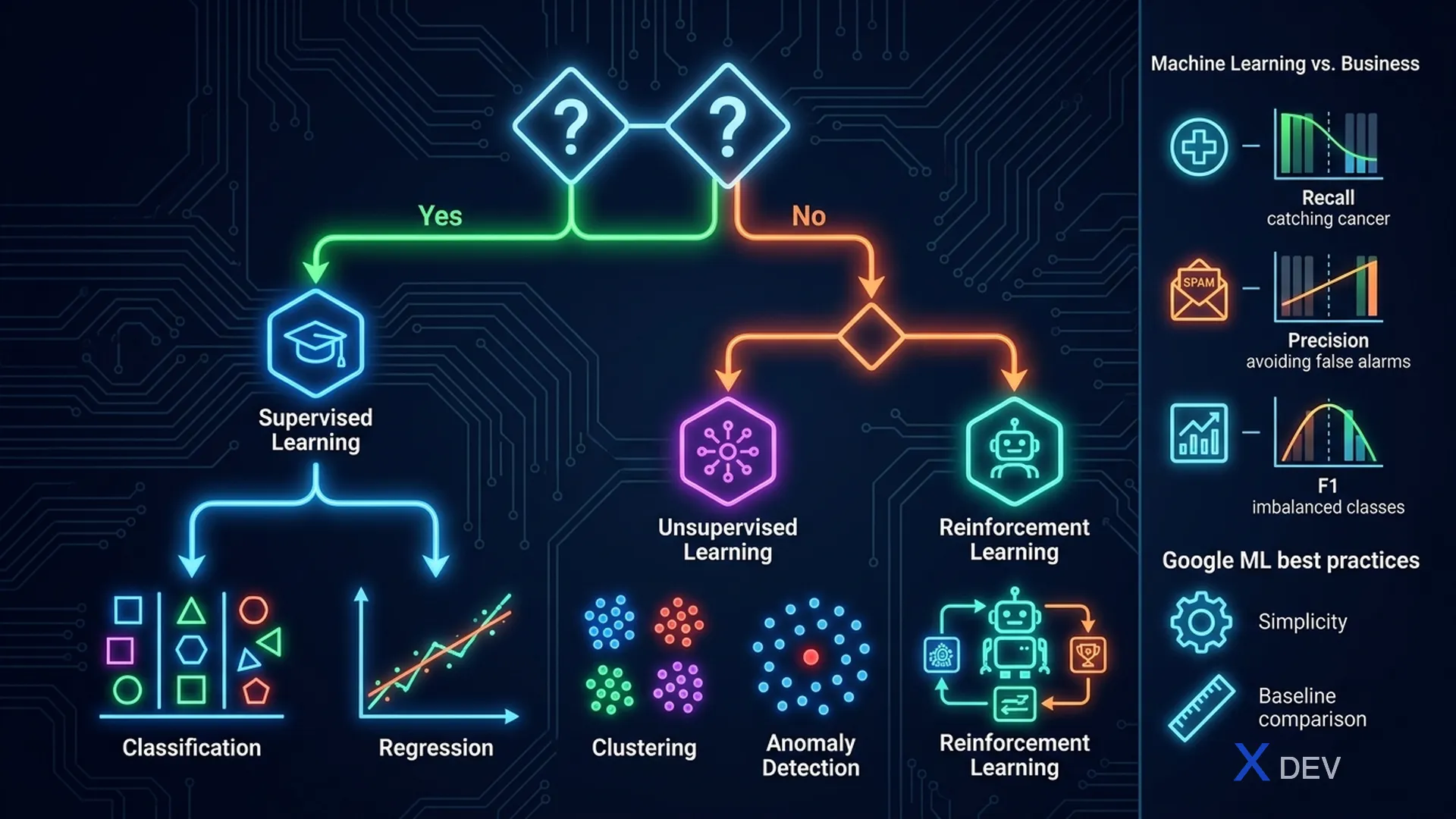
ML Problem Framing: identifying the problem, choosing the model type, and defining metrics per Google standards
1. When to Use ML?
The Google ML certification often tests problem framing — determining whether a problem is suitable for ML and, if so, which type of ML to apply. This is a critical skill for a professional ML Engineer.
| Question to Ask | If "Yes" | If "No" |
|---|---|---|
| Are there complex patterns in the data? | ML can help | Rules-based logic is sufficient |
| Is there enough data (labels)? | Supervised Learning | Unsupervised or collect more data |
| Can the output be clearly defined? | Supervised ML | Clarify with stakeholders |
| Does the problem require an agent interacting with an environment? | Reinforcement Learning | Supervised/Unsupervised |
2. ML Types and When to Use Them
Problem Framing Decision Tree:

Has labeled training data?
    YES → Supervised Learning
           ├── Output is category? → Classification
           └── Output is number? → Regression

    NO → Has examples, no labels?
           YES → Unsupervised Learning
                  ├── Find groups? → Clustering
                  └── Find patterns/anomalies? → Density estimation
           NO → Agent in environment?
                  YES → Reinforcement Learning
                  NO → Reconsider problem definition
| ML Type | When to Use | GCP Services |
|---|---|---|
| Supervised Classification | Email spam, image labels, churn prediction | Vertex AI AutoML, BigQuery ML |
| Supervised Regression | Price prediction, demand forecast | Vertex AI, BigQuery ML BQML_REGRESSOR |
| Unsupervised Clustering | Customer segmentation, topic discovery | Vertex AI Custom Training (k-means) |
| Reinforcement Learning | Game agents, robotics, ad bidding | Vertex AI + custom environment |
| Self-supervised | LLMs, foundation models | Vertex AI Model Garden |
3. Business Metrics vs. ML Metrics
A common mistake is optimizing the wrong metric. ML objectives must align with business goals.
| Business Goal | Wrong ML Metric | Correct ML Metric |
|---|---|---|
| Reduce fraud-related revenue loss | Accuracy (99%!) | Recall (catch more fraud) |
| Reduce spam for better user experience | Recall | Precision (fewer false positives) |
| Forecast inventory demand | MSE | MAPE (scale-independent) |
| Rank products in search results | Accuracy | NDCG, MRR (ranking metrics) |
Exam tip: The Professional ML Engineer exam often asks "which metric BEST aligns with the business objective." For fraud/medical diagnosis → Recall. For spam/precision-critical → Precision. For class imbalance → F1 or AUC-ROC.
4. Data Availability Assessment
| Data Situation | ML Approach |
|---|---|
| Plenty of labeled data | Fully supervised, train from scratch |
| Little labeled data (<1000) | Transfer Learning (pre-trained + fine-tune) |
| No labels | Unsupervised or collect labels (Vertex AI Data Labeling) |
| Labels are expensive | Active Learning — label uncertain samples first |
| Imbalanced data | Oversampling, undersampling, class weights |
5. Google's ML Best Practices
- Start simple: Begin with the simplest model, then increase complexity gradually
- Establish baseline: Compare against heuristics/rules before using ML
- Data quality first: 80% of ML project time is data preparation
- Reproducibility: Pipelines must be reproducible with the same data
- Monitor in production: Models decay over time — continuous monitoring is needed
6. Practice Questions
Q1: A company wants to identify which of its customers are most likely to cancel their subscription in the next 30 days. They have 3 years of historical customer behavior data with known churn events. Which ML approach should they use?
- A) Unsupervised clustering to find customer groups
- B) Reinforcement learning to optimize retention campaigns
- C) Supervised binary classification with historical churn labels ✓
- D) Anomaly detection to find unusual behavior
Explanation: This is a classic supervised classification problem (churn = yes/no). Historical data with known outcomes (churned/not churned) provides the labels needed. Clustering would not predict individual churn probability. RL is for sequential decision making, not prediction.
Q2: A medical imaging ML model achieves 98% accuracy on test data but the business team is unsatisfied. The task is detecting rare cancer cells (1% prevalence). What is the most likely issue?
- A) The model is overfitting to training data
- B) Accuracy is the wrong metric — the model may be predicting "no cancer" for everything ✓
- C) The model needs more training iterations
- D) The test dataset is too small
Explanation: With 1% prevalence, a model always predicting "no cancer" achieves 99% accuracy but has 0% recall — it misses every cancer case. For rare class problems, Recall (sensitivity) is the critical metric, not accuracy.
Q3: A startup has 500 labeled product images for a new custom classification task. Which training approach is MOST appropriate?
- A) Train a deep learning CNN from scratch on the 500 images
- B) Use AutoML Tabular on the image metadata
- C) Use Transfer Learning from a pre-trained image model ✓
- D) Apply K-Means clustering since the dataset is too small
Explanation: With only 500 labeled examples, training from scratch would overfit severely. Transfer Learning reuses features from a model pre-trained on millions of images (e.g., ImageNet), requiring far less data to achieve good accuracy on the new task.