Introduction
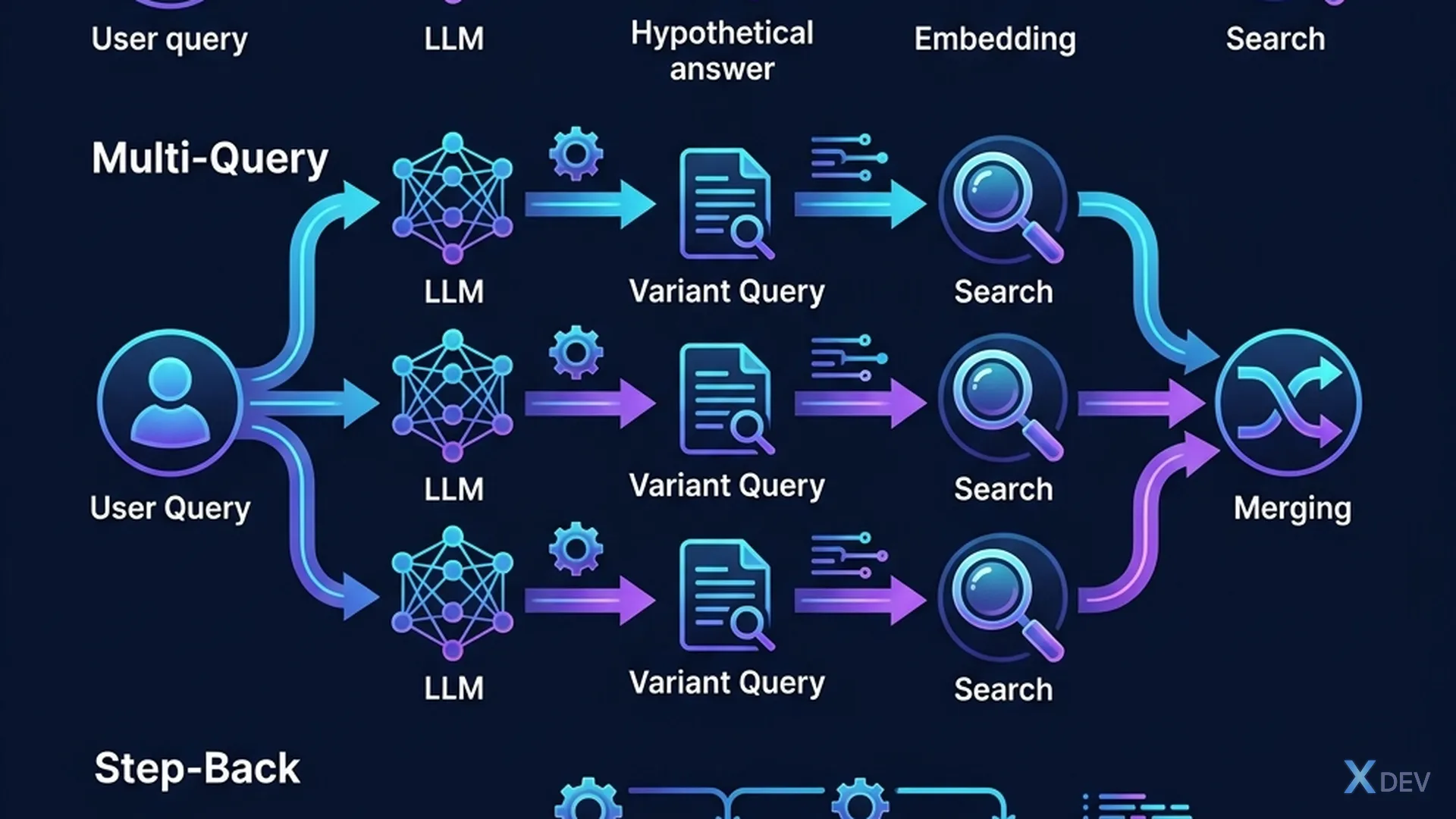
User questions are often not ideal for searching: too short, vague, or worded outside the literature. Query Transformation transforms the original query into an optimal form for retrieval.
Example: User asks "How about vacation?" → too vague. Transforms into:
- "Annual leave application process and approval steps"
- "Number of vacation days for full-time and part-time employees"
- "Policy on leave when employees have urgent matters" → 3 queries looking for 3 different aspects!
This article covers 3 main techniques:
| Engineering | Ideas | When to use |
|---|---|---|
| Multi-Query | Generate many variations of the question | Vague, multi-faceted question |
| HyDE | Create "fake answers" to find the real answer | Short query, different document language |
| Step-Back | Ask an overview question first | The question is too specific |
1. Multi-Query — Generate multiple variations
1.1 Problem
User query:    "lương thế nào?"
Vector search: tìm 1 lần → có thể miss "chế độ đãi ngộ", "phúc lợi"

Multi-Query:   "lương thế nào?" → LLM sinh 3 queries:
               Q1: "Mức lương cơ bản và bậc lương"
               Q2: "Chế độ đãi ngộ, thưởng, phúc lợi"
               Q3: "Quy trình review và tăng lương"
               → Search 3 lần → merge kết quả → cover nhiều khía cạnh!
1.2 Implementation
"""Multi-Query Retriever — tự sinh nhiều câu hỏi biến thể"""
from langchain.retrievers import MultiQueryRetriever
from langchain_openai import ChatOpenAI
from langchain_community.vectorstores import Chroma

llm = ChatOpenAI(model="gpt-4o-mini", temperature=0.3)
vectorstore = Chroma(...)  # Đã index sẵn

retriever = MultiQueryRetriever.from_llm(
    retriever=vectorstore.as_retriever(search_kwargs={"k": 3}),
    llm=llm,
)

# Nội bộ: LLM sinh 3 câu hỏi khác nhau, search mỗi câu, merge kết quả
results = retriever.invoke("lương thế nào?")
# Trả về documents từ CẢ 3 queries (đã deduplicate)
1.3 Custom prompt for Multi-Query
"""Custom prompt — kiểm soát cách sinh biến thể"""
from langchain.prompts import PromptTemplate

MULTI_QUERY_PROMPT = PromptTemplate(
    input_variables=["question"],
    template="""Bạn là AI assistant. Nhiệm vụ: sinh 3 câu hỏi biến thể
cho câu hỏi gốc, mỗi câu tập trung 1 khía cạnh khác nhau.

Câu hỏi gốc: {question}

Sinh 3 câu hỏi (mỗi câu 1 dòng, không đánh số):""",
)

retriever = MultiQueryRetriever.from_llm(
    retriever=vectorstore.as_retriever(),
    llm=llm,
    prompt=MULTI_QUERY_PROMPT,
)
💡 Exercise 1: Implement Multi-Query Retriever. Comparison of retrieval recall between single query vs multi-query on 10 test sentences. Does multi-query cover more aspects?
2. HyDE — Hypothetical Document Embeddings
2.1 Ideas
Vấn đề: User query (câu hỏi) và document (đáp án)
         có dạng KHÁC NHAU → embedding khác nhau

Query:   "Nghỉ phép bao nhiêu ngày?"     → embedding Q
Doc:     "Nhân viên full-time được 15     → embedding D
          ngày phép mỗi năm."

Q và D có thể cách xa nhau trong vector space!

HyDE giải quyết:
1. LLM tạo "đáp án giả" từ câu hỏi (hypothetical document)
2. Embed đáp án giả → gần hơn với đáp án thật
3. Dùng embedding đáp án giả để tìm đáp án thật

Query:      "Nghỉ phép bao nhiêu ngày?"
            ↓ LLM generate
HyDE doc:   "Theo chính sách công ty, nhân viên toàn thời gian
             được hưởng 15 ngày nghỉ phép có lương mỗi năm..."
            ↓ embed
HyDE embed: [0.45, 0.12, ...]  ← GẦN với doc thật hơn!
            ↓ search
Real doc:   "Nhân viên full-time: 15 ngày phép/năm" ← MATCH!
2.2 Implementation
"""HyDE — Hypothetical Document Embeddings"""
from langchain.chains import HypotheticalDocumentEmbedder
from langchain_openai import ChatOpenAI, OpenAIEmbeddings

llm = ChatOpenAI(model="gpt-4o-mini", temperature=0)
embeddings = OpenAIEmbeddings(model="text-embedding-3-small")

# HyDE embedder: wrap LLM + embedding
hyde_embeddings = HypotheticalDocumentEmbedder.from_llm(
    llm=llm,
    base_embeddings=embeddings,
    prompt_key="web_search",  # Hoặc custom prompt
)

# Dùng HyDE embeddings thay OpenAIEmbeddings trong retriever
vectorstore = Chroma(
    collection_name="docs",
    embedding_function=hyde_embeddings,  # ← HyDE thay vì direct
)

retriever = vectorstore.as_retriever(search_kwargs={"k": 5})
results = retriever.invoke("Nghỉ phép bao nhiêu ngày?")
2.3 Custom HyDE Prompt
"""Custom prompt cho HyDE — kiểm soát chất lượng hypothetical doc"""
from langchain.prompts import PromptTemplate

HYDE_PROMPT = PromptTemplate(
    input_variables=["question"],
    template="""Viết 1 đoạn văn ngắn (50-100 từ) trả lời câu hỏi sau,
giả sử bạn đang viết tài liệu chính thức cho công ty:

Câu hỏi: {question}

Đoạn trả lời:""",
)

hyde_embeddings = HypotheticalDocumentEmbedder(
    llm_chain=LLMChain(llm=llm, prompt=HYDE_PROMPT),
    base_embeddings=embeddings,
)
2.4 When to use HyDE?
| Scenario | Is HyDE effective? | Reason |
|---|---|---|
| Short query (2-3 words) | ✅ | Expand into a context-rich paragraph |
| Query in question form, document in narrative form | ✅ | Bridge gap question↔answer |
| Cross-language (ask Vietnamese, read English) | ✅ | LLM generate same language doc |
| Query was clear, long | ❌ | HyDE adds noise |
| Real-time (latency-critical) | ❌ | 1 more LLM call = slower |
💡 Exercise 2: Compare retrieval accuracy: direct embedding vs HyDE. Use 10 short questions (2-3 words). How much better is HyDE?
3. Step-Back Prompting
3.1 Ideas
Câu hỏi quá CỤ THỂ: "Nhân viên bộ phận Kế toán nghỉ phép
                       ngày 31/12 có được không?"

Vector search: không tìm thấy (quá cụ thể, không ai viết exact match)

Step-Back: Lùi 1 bước → hỏi câu TỔNG QUÁT trước:
           "Quy định nghỉ phép vào ngày lễ, cuối năm?"
           → Tìm được! Rồi kết hợp context trả lời câu cụ thể.
3.2 Implementation
"""Step-Back Prompting cho RAG"""
from langchain_openai import ChatOpenAI
from langchain.prompts import ChatPromptTemplate

llm = ChatOpenAI(model="gpt-4o-mini", temperature=0)

# Step 1: Generate step-back question
step_back_prompt = ChatPromptTemplate.from_messages([
    ("system", """Bạn là expert tạo câu hỏi tổng quát hơn.
Cho 1 câu hỏi cụ thể, tạo câu hỏi TỔNG QUÁT hơn 1 bậc
để tìm kiếm context rộng hơn."""),
    ("human", "Câu hỏi: {question}\n\nCâu hỏi tổng quát hơn:"),
])

step_back_chain = step_back_prompt | llm

# Step 2: Search cả câu gốc + step-back
def step_back_retrieval(question: str, retriever):
    # Tạo step-back question
    step_back_q = step_back_chain.invoke({"question": question}).content

    # Search cả 2
    original_docs = retriever.invoke(question)
    step_back_docs = retriever.invoke(step_back_q)

    # Merge + deduplicate
    all_docs = original_docs + step_back_docs
    seen = set()
    unique_docs = []
    for doc in all_docs:
        key = doc.page_content[:100]
        if key not in seen:
            seen.add(key)
            unique_docs.append(doc)

    return unique_docs

results = step_back_retrieval(
    "Nhân viên Kế toán nghỉ phép ngày 31/12 có được không?",
    retriever
)
4. Combine multiple techniques
4.1 Actual Pipeline
User query
    │
    ├──→ Multi-Query (sinh 3 biến thể)
    │        │
    │        ├──→ Query 1 → Vector search → docs_1
    │        ├──→ Query 2 → Vector search → docs_2
    │        └──→ Query 3 → Vector search → docs_3
    │
    ├──→ Step-Back (câu tổng quát)
    │        └──→ BM25 search → docs_4
    │
    └──→ HyDE (hypothetical doc)
             └──→ Vector search → docs_5

    Merge all → Deduplicate → Re-rank (bài tiếp theo) → Top K
4.2 Routing — Choose strategy according to query type
"""Router: tự chọn strategy phù hợp với câu hỏi"""
from langchain_openai import ChatOpenAI
from langchain.prompts import ChatPromptTemplate

router_prompt = ChatPromptTemplate.from_messages([
    ("system", """Phân loại câu hỏi thành 1 trong 3 loại:
- MULTI_QUERY: câu hỏi mơ hồ, nhiều khía cạnh
- HYDE: câu hỏi ngắn, khó match trực tiếp
- STEP_BACK: câu hỏi quá cụ thể, cần context rộng
- DIRECT: câu hỏi rõ ràng, không cần transform

Chỉ trả lời 1 từ: MULTI_QUERY, HYDE, STEP_BACK, hoặc DIRECT."""),
    ("human", "{question}"),
])

def smart_retrieve(question, retriever):
    llm = ChatOpenAI(model="gpt-4o-mini", temperature=0)
    strategy = (router_prompt | llm).invoke({"question": question}).content.strip()

    if strategy == "MULTI_QUERY":
        return multi_query_retrieve(question, retriever)
    elif strategy == "HYDE":
        return hyde_retrieve(question, retriever)
    elif strategy == "STEP_BACK":
        return step_back_retrieval(question, retriever)
    else:
        return retriever.invoke(question)
💡 Exercise 3: Implement router. Test with 15 questions (5 vague, 5 short, 5 specific). How many % does the router choose the correct strategy?
Summary
| Concepts | Remember |
|---|---|
| Multi-Query | Generate many variations, find many aspects |
| HyDE | Create fake answers → embed → find real answers |
| Step-Back | Ask general questions first, specific questions later |
| Router | Choose your own strategy according to question type |
| Combine | Combining multiple techniques + merge + dedup |
General exercises
- ✅ Complete 3 small exercises (1, 2, 3)
- Full Pipeline: Implement combined pipeline: Router → choose strategy → retrieve → merge. Test on 20 diverse questions.
- Benchmark: Compare the accuracy of 4 approaches (direct, multi-query, HyDE, step-back) on the same dataset. Draw a comparison chart.
- Latency vs Quality: Measure the processing time of each strategy. How much slower is HyDE? How much slower is multi-query? Is trade-off worth it?
Next article: Re-Ranking & Contextual Compression — after retrieving, how to choose the best chunks and context compression for LLM.