1. Overview of Disaster Recovery for Healthcare
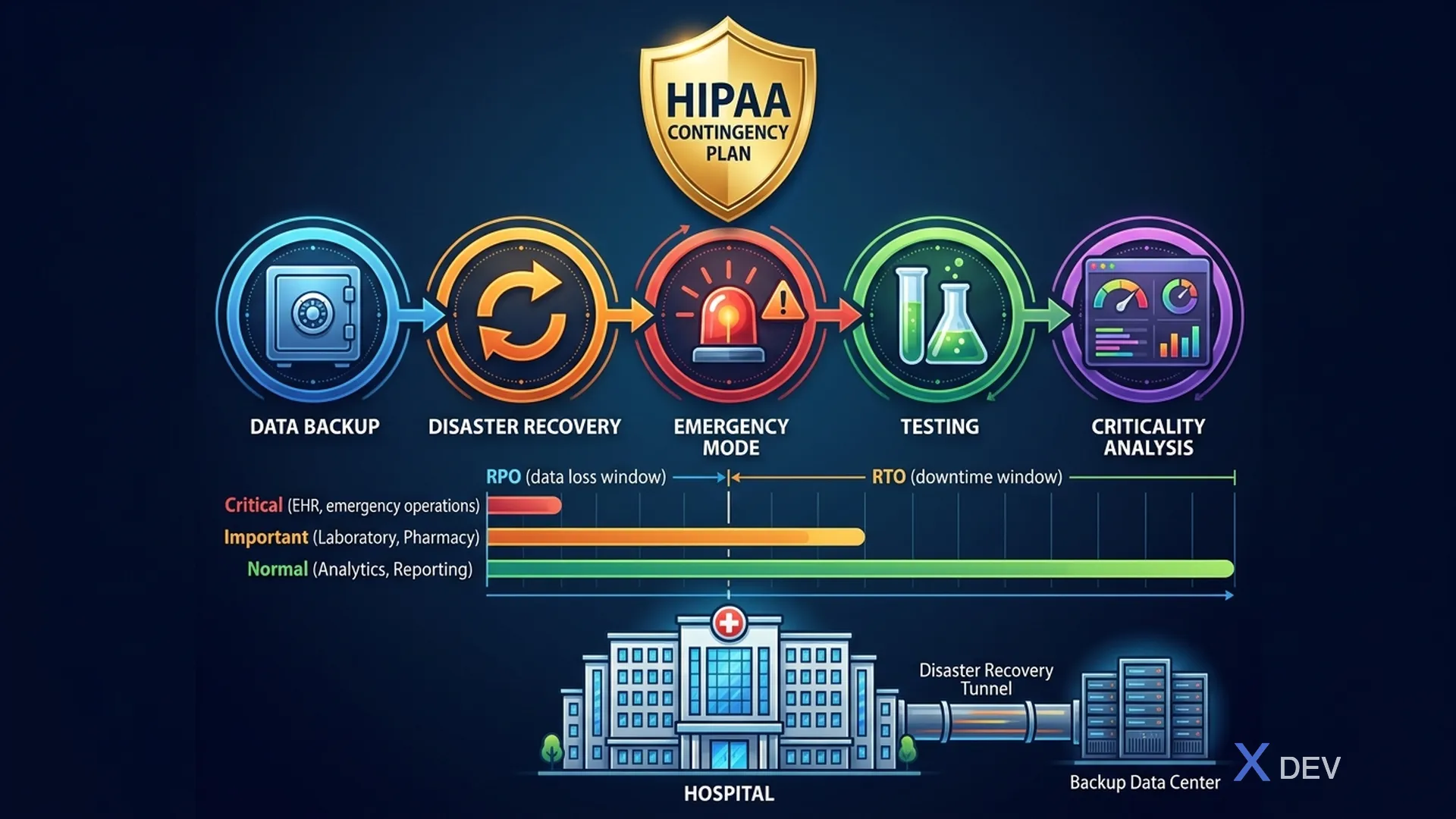
HIPAA Security Rule §164.308(a)(7) requires every organization that handles ePHI to have a Contingency Plan — a contingency plan for emergency situations (natural disasters, ransomware attacks, hardware failures, human error). In healthcare, downtime can directly affect patient lives.
1.1. HIPAA Contingency Plan Requirements
HIPAA Contingency Plan — §164.308(a)(7):
- Data Backup Plan [Required]
- Create and maintain exact copies of ePHI
- Regular backup schedule
- Backup verification
- Disaster Recovery Plan [Required]
- Procedures to restore lost data
- Restore from backups
- Test recovery procedures
- Emergency Mode Operation Plan [Required]
- Continue critical operations during emergency
- Protect ePHI during emergency
- Prioritize patient safety systems
- Testing and Revision Procedures [Addressable]
- Periodic testing of contingency plans
- Update plans based on test results
- Applications and Data Criticality Analysis [Addressable]
- Identify critical applications
- Prioritize recovery orders
1.2. RTO/RPO Requirements for Healthcare
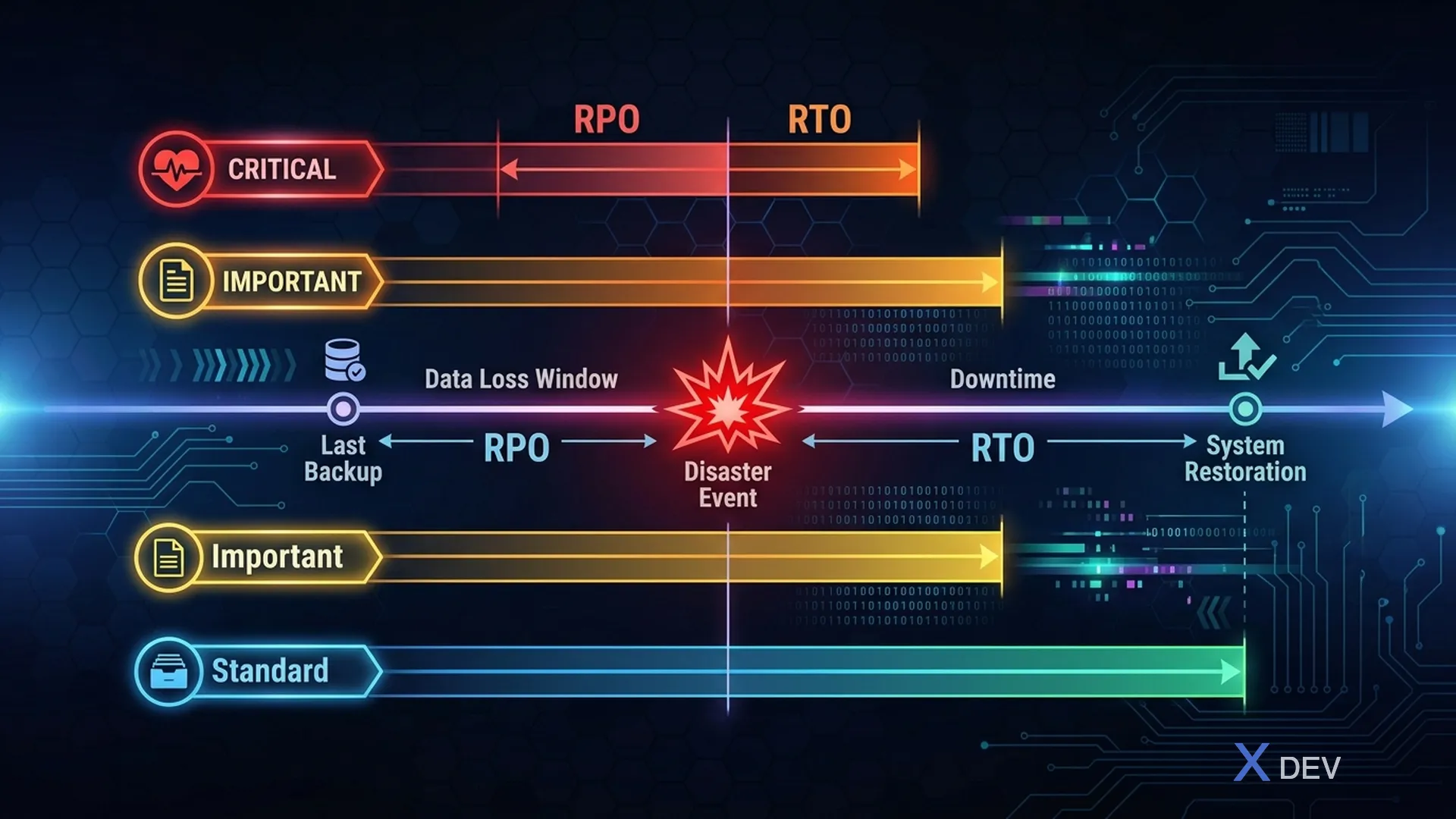
| System | RPO | RTO | Criticality |
|---|---|---|---|
| EHR (Medical Record) | 0-1min | <15min | Critical |
| Lab Results | <5min | <30min | Critical |
| Pharmacy | <5min | <30min | Critical |
| Patient Portal | <1hr | <4hr | Important |
| Billing | <4hr | <8hr | Standard |
| Analytics | <24hr | <24hr | Low |
| Audit Logs | 0 | <1hr | Critical (HIPAA) |
Timeline: ◄── RPO (Data loss window) ──┤ Disaster occurs ├── RTO (Downtime window) ──►
Target cho Critical Healthcare: RPO ≈ 0 (synchronous replication), RTO < 15 minutes (automated failover)
2. PostgreSQL Backup Strategies
2.1. Compare Backup Methods
| Method | Type | RPO | Speed | Size | Complexity | Use Case |
|---|---|---|---|---|---|---|
pg_dump | Logical | Hours | Slow | Small (compressed) | Low | Small DB, schema migration |
pg_basebackup | Physical | Minutes | Medium | Full DB size | Medium | Standbys, PITR |
| pgBackRest | Physical | Seconds | Fast | Incremental | Medium | Production healthcare |
| Barman | Physical | Seconds | Fast | Incremental | High | Large enterprise |
| WAL archiving | Continuous | Seconds | Minimal | WAL files | Low | PITR supplement |
| Streaming replication | Continuous | ~0 | Real-time | Full replica | Medium | HA / Failover |
2.2. pg_dump — Logical Backup
#!/bin/bash
# pg-logical-backup.sh
# Logical backup cho healthcare database

set -euo pipefail

DB_NAME="healthcare"
DB_USER="backup_user"
BACKUP_DIR="/var/backups/postgresql"
DATE=$(date +%Y%m%d_%H%M%S)
BACKUP_FILE="${BACKUP_DIR}/${DB_NAME}_${DATE}.dump"
ENCRYPTION_KEY_FILE="/etc/healthcare/backup-encryption-key"

# Backup
echo "[$(date)] Starting logical backup: ${DB_NAME}"

pg_dump \
    --host=localhost \
    --port=5432 \
    --username="${DB_USER}" \
    --format=custom \
    --compress=9 \
    --verbose \
    --file="${BACKUP_FILE}" \
    "${DB_NAME}"

# Encrypt backup (HIPAA requirement)
echo "[$(date)] Encrypting backup..."
openssl enc -aes-256-cbc -salt \
    -in "${BACKUP_FILE}" \
    -out "${BACKUP_FILE}.enc" \
    -pass file:"${ENCRYPTION_KEY_FILE}" \
    -pbkdf2 -iter 100000

# Remove unencrypted backup
rm -f "${BACKUP_FILE}"

# Verify backup integrity
echo "[$(date)] Verifying backup..."
VERIFY_FILE=$(mktemp)
openssl enc -d -aes-256-cbc \
    -in "${BACKUP_FILE}.enc" \
    -out "${VERIFY_FILE}" \
    -pass file:"${ENCRYPTION_KEY_FILE}" \
    -pbkdf2 -iter 100000

pg_restore --list "${VERIFY_FILE}" > /dev/null 2>&1
VERIFY_STATUS=$?
rm -f "${VERIFY_FILE}"

if [ ${VERIFY_STATUS} -eq 0 ]; then
    echo "[$(date)] Backup verification: PASSED"
    # Calculate checksum
    SHA256=$(sha256sum "${BACKUP_FILE}.enc" | awk '{print $1}')
    echo "[$(date)] SHA256: ${SHA256}"

    # Log to audit
    echo "{\"event\":\"backup_completed\",\"type\":\"logical\",\"database\":\"${DB_NAME}\",\"file\":\"${BACKUP_FILE}.enc\",\"sha256\":\"${SHA256}\",\"timestamp\":\"$(date -u +"%Y-%m-%dT%H:%M:%SZ")\"}" \
        | logger -t healthcare-backup
else. else
    echo "[$(date)] Backup verification: FAILED"
    exit 1
fi

# Retention: keep 30 days of daily backups
echo "[$(date)] Cleaning old backups (>30 days)..."
find "${BACKUP_DIR}" -name "*.dump.enc" -mtime +30 -delete

echo "[$(date)] Backup complete: ${BACKUP_FILE}.enc"
2.3. WAL Archiving Configuration
# postgresql.conf - WAL Archiving for PITR

# === WAL Configuration ===
wal_level = replica
max_wal_senders = 10
wal_keep_size = 1GB

# === Archive Mode ===
archive_mode = on
archive_command = 'pgbackrest --stanza=healthcare archive-push %p'
archive_timeout = 60

# === Checkpoint tuning ===
checkpoint_timeout = 15min
checkpoint_completion_target = 0.9
max_wal_size = 4GB
min_wal_size = 1GB
3. pgBackRest — Production Backup Solution
3.1. Why pgBackRest for Healthcare?
pgBackRest is a backup solution that is recommended for production PostgreSQL because:
- Incremental backup: Only backs up changes since the previous backup → fast, saves storage
- Parallel backup/restore: Uses multiple CPU cores → reduces time
- Built-in encryption: AES-256-CBC encryption → HIPAA compliant
- Backup verification: Automatically verify backup integrity
- PITR: Point-in-time recovery from any point in time
- Remote backup: Backup to remote server or object storage (S3, GCS)
3.2. pgBackRest Configuration
# /etc/pgbackrest/pgbackrest.conf

[global]
# === Repository Configuration ===
repo1-type=s3
repo1-path=/healthcare-backups
repo1-s3-bucket=hospital-db-backups
repo1-s3-endpoint=s3.ap-southeast-1.amazonaws.com
repo1-s3-region=ap-southeast-1
repo1-s3-key=AKIAIOSFODNN7EXAMPLE
repo1-s3-key-secret=wJalrXUtnFEMI/K7MDENG/bPxRfiCYEXAMPLEKEY

# === Encryption (HIPAA Required) ===
repo1-cipher-type=aes-256-cbc
repo1-cipher-pass=STRONG_ENCRYPTION_PASSPHRASE_HERE

# === Retention Policy ===
repo1-retention-full=4
repo1-retention-diff=14
repo1-retention-archive=2
repo1-retention-archive-type=full

# === Performance ===
process-max=4
compress-type=zst
compress-level=6
delta=y

# === Logging ===
log-level-console=info
log-level-file=detail
log-path=/var/log/pgbackrest

[healthcare]
# === Stanza Configuration ===
pg1-path=/var/lib/postgresql/16/main
pg1-port=5432
pg1-user=postgres

# === Second Repository (DR site) ===
# repo2-type=s3
# repo2-path=/healthcare-backups-dr
# repo2-s3-bucket=hospital-db-backups-dr
# repo2-s3-endpoint=s3.ap-northeast-1.amazonaws.com
# repo2-s3-region=ap-northeast-1
# repo2-cipher-type=aes-256-cbc
# repo2-cipher-pass=DR_ENCRYPTION_PASSPHRASE
3.3. Backup Schedule
#!/bin/bash
# pgbackrest-schedule.sh
# Automated backup schedule for healthcare

set -euo pipefail

STANZA="healthcare"
LOG_FILE="/var/log/pgbackrest/schedule.log"

log() {
    echo "[$(date -u +"%Y-%m-%dT%H:%M:%SZ")] $1" | tee -a "$LOG_FILE"
}

case "${1:-}" in
    full)
        # Full backup — runs weekly (Sunday 2:00 AM)
        log "Starting FULL backup..."
        pgbackrest --stanza="${STANZA}" --type=full backup
        log "Full backup completed"
        ;;

    diff)
        # Differential backup — runs daily (2:00 AM)
        log "Starting DIFFERENTIAL backup..."
        pgbackrest --stanza="${STANZA}" --type=diff backup
        log "Differential backup completed"
        ;;

    incr)
        # Incremental backup — runs every hour
        log "Starting INCREMENTAL backup..."
        pgbackrest --stanza="${STANZA}" --type=incr backup
        log "Incremental backup completed"
        ;;

    verify)
        # Verify backup integrity
        log "Starting backup VERIFICATION..."
        pgbackrest --stanza="${STANZA}" verify
        log "Verification completed"
        ;;

    info)
        pgbackrest --stanza="${STANZA}" info
        ;;

    *)
        echo "Usage: $0 {full|diff|incr|verify|info}"
        exit 1
        ;;
esac

# Log backup information for audit trail
BACKUP_INFO=$(pgbackrest --stanza="${STANZA}" --output=json info 2>/dev/null)
echo "{\"event\":\"backup_schedule\",\"type\":\"${1:-unknown}\",\"stanza\":\"${STANZA}\",\"timestamp\":\"$(date -u +"%Y-%m-%dT%H:%M:%SZ")\"}" \
    | logger -t healthcare-backup
Crontab Configuration:
# /etc/cron.d/pgbackrest-healthcare

# Incremental backup every hour
0 * * * * postgres /opt/scripts/pgbackrest-schedule.sh incr

# Differential backup daily 2:00 AM
0 2 * * 1-6 postgres /opt/scripts/pgbackrest-schedule.sh diff

# Full backup Sunday 2:00 AM
0 2 * * 0 postgres /opt/scripts/pgbackrest-schedule.sh full

# Verify backup daily 6:00 AM
0 6 * * * postgres /opt/scripts/pgbackrest-schedule.sh verify
3.4. Point-in-Time Recovery (PITR)
#!/bin/bash
# pitr-restore.sh
# Point-in-Time Recovery for healthcare database

set -euo pipefail

STANZA="healthcare"
TARGET_TIME="${1:-}"
PG_DATA="/var/lib/postgresql/16/main"

if [ -z "$TARGET_TIME" ]; then
    echo "Usage: $0 <target_time>"
    echo "Example: $0 '2024-03-15 14:30:00+07'"
    echo ""
    echo "Available backups:"
    pgbackrest --stanza="${STANZA}" info
    exit 1
fi

echo "=== POINT-IN-TIME RECOVERY ==="
echo "Target time: ${TARGET_TIME}"
echo "Stanza: ${STANZA}"
echo ""
echo "WARNING: This will REPLACE the current database!"
read -p "Are you sure? (yes/no): "CONFIRM

if [ "$CONFIRM" != "yes" ]; then
    echo "Aborted."
    exit 0
fi

#1. Stop PostgreSQL
echo "[$(date)] Stopping PostgreSQL..."
systemctl stop postgresql

#2. Perform PITR restore
echo "[$(date)] Starting PITR restore to: ${TARGET_TIME}"
pgbackrest --stanza="${STANZA}" \
    --type=time \
    --target="${TARGET_TIME}" \
    --target-action=promote \
    --delta \
    restore. restore

#3. Start PostgreSQL
echo "[$(date)] Starting PostgreSQL..."
systemctl start postgresql

# 4. Verify database
echo "[$(date)] Verifying database..."
sleep 5
pg_isready -h localhost -p 5432
if [ $? -eq 0 ]; then
    echo "[$(date)] PostgreSQL is ready"

    # Verify data
    PATIENT_COUNT=$(psql -d healthcare -tAc "SELECT COUNT(*) FROM healthcare.patients" 2>/dev/null)
    echo "[$(date)]Patient records: ${PATIENT_COUNT}"

    # Log recovery events
    echo "{\"event\":\"pitr_restore\",\"target_time\":\"${TARGET_TIME}\",\"patient_count\":${PATIENT_COUNT},\"timestamp\":\"$(date -u +"%Y-%m-%dT%H:%M:%SZ")\"}" \
        | logger -t healthcare-backup
else. else
    echo "[$(date)] ERROR: PostgreSQL failed to start after restore"
    exit 1
fi

echo "[$(date)] PITR restore completed successfully"
4. Streaming Replication & Patroni
4.1. High Availability Architecture
┌────────────────────────────── ───────────────────────────────┐
│ PostgreSQL HA with Patroni │
│ │
│ ┌──────────────────────────── ────────────────────────────┐ │
│ │ HAProxy (VIP) │ │
│ │ Read/Write ──► Port 5432 │ │
│ │ Read-Only ──► Port 5433 │ │
│ └──────────┬───────────────── ───┬────────────────────────┘ │
│ │ │ │
│ ┌────────▼─────────┐ ┌───────▼──────────┐ │
│ │ PostgreSQL │ │ PostgreSQL │ │
│ │ PRIMARY │ │ REPLICA │ │
│ │ (Read/Write) │ │ (Read-Only) │ │
│ │ │ │ │ │
│ │ Patroni Agent │ │ Patroni Agent │ │
│ │ pg1:5432 │ │ pg2:5432 │ │
│ └────────┬──────────┘ └──────┬────────────┘ │
│ │ │ │
│ └───────┬───────────┘ │
│ │ │
│ ┌────────▼──────────┐ │
│ │ etcd Cluster │ │
│ │ (DCS - Consensus)│ │
│ │ etcd1, etcd2, │ │
│ │ etcd3 │ │
│ └───────────────────┘ │
│ │
│ Failover Flow: │
│ 1. Primary fails │
│ 2. Patroni detects via health check │
│ 3. etcd consensus: elect new primary │
│ 4. Patroni promotes replica to primary │
│ 5. HAProxy routes traffic to new primary │
│ 6. RTO < 30 seconds (automated)                             │
└─────────────────────────────────────────────────────────────┘
4.2. Patroni Configuration
# patroni.yml - Primary node

scope: healthcare-cluster
namespace: /healthcare/
name: pg1

restapi:
  listen: 0.0.0.0:8008
  connect_address: pg1:8008
  authentication:
    username: admin
    password: ${PATRONI_REST_PASSWORD}

etcd3:
  hosts:
    - etcd1:2379
    - etcd2:2379
    - etcd3:2379
  username: patroni
  password: ${ETCD_PASSWORD}

bootstrap:
  dcs:
    ttl: 30
    loop_wait: 10
    retry_timeout: 10
    maximum_lag_on_failover: 1048576  # 1MB WAL lag max
    synchronous_mode: true  # Synchronous replication (RPO = 0)
    synchronous_mode_strict: true
    postgresql:
      use_pg_rewind: true
      use_slots: true
      parameters:
        wal_level: replica
        max_wal_senders: 10
        max_replication_slots: 10
        wal_keep_size: 2GB
        hot_standby: "on"
        synchronous_commit: "on"  # RPO = 0 cho healthcare
        synchronous_standby_names: "*"
        # Audit logging
        log_statement: all
        log_connections: "on"
        log_disconnections: "on"
        log_line_prefix: '%t [%p]: [%l-1] user=%u,db=%d,app=%a,client=%h '

  initdb:
    - encoding: UTF8
    - data-checksums
    - locale: en_US.UTF-8

  pg_hba:
    - local all postgres peer
    - host replication replicator 10.0.0.0/8 scram-sha-256
    - host all all 10.0.0.0/8 scram-sha-256
    - host all all 0.0.0.0/0 reject

postgresql:
  listen: 0.0.0.0:5432
  connect_address: pg1:5432
  data_dir: /var/lib/postgresql/16/main
  bin_dir: /usr/lib/postgresql/16/bin

  authentication:
    superuser:
      username: postgres
      password: ${PG_SUPERUSER_PASSWORD}
    replication:
      username: replicator
      password: ${PG_REPLICATION_PASSWORD}

  parameters:
    # Performance
    shared_buffers: 4GB
    effective_cache_size: 12GB
    work_mem: 64MB
    maintenance_work_mem: 512MB

    # WAL
    wal_level: replica
    max_wal_senders: 10
    max_replication_slots: 10
    synchronous_commit: "on"

    # Archive
    archive_mode: "on"
    archive_command: "pgbackrest --stanza=healthcare archive-push %p"

    # SSL (HIPAA)
    ssl: "on"
    ssl_cert_file: /etc/ssl/certs/pg-server.crt
    ssl_key_file: /etc/ssl/private/pg-server.key
    ssl_ca_file: /etc/ssl/certs/ca.crt

  pgpass: /tmp/pgpass

tags:
  nofailover: false
  noloadbalance: false
  clonefrom: false
  nosync: false
4.3. HAProxy Configuration
# haproxy.cfg - Load balancing cho PostgreSQL

global
    maxconn 1000
    log stdout local0

defaults
    mode tcp
    log global
    retries 3
    timeout connect 10s
    timeout client 30m
    timeout server 30m
    timeout check 5s

# Primary (Read/Write)
listen healthcare-primary
    bind *:5432
    option httpchk OPTIONS /primary
    http-check expect status 200
    default-server inter 3s fall 3 rise 2 on-marked-down shutdown-sessions
    server pg1 pg1:5432 maxconn 500 check port 8008
    server pg2 pg2:5432 maxconn 500 check port 8008

# Replicas (Read-Only)
listen healthcare-replica
    bind *:5433
    option httpchk OPTIONS /replica
    http-check expect status 200
    balance roundrobin
    default-server inter 3s fall 3 rise 2 on-marked-down shutdown-sessions
    server pg1 pg1:5432 maxconn 300 check port 8008
    server pg2 pg2:5432 maxconn 300 check port 8008

# Patroni REST API
listen patroni-api
    bind *:8008
    mode http
    option httpchk GET /health
    default-server inter 5s fall 3 rise 2
    server pg1 pg1:8008 check
    server pg2 pg2:8008 check

# Stats
listen stats
    bind *:7000
    mode http
    stats enable
    stats uri /
    stats refresh 10s
4.4. Docker Compose cho HA Stack
# docker-compose-ha.yml
version: '3.8'

services:
  # === etcd Cluster ===
  etcd1:
    image: quay.io/coreos/etcd:v3.5.12
    container_name: etcd1
    environment:
      ETCD_NAME: etcd1
      ETCD_INITIAL_ADVERTISE_PEER_URLS: http://etcd1:2380
      ETCD_LISTEN_PEER_URLS: http://0.0.0.0:2380
      ETCD_LISTEN_CLIENT_URLS: http://0.0.0.0:2379
      ETCD_ADVERTISE_CLIENT_URLS: http://etcd1:2379
      ETCD_INITIAL_CLUSTER: etcd1=http://etcd1:2380,etcd2=http://etcd2:2380,etcd3=http://etcd3:2380
      ETCD_INITIAL_CLUSTER_STATE: new
    volumes:
      - etcd1_data:/etcd-data

  etcd2:
    image: quay.io/coreos/etcd:v3.5.12
    container_name: etcd2
    environment:
      ETCD_NAME: etcd2
      ETCD_INITIAL_ADVERTISE_PEER_URLS: http://etcd2:2380
      ETCD_LISTEN_PEER_URLS: http://0.0.0.0:2380
      ETCD_LISTEN_CLIENT_URLS: http://0.0.0.0:2379
      ETCD_ADVERTISE_CLIENT_URLS: http://etcd2:2379
      ETCD_INITIAL_CLUSTER: etcd1=http://etcd1:2380,etcd2=http://etcd2:2380,etcd3=http://etcd3:2380
      ETCD_INITIAL_CLUSTER_STATE: new
    volumes:
      - etcd2_data:/etcd-data

  etcd3:
    image: quay.io/coreos/etcd:v3.5.12
    container_name: etcd3
    environment:
      ETCD_NAME: etcd3
      ETCD_INITIAL_ADVERTISE_PEER_URLS: http://etcd3:2380
      ETCD_LISTEN_PEER_URLS: http://0.0.0.0:2380
      ETCD_LISTEN_CLIENT_URLS: http://0.0.0.0:2379
      ETCD_ADVERTISE_CLIENT_URLS: http://etcd3:2379
      ETCD_INITIAL_CLUSTER: etcd1=http://etcd1:2380,etcd2=http://etcd2:2380,etcd3=http://etcd3:2380
      ETCD_INITIAL_CLUSTER_STATE: new
    volumes:
      - etcd3_data:/etcd-data

  # === PostgreSQL + Patroni ===
  pg1:
    image: postgres:16-bookworm
    container_name: pg1
    environment:
      PATRONI_SCOPE: healthcare-cluster
      PATRONI_NAME: pg1
      PATRONI_POSTGRESQL_DATA_DIR: /var/lib/postgresql/data
      PATRONI_POSTGRESQL_CONNECT_ADDRESS: pg1:5432
      PATRONI_RESTAPI_CONNECT_ADDRESS: pg1:8008
      PATRONI_ETCD3_HOSTS: "'etcd1:2379','etcd2:2379','etcd3:2379'"
      PG_SUPERUSER_PASSWORD: ${PG_SUPERUSER_PASSWORD}
      PG_REPLICATION_PASSWORD: ${PG_REPLICATION_PASSWORD}
    volumes:
      - pg1_data:/var/lib/postgresql/data
      - ./config/patroni.yml:/etc/patroni.yml
    ports:
      - "5432"
    depends_on:
      - etcd1
      - etcd2
      - etcd3

  pg2:
    image: postgres:16-bookworm
    container_name: pg2
    environment:
      PATRONI_SCOPE: healthcare-cluster
      PATRONI_NAME: pg2
      PATRONI_POSTGRESQL_DATA_DIR: /var/lib/postgresql/data
      PATRONI_POSTGRESQL_CONNECT_ADDRESS: pg2:5432
      PATRONI_RESTAPI_CONNECT_ADDRESS: pg2:8008
      PATRONI_ETCD3_HOSTS: "'etcd1:2379','etcd2:2379','etcd3:2379'"
      PG_SUPERUSER_PASSWORD: ${PG_SUPERUSER_PASSWORD}
      PG_REPLICATION_PASSWORD: ${PG_REPLICATION_PASSWORD}
    volumes:
      - pg2_data:/var/lib/postgresql/data
      - ./config/patroni.yml:/etc/patroni.yml
    ports:
      - "5432"
    depends_on:
      - etcd1
      - etcd2
      - etcd3

  # === HAProxy ===
  haproxy:
    image: haproxy:2.9
    container_name: haproxy
    volumes:
      - ./config/haproxy.cfg:/usr/local/etc/haproxy/haproxy.cfg:ro
    ports:
      - "5432:5432"   # Primary (R/W)
      - "5433:5433"   # Replica (R/O)
      - "7000:7000"   # Stats
    depends_on:
      - pg1
      - pg2

volumes:
  etcd1_data:
  etcd2_data:
  etcd3_data:
  pg1_data:
  pg2_data:
5. Cross-Region Replication cho DR
5.1. Cross-Region Architecture
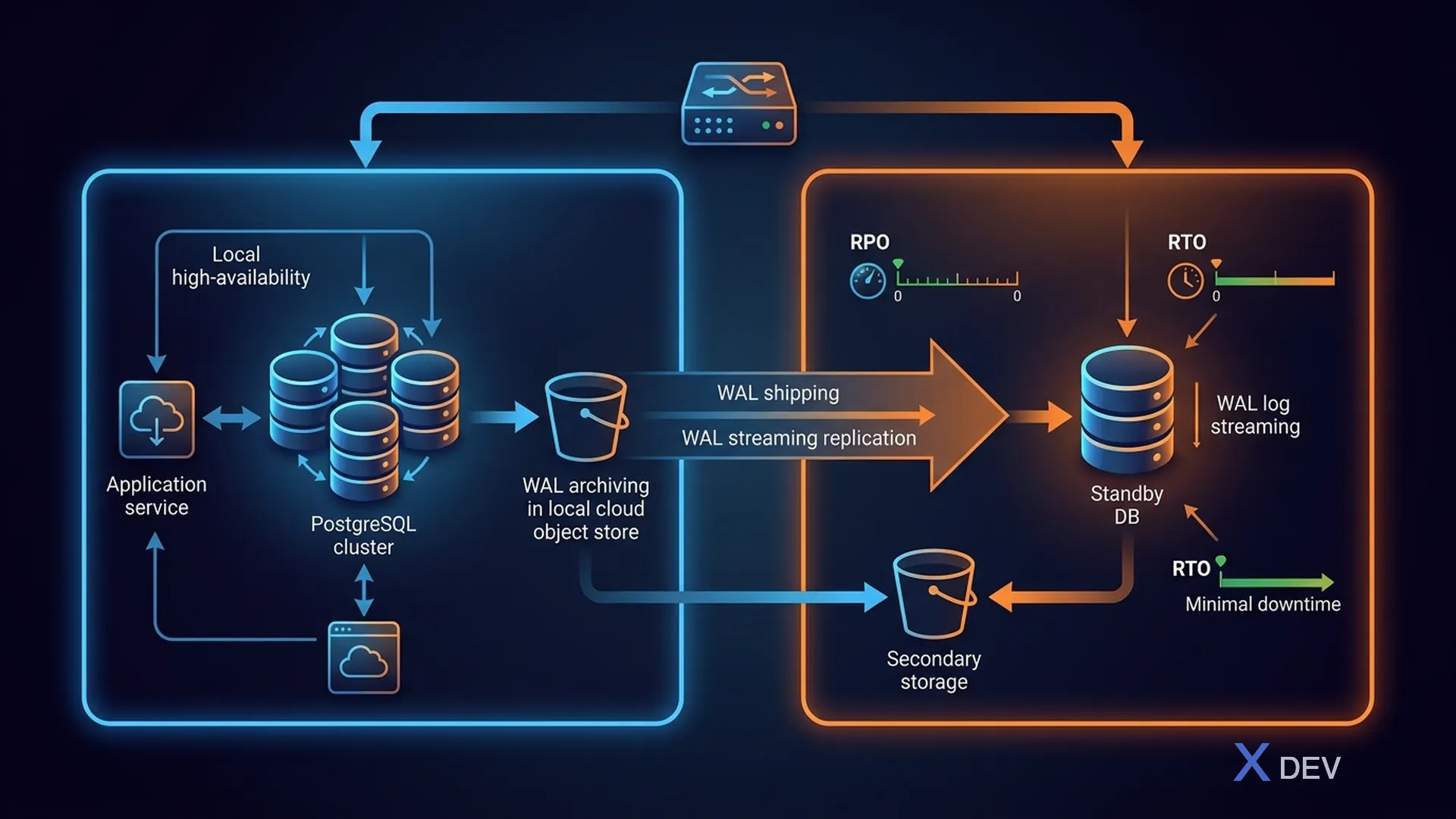
PRIMARY REGION (ap-southeast-1: Singapore):
- pg-primary (R/W) → pg-replica (R/O) — sync replication
- WAL streaming (async) to DR region
DR REGION (ap-northeast-1: Tokyo):
- pg-dr (async replica, read-only) — Lag: < 1 minute
- pgBackRest S3 backup (encrypted)
- Standby microservices (cold/warm)
Failover: DNS switch + Patroni promote DR — RPO < 1 minute, RTO < 15 minutes (automated)
5.2. DR Replication Setup
#!/bin/bash
# setup-dr-replica.sh
# Setup cross-region DR replica

set -euo pipefail

PRIMARY_HOST="pg-primary.ap-southeast-1.hospital.internal"
DR_HOST="pg-dr.ap-northeast-1.hospital.internal"
REPLICATION_USER="replicator"
PG_DATA="/var/lib/postgresql/16/main"

echo "=== Setting up DR Replica ==="
echo "Primary: ${PRIMARY_HOST}"
echo "DR: ${DR_HOST}"

# 1. Stop PostgreSQL on DR node
systemctl stop postgresql

# 2. Backup existing data
if [ -d "${PG_DATA}" ]; then
    mv "${PG_DATA}" "${PG_DATA}.backup.$(date +%Y%m%d)"
fi

# 3. Base backup from primary
pg_basebackup \
    --host="${PRIMARY_HOST}" \
    --port=5432 \
    --username="${REPLICATION_USER}" \
    --pgdata="${PG_DATA}" \
    --wal-method=stream \
    --checkpoint=fast \
    --progress \
    --verbose

# 4. Configure as standby
cat > "${PG_DATA}/postgresql.auto.conf" << EOF
# DR Replica Configuration
primary_conninfo = 'host=${PRIMARY_HOST} port=5432 user=${REPLICATION_USER} password=${PG_REPLICATION_PASSWORD} sslmode=verify-full sslcert=/etc/ssl/certs/pg-client.crt sslkey=/etc/ssl/private/pg-client.key sslrootcert=/etc/ssl/certs/ca.crt application_name=dr-replica'
primary_slot_name = 'dr_replica'
recovery_target_timeline = 'latest'
restore_command = 'pgbackrest --stanza=healthcare archive-get %f "%p"'

# Performance
max_standby_streaming_delay = 30s
max_standby_archive_delay = 60s
hot_standby = on
hot_standby_feedback = on
EOF

# 5. Create standby signal
touch "${PG_DATA}/standby.signal"

# 6. Fix permissions
chown -R postgres:postgres "${PG_DATA}"
chmod 700 "${PG_DATA}"

# 7. Start PostgreSQL
systemctl start postgresql

# 8. Verify replication
sleep 5
REPLAY_LAG=$(psql -h localhost -tAc \
    "SELECT EXTRACT(EPOCH FROM replay_lag) FROM pg_stat_wal_receiver" 2>/dev/null)
echo "Replication lag: ${REPLAY_LAG:-N/A} seconds"

echo "==== DR Replica setup complete ==="
6. Microservices State Recovery
6.1. Recovery Scope
| Component | State | Recovery |
|---|---|---|
| PostgreSQL | Patient data (PHI) | PITR/Replica |
| Kafka | Consumer offsets | Reset offset |
| Kafka | Topic data | Replay logs |
| Keycloak | Realm, users, roles | Realm export |
| HashiCorp Vault | Encryption keys | Snapshot |
| Elasticsearch | Audit logs | Snapshot |
| Application Config | ConfigMaps, Secrets | Git + Velero |
| Container Images | Docker images | Registry |
| Certificates | TLS certs | cert-manager |
6.2. Kafka Consumer Offset Recovery
#!/bin/bash
# kafka-recovery.sh
# Recovery Kafka consumer offsets and topics

set -euo pipefail

KAFKA_BOOTSTRAP="kafka.hospital.internal:9093"
GROUP_ID="patient-service"

echo "=== Kafka Recovery ==="

# Option 1: Reset to latest (skip missed messages)
echo "Resetting consumer group to latest..."
kafka-consumer-groups.sh\
    --bootstrap-server "${KAFKA_BOOTSTRAP}" \
    --group "${GROUP_ID}" \
    --reset-offsets \
    --to-latest \
    --all-topics \
    --execute \
    --command-config /etc/kafka/client.properties

# Option 2: Reset to specific timestamp
# kafka-consumer-groups.sh\
# --bootstrap-server "${KAFKA_BOOTSTRAP}" \
# --group "${GROUP_ID}" \
# --reset-offsets \
# --to-datetime "2024-03-15T00:00:00.000" \
# --all-topics \
# --execute \
# --command-config /etc/kafka/client.properties

# Option 3: Reset to specific offset
# kafka-consumer-groups.sh\
# --bootstrap-server "${KAFKA_BOOTSTRAP}" \
# --group "${GROUP_ID}" \
# --reset-offsets \
# --to-offset 12345 \
# --topic healthcare.patient-events \
# --execute \
# --command-config /etc/kafka/client.properties

echo "Current consumer group status:"
kafka-consumer-groups.sh\
    --bootstrap-server "${KAFKA_BOOTSTRAP}" \
    --group "${GROUP_ID}" \
    --describe \
    --command-config /etc/kafka/client.properties
6.3. Keycloak Realm Backup & Restore
#!/bin/bash
# keycloak-backup.sh
# Backup Keycloak realm configuration

set -euo pipefail

KC_URL="${KEYCLOAK_URL:-http://keycloak:8080}"
REALM="healthcare"
BACKUP_DIR="/var/backups/keycloak"
DATE=$(date +%Y%m%d_%H%M%S)

# Get admin token
TOKEN=$(curl -s -X POST "${KC_URL}/realms/master/protocol/openid-connect/token" \
    -d "client_id=admin-cli" \
    -d "username=admin" \
    -d "password=${KC_ADMIN_PASSWORD}" \
    -d "grant_type=password" | jq -r '.access_token')

# Export realm (includes users, roles, clients, groups)
echo "Exporting realm: ${REALM}"
curl -s -H "Authorization: Bearer ${TOKEN}" \
    "${KC_URL}/admin/realms/${REALM}" \
    -o "${BACKUP_DIR}/realm-${REALM}-${DATE}.json"

# Export users separately (with credentials for full restore)
curl -s -H "Authorization: Bearer ${TOKEN}" \
    "${KC_URL}/admin/realms/${REALM}/users?max=10000" \
    -o "${BACKUP_DIR}/users-${REALM}-${DATE}.json"

# Encrypt backup
openssl enc -aes-256-cbc -salt \
    -in "${BACKUP_DIR}/realm-${REALM}-${DATE}.json" \
    -out "${BACKUP_DIR}/realm-${REALM}-${DATE}.json.enc" \
    -pass file:/etc/healthcare/backup-encryption-key\
    -pbkdf2 -iter 100000

rm "${BACKUP_DIR}/realm-${REALM}-${DATE}.json"

echo "Keycloak realm backup: ${BACKUP_DIR}/realm-${REALM}-${DATE}.json.enc"
7. Kubernetes DR with Velero
7.1. Velero Configuration
# velero-install.yaml
apiVersion: v1
kind: Namespace
metadata:
  name: velero
---
# Velero installation values
# helm install velero vmware-tanzu/velero -f velero-values.yaml -n velero
configuration:
  backupStorageLocation:
    - name: default
      provider: aws
      bucket: hospital-k8s-backups
      config:
        region: ap-southeast-1
        s3ForcePathStyle: true
  volumeSnapshotLocation:
    - name: default
      provider: aws
      config:
        region: ap-southeast-1

credentials:
  useSecret: true
  secretContents:
    cloud: |
      [default]
      aws_access_key_id=AKIAIOSFODNN7EXAMPLE
      aws_secret_access_key=wJalrXUtnFEMI/K7MDENG/bPxRfiCYEXAMPLEKEY

initialContainers:
  - name: velero-plugin-for-aws
    image: velero/velero-plugin-for-aws:v1.9.0
    volumeMounts:
      - name: plugins
        mountPath: /target

defaultVolumesToFsBackup: true

schedules:
  healthcare-daily:
    schedule: "0 3 * * *"
    templates:
      ttl: "720h0m0s" # 30 days
      includedNamespaces:
        - healthcare
      labelSelector:
        matchLabels:
          backup: "true"
      snapshotVolumes: true
      storageLocation: default
7.2. Velero Backup & Restore Commands
#!/bin/bash
#velero-healthcare.sh
# Kubernetes DR operations for healthcare

case "${1:-}" in
    backup)
        echo "Creating healthcare namespace backup..."
        velero backup create healthcare-$(date +%Y%m%d-%H%M) \
            --include-namespaces healthcare\
            --snapshot-volumes \
            --default-volumes-to-fs-backup \
            --wait
        ;;

    restore)
        BACKUP_NAME="${2:-}"
        if [ -z "$BACKUP_NAME" ]; then
            echo "Available backups:"
            velero backup get | grep healthcare
            exit 1
        fi

        echo "Restoring from backup: ${BACKUP_NAME}"
        velero restore create \
            --from-backup "${BACKUP_NAME}" \
            --include-namespaces healthcare\
            --restore-volumes \
            --wait
        ;;

    list)
        echo "==== Backups ==="
        velero backup get | grep healthcare
        echo ""
        echo "=== Restores ==="
        velero restore get | grep healthcare
        ;;

    *)
        echo "Usage: $0 {backup|restore <backup-name>|list}"
        ;;
esac
8. DR Testing & Validation
8.1. DR Test Runbook
Healthcare DR Test Runbook:
Pre-Test (T-1 week):
- Notify all stakeholders
- Verify backup integrity (
pgbackrest verify) - Confirm DR environment is ready
- Review escalation contacts
- Prepare rollback plan
Test Execution:
- T+0:00 — Simulate primary failure
- T+0:01 — Verify automated failover triggered
- T+0:05 — Verify DR database accessible
- T+0:10 — Verify application connectivity
- T+0:15 — Verify PHI data integrity (record counts)
- T+0:20 — Test critical operations: Patient lookup, Lab result entry, Prescription creation, Audit log writing
- T+0:30 — Verify audit trail continuity
- T+0:45 — Performance benchmarks
Post-Test:
- Document actual RTO achieved
- Document actual RPO (data loss)
- Document any issues encountered
- Update DR plan based on findings
- Failback to primary
- Verify failback successful
- Submit test report to compliance
Frequency: Quarterly (HIPAA Addressable §164.308(a)(7)(iv))
8.2. Automated DR Test Script
#!/bin/bash
# dr-test.sh
# Automated DR testing script for healthcare systems

set -euo pipefail

DR_HOST="${DR_HOST:-pg-dr.hospital.internal}"
DR_PORT="${DR_PORT:-5432}"
DR_DB="healthcare"
DR_USER="app_user"
REPORT_FILE="dr-test-report-$(date +%Y%m%d_%H%M%S).json"

PASS=0
FAIL=0
TOTAL_START=$(date +%s)

log_test() {
    local test_name=$1
    local status=$2
    local duration=$3
    local details=$4

    if [ "$status" = "PASS" ]; then ((PASS++)); else ((FAIL++)); fi

    echo "{\"test\":\"${test_name}\",\"status\":\"${status}\",\"duration_ms\":${duration},\"details\":\"${details}\"}" >> "${REPORT_FILE}"
    echo "[$status] ${test_name} (${duration}ms): ${details}"
}

echo "=== Healthcare DR Test - $(date) ===" | tee "${REPORT_FILE}"

# Test 1: Database connectivity
START=$(date +%s%N)
if pg_isready -h "$DR_HOST" -p "$DR_PORT" -d "$DR_DB" > /dev/null 2>&1; then
    DURATION=$(( ($(date +%s%N) - START) / 1000000 ))
    log_test "db_connectivity" "PASS" "$DURATION" "PostgreSQL is accepting connections"
else. else
    DURATION=$(( ($(date +%s%N) - START) / 1000000 ))
    log_test "db_connectivity" "FAIL" "$DURATION" "Cannot connect to DR database"
fi

# Test 2: Patient data integrity
START=$(date +%s%N)
PATIENT_COUNT=$(psql -h "$DR_HOST" -p "$DR_PORT" -U "$DR_USER" -d "$DR_DB" \
    -tAc "SELECT COUNT(*) FROM healthcare.patients" 2>/dev/null || echo "0")
DURATION=$(( ($(date +%s%N) - START) / 1000000 ))
if [ "$PATIENT_COUNT" -gt 0 ]; then
    log_test "patient_data_integrity" "PASS" "$DURATION" "Patient records: ${PATIENT_COUNT}"
else. else
    log_test "patient_data_integrity" "FAIL" "$DURATION" "No patient records found"
fi

# Test 3: Audit log integrity
START=$(date +%s%N)
AUDIT_COUNT=$(psql -h "$DR_HOST" -p "$DR_PORT" -U "$DR_USER" -d "$DR_DB" \
    -tAc "SELECT COUNT(*) FROM compliance.audit_logs" 2>/dev/null || echo "0")
DURATION=$(( ($(date +%s%N) - START) / 1000000 ))
if [ "$AUDIT_COUNT" -gt 0 ]; then
    log_test "audit_log_integrity" "PASS" "$DURATION" "Audit log entries: ${AUDIT_COUNT}"
else. else
    log_test "audit_log_integrity" "FAIL" "$DURATION" "No audit log entries"
fi

# Test 4: Replication lag
START=$(date +%s%N)
LAG=$(psql -h "$DR_HOST" -p "$DR_PORT" -U "$DR_USER" -d "$DR_DB" \
    -tAc "SELECT EXTRACT(EPOCH FROM NOW() - pg_last_xact_replay_timestamp())::INTEGER" 2>/dev/null || echo "-1")
DURATION=$(( ($(date +%s%N) - START) / 1000000 ))
if [ "$LAG" -ge 0 ] && [ "$LAG" -lt 300 ]; then
    log_test "replication_lag" "PASS" "$DURATION" "Lag: ${LAG}s (< 5 min)"
else
    log_test "replication_lag" "FAIL" "$DURATION" "Lag: ${LAG}s (too high or unknown)"
fi

# Test 5: Encrypted columns readable
START=$(date +%s%N)
ENCRYPTED=$(psql -h "$DR_HOST" -p "$DR_PORT" -U "$DR_USER" -d "$DR_DB" \
    -tAc "SELECT full_name FROM healthcare.patients LIMIT 1" 2>/dev/null || echo "ERROR")
DURATION=$(( ($(date +%s%N) - START) / 1000000 ))
if [[ "$ENCRYPTED" == vault:* ]] || [ "$ENCRYPTED" != "ERROR" ]; then
    log_test "encrypted_data_access" "PASS" "$DURATION" "Encrypted columns accessible"
else. else
    log_test "encrypted_data_access" "FAIL" "$DURATION" "Cannot read encrypted columns"
fi

# Test 6: Write capability (after promotion)
START=$(date +%s%N)
WRITE_TEST=$(psql -h "$DR_HOST" -p "$DR_PORT" -U "$DR_USER" -d "$DR_DB" \
    -tAc "SELECT pg_is_in_recovery()" 2>/dev/null || echo "ERROR")
DURATION=$(( ($(date +%s%N) - START) / 1000000 ))
if [ "$WRITE_TEST" = "f" ]; then
    log_test "write_capability" "PASS" "$DURATION" "Database is in read-write mode"
elif [ "$WRITE_TEST" = "t" ]; then
    log_test "write_capability" "PASS" "$DURATION" "Database is in recovery (replica) — promote needed for writes"
else. else
    log_test "write_capability" "FAIL" "$DURATION" "Cannot determine database mode"
fi

#Summary
TOTAL_DURATION=$(( $(date +%s) - TOTAL_START ))
TOTAL=$((PASS + FAIL))

echo ""
echo "==== DR TEST SUMMARY ==="
echo "Total tests: ${TOTAL}"
echo "Passed: ${PASS}"
echo "Failed: ${FAIL}"
echo "Duration: ${TOTAL_DURATION}s"

if [ "$FAIL" -eq 0 ]; then
    echo "RESULT: ALL TESTS PASSED"
else. else
    echo "RESULT: ${FAIL} TESTS FAILED — Review and remediate"
fi
9. Backup & DR Checklist
9.1. Comprehensive Healthcare DR Checklist
| # | Item | Frequency | Owner | Status |
|---|---|---|---|---|
| 1 | Full database backup (pgBackRest) | Weekly | DBA | |
| 2 | Differential backup | Daily | DBA | |
| 3 | Incremental backup | Hourly | Automated | |
| 4 | Backup encryption verification | Weekly | Security | |
| 5 | Backup integrity check (pgbackrest verify) | Daily | Automated | |
| 6 | PITR test restore | Monthly | DBA | |
| 7 | Replication lag monitoring | Real-time | Monitoring | |
| 8 | DR failover test | Quarterly | DR Team | |
| 9 | Full DR simulation | Annually | All Teams | |
| 10 | Keycloak realm backup | Daily | DevOps | |
| 11 | Vault snapshot | Daily | Security | |
| 12 | Kafka topic backup | Daily | DevOps | |
| 13 | Kubernetes state backup (Velero) | Daily | DevOps | |
| 14 | Audit log backup verification | Weekly | Compliance | |
| 15 | DR documentation review | Quarterly | DR Lead | |
| 16 | Backup retention check (6-year HIPAA) | Monthly | Compliance | |
| 17 | Cross-region backup sync | Real-time | Automated | |
| 18 | Emergency contact list update | Quarterly | Management | |
| 19 | RPO/RTO metrics review | Monthly | DR Lead | |
| 20 | Compliance report submission | Annually | CISO |
9.2. Backup Monitoring Queries
-- Monitor backup status and health

-- 1. Check WAL archiving status
SELECT
    archived_count,
    last_archived_wal,
    last_archived_time,
    failed_count,
    last_failed_wal,
    last_failed_time
FROM pg_stat_archiver;

-- 2. Replication lag
SELECT
    client_addr,
    application_name,
    state,
    sent_lsn,
    write_lsn,
    flush_lsn,
    replay_lsn,
    pg_wal_lsn_diff(sent_lsn, replay_lsn) AS lag_bytes,
    write_lag,
    flush_lag,
    replay_lag
FROM pg_stat_replication;

-- 3. Replication slot status
SELECT
    slot_name,
    slot_type,
    active,
    restart_lsn,
    confirmed_flush_lsn,
    pg_wal_lsn_diff(pg_current_wal_lsn(), restart_lsn) AS slot_lag_bytes
FROM pg_replication_slots;

-- 4. Database size (for backup planning)
SELECT
    pg_database.datname AS database_name,
    pg_size_pretty(pg_database_size(pg_database.datname)) AS size
FROM pg_database
ORDER BY pg_database_size(pg_database.datname) DESC;

-- 5. Table sizes (identify largest tables for backup optimization)
SELECT
    schemaname || '.' || tablename AS table_name,
    pg_size_pretty(pg_total_relation_size(schemaname || '.' || tablename)) AS total_size,
    pg_size_pretty(pg_relation_size(schemaname || '.' || tablename)) AS table_size,
    pg_size_pretty(pg_indexes_size(schemaname || '.' || tablename)) AS index_size
FROM pg_tables
WHERE schemaname IN ('healthcare', 'compliance')
ORDER BY pg_total_relation_size(schemaname || '.' || tablename) DESC
LIMIT 20;
Summary
In this lesson, we have built a comprehensive Backup, Disaster Recovery & Business Continuity for healthcare:
- HIPAA Contingency Plan: Data backup plan, disaster recovery plan, emergency mode operations — meets §164.308(a)(7)
- RTO/RPO Requirements: Critical systems (EHR, Lab) need RPO < 1 min, RTO < 15 min; Determine criticality levels
- PostgreSQL Backup: pg_dump (logical), pg_basebackup (physical), compare methods by RPO/speed/complexity
- pgBackRest: Production backup solution with incremental backup, AES-256 encryption, S3 storage, automated scheduling (hourly/daily/weekly)
- PITR: Point-in-time recovery from WAL archives — restore database to any specific point in time
- Patroni HA: Automated failover with etcd consensus, synchronous replication (RPO = 0), HAProxy load balancing
- Cross-Region DR: Async replication to DR region, encrypted WAL streaming, failover procedure
- Microservices Recovery: Kafka consumer offset reset, Keycloak realm export, Vault snapshots
- Kubernetes DR: Velero backup cho namespace state, PV snapshots, scheduled backups
- DR Testing: Quarterly test runbook, automated DR test scripts, validation checklist
Exercise
-
pgBackRest Setup: Install pgBackRest on local PostgreSQL. Stanza configuration
healthcarewith local repository. Create full backup, add data, create incremental backup. Verify backup withpgbackrest verify. Test PITR: restore database to the time before adding data. -
Patroni HA Cluster: Deploy Docker Compose stack (etcd × 3, PostgreSQL × 2, HAProxy). Verify primary/replica roles with
patronictl list. Verify synchronous replication works. Test failover: stop primary container, verify replica self-promotes. Measure failover time (target < 30 seconds). -
DR Test Script: Customize script
dr-test.shfor your environment. Add test cases: SSL certificate validity, application endpoint health, API response time. Run test script and generate report. Fix any failures. Schedule runs monthly using cron. -
End-to-End DR Simulation: Backup the entire healthcare stack (PostgreSQL + Keycloak + config). Simulate disaster: destroy primary database. Restore from backup (PITR). Restore Keycloak realm. Verify: login Keycloak, query patients, audit logs intact. Document: actual RPO, actual RTO, lessons learned.
| ◀ Previous article | Next article ▶ |
|---|---|
| Lesson 19: Data Masking, Anonymization & De-identification for PHI | Lesson 21: Zero Trust Architecture for Healthcare Systems |