1. Giới thiệu Capstone Project
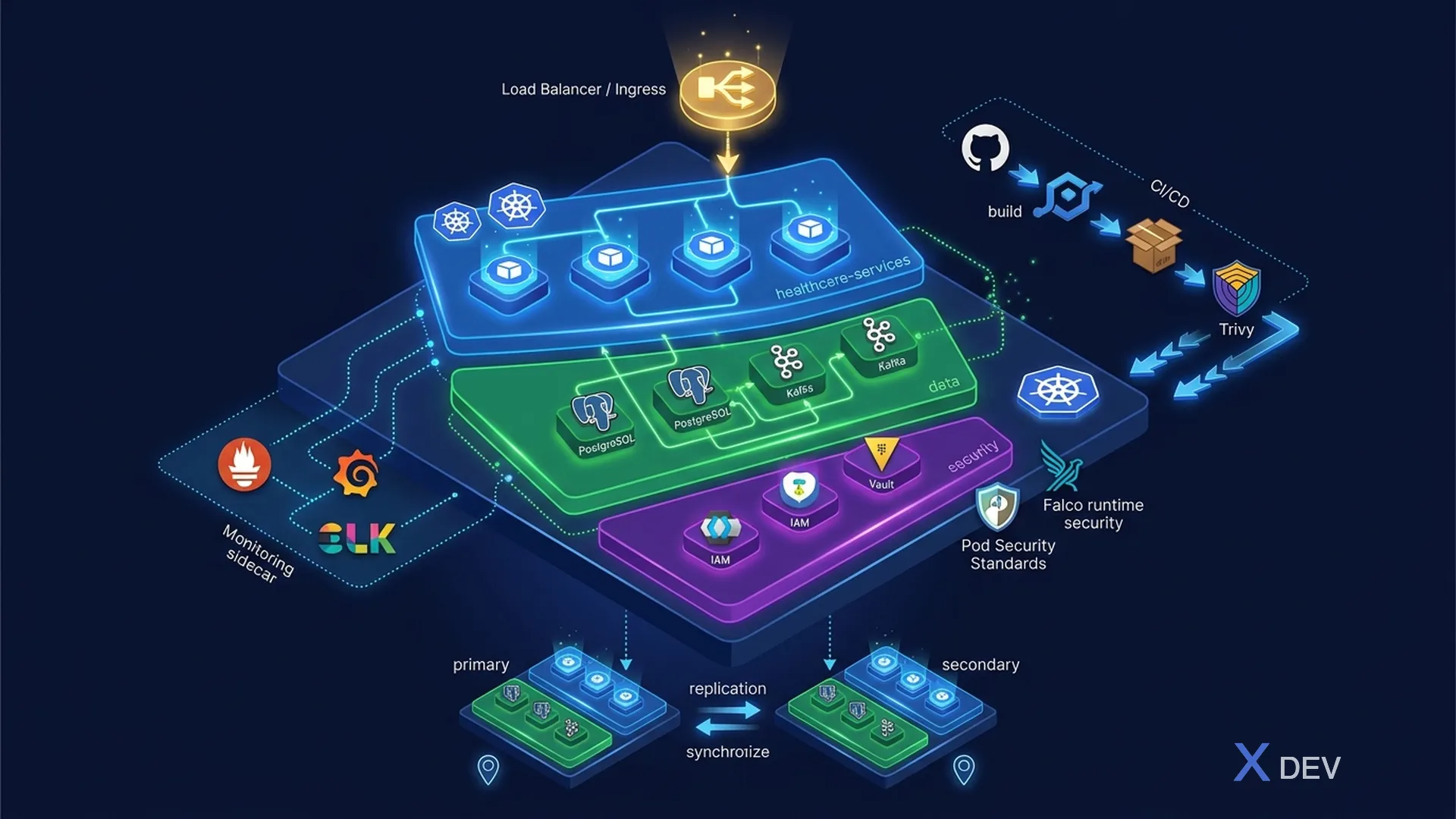
1.1. Mục tiêu
Trong bài cuối cùng này, chúng ta sẽ tổng hợp toàn bộ kiến thức từ 23 bài trước để xây dựng một Secure Healthcare Microservices Platform hoàn chỉnh — từ thiết kế kiến trúc, triển khai security controls, đến compliance verification.
Tổng hợp từ 23 bài học:
| Phần | Bài | Chủ đề chính |
|---|---|---|
| Phần 1: Nền tảng | Bài 1–4 | HIPAA, Threat Modeling, Risk Assessment, Architecture |
| Phần 2: IAM | Bài 5–8 | Keycloak, RBAC/ABAC, MFA, SMART on FHIR |
| Phần 3: Database | Bài 9–12 | PostgreSQL Security, Encryption, RLS, pgAudit |
| Phần 4: Microservices | Bài 13–16 | Quarkus Security, API Gateway, E2E Encryption, mTLS |
| Phần 5: Compliance | Bài 17–20 | HIPAA Safeguards, Audit Trail, Data Masking, DR/BCP |
| Phần 6: Nâng cao | Bài 21–24 | Zero Trust, Container Security, Pentest, Capstone |
Deliverables:
- ✅ Working microservices with full security
- ✅ HIPAA Technical Safeguards compliance
- ✅ Automated security testing pipeline
- ✅ Deployment on Kubernetes with hardening
- ✅ Security Assessment Report
1.2. Phạm vi hệ thống
Chúng ta sẽ xây dựng Hệ thống Quản lý Bệnh viện (Hospital Management System — HMS) với các microservices:
| Service | Mô tả | Dữ liệu PHI |
|---|---|---|
| Patient Service | Quản lý hồ sơ bệnh nhân | Tên, DOB, SSN, địa chỉ, liên lạc |
| Encounter Service | Quản lý lượt khám/nhập viện | Chẩn đoán, lý do khám, bác sĩ điều trị |
| Lab Service | Kết quả xét nghiệm | Kết quả XN máu, nước tiểu, sinh thiết |
| Prescription Service | Đơn thuốc | Thuốc kê, liều lượng, tương tác thuốc |
| Notification Service | Thông báo & nhắc nhở | Lịch tái khám, nhắc uống thuốc |
| Audit Service | Ghi nhận audit trail | Toàn bộ access logs |
2. Kiến trúc tổng thể
2.1. System Architecture
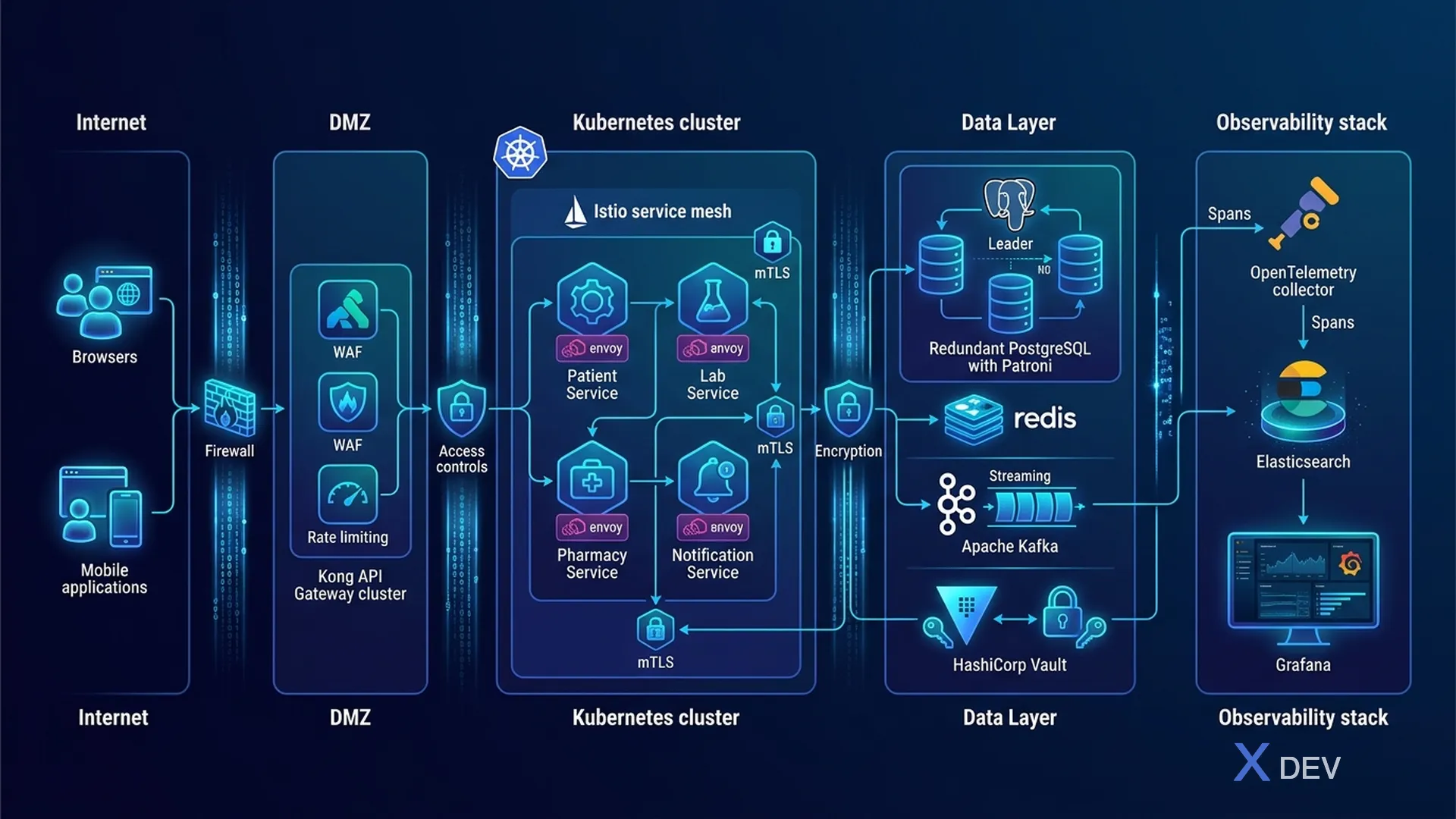
Kiến trúc 3 lớp bảo mật:
| Layer | Components | Security Controls |
|---|---|---|
| DMZ / Edge | API Gateway (Kong) | Rate limiting (100 req/min), WAF (OWASP CRS), JWT verification, IP allowlisting |
| Application (K8s) | Patient, Encounter, Lab, Prescription Services (Quarkus) | OIDC, RBAC/ABAC, Encryption, Audit |
| Service Mesh | Istio | mTLS everywhere, Network Policies, Distributed Tracing |
| Supporting | Notification, Audit, Keycloak IAM | Event-driven, immutable logs, multi-tenant |
| Data | PostgreSQL (Primary + Replica) | RLS, pgcrypto, pgAudit, SSL, Backups |
| Messaging | Kafka (Events) | Encrypted topics, Schema Registry |
| Secrets | Vault (KMS) | Transit encryption, PKI, Auto-unseal |
| Logging | Elasticsearch | Audit log aggregation |
2.2. Project Structure
healthcare-platform/
├── docker-compose.yml           # Local development
├── docker-compose.security.yml  # Security testing
├── pom.xml                      # Parent POM
│
├── infrastructure/
│   ├── keycloak/
│   │   ├── hospital-realm.json  # Realm configuration
│   │   └── themes/              # Custom login theme
│   ├── postgresql/
│   │   ├── init.sql             # Database initialization
│   │   ├── rls-policies.sql     # Row-Level Security
│   │   ├── audit-setup.sql      # pgAudit configuration
│   │   └── encryption.sql       # Column encryption functions
│   ├── kong/
│   │   └── kong.yml             # API Gateway config
│   ├── vault/
│   │   └── policies/            # Vault policies
│   └── kubernetes/
│       ├── base/                # Kustomize base
│       ├── overlays/
│       │   ├── dev/
│       │   ├── staging/
│       │   └── production/
│       └── security/
│           ├── network-policies.yaml
│           ├── pod-security.yaml
│           └── falco-rules.yaml
│
├── services/
│   ├── patient-service/
│   │   ├── pom.xml
│   │   └── src/
│   ├── encounter-service/
│   ├── lab-service/
│   ├── prescription-service/
│   ├── notification-service/
│   └── audit-service/
│
├── shared/
│   ├── security-lib/            # Shared security utilities
│   │   ├── encryption/
│   │   ├── audit/
│   │   └── validation/
│   └── test-lib/                # Shared test utilities
│       ├── security-tests/
│       └── test-data/           # Synthetic healthcare data
│
├── security/
│   ├── .semgrep/                # SAST rules
│   ├── zap/                     # DAST configuration
│   ├── nuclei/                  # Nuclei templates
│   └── compliance/              # HIPAA compliance checks
│
└── .github/
    └── workflows/
        ├── ci.yml               # Build + Security scans
        └── security-audit.yml   # Scheduled audit
3. Bước 1: Cấu hình Keycloak — IAM
3.1. Hospital Realm Configuration
{
  "realm": "hospital",
  "enabled": true,
  "sslRequired": "all",
  "registrationAllowed": false,
  "bruteForceProtected": true,
  "permanentLockout": false,
  "maxFailureWaitSeconds": 900,
  "failureFactor": 5,
  "passwordPolicy": "length(12) and upperCase(1) and lowerCase(1) and digits(1) and specialChars(1) and notUsername and passwordHistory(6) and forceExpiredPasswordChange(90)",
  "ssoSessionIdleTimeout": 900,
  "ssoSessionMaxLifespan": 28800,
  "accessTokenLifespan": 300,
  "refreshTokenMaxReuse": 0,

  "roles": {
    "realm": [
      {
        "name": "chief-physician",
        "description": "Bác sĩ trưởng khoa",
        "composite": true,
        "composites": {
          "realm": ["physician", "view-department-records"]
        }
      },
      {
        "name": "physician",
        "description": "Bác sĩ điều trị",
        "composite": true,
        "composites": {
          "realm": ["view-assigned-patients", "create-encounter",
                     "create-prescription", "view-lab-results"]
        }
      },
      {
        "name": "head-nurse",
        "description": "Y tá trưởng",
        "composite": true,
        "composites": {
          "realm": ["nurse", "manage-ward-schedule"]
        }
      },
      {
        "name": "nurse",
        "description": "Y tá",
        "composite": false
      },
      {
        "name": "lab-technician",
        "description": "Kỹ thuật viên xét nghiệm",
        "composite": false
      },
      {
        "name": "pharmacist",
        "description": "Dược sĩ",
        "composite": false
      },
      {
        "name": "patient",
        "description": "Bệnh nhân",
        "composite": false
      },
      {
        "name": "admin",
        "description": "Quản trị hệ thống",
        "composite": false
      }
    ]
  },

  "users": [
    {
      "username": "dr.nguyen",
      "email": "[email protected]",
      "firstName": "Nguyễn",
      "lastName": "Văn A",
      "enabled": true,
      "requiredActions": ["CONFIGURE_TOTP"],
      "attributes": {
        "department": ["cardiology"],
        "medical_license": ["BS-12345"],
        "employee_id": ["EMP-001"]
      },
      "realmRoles": ["physician"]
    },
    {
      "username": "yta.tran",
      "email": "[email protected]",
      "firstName": "Trần",
      "lastName": "Thị B",
      "enabled": true,
      "attributes": {
        "department": ["cardiology"],
        "ward": ["ward-3"],
        "employee_id": ["EMP-042"]
      },
      "realmRoles": ["nurse"]
    },
    {
      "username": "patient.le",
      "email": "[email protected]",
      "firstName": "Lê",
      "lastName": "Văn C",
      "enabled": true,
      "attributes": {
        "patient_id": ["PAT-001"],
        "insurance_id": ["INS-BH-123456"]
      },
      "realmRoles": ["patient"]
    }
  ],

  "clients": [
    {
      "clientId": "patient-service",
      "name": "Patient Microservice",
      "enabled": true,
      "clientAuthenticatorType": "client-secret",
      "serviceAccountsEnabled": true,
      "authorizationServicesEnabled": true,
      "directAccessGrantsEnabled": false,
      "publicClient": false,
      "protocol": "openid-connect",
      "defaultClientScopes": ["openid", "profile", "healthcare"],
      "attributes": {
        "access.token.lifespan": "300"
      }
    },
    {
      "clientId": "patient-portal",
      "name": "Patient Portal SPA",
      "enabled": true,
      "publicClient": true,
      "directAccessGrantsEnabled": false,
      "standardFlowEnabled": true,
      "redirectUris": ["https://portal.hospital.local/*"],
      "webOrigins": ["https://portal.hospital.local"],
      "defaultClientScopes": ["openid", "profile"],
      "attributes": {
        "pkce.code.challenge.method": "S256",
        "access.token.lifespan": "300"
      }
    }
  ],

  "clientScopes": [
    {
      "name": "healthcare",
      "protocol": "openid-connect",
      "protocolMappers": [
        {
          "name": "department-mapper",
          "protocol": "openid-connect",
          "protocolMapper": "oidc-usermodel-attribute-mapper",
          "config": {
            "user.attribute": "department",
            "claim.name": "department",
            "access.token.claim": "true",
            "id.token.claim": "true"
          }
        },
        {
          "name": "employee-id-mapper",
          "protocol": "openid-connect",
          "protocolMapper": "oidc-usermodel-attribute-mapper",
          "config": {
            "user.attribute": "employee_id",
            "claim.name": "employee_id",
            "access.token.claim": "true"
          }
        },
        {
          "name": "patient-id-mapper",
          "protocol": "openid-connect",
          "protocolMapper": "oidc-usermodel-attribute-mapper",
          "config": {
            "user.attribute": "patient_id",
            "claim.name": "patient_id",
            "access.token.claim": "true"
          }
        }
      ]
    }
  ],

  "authenticationFlows": [
    {
      "alias": "healthcare-browser-flow",
      "description": "Browser flow with MFA for healthcare",
      "providerId": "basic-flow",
      "topLevel": true,
      "builtIn": false,
      "authenticationExecutions": [
        {
          "authenticator": "auth-cookie",
          "requirement": "ALTERNATIVE"
        },
        {
          "authenticator": "auth-username-password-form",
          "requirement": "REQUIRED"
        },
        {
          "authenticator": "auth-otp-form",
          "requirement": "CONDITIONAL",
          "authenticatorConfig": {
            "alias": "healthcare-otp-config"
          }
        }
      ]
    }
  ]
}
4. Bước 2: PostgreSQL Security Setup
4.1. Database Initialization với Security
-- infrastructure/postgresql/init.sql

-- ================================================================
-- 1. Create application roles (least privilege)
-- ================================================================

-- Service accounts (one per microservice)
CREATE ROLE patient_service_role LOGIN PASSWORD NULL; -- cert auth only
CREATE ROLE encounter_service_role LOGIN PASSWORD NULL;
CREATE ROLE lab_service_role LOGIN PASSWORD NULL;
CREATE ROLE prescription_service_role LOGIN PASSWORD NULL;
CREATE ROLE audit_service_role LOGIN PASSWORD NULL;

-- Read-only role for reporting
CREATE ROLE reporting_role LOGIN PASSWORD NULL;

-- ================================================================
-- 2. Create schemas with isolation
-- ================================================================

CREATE SCHEMA IF NOT EXISTS patient_data;
CREATE SCHEMA IF NOT EXISTS encounter_data;
CREATE SCHEMA IF NOT EXISTS lab_data;
CREATE SCHEMA IF NOT EXISTS prescription_data;
CREATE SCHEMA IF NOT EXISTS audit_data;

-- Grant schema access to respective services
GRANT USAGE ON SCHEMA patient_data TO patient_service_role;
GRANT USAGE ON SCHEMA encounter_data TO encounter_service_role;
GRANT USAGE ON SCHEMA lab_data TO lab_service_role;
GRANT USAGE ON SCHEMA prescription_data TO prescription_service_role;
GRANT USAGE ON SCHEMA audit_data TO audit_service_role;

-- ================================================================
-- 3. Install security extensions
-- ================================================================

CREATE EXTENSION IF NOT EXISTS pgcrypto;
CREATE EXTENSION IF NOT EXISTS pgaudit;
CREATE EXTENSION IF NOT EXISTS "uuid-ossp";

-- ================================================================
-- 4. Encryption helper functions
-- ================================================================

-- Envelope encryption: encrypt data with DEK, DEK encrypted with KEK
CREATE OR REPLACE FUNCTION patient_data.encrypt_phi(
    plaintext TEXT,
    context TEXT DEFAULT 'patient_phi'
) RETURNS JSONB AS $$
DECLARE
    dek BYTEA;
    encrypted_data BYTEA;
    encrypted_dek BYTEA;
    kek BYTEA;
BEGIN
    -- Generate random DEK (Data Encryption Key)
    dek := gen_random_bytes(32);

    -- Encrypt data with DEK (AES-256-GCM via pgcrypto)
    encrypted_data := encrypt_iv(
        convert_to(plaintext, 'UTF8'),
        dek,
        gen_random_bytes(16), -- IV
        'aes-cbc/pad:pkcs'
    );

    -- In production: DEK encrypted by Vault Transit engine
    -- For demo: encrypt DEK with master key from env
    kek := decode(current_setting('app.master_key', true), 'hex');
    encrypted_dek := encrypt(dek, kek, 'aes');

    RETURN jsonb_build_object(
        'v', 1,
        'ctx', context,
        'dek', encode(encrypted_dek, 'base64'),
        'data', encode(encrypted_data, 'base64'),
        'ts', extract(epoch from now())
    );
END;
$$ LANGUAGE plpgsql SECURITY DEFINER;

-- ================================================================
-- 5. Create tables with security
-- ================================================================

CREATE TABLE patient_data.patients (
    id UUID PRIMARY KEY DEFAULT uuid_generate_v7(),
    mrn VARCHAR(20) NOT NULL UNIQUE,          -- Medical Record Number

    -- PHI fields — encrypted at column level
    full_name_encrypted JSONB,                 -- Encrypted via encrypt_phi()
    date_of_birth_encrypted JSONB,
    ssn_encrypted JSONB,                       -- Social Security Number
    phone_encrypted JSONB,
    address_encrypted JSONB,

    -- Non-PHI fields — stored in plaintext
    gender VARCHAR(10),
    blood_type VARCHAR(5),
    department_id VARCHAR(50) NOT NULL,        -- For RLS
    primary_physician_id VARCHAR(50),          -- For RLS

    -- Metadata
    tenant_id UUID NOT NULL,                   -- Hospital/tenant
    created_at TIMESTAMPTZ DEFAULT NOW(),
    updated_at TIMESTAMPTZ DEFAULT NOW(),
    created_by VARCHAR(100) NOT NULL,
    is_active BOOLEAN DEFAULT TRUE
);

CREATE TABLE encounter_data.encounters (
    id UUID PRIMARY KEY DEFAULT uuid_generate_v7(),
    patient_id UUID NOT NULL,
    encounter_type VARCHAR(20) NOT NULL,       -- INPATIENT, OUTPATIENT, EMERGENCY

    -- PHI fields — encrypted
    chief_complaint_encrypted JSONB,
    diagnosis_encrypted JSONB,
    clinical_notes_encrypted JSONB,

    -- Non-PHI
    department_id VARCHAR(50) NOT NULL,
    attending_physician_id VARCHAR(50) NOT NULL,
    status VARCHAR(20) DEFAULT 'ACTIVE',

    -- Metadata
    tenant_id UUID NOT NULL,
    encounter_date TIMESTAMPTZ DEFAULT NOW(),
    discharge_date TIMESTAMPTZ,
    created_by VARCHAR(100) NOT NULL,
    created_at TIMESTAMPTZ DEFAULT NOW()
);

CREATE TABLE lab_data.lab_results (
    id UUID PRIMARY KEY DEFAULT uuid_generate_v7(),
    patient_id UUID NOT NULL,
    encounter_id UUID,

    -- PHI fields — encrypted
    test_results_encrypted JSONB,
    interpretation_encrypted JSONB,

    -- Non-PHI
    test_type VARCHAR(100) NOT NULL,
    status VARCHAR(20) DEFAULT 'PENDING',
    ordering_physician_id VARCHAR(50) NOT NULL,
    performing_technician_id VARCHAR(50),
    department_id VARCHAR(50) NOT NULL,

    -- Metadata
    tenant_id UUID NOT NULL,
    ordered_at TIMESTAMPTZ DEFAULT NOW(),
    resulted_at TIMESTAMPTZ,
    created_by VARCHAR(100) NOT NULL
);

CREATE TABLE prescription_data.prescriptions (
    id UUID PRIMARY KEY DEFAULT uuid_generate_v7(),
    patient_id UUID NOT NULL,
    encounter_id UUID,

    -- PHI fields — encrypted
    medications_encrypted JSONB,              -- Drug names, dosages
    instructions_encrypted JSONB,

    -- Non-PHI
    status VARCHAR(20) DEFAULT 'ACTIVE',
    prescribing_physician_id VARCHAR(50) NOT NULL,
    dispensing_pharmacist_id VARCHAR(50),
    department_id VARCHAR(50) NOT NULL,

    -- Digital signature for non-repudiation
    physician_signature JSONB,                -- {algorithm, signature, cert_thumbprint}

    -- Metadata
    tenant_id UUID NOT NULL,
    prescribed_at TIMESTAMPTZ DEFAULT NOW(),
    dispensed_at TIMESTAMPTZ,
    created_by VARCHAR(100) NOT NULL
);

-- ================================================================
-- 6. Row-Level Security Policies
-- ================================================================

ALTER TABLE patient_data.patients ENABLE ROW LEVEL SECURITY;
ALTER TABLE encounter_data.encounters ENABLE ROW LEVEL SECURITY;
ALTER TABLE lab_data.lab_results ENABLE ROW LEVEL SECURITY;
ALTER TABLE prescription_data.prescriptions ENABLE ROW LEVEL SECURITY;

-- Patient Service: can only access patients in its department scope
CREATE POLICY patient_department_isolation ON patient_data.patients
    FOR ALL
    TO patient_service_role
    USING (
        department_id = current_setting('app.current_department', true)
        OR current_setting('app.current_role', true) = 'admin'
        OR (
            -- Bác sĩ chỉ thấy bệnh nhân của mình
            current_setting('app.current_role', true) = 'physician'
            AND primary_physician_id = current_setting('app.current_user_id', true)
        )
        OR (
            -- Bệnh nhân chỉ thấy hồ sơ của chính mình
            current_setting('app.current_role', true) = 'patient'
            AND id::text = current_setting('app.current_patient_id', true)
        )
    );

-- Multi-tenant isolation
CREATE POLICY patient_tenant_isolation ON patient_data.patients
    FOR ALL
    TO patient_service_role
    USING (tenant_id::text = current_setting('app.current_tenant_id', true));

-- Encounter: physician sees own patients' encounters
CREATE POLICY encounter_physician_policy ON encounter_data.encounters
    FOR ALL
    TO encounter_service_role
    USING (
        attending_physician_id = current_setting('app.current_user_id', true)
        OR department_id = current_setting('app.current_department', true)
        OR current_setting('app.current_role', true) IN ('admin', 'chief-physician')
    );

-- Lab Results: accessible by ordering physician, lab tech, assigned nurse
CREATE POLICY lab_result_policy ON lab_data.lab_results
    FOR ALL
    TO lab_service_role
    USING (
        ordering_physician_id = current_setting('app.current_user_id', true)
        OR performing_technician_id = current_setting('app.current_user_id', true)
        OR department_id = current_setting('app.current_department', true)
    );

-- ================================================================
-- 7. pgAudit Configuration
-- ================================================================

ALTER SYSTEM SET pgaudit.log = 'read, write, ddl';
ALTER SYSTEM SET pgaudit.log_relation = 'on';
ALTER SYSTEM SET pgaudit.log_parameter = 'on';
ALTER SYSTEM SET pgaudit.log_catalog = 'off';

-- Object-level audit for PHI tables
SELECT pgaudit.set_config('log', 'all', true);

-- ================================================================
-- 8. Audit trail table (immutable — no UPDATE/DELETE)
-- ================================================================

CREATE TABLE audit_data.access_log (
    id UUID PRIMARY KEY DEFAULT uuid_generate_v7(),
    timestamp TIMESTAMPTZ NOT NULL DEFAULT NOW(),
    user_id VARCHAR(100) NOT NULL,
    user_role VARCHAR(50) NOT NULL,
    action VARCHAR(20) NOT NULL,         -- READ, CREATE, UPDATE, DELETE
    resource_type VARCHAR(50) NOT NULL,  -- Patient, Encounter, LabResult
    resource_id UUID,
    department VARCHAR(50),
    tenant_id UUID NOT NULL,
    ip_address INET,
    user_agent TEXT,
    request_id UUID,                     -- Correlation ID
    details JSONB,
    result VARCHAR(20) NOT NULL          -- SUCCESS, DENIED, ERROR
);

-- Prevent modification of audit logs
REVOKE UPDATE, DELETE ON audit_data.access_log FROM PUBLIC;
GRANT INSERT, SELECT ON audit_data.access_log TO audit_service_role;
5. Bước 3: Patient Service — Quarkus Security
5.1. Application Configuration
# application.properties — Patient Service

# === OIDC Configuration ===
quarkus.oidc.auth-server-url=https://keycloak.hospital.local/realms/hospital
quarkus.oidc.client-id=patient-service
quarkus.oidc.credentials.secret=${OIDC_CLIENT_SECRET}
quarkus.oidc.token.issuer=https://keycloak.hospital.local/realms/hospital
quarkus.oidc.token.audience=patient-service

# Token verification
quarkus.oidc.token.customizer-name=healthcare-token-customizer

# === Database with SSL ===
quarkus.datasource.db-kind=postgresql
quarkus.datasource.jdbc.url=jdbc:postgresql://pg-primary:5432/healthcare?ssl=true&sslmode=verify-full&sslrootcert=/certs/ca.crt&sslcert=/certs/client.crt&sslkey=/certs/client.key
quarkus.datasource.username=patient_service_role
# No password — using certificate authentication

# Connection pool security
quarkus.datasource.jdbc.max-size=20
quarkus.datasource.jdbc.min-size=2
quarkus.datasource.jdbc.idle-removal-interval=PT5M
quarkus.datasource.jdbc.max-lifetime=PT30M

# === Security Headers ===
quarkus.http.header."X-Content-Type-Options".value=nosniff
quarkus.http.header."X-Frame-Options".value=DENY
quarkus.http.header."X-XSS-Protection".value=1; mode=block
quarkus.http.header."Strict-Transport-Security".value=max-age=31536000; includeSubDomains
quarkus.http.header."Content-Security-Policy".value=default-src 'self'
quarkus.http.header."Cache-Control".value=no-store, no-cache, must-revalidate
quarkus.http.header."Pragma".value=no-cache

# Remove technology fingerprints
quarkus.http.header."Server".value=
quarkus.http.header."X-Powered-By".value=

# === TLS ===
quarkus.http.ssl.certificate.files=/certs/tls.crt
quarkus.http.ssl.certificate.key-files=/certs/tls.key
quarkus.http.insecure-requests=disabled

# === Vault Integration ===
quarkus.vault.url=https://vault.hospital.local
quarkus.vault.authentication.kubernetes.role=patient-service
quarkus.vault.transit.key.healthcare-phi=patient-phi-key

# === Audit ===
quarkus.log.handler.kafka.enabled=true
quarkus.log.handler.kafka.topic=healthcare-audit-events
quarkus.log.handler.kafka.bootstrap-servers=kafka:9093
5.2. Security Filter — JWT to PostgreSQL Session
// RLSContextFilter.java — Propagate JWT claims to PostgreSQL session variables

@Provider
@Priority(Priorities.AUTHORIZATION + 1)
@RequestScoped
public class RLSContextFilter implements ContainerRequestFilter {

    @Inject
    SecurityIdentity securityIdentity;

    @Inject
    AgroalDataSource dataSource;

    @Inject
    AuditService auditService;

    @Override
    public void filter(ContainerRequestContext requestContext) {
        if (securityIdentity.isAnonymous()) {
            return;
        }

        JsonWebToken jwt = (JsonWebToken) securityIdentity.getPrincipal();

        try (Connection conn = dataSource.getConnection()) {
            // Set PostgreSQL session variables from JWT claims
            // These are used by RLS policies
            setSessionVariable(conn, "app.current_user_id",
                jwt.getClaim("employee_id") != null ?
                    jwt.getClaim("employee_id").toString() :
                    jwt.getClaim("patient_id").toString());

            setSessionVariable(conn, "app.current_role",
                getPrimaryRole(securityIdentity));

            setSessionVariable(conn, "app.current_department",
                jwt.getClaim("department") != null ?
                    jwt.getClaim("department").toString() : "");

            setSessionVariable(conn, "app.current_tenant_id",
                jwt.getClaim("tenant_id") != null ?
                    jwt.getClaim("tenant_id").toString() : "");

            if (jwt.getClaim("patient_id") != null) {
                setSessionVariable(conn, "app.current_patient_id",
                    jwt.getClaim("patient_id").toString());
            }

        } catch (SQLException e) {
            Log.error("Failed to set RLS context", e);
            requestContext.abortWith(
                Response.status(Response.Status.INTERNAL_SERVER_ERROR)
                    .entity(Map.of("error", "Security context initialization failed"))
                    .build());
        }
    }

    private void setSessionVariable(Connection conn, String name, String value)
            throws SQLException {
        // Use parameterized SET to prevent SQL injection
        try (var stmt = conn.prepareStatement(
                "SELECT set_config(?, ?, true)")) {
            stmt.setString(1, name);
            stmt.setString(2, value);
            stmt.execute();
        }
    }

    private String getPrimaryRole(SecurityIdentity identity) {
        Set<String> roles = identity.getRoles();
        // Priority order for healthcare roles
        List<String> priority = List.of(
            "admin", "chief-physician", "physician", "head-nurse",
            "nurse", "lab-technician", "pharmacist", "patient"
        );
        return priority.stream()
            .filter(roles::contains)
            .findFirst()
            .orElse("unknown");
    }
}
5.3. Patient Resource với Security
// PatientResource.java

@Path("/api/v1/patients")
@Produces(MediaType.APPLICATION_JSON)
@Consumes(MediaType.APPLICATION_JSON)
@Authenticated
public class PatientResource {

    @Inject
    PatientService patientService;

    @Inject
    AuditService auditService;

    @Inject
    SecurityIdentity securityIdentity;

    @Inject
    EncryptionService encryptionService;

    /**
     * Get patient by ID — with audit logging and field-level decryption
     */
    @GET
    @Path("/{patientId}")
    @RolesAllowed({"physician", "chief-physician", "nurse", "patient", "admin"})
    public Response getPatient(
            @PathParam("patientId") UUID patientId,
            @HeaderParam("X-Request-ID") String requestId) {

        // Audit: record access attempt
        String userId = getUserId();
        auditService.logAccess(AuditEvent.builder()
            .action("READ")
            .resourceType("Patient")
            .resourceId(patientId)
            .userId(userId)
            .requestId(requestId)
            .build());

        // Fetch patient — RLS automatically filters based on JWT claims
        Optional<Patient> patient = patientService.findById(patientId);

        if (patient.isEmpty()) {
            // Don't reveal whether patient exists — return same error
            auditService.logAccess(AuditEvent.builder()
                .action("READ")
                .resourceType("Patient")
                .resourceId(patientId)
                .userId(userId)
                .result("DENIED")
                .details("Patient not found or access denied by RLS")
                .build());

            return Response.status(Response.Status.NOT_FOUND)
                .entity(Map.of("error", "Patient not found"))
                .build();
        }

        // Decrypt PHI fields for response
        PatientDTO dto = mapToDTO(patient.get());

        // Audit: successful access
        auditService.logAccess(AuditEvent.builder()
            .action("READ")
            .resourceType("Patient")
            .resourceId(patientId)
            .userId(userId)
            .result("SUCCESS")
            .build());

        return Response.ok(dto).build();
    }

    /**
     * Create patient — physicians and admin only, with MFA verification
     */
    @POST
    @RolesAllowed({"physician", "chief-physician", "admin"})
    public Response createPatient(
            @Valid CreatePatientRequest request,
            @HeaderParam("X-Request-ID") String requestId) {

        // Verify MFA was used for this session (check 'amr' claim)
        verifyMFA();

        // Validate and sanitize input
        sanitizeInput(request);

        // Encrypt PHI fields before persistence
        Patient patient = new Patient();
        patient.setMrn(generateMRN());
        patient.setFullNameEncrypted(
            encryptionService.encryptPHI(request.getFullName(), "patient_name"));
        patient.setDateOfBirthEncrypted(
            encryptionService.encryptPHI(request.getDateOfBirth().toString(), "dob"));
        patient.setSsnEncrypted(
            encryptionService.encryptPHI(request.getSsn(), "ssn"));
        patient.setPhoneEncrypted(
            encryptionService.encryptPHI(request.getPhone(), "phone"));
        patient.setAddressEncrypted(
            encryptionService.encryptPHI(request.getAddress(), "address"));

        // Non-PHI fields
        patient.setGender(request.getGender());
        patient.setBloodType(request.getBloodType());
        patient.setDepartmentId(getDepartmentFromJWT());
        patient.setPrimaryPhysicianId(getUserId());
        patient.setTenantId(getTenantFromJWT());
        patient.setCreatedBy(getUserId());

        Patient created = patientService.create(patient);

        // Audit
        auditService.logAccess(AuditEvent.builder()
            .action("CREATE")
            .resourceType("Patient")
            .resourceId(created.getId())
            .userId(getUserId())
            .result("SUCCESS")
            .details("New patient registered: " + created.getMrn())
            .build());

        return Response.status(Response.Status.CREATED)
            .entity(mapToDTO(created))
            .build();
    }

    /**
     * Search patients — results filtered by RLS
     */
    @GET
    @Path("/search")
    @RolesAllowed({"physician", "chief-physician", "nurse", "admin"})
    public Response searchPatients(
            @QueryParam("name") String name,
            @QueryParam("mrn") String mrn,
            @QueryParam("page") @DefaultValue("0") int page,
            @QueryParam("size") @DefaultValue("20") int size) {

        // Limit page size to prevent data exfiltration
        size = Math.min(size, 50);

        // Search — RLS ensures only authorized patients are returned
        Page<PatientDTO> results;
        if (mrn != null && !mrn.isBlank()) {
            results = patientService.findByMrn(mrn.trim(), page, size);
        } else if (name != null && !name.isBlank()) {
            // Search on encrypted fields requires special handling
            results = patientService.searchByName(name.trim(), page, size);
        } else {
            results = patientService.findAll(page, size);
        }

        // Audit bulk access
        auditService.logAccess(AuditEvent.builder()
            .action("SEARCH")
            .resourceType("Patient")
            .userId(getUserId())
            .result("SUCCESS")
            .details("Search returned " + results.getTotalElements() + " results")
            .build());

        return Response.ok(results).build();
    }

    // ================================================================
    // Emergency Access (Break-the-Glass)
    // ================================================================

    /**
     * Emergency access to any patient — bypasses department restriction
     * Requires explicit reason and triggers immediate alert
     */
    @GET
    @Path("/{patientId}/emergency-access")
    @RolesAllowed({"physician", "chief-physician", "nurse"})
    public Response emergencyAccess(
            @PathParam("patientId") UUID patientId,
            @QueryParam("reason") @NotBlank String reason,
            @HeaderParam("X-Request-ID") String requestId) {

        // Log CRITICAL audit event
        auditService.logEmergencyAccess(AuditEvent.builder()
            .action("EMERGENCY_ACCESS")
            .resourceType("Patient")
            .resourceId(patientId)
            .userId(getUserId())
            .result("GRANTED")
            .details("Emergency reason: " + reason)
            .build());

        // Trigger immediate alert to security team
        auditService.triggerSecurityAlert(
            "EMERGENCY_ACCESS",
            "User " + getUserId() + " invoked emergency access for patient "
                + patientId + ". Reason: " + reason
        );

        // Fetch with elevated privileges (bypass RLS via superuser context)
        Optional<Patient> patient = patientService.findByIdElevated(patientId);

        return patient.map(p -> Response.ok(mapToDTO(p)).build())
            .orElse(Response.status(404).build());
    }

    private void verifyMFA() {
        JsonWebToken jwt = (JsonWebToken) securityIdentity.getPrincipal();
        List<String> amr = jwt.getClaim("amr");
        if (amr == null || !amr.contains("mfa")) {
            throw new ForbiddenException("MFA required for this operation");
        }
    }

    private void sanitizeInput(CreatePatientRequest request) {
        // Input validation is handled by @Valid + Bean Validation
        // Additional sanitization for XSS prevention
        request.setFullName(HtmlUtils.sanitize(request.getFullName()));
        request.setAddress(HtmlUtils.sanitize(request.getAddress()));
    }
}
5.4. Encryption Service
// EncryptionService.java — Vault-backed PHI encryption

@ApplicationScoped
public class EncryptionService {

    @Inject
    VaultTransitSecretEngine vaultTransit;

    private static final String TRANSIT_KEY = "healthcare-phi";

    /**
     * Encrypt PHI field using Vault Transit engine (envelope encryption)
     */
    public JsonObject encryptPHI(String plaintext, String context) {
        if (plaintext == null || plaintext.isBlank()) {
            return null;
        }

        // Vault Transit: server-side encryption, key never leaves Vault
        String ciphertext = vaultTransit.encrypt(
            TRANSIT_KEY,
            plaintext,
            VaultTransitContext.builder()
                .context(context)
                .build()
        );

        return Json.createObjectBuilder()
            .add("v", 1)
            .add("engine", "vault-transit")
            .add("key", TRANSIT_KEY)
            .add("ctx", context)
            .add("ciphertext", ciphertext)
            .add("encrypted_at", Instant.now().toString())
            .build();
    }

    /**
     * Decrypt PHI field
     */
    public String decryptPHI(JsonObject encrypted) {
        if (encrypted == null) {
            return null;
        }

        String ciphertext = encrypted.getString("ciphertext");
        String context = encrypted.getString("ctx");

        return vaultTransit.decrypt(
            TRANSIT_KEY,
            ciphertext,
            VaultTransitContext.builder()
                .context(context)
                .build()
        ).asString();
    }
}
6. Bước 4: Audit Service
6.1. Centralized Audit Service
// AuditService.java — Immutable audit trail

@ApplicationScoped
public class AuditService {

    @Inject
    AuditRepository auditRepository;

    @Inject
    @Channel("audit-events")
    Emitter<AuditEvent> auditEmitter;

    @Inject
    SecurityIdentity securityIdentity;

    @Inject
    @ConfigProperty(name = "app.security.alert.enabled", defaultValue = "true")
    boolean alertEnabled;

    /**
     * Log access event — immutable, append-only
     */
    public void logAccess(AuditEvent event) {
        // Enrich event with context
        event.setTimestamp(Instant.now());
        event.setIpAddress(getClientIP());
        event.setUserAgent(getUserAgent());

        if (event.getDepartment() == null && !securityIdentity.isAnonymous()) {
            JsonWebToken jwt = (JsonWebToken) securityIdentity.getPrincipal();
            event.setDepartment(jwt.getClaim("department"));
            event.setTenantId(jwt.getClaim("tenant_id"));
        }

        // 1. Persist to PostgreSQL (audit_data.access_log)
        auditRepository.insert(event);

        // 2. Emit to Kafka for ELK/SIEM consumption
        auditEmitter.send(event);

        // 3. Check for suspicious patterns
        detectSuspiciousActivity(event);
    }

    /**
     * Emergency access — elevated severity
     */
    public void logEmergencyAccess(AuditEvent event) {
        event.setSeverity("CRITICAL");
        event.setEmergencyAccess(true);
        logAccess(event);
    }

    /**
     * Trigger security alert (email + Slack + PagerDuty)
     */
    public void triggerSecurityAlert(String type, String message) {
        if (!alertEnabled) return;

        SecurityAlert alert = SecurityAlert.builder()
            .type(type)
            .message(message)
            .timestamp(Instant.now())
            .severity("HIGH")
            .build();

        // Send to security monitoring channel
        auditEmitter.send(Message.of(alert)
            .withMetadata(OutgoingKafkaRecordMetadata.builder()
                .withTopic("security-alerts")
                .withKey(type)
                .build()));
    }

    /**
     * Detect suspicious access patterns
     */
    private void detectSuspiciousActivity(AuditEvent event) {
        String userId = event.getUserId();

        // Pattern 1: High-volume patient record access (data exfiltration)
        long recentAccesses = auditRepository.countRecentAccesses(
            userId, "Patient", Duration.ofMinutes(5));
        if (recentAccesses > 50) {
            triggerSecurityAlert("HIGH_VOLUME_ACCESS",
                "User " + userId + " accessed " + recentAccesses +
                " patient records in 5 minutes. Possible data exfiltration.");
        }

        // Pattern 2: Access denied followed by emergency access
        if ("EMERGENCY_ACCESS".equals(event.getAction())) {
            long recentDenials = auditRepository.countRecentDenials(
                userId, Duration.ofMinutes(10));
            if (recentDenials > 0) {
                triggerSecurityAlert("EMERGENCY_AFTER_DENIAL",
                    "User " + userId + " used emergency access after " +
                    recentDenials + " access denials. Requires review.");
            }
        }

        // Pattern 3: After-hours access to sensitive records
        LocalTime now = LocalTime.now(ZoneId.of("Asia/Ho_Chi_Minh"));
        if ((now.isBefore(LocalTime.of(6, 0)) || now.isAfter(LocalTime.of(22, 0)))
            && "READ".equals(event.getAction())
            && Set.of("Patient", "LabResult", "Prescription")
                   .contains(event.getResourceType())) {
            triggerSecurityAlert("AFTER_HOURS_ACCESS",
                "User " + userId + " accessed " + event.getResourceType() +
                " at " + now + ". After-hours access requires review.");
        }
    }
}
7. Bước 5: Kubernetes Deployment
7.1. Secure Deployment Manifests
# kubernetes/base/patient-service/deployment.yaml
apiVersion: apps/v1
kind: Deployment
metadata:
  name: patient-service
  namespace: healthcare
  labels:
    app: patient-service
    compliance: hipaa
spec:
  replicas: 3
  selector:
    matchLabels:
      app: patient-service
  template:
    metadata:
      labels:
        app: patient-service
        security.istio.io/tlsMode: istio
      annotations:
        sidecar.istio.io/inject: "true"
        vault.hashicorp.com/agent-inject: "true"
        vault.hashicorp.com/role: "patient-service"
        vault.hashicorp.com/agent-inject-secret-db-certs: "pki/issue/patient-service"
    spec:
      serviceAccountName: patient-service-sa
      automountServiceAccountToken: false

      securityContext:
        runAsNonRoot: true
        runAsUser: 1000
        runAsGroup: 1000
        fsGroup: 1000
        seccompProfile:
          type: RuntimeDefault

      containers:
        - name: patient-service
          image: registry.hospital.local/patient-service:1.0.0

          securityContext:
            allowPrivilegeEscalation: false
            readOnlyRootFilesystem: true
            capabilities:
              drop: ["ALL"]

          ports:
            - containerPort: 8443
              name: https
              protocol: TCP

          env:
            - name: QUARKUS_PROFILE
              value: "production"
            - name: OIDC_CLIENT_SECRET
              valueFrom:
                secretKeyRef:
                  name: patient-service-oidc
                  key: client-secret

          resources:
            requests:
              memory: "256Mi"
              cpu: "250m"
            limits:
              memory: "512Mi"
              cpu: "500m"

          livenessProbe:
            httpGet:
              path: /q/health/live
              port: 8443
              scheme: HTTPS
            initialDelaySeconds: 15
            periodSeconds: 10

          readinessProbe:
            httpGet:
              path: /q/health/ready
              port: 8443
              scheme: HTTPS
            initialDelaySeconds: 5
            periodSeconds: 5

          volumeMounts:
            - name: tls-certs
              mountPath: /certs
              readOnly: true
            - name: tmp
              mountPath: /tmp

      volumes:
        - name: tls-certs
          secret:
            secretName: patient-service-tls
        - name: tmp
          emptyDir:
            medium: Memory
            sizeLimit: 64Mi
---
# Network Policy — restrict ingress/egress
apiVersion: networking.k8s.io/v1
kind: NetworkPolicy
metadata:
  name: patient-service-netpol
  namespace: healthcare
spec:
  podSelector:
    matchLabels:
      app: patient-service
  policyTypes:
    - Ingress
    - Egress
  ingress:
    - from:
        # Only API Gateway can access Patient Service
        - podSelector:
            matchLabels:
              app: api-gateway
      ports:
        - port: 8443
          protocol: TCP
  egress:
    # PostgreSQL
    - to:
        - podSelector:
            matchLabels:
              app: postgresql
      ports:
        - port: 5432
    # Keycloak (token verification)
    - to:
        - podSelector:
            matchLabels:
              app: keycloak
      ports:
        - port: 8443
    # Kafka (audit events)
    - to:
        - podSelector:
            matchLabels:
              app: kafka
      ports:
        - port: 9093
    # Vault (encryption)
    - to:
        - podSelector:
            matchLabels:
              app: vault
      ports:
        - port: 8200
    # DNS
    - to: []
      ports:
        - port: 53
          protocol: UDP
8. Bước 6: Security Testing & Compliance
8.1. Automated HIPAA Compliance Verification
// HIPAAComplianceTest.java — Run as integration test

@QuarkusIntegrationTest
public class HIPAAComplianceTest {

    /**
     * §164.312(a)(1) — Access Control
     */
    @Test
    void testAccessControl_uniqueUserIdentification() {
        // Every API call must have a unique user identifier
        Response response = given()
            .header("Authorization", "Bearer " + getValidToken("dr.nguyen"))
            .when()
            .get("/api/v1/patients/PAT-001")
            .then()
            .statusCode(200)
            .extract().response();

        // Verify audit log has unique user ID
        AuditEntry audit = getLatestAuditEntry();
        assertThat(audit.getUserId()).isEqualTo("EMP-001");
        assertThat(audit.getUserId()).isNotBlank();
    }

    @Test
    void testAccessControl_automaticLogoff() {
        // Session timeout must be <= 15 minutes
        String token = getValidToken("dr.nguyen");

        // Token should expire within 5 minutes (access token)
        DecodedJWT jwt = JWT.decode(token);
        long lifespanSeconds = jwt.getExpiresAt().getTime() / 1000 -
                              jwt.getIssuedAt().getTime() / 1000;
        assertThat(lifespanSeconds).isLessThanOrEqualTo(300); // 5 min
    }

    @Test
    void testAccessControl_encryptionAtRest() {
        // Create a patient and verify data is encrypted in DB
        createTestPatient();

        // Direct DB query — PHI fields must be encrypted
        try (Connection conn = getDirectDBConnection()) {
            var rs = conn.createStatement().executeQuery(
                "SELECT full_name_encrypted, ssn_encrypted " +
                "FROM patient_data.patients WHERE mrn = 'TEST-MRN-001'");

            assertTrue(rs.next());

            String nameField = rs.getString("full_name_encrypted");
            String ssnField = rs.getString("ssn_encrypted");

            // Fields should be JSON with encrypted data, not plaintext
            assertThat(nameField).contains("ciphertext");
            assertThat(nameField).doesNotContain("Nguyễn");
            assertThat(ssnField).contains("ciphertext");
            assertThat(ssnField).doesNotContain("123-45-6789");
        }
    }

    /**
     * §164.312(b) — Audit Controls
     */
    @Test
    void testAuditControls_allPHIAccessLogged() {
        long auditCountBefore = getAuditLogCount();

        // Access patient record
        given()
            .header("Authorization", "Bearer " + getValidToken("dr.nguyen"))
            .when()
            .get("/api/v1/patients/PAT-001")
            .then()
            .statusCode(200);

        long auditCountAfter = getAuditLogCount();
        assertThat(auditCountAfter).isGreaterThan(auditCountBefore);

        AuditEntry latest = getLatestAuditEntry();
        assertThat(latest.getAction()).isEqualTo("READ");
        assertThat(latest.getResourceType()).isEqualTo("Patient");
        assertThat(latest.getUserId()).isNotBlank();
        assertThat(latest.getTimestamp()).isNotNull();
        assertThat(latest.getResult()).isEqualTo("SUCCESS");
    }

    @Test
    void testAuditControls_auditLogsImmutable() {
        // Attempt to delete audit logs should fail
        try (Connection conn = getServiceDBConnection()) {
            assertThrows(SQLException.class, () -> {
                conn.createStatement().executeUpdate(
                    "DELETE FROM audit_data.access_log WHERE id IS NOT NULL");
            });
        }

        // Attempt to update audit logs should fail
        try (Connection conn = getServiceDBConnection()) {
            assertThrows(SQLException.class, () -> {
                conn.createStatement().executeUpdate(
                    "UPDATE audit_data.access_log SET result = 'MODIFIED'");
            });
        }
    }

    /**
     * §164.312(c)(1) — Integrity
     */
    @Test
    void testIntegrity_prescriptionDigitalSignature() {
        // Create prescription
        String prescriptionId = createTestPrescription();

        // Verify digital signature exists
        try (Connection conn = getDirectDBConnection()) {
            var rs = conn.createStatement().executeQuery(
                "SELECT physician_signature FROM prescription_data.prescriptions " +
                "WHERE id = '" + prescriptionId + "'");

            assertTrue(rs.next());
            String signature = rs.getString("physician_signature");
            assertThat(signature).isNotNull();
            assertThat(signature).contains("algorithm");
            assertThat(signature).contains("signature");
        }
    }

    /**
     * §164.312(d) — Person or Entity Authentication
     */
    @Test
    void testAuthentication_mfaForSensitiveOps() {
        // Token without MFA claim
        String tokenNoMFA = getTokenWithoutMFA("dr.nguyen");

        // Creating prescription should require MFA
        given()
            .header("Authorization", "Bearer " + tokenNoMFA)
            .contentType(ContentType.JSON)
            .body(createPrescriptionPayload())
            .when()
            .post("/api/v1/prescriptions")
            .then()
            .statusCode(403)
            .body("error", containsString("MFA"));
    }

    /**
     * §164.312(e)(1) — Transmission Security
     */
    @Test
    void testTransmissionSecurity_tlsEnforced() {
        // HTTP (non-TLS) request should be rejected
        given()
            .baseUri("http://localhost:8080") // HTTP, not HTTPS
            .when()
            .get("/api/v1/health")
            .then()
            // Should redirect to HTTPS or reject
            .statusCode(anyOf(is(301), is(400), is(403)));
    }

    @Test
    void testTransmissionSecurity_securityHeaders() {
        Response response = given()
            .header("Authorization", "Bearer " + getValidToken("dr.nguyen"))
            .when()
            .get("/api/v1/patients/PAT-001")
            .then()
            .statusCode(200)
            .extract().response();

        Headers headers = response.headers();
        assertThat(headers.getValue("Strict-Transport-Security")).isNotNull();
        assertThat(headers.getValue("X-Content-Type-Options")).isEqualTo("nosniff");
        assertThat(headers.getValue("X-Frame-Options")).isEqualTo("DENY");
        assertThat(headers.getValue("Cache-Control")).contains("no-store");
    }

    /**
     * RLS Verification — Department Isolation
     */
    @Test
    void testRLS_departmentIsolation() {
        // Cardiologist should not see neurology patients
        String cardioToken = getTokenForDepartment("dr.nguyen", "cardiology");

        String result = given()
            .header("Authorization", "Bearer " + cardioToken)
            .when()
            .get("/api/v1/patients/search?department=neurology")
            .then()
            .statusCode(200)
            .extract().body().asString();

        // RLS should filter out neurology patients
        assertThat(result).doesNotContain("neurology");
    }

    @Test
    void testRLS_patientSelfAccess() {
        // Patient can only see their own records
        String patientToken = getTokenForPatient("patient.le", "PAT-001");

        // Access own record — should succeed
        given()
            .header("Authorization", "Bearer " + patientToken)
            .when()
            .get("/api/v1/patients/PAT-001")
            .then()
            .statusCode(200);

        // Access other patient — should fail
        given()
            .header("Authorization", "Bearer " + patientToken)
            .when()
            .get("/api/v1/patients/PAT-002")
            .then()
            .statusCode(anyOf(is(403), is(404)));
    }
}
9. Bước 7: Monitoring & Observability
9.1. Security Monitoring Stack
# docker-compose.monitoring.yml
services:
  # Elasticsearch for audit log storage
  elasticsearch:
    image: docker.elastic.co/elasticsearch/elasticsearch:8.15.0
    environment:
      - discovery.type=single-node
      - xpack.security.enabled=true
      - ELASTIC_PASSWORD=${ELASTIC_PASSWORD}
    volumes:
      - es-data:/usr/share/elasticsearch/data

  # Kibana for security dashboards
  kibana:
    image: docker.elastic.co/kibana/kibana:8.15.0
    environment:
      - ELASTICSEARCH_HOSTS=http://elasticsearch:9200
      - ELASTICSEARCH_PASSWORD=${ELASTIC_PASSWORD}
    depends_on:
      - elasticsearch

  # Grafana for security metrics
  grafana:
    image: grafana/grafana:11.0.0
    volumes:
      - ./monitoring/grafana/dashboards:/var/lib/grafana/dashboards
      - ./monitoring/grafana/datasources:/etc/grafana/provisioning/datasources

  # Prometheus for metrics collection
  prometheus:
    image: prom/prometheus:v2.53.0
    volumes:
      - ./monitoring/prometheus/prometheus.yml:/etc/prometheus/prometheus.yml
      - ./monitoring/prometheus/alerts/:/etc/prometheus/alerts/

  # Alertmanager for security alerts
  alertmanager:
    image: prom/alertmanager:v0.27.0
    volumes:
      - ./monitoring/alertmanager/config.yml:/etc/alertmanager/config.yml
9.2. Security Dashboard Panels
Healthcare Security Dashboard — Key Metrics:
| Metric | Giá trị | Trạng thái |
|---|---|---|
| Auth Failures Today | 12 | ▼ Giảm so với hôm qua |
| PHI Access Today | 1,234 | ≈ Bình thường |
| Emergency Access | 0 | ✅ OK |
PHI Access by Department (Last 24h):
| Department | Lượt truy cập |
|---|---|
| Cardiology | 450 |
| Internal Medicine | 320 |
| Neurology | 210 |
| Pediatrics | 120 |
| Emergency | 78 |
Recent Security Events:
- ⚠️ 14:23 —
dr.tran: 45 patient records in 3 min (alert) - ✅ 14:15 —
yta.pham: Normal ward rounds access - ✅ 13:50 —
lab.tech: Lab results upload (batch) - ℹ️ 13:30 — System: Certificate rotation completed
10. Deliverables & Checklist
10.1. Final Project Checklist
Capstone Project — HIPAA Compliance Checklist
IDENTITY & ACCESS MANAGEMENT
- Keycloak realm with RBAC/ABAC roles
- MFA required for sensitive operations
- Break-the-glass emergency access with audit
- Session timeout ≤ 15 minutes
- Password policy (12+ chars, complexity, history)
- Brute force protection enabled
DATA PROTECTION
- PHI encrypted at rest (Vault Transit / pgcrypto)
- PHI encrypted in transit (TLS 1.2+, mTLS)
- Column-level encryption for sensitive fields
- Key management via HashiCorp Vault
- Key rotation policy configured
ACCESS CONTROL
- Row-Level Security on all PHI tables
- Department-based data isolation
- Patient self-access restriction
- Multi-tenant isolation
- Principle of least privilege for DB roles
AUDIT & MONITORING
- All PHI access logged (audit_data.access_log)
- pgAudit enabled for SQL-level audit
- Immutable audit trail (no UPDATE/DELETE)
- Centralized logging (ELK Stack)
- Security alerts for suspicious patterns
- After-hours access monitoring
APPLICATION SECURITY
- JWT validation + claim-based authorization
- Input validation (Bean Validation)
- Output encoding (XSS prevention)
- Parameterized queries (SQL injection prevention)
- Security headers configured
- Error responses sanitized (no stack traces)
- Rate limiting at API Gateway
INFRASTRUCTURE SECURITY
- Container security (non-root, read-only FS)
- Network Policies (microsegmentation)
- Pod Security Standards enforced
- Service mesh with mTLS (Istio)
- Secrets managed by Vault (not in env vars)
SECURITY TESTING
- SAST in CI/CD (SonarQube, Semgrep, SpotBugs)
- SCA dependency scanning (Trivy, Snyk)
- DAST with OWASP ZAP + Nuclei
- HIPAA compliance integration tests
- SBOM generation (CycloneDX)
COMPLIANCE
- HIPAA Technical Safeguards mapped and verified
- Risk Assessment documented
- Security Assessment Report generated
- Backup & DR procedures tested
- Incident Response Plan documented
Status: ✅ ALL CHECKS PASSED — HIPAA Compliance: 100% Technical Safeguards
11. Tổng kết khóa học
Qua 24 bài học, chúng ta đã xây dựng kiến thức và kỹ năng toàn diện để bảo mật hệ thống y tế:
| Phần | Chủ đề | Kiến thức đạt được |
|---|---|---|
| Phần 1: Nền tảng | Bài 1–4 | HIPAA, HL7 FHIR, Threat Modeling, Risk Assessment, Architecture |
| Phần 2: IAM | Bài 5–8 | Keycloak multi-tenant, RBAC/ABAC healthcare, SMART on FHIR, MFA + Emergency Access |
| Phần 3: Database | Bài 9–12 | PostgreSQL Hardening, Encryption (TDE, pgcrypto), Row-Level Security, pgAudit + CDC |
| Phần 4: Microservices | Bài 13–16 | Quarkus OIDC + JWT, API Gateway + WAF, E2E Encryption, mTLS + Service Mesh |
| Phần 5: Compliance | Bài 17–20 | HIPAA Safeguards, Audit Trail + ELK, Data Masking, DR + BCP |
| Phần 6: Nâng cao | Bài 21–24 | Zero Trust Architecture, Container + K8s Security, Penetration Testing, Capstone Project |
Kết quả: Secure Healthcare Microservices Platform với FULL HIPAA Technical Safeguards compliance trên Quarkus + PostgreSQL + Keycloak
Bước tiếp theo
- Fork repository và chạy local development environment
- Customize cho bệnh viện/tổ chức y tế cụ thể
- Audit bằng third-party penetration testing
- Certify HIPAA compliance với đánh giá chính thức
- Monitor liên tục với security dashboard và alert system
Lưu ý quan trọng: Bảo mật là một hành trình liên tục, không phải đích đến. Hệ thống cần được review, audit, và cập nhật thường xuyên khi có vulnerability mới, thay đổi regulations, hoặc mở rộng chức năng.
◀ Bài trước: Bài 23: Penetration Testing & Vulnerability Assessment cho Hệ thống Y Tế
🎉 Chúc mừng! Bạn đã hoàn thành series. Hãy quay lại trang tổng quan để ôn tập.