
On April 16, 2026, Anthropic officially launched Claude Opus 4.7 — the latest flagship AI model, specifically designed for complex programming tasks, long-running agentic workflows, and high-resolution image processing. This isn't just a routine update — it's a significant leap over Opus 4.6, demonstrated across dozens of benchmarks and real-world feedback from leading technology companies worldwide.
This article synthesizes and analyzes everything you need to know about Claude Opus 4.7: its strengths, benchmarks, pricing, and a guide for migrating from Opus 4.6.
1. What Is Claude Opus 4.7?

Claude Opus 4.7 is the latest flagship model in the Claude 4 line, positioned by Anthropic as the best model for:
- Advanced software engineering — especially difficult tasks requiring deep reasoning
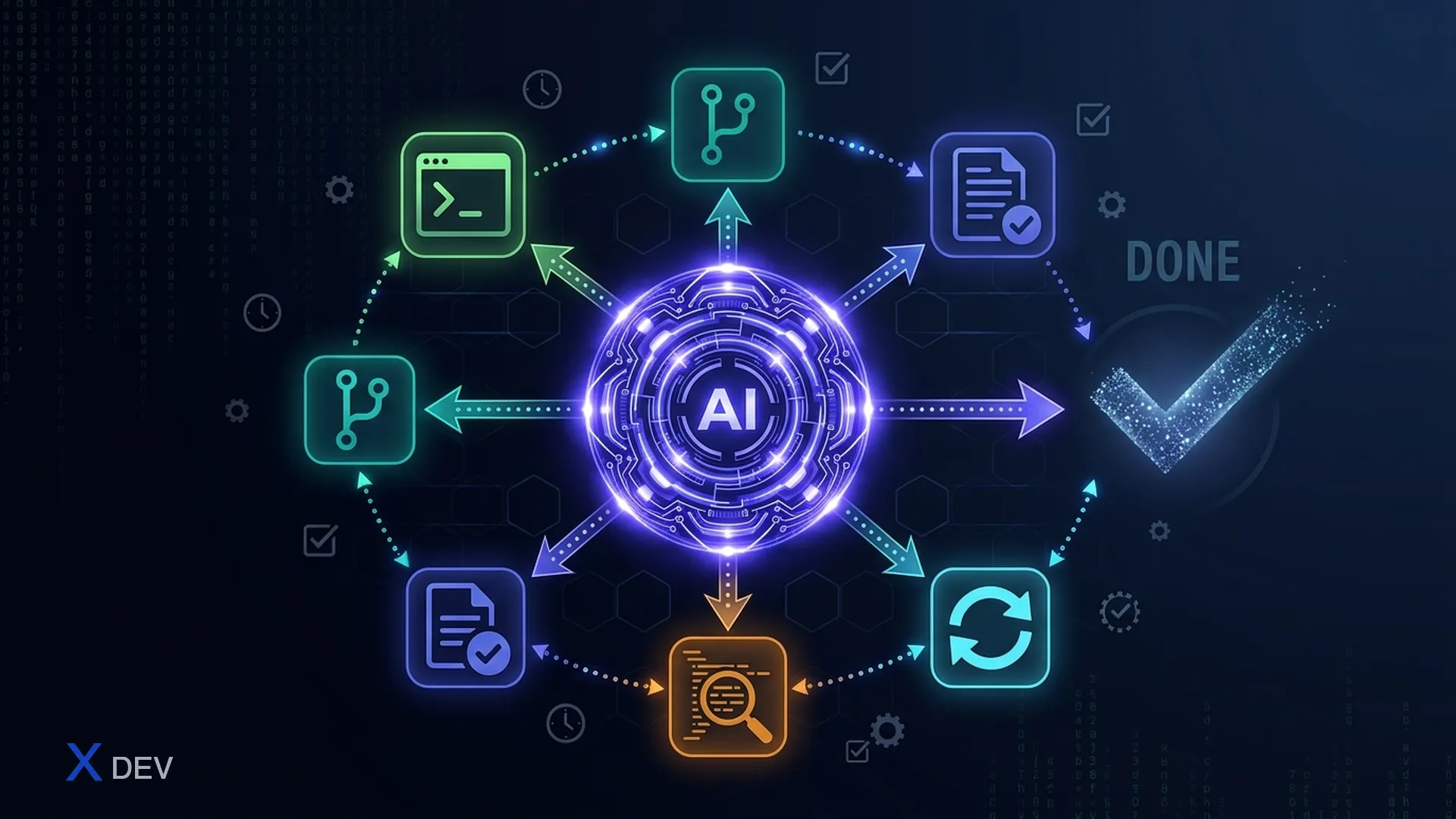
- Long-running agentic workflows — CI/CD automation, research agents, multi-step tasks
- Multimodal — reading and analyzing high-resolution images
- Professional work — financial analysis, legal documents, complex documentation
Anthropic notes that Opus 4.7 handles complex, long-horizon tasks with rigor and consistency, precisely following instructions while independently devising ways to verify its own output before reporting back.
While not as all-encompassing as Claude Mythos Preview — Anthropic's most powerful model — Opus 4.7 still outperforms Opus 4.6 across a range of important benchmarks.
2. Benchmarks and Performance
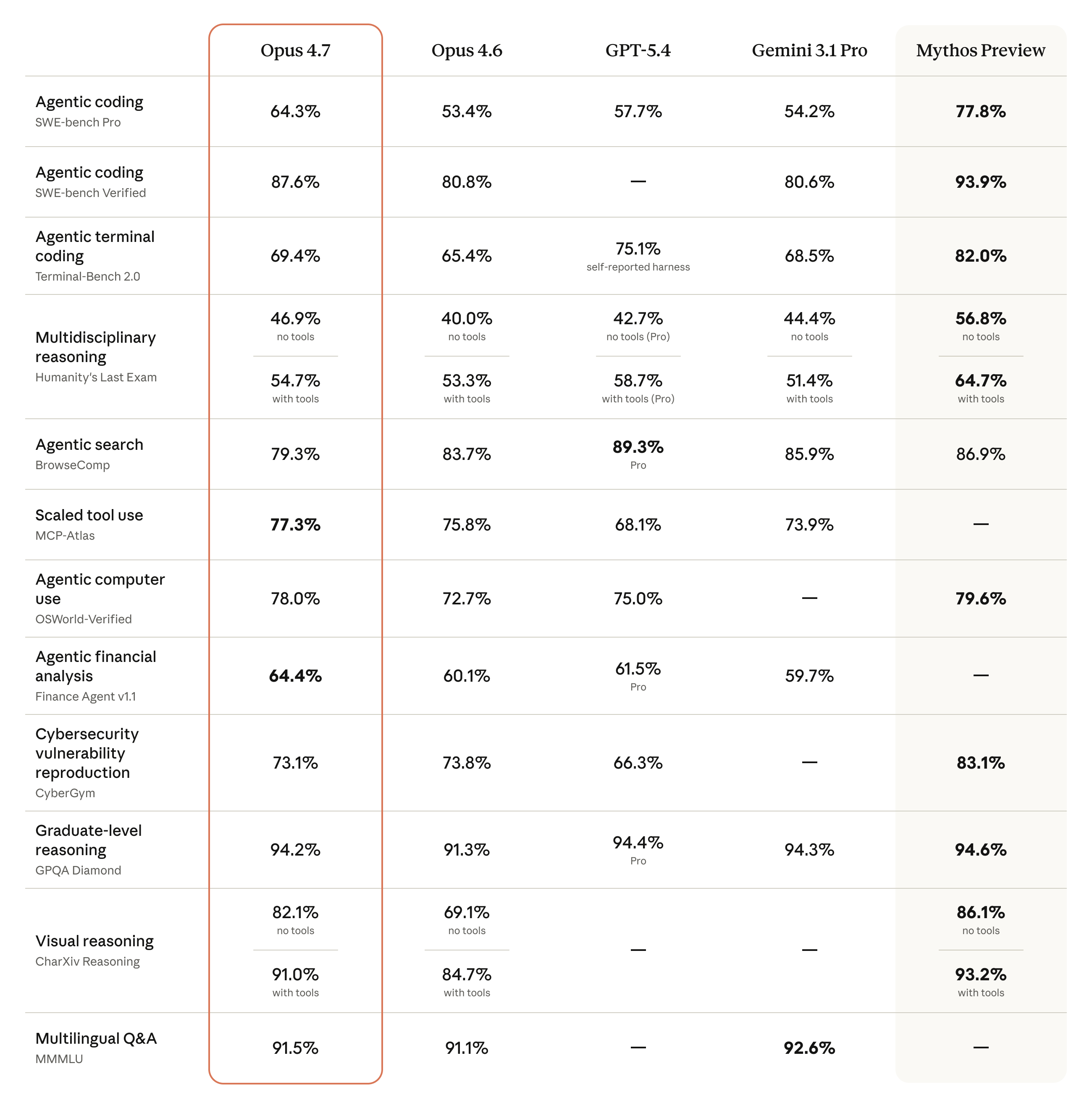
2.1 Overall Comparison with Opus 4.6 and Competitors
Anthropic compared Opus 4.7 against Opus 4.6, GPT-5.4, and Gemini 3.1 Pro across multiple domains:
| Benchmark | Opus 4.7 | Opus 4.6 | Improvement |
|---|---|---|---|
| SWE-bench Verified | Top tier | Baseline | +significant |
| CursorBench | 70% | 58% | +12% |
| BigLaw Bench (High Effort) | 90.9% | — | Strongest |
| Rakuten-SWE-Bench | 3× more tasks | Baseline | 3× |
| GDPval-AA (Finance/Legal) | State-of-the-art | — | Top-ranked |
| Finance Agent Eval | State-of-the-art | 0.767 | 0.813 |
| Visual Acuity (XBOW) | 98.5% | 54.5% | +44% |
| General coding (93 tasks) | +13% | Baseline | +13% |
2.2 Domain-by-Domain Assessment
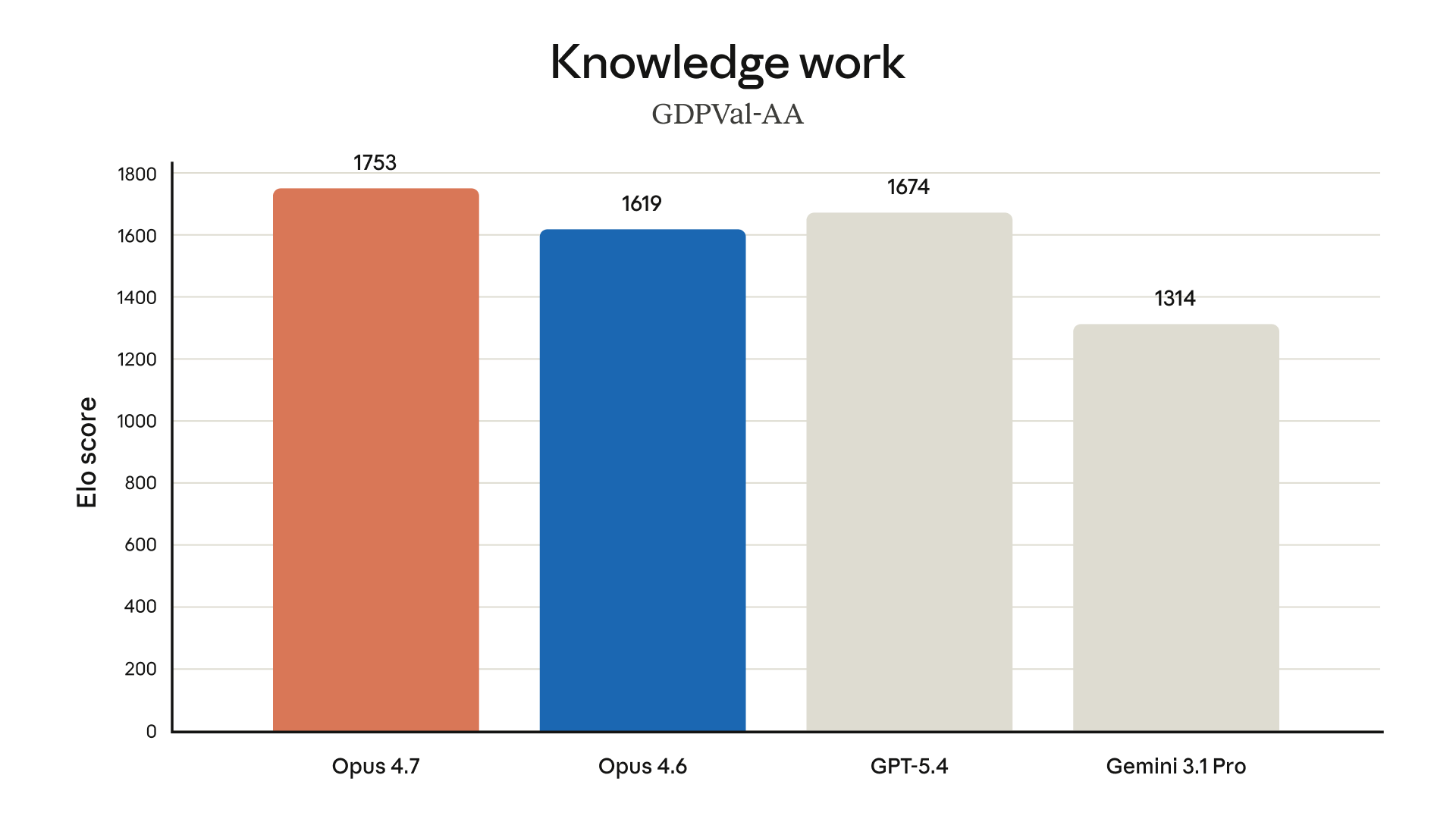
Anthropic's internal testing shows Opus 4.7 significantly improves across:
- Office tasks (PowerPoint, Excel, document creation)
- Vision (image recognition and analysis)
- Document reasoning (21% fewer errors than Opus 4.6 per Databricks)
- Long-context reasoning (coherent reasoning across lengthy content)
- Biology (life sciences applications)
- Long-term coherence (consistency in multi-step tasks)
- Coding (programming, debugging, code review)
3. Core Improvements
3.1 Vision Resolution More Than 3× Higher

This is one of the most significant upgrades. Opus 4.7 can process images up to 2,576 pixels on the long edge (~3.75 megapixels) — more than 3 times previous Claude models.
This unlocks a range of new use cases:
- Computer-use agents reading information-dense screenshots
- Data extraction from complex technical charts
- Life sciences — reading chemical structures, engineering diagrams, patent files
- Work requiring pixel-perfect reference
Note: This is a model-level change, not an API parameter. Images sent to the model will be processed at higher resolution, meaning more tokens consumed. If high detail isn't needed, you can downsample images before sending.
3.2 Superior Instruction Following
Opus 4.7 significantly improves instruction adherence. Anthropic warns this is a two-directional change:
- Good: The model follows instructions more precisely, without skipping or loosely interpreting them
- Worth noting: Prompts written for Opus 4.6 may produce unexpected results since Opus 4.7 interprets more literally
→ Recommendation: Re-tune prompts and harnesses when migrating to 4.7.
3.3 Better Long-Term Memory
Opus 4.7 uses file system-based memory more effectively. The model can:
- Remember important notes across multiple long sessions
- Use memory to continue new tasks without re-providing full context
This is an important improvement for multi-day agentic workflows.
3.4 New Effort Level: xhigh
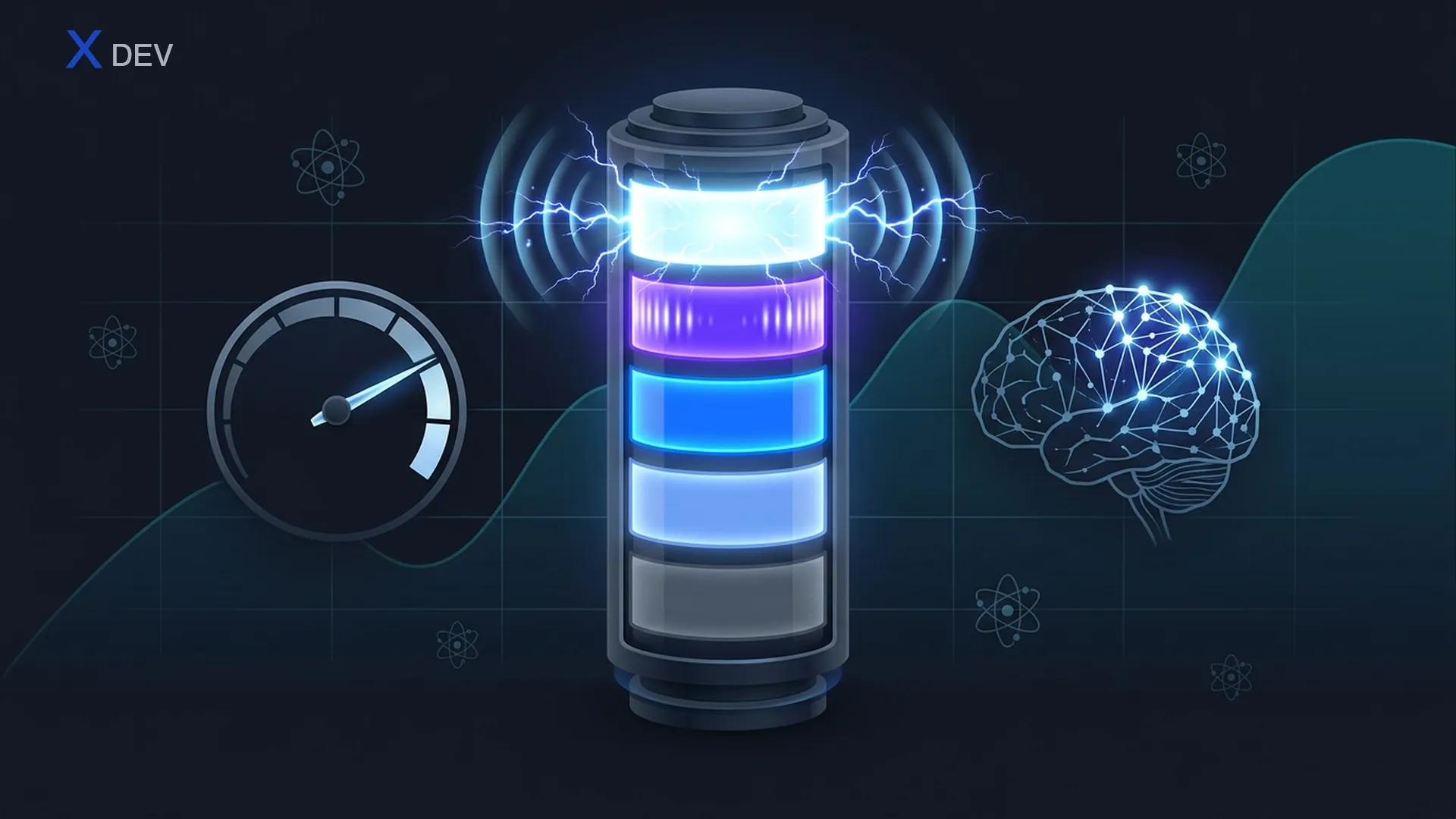
Opus 4.7 introduces the xhigh (extra high) effort level — sitting between high and max. This allows finer control over the balance between:
- Reasoning depth
- Latency
- Token cost
In Claude Code, Anthropic has raised the default effort level to xhigh for all plans. The recommendation is to start with high or xhigh when testing Opus 4.7 for coding and agentic use cases.
4. Real-World Feedback: What Companies Are Saying
Anthropic collected feedback from over 20 major technology companies during early access. Here are the highlights:
4.1 Coding & Engineering
Cursor (CursorBench: 70% vs 58% for Opus 4.6):
"Claude Opus 4.7 is a significant capability jump, particularly in autonomy and more creative reasoning." — Michael Truell, Co-Founder & CEO
Replit:
"Opus 4.7 is an easy upgrade decision. Same quality at lower cost — more efficient and precise for log analysis, finding bugs, and suggesting fixes. It pushes back in technical discussions to help me make better decisions. It feels like a genuinely better colleague." — Michele Catasta, President
Warp (Terminal Bench):
"Opus 4.7 passes Terminal Bench tasks that previous Claude models couldn't, and solved a complex concurrency bug that Opus 4.6 couldn't crack." — Zach Lloyd, Founder & CEO
Bolt:
"10% better than Opus 4.6 on long-horizon app-building tasks, with no regression — something rare in agentic models." — Eric Simons, CEO & Founder
Rakuten:
"Claude Opus 4.7 solves 3× more production tasks than Opus 4.6, with double-digit growth in Code Quality and Test Quality." — Yusuke Kaji, GM AI for Business
4.2 Agentic & Long-Horizon Tasks
Devin (Cognition):
"Claude Opus 4.7 takes long-horizon autonomy to a new level in Devin. It works coherently for hours, doesn't give up on hard problems, unlocking a class of deep investigation work that couldn't run stably before." — Scott Wu, CEO
Notion:
"Plus 14% over Opus 4.6 with fewer tokens and one-third the tool errors. The first model to pass our implicit-need tests, continuing to execute through tool failures that previously stopped Opus." — Sarah Sachs, AI Lead
Factory:
"10–15% lift in task success, fewer tool errors, more reliable follow-through on validation steps. Finishes the job instead of stopping midway." — Leo Tchourakov, MTS
4.3 Finance & Legal
Ramp:
"Stronger in agent-team workflows: better role fidelity, instruction-following, coordination, and complex reasoning. Needs far less step-by-step guidance." — Austin Ray, Software Engineer
Harvey (BigLaw Bench: 90.9% accuracy):
"Strongest substantive accuracy on BigLaw Bench. Correctly distinguished assignment provisions from change-of-control provisions — a task that challenged previous frontier models." — Niko Grupen, Head of Applied Research
Databricks:
"21% fewer errors than Opus 4.6 when working with source information. The best Claude model for enterprise document analysis." — Hanlin Tang, CTO Neural Networks
4.4 Vision & Multimodal
Solve Intelligence (life sciences patents):
"Major improvement in multimodal understanding: reading chemical structures, analyzing complex engineering diagrams. High resolution support enables building best-in-class tools for life sciences patent workflows." — Sanj Ahilan, CRO
XBOW (penetration testing — visual acuity: 98.5% vs 54.5%):
"98.5% on visual-acuity benchmark vs 54.5% for Opus 4.6. Our biggest pain point with computer-use is gone, unlocking an entire class of work that wasn't usable before." — Oege de Moor, CEO
5. Safety & Alignment
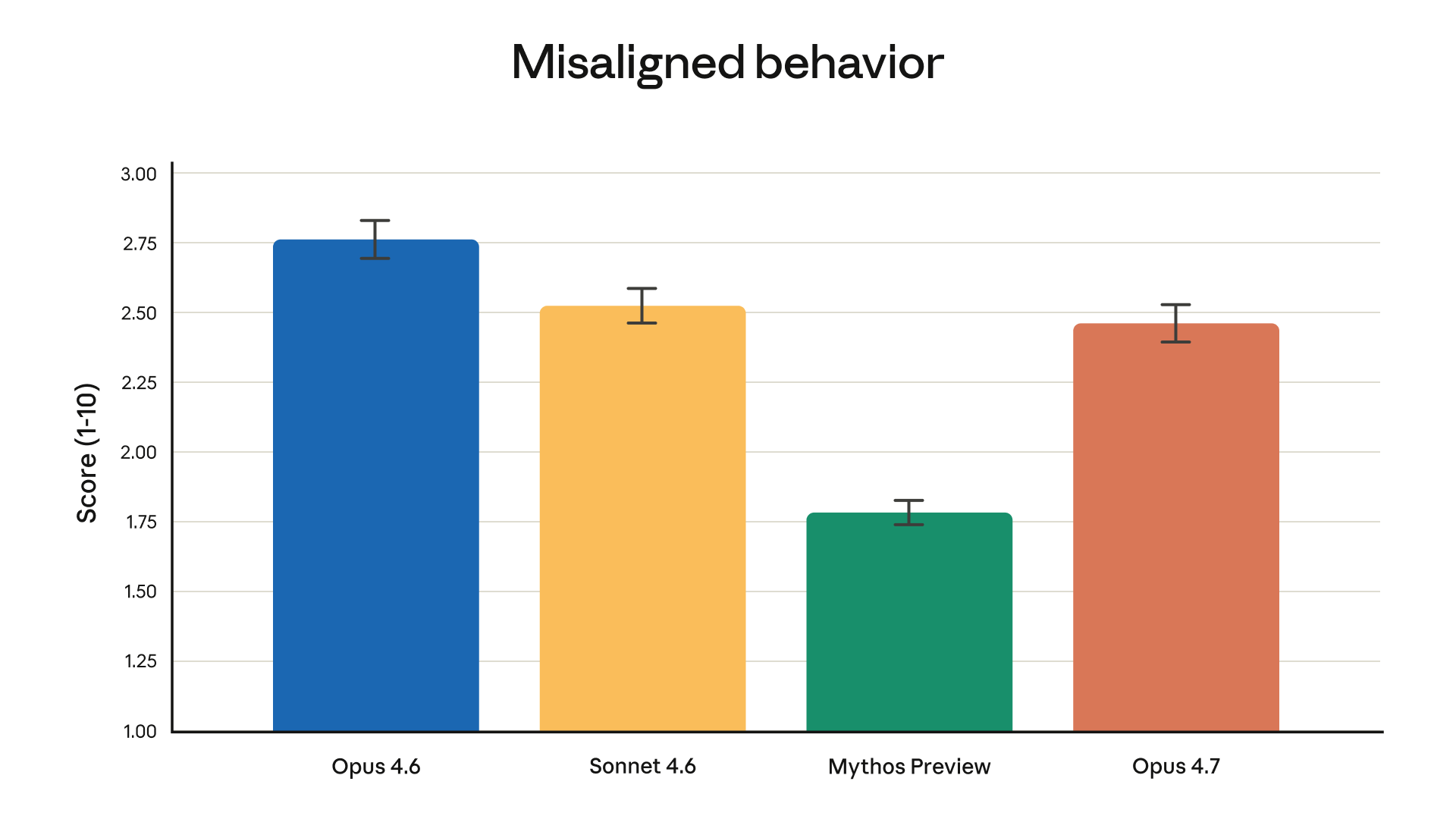
Opus 4.7 has a safety profile similar to Opus 4.6:
Improvements over 4.6:
- Honesty (more truthful)
- Resistance to prompt injection attacks
Minor weaknesses:
- Occasionally provides overly detailed harm-reduction advice about controlled substances
Anthropic concludes the model is "largely well-aligned and trustworthy, though not fully ideal in its behavior." Mythos Preview remains the best-aligned model by Anthropic's own assessment.
Cybersecurity Safeguards
Opus 4.7 is the first model equipped with automated safeguards to detect and block requests related to prohibited or high-risk cybersecurity activities. Anthropic explains this is groundwork for the eventual wider release of Mythos-class models.
Security professionals who want to use Opus 4.7 for legitimate cybersecurity work (vulnerability research, pen testing, red-teaming) can apply to the Cyber Verification Program.
6. New Accompanying Features
6.1 Task Budgets (Public Beta)
A new feature on the Claude Platform (API): developers can guide Claude's token spend so the model prioritizes work across longer runs. Useful for agentic workflows that need cost control.
6.2 /ultrareview in Claude Code
A new slash command that creates a dedicated review session that reads through all code changes and flags bugs and design issues a thorough reviewer would catch.
- Pro and Max users get 3 free ultrareviews to try
- Anthropic has raised the default effort to
xhighfor Claude Code on all plans
6.3 Auto Mode for Max Users
Auto mode is a new permissions option: Claude makes decisions on your behalf, allowing longer tasks to run with fewer interruptions and less risk of skipping permissions.
7. Pricing & Availability
| Detail | Information |
|---|---|
| Input price | $5 / million tokens |
| Output price | $25 / million tokens |
| Compared to Opus 4.6 | Unchanged |
| API model ID | claude-opus-4-7 |
| Claude.ai | ✅ All plans |
| Claude API | ✅ Available |
| Amazon Bedrock | ✅ Available |
| Google Cloud Vertex AI | ✅ Available |
| Microsoft Foundry | ✅ Available |
8. Migrating from Opus 4.6: What You Need to Know
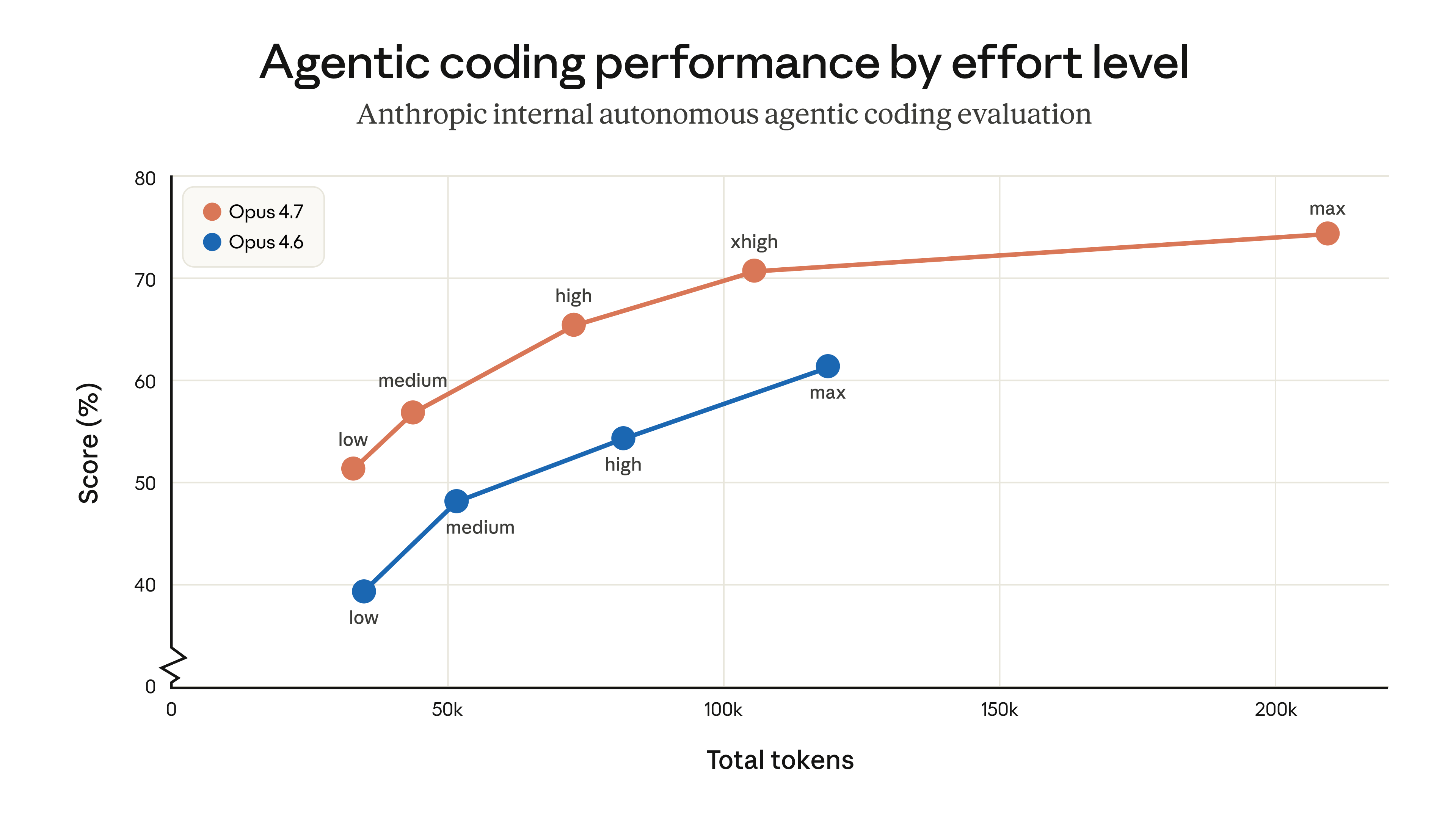
Opus 4.7 is a direct upgrade of Opus 4.6, but there are two token usage changes to plan for:
8.1 New Tokenizer
Opus 4.7 uses an improved tokenizer that processes text more efficiently. The trade-off: the same input may map to more tokens — approximately 1.0–1.35× depending on content type.
8.2 More Thinking at High Effort
Opus 4.7 "thinks" more at high effort levels, especially in later turns within agentic settings. This improves reliability but produces more output tokens.
How to Control Token Usage
- Use the effort parameter (drop to
mediumorlowif top accuracy isn't needed) - Adjust task budgets
- Prompt the model more explicitly for conciseness
Practical result: In internal coding evaluations, total token usage across all effort levels has improved compared to Opus 4.6. But Anthropic recommends measuring on your actual traffic.
See the official Migration Guide.
9. Comparison with Competitors

| Model | Strengths | Relative Weaknesses |
|---|---|---|
| Claude Opus 4.7 | Agentic coding, vision, instruction-following, long-horizon | Less all-around than Mythos Preview |
| GPT-5.4 | All-around, broad ecosystem | Trails Opus 4.7 on specific coding benchmarks |
| Gemini 3.1 Pro | Native multimodal, Google integration | Trails on agentic coding tasks |
| Claude Mythos Preview | Most capable, best-aligned | Limited access, cybersecurity safeguards incomplete |
10. Which Tasks Is Opus 4.7 Best For?
✅ Highly Recommended
- Agentic coding: CI/CD automation, long-running debugging sessions, code review
- Multi-step agent workflows: research agents, complex orchestration
- Vision tasks: analyzing dense screenshots, technical diagrams, scientific files
- Document analysis: legal, financial, enterprise documents
- Professional content: presentations, dashboards, report generation
⚠️ Consider Alternatives
- Simple Q&A: Sonnet 4.6 is sufficient and much cheaper
- High-volume simple tasks: Claude Haiku is more economical
- Need the absolute most powerful model: Wait for a broader release of Mythos Preview
Conclusion
Claude Opus 4.7 represents a genuinely significant advance from Anthropic in 2026. It's not the most all-around model on the market (Mythos Preview still holds that title), but for advanced coding, agentic workflows, and vision — Opus 4.7 is setting a new standard.
What's especially notable is that pricing remains unchanged ($5/$25 per M tokens) while performance has improved substantially. Combined with the xhigh effort level, task budgets, and /ultrareview in Claude Code — this is a toolkit that engineering teams and developers should seriously consider today.
Primary sources: Anthropic Blog — Introducing Claude Opus 4.7 (April 16, 2026) | Claude Opus 4.7 System Card | API Documentation