Introduction
Have you ever asked ChatGPT about your company's rules and received a... made-up answer? Or ask about events last week but AI says "I don't have information after April 2024"?
Those are the 2 biggest problems of LLM:
| Problem | Explanation | Example |
|---|---|---|
| Hallucination | AI "makes up" information without knowing it | Ask about the rules → WHO made up the rules |
| Knowledge Cutoff | AI only knows the data up to the time of training | Ask about this week's news → "I don't know" |
| No Domain Knowledge | AI doesn't know your private data | Ask about company products → general answer |
RAG (Retrieval-Augmented Generation) solves all 3 problems by having the LLM "read" your document before responding.
1. What is RAG?
1.1 Main idea
Normal life example: Imagine you take an oral exam:
- No RAG = Exam closed book → only uses knowledge in the head → easy to make mistakes, easy to forget
- Yes RAG = Open book exam → can look up documents before answering → much more accurate!
RAG = Let the AI "open the book" before answering.
1.2 Three steps of RAG
User hỏi: "Chính sách nghỉ phép 2026 là gì?"
                                          │
                                          ▼
                    ┌─────────────────────────┐
Step 1: RETRIEVE    │ Tìm tài liệu liên quan  │
(Tìm kiếm)         │ trong knowledge base     │
                    │ → "HR_Policy_2026.pdf"   │
                    │    trang 15-17            │
                    └──────────┬──────────────┘
                               ▼
                    ┌─────────────────────────┐
Step 2: AUGMENT     │ Ghép tài liệu tìm được  │
(Bổ sung)           │ vào prompt cho LLM       │
                    │ → "Dựa trên tài liệu    │
                    │    sau, trả lời câu hỏi" │
                    └──────────┬──────────────┘
                               ▼
                    ┌─────────────────────────┐
Step 3: GENERATE    │ LLM đọc tài liệu        │
(Trả lời)          │ + tạo câu trả lời        │
                    │ → "Theo chính sách 2026, │
                    │    nhân viên được 15 ngày │
                    │    phép/năm..."           │
                    └─────────────────────────┘
1.3 Why is RAG effective?
| No RAG | Yes RAG |
|---|---|
| AI answers from "memory" (training data) | AI answers from real documents |
| You can make it up if you don't know | Citation from specific source |
| Old knowledge (cutoff) | Documents updated real-time |
| Don't know private data | Read your private data |
2. Detailed RAG architecture
2.1 Two stages: Indexing & Querying
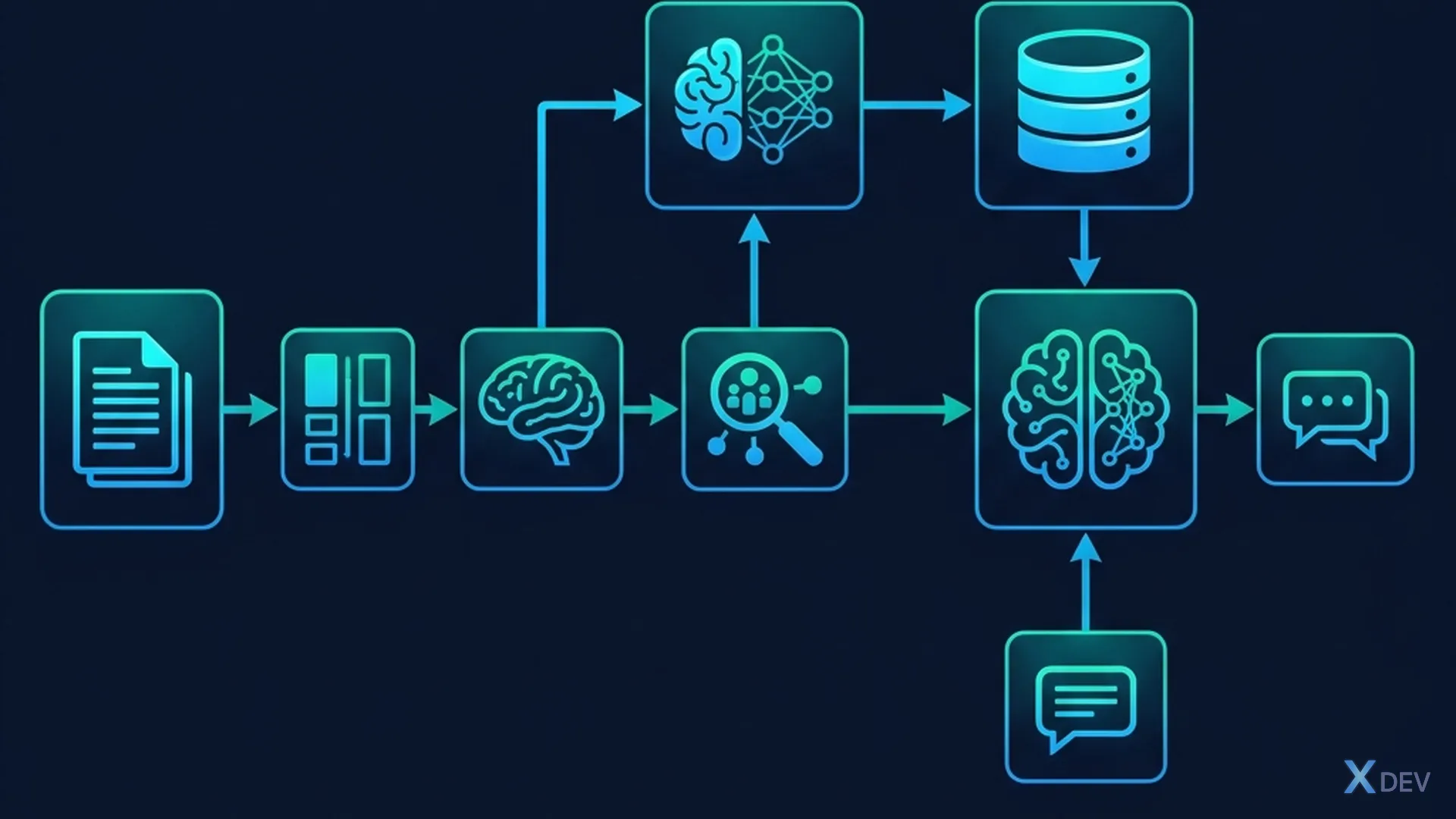
=== GIAI ĐOẠN 1: INDEXING (làm 1 lần, offline) ===

Tài liệu gốc     →    Chunking    →    Embedding    →    Vector DB
[PDF, DOCX, Web]     [Chia nhỏ]      [Text → Vector]    [Lưu trữ]

company_policy.pdf → Chunk 1: 300 từ → [0.23, -0.15, ...] → ChromaDB
                     Chunk 2: 300 từ → [0.45, 0.22, ...]
                     Chunk 3: 300 từ → [-0.11, 0.67, ...]


=== GIAI ĐOẠN 2: QUERYING (mỗi câu hỏi, real-time) ===

Câu hỏi user → Embedding → Similarity Search → Top-K chunks → LLM → Answer
"Nghỉ phép              tìm chunks               ghép vào      trả lời
 bao nhiêu?"            gần nhất                  prompt        từ tài liệu
2.2 Step-by-step explanation
Step 1 — Chunking: Divide the document into small paragraphs (~300-500 words). Why? Because LLM has a limited context window, small fragments are easier to search accurately.
Step 2 — Embedding: Turn text into vector (number sequence). Text segments with similar meanings will have vectors close to each other in high-dimensional space.
# "Chính sách nghỉ phép" → [0.23, -0.15, 0.87, ...]
# "Quy định ngày phép"   → [0.25, -0.12, 0.85, ...]  ← rất gần!
# "Lương thưởng"         → [-0.45, 0.55, 0.12, ...]  ← rất xa
Step 3 — Similarity Search: When the user asks, embedding the question → find the chunks with the closest vector → return the top-K most related chunks (usually K=3-5).
Step 4 — Generate: Combine chunks into prompt, send to LLM:
System: Trả lời câu hỏi dựa trên context được cung cấp.
        Nếu context không chứa câu trả lời, nói "Tôi không
        tìm thấy thông tin trong tài liệu."

Context:
---
[Chunk 1: "Theo chính sách 2026, nhân viên full-time được
15 ngày phép/năm. Nhân viên trên 5 năm được 18 ngày..."]
[Chunk 2: "Quy trình xin phép: gửi đơn trước 3 ngày..."]
---

User: Nhân viên mới được bao nhiêu ngày nghỉ phép?
💡 Exercise 2: Explain RAG to non-tech colleagues using the "library" example: librarian (retriever), related books (context), students (LLM compiles the answer himself). Try writing 3-4 sentences.
3. Demo: "Chat with PDF" in 50 lines
Here is the simplest RAG pipeline — just Python + OpenAI + ChromaDB:
3.1 Installation
pip install openai chromadb langchain langchain-openai \
            langchain-community pypdf
3.2 Complete code
"""
RAG đơn giản nhất: Chat with PDF
50 dòng code — hiểu toàn bộ flow!
"""
from langchain_community.document_loaders import PyPDFLoader
from langchain.text_splitter import RecursiveCharacterTextSplitter
from langchain_openai import OpenAIEmbeddings, ChatOpenAI
from langchain_community.vectorstores import Chroma
from langchain.prompts import ChatPromptTemplate
from langchain.schema.runnable import RunnablePassthrough

# === Bước 1: Load PDF ===
loader = PyPDFLoader("company_policy.pdf")
pages = loader.load()
print(f"Loaded {len(pages)} pages")

# === Bước 2: Chunking ===
splitter = RecursiveCharacterTextSplitter(
    chunk_size=500,     # Mỗi chunk ~500 ký tự
    chunk_overlap=50    # Overlap 50 ký tự (tránh cắt giữa câu)
)
chunks = splitter.split_documents(pages)
print(f"Split into {len(chunks)} chunks")

# === Bước 3: Embedding + Store vào Vector DB ===
embeddings = OpenAIEmbeddings(model="text-embedding-3-small")
vectorstore = Chroma.from_documents(chunks, embeddings)
retriever = vectorstore.as_retriever(search_kwargs={"k": 3})

# === Bước 4: RAG Chain ===
template = """Trả lời câu hỏi dựa trên context sau.
Nếu không tìm thấy, nói "Tôi không tìm thấy trong tài liệu."
Trích dẫn nguồn (trang số) nếu có thể.

Context:
{context}

Câu hỏi: {question}
"""
prompt = ChatPromptTemplate.from_template(template)
llm = ChatOpenAI(model="gpt-4o-mini", temperature=0)

rag_chain = (
    {"context": retriever, "question": RunnablePassthrough()}
    | prompt
    | llm
)

# === Bước 5: Hỏi! ===
while True:
    question = input("\n❓ Hỏi: ")
    if question.lower() in ["quit", "exit"]:
        break
    answer = rag_chain.invoke(question)
    print(f"\n💬 {answer.content}")
3.3 Explain flow
User: "Nhân viên mới được bao nhiêu ngày phép?"
  ↓
1. Embedding câu hỏi → vector [0.3, -0.1, ...]
  ↓
2. Tìm 3 chunks gần nhất trong ChromaDB
  ↓
3. Ghép chunks vào template prompt
  ↓
4. Gửi cho GPT-4o-mini
  ↓
5. AI đọc chunks + trả lời: "Theo tài liệu trang 15,
   nhân viên mới được 15 ngày phép/năm..."
Important: AI answers based on documents, not made up! This is RAG's core strength.
💡 Exercise 3:
- Run the above code with any PDF file (CV, study materials, docs).
- Ask 5 questions: 3 have answers in PDF, 2 do not → How does AI handle it?
- Try changing
chunk_size=500into200and1000— how does the quality change?
4. RAG vs Fine-tuning — When to use what?
This is the most common question: "Should I use RAG or fine-tune model?"
4.1 Detailed comparison table
| Criteria | RAG | Fine-tuning |
|---|---|---|
| Purpose | Add knowledge (knowledge) | Changing behavior (behavior) |
| Example | Reply from company docs | Write according to brand voice |
| Setup costs | Low (~$5-50) | High (~$50-500+) |
| Time | Few minutes | Hours → days |
| Update data | ✅ Real-time updates | ❌ Must re-train |
| Accuracy | Cao (cited source) | Moderate (possibly hallucinate) |
| Scalable | ✅ Add documents easily | ❌ Difficult to scale |
4.2 Decision Framework
Câu hỏi quyết định:
                        ┌─ Cần AI biết data MỚI/RIÊNG? → RAG
                        │
Bạn cần gì? ────────── ├─ Cần AI thay đổi PHONG CÁCH/FORMAT? → Fine-tuning
                        │
                        ├─ Cần CẢ HAI? → RAG + Fine-tuning (Hybrid)
                        │
                        └─ Không chắc? → Thử RAG trước (rẻ, nhanh)
4.3 Practical example
| Math problem | Select | Reason |
|---|---|---|
| Chatbot answers FAQs from 100 blog posts | RAG | Knowledge gap — needs separate data |
| AI writes emails in the CEO's voice | Fine-tuning | Behavior gap — need to change style |
| AI supports doctors in looking up drugs | RAG | Need updated data + source citation |
| AI classifies support tickets | Fine-tuning | Task-specific behavior |
| Internal chatbot + brand voice | Hybrid | Need both knowledge + own style |
Rule of thumb: If in doubt, start with RAG. RAG is cheap, fast, easy to iterate. Fine-tuning only when RAG is not enough.
5. Most common Use Cases
5.1 Business
| Use Case | Description | Data source |
|---|---|---|
| Internal Knowledge Bot | Employees ask about processes and policies | HR docs, SOPs, wiki |
| Customer Support | Bot answers from FAQ + product docs | Help center, manuals |
| Legal Assistant | Look up laws and contracts | Legal documents, contracts |
| Sales Enablement | Find case studies, competitive intel | CRM data, reports |
5.2 Personal / Education
| Use Case | Description | Data source |
|---|---|---|
| Study Assistant | "Chat with textbook" — ask textbook questions | PDF books, slides |
| Research Helper | Summary of insights from 50+ papers | Arxiv papers |
| Personal Wiki | Note-taking + Q&A from notes | Obsidian, Notion |
| Code Documentation | Ask about 100K+ line codebase | Source code, docs |
5.3 AI Products
| Use Case | Real-life example |
|---|---|
| Perplexity AI | Search engine + RAG (search web → reply) |
| Notion AI | RAG from your Notion workspace |
| GitHub Copilot | RAG from current codebase |
| ChatGPT + Browse | RAG from real-time web |
💡 Exercise 5: List 3 RAG use cases for your company/project/school. For each use case, determine: the data source, who the user is, and the success metrics.
6. Limitations — RAG is not "silver bullet"
| Limitations | Explanation | Solution (learn in the next lesson) |
|---|---|---|
| Garbage in, garbage out | Bad data → bad RAG | Data cleaning (Lesson 5) |
| Chunk too small/big | Lost context or too much noise | Chunking strategies (Lesson 5) |
| Ambiguous query | Retriever did not find the correct | Query transformation (Lesson 7) |
| Lost in the middle | LLM ignores the context between | Re-ranking (Lesson 8) |
| Multimodal | Image/table in PDF removed | Multimodal RAG (Lesson 10) |
Summary
| Concepts | Remember |
|---|---|
| RAG | Retrieve → Augment → Generate (exam "open book") |
| Resolved | Hallucination, knowledge cutoff, domain knowledge |
| Indexing | Chunk → Embed → Store (offline, 1 time) |
| Querying | Embed query → Search → Augment → Generate (real-time) |
| vs Fine-tuning | RAG = more knowledge, Fine-tuning = change behavior |
| Begins with | RAG first (cheap, fast, easy to iterate) |
General exercises
- ✅ Complete small exercises (2, 3, 5)
- Hands-on: Run the "Chat with PDF" demo in part 3 with real documents. Take a screenshot of the result.
- Architecture Diagram: Redraw the RAG architecture for a specific use case in part 5 (using draw.io or Mermaid).
- Research: Find the 3 most used RAG tools/products in 2026 (hint: LangChain, LlamaIndex, Vercel AI SDK). Compare pros/cons.
Next article: Embedding Models — how to turn text into vector, compare OpenAI vs Cohere vs Open-source, and embedding in Vietnamese.