1. SMART on FHIR Overview
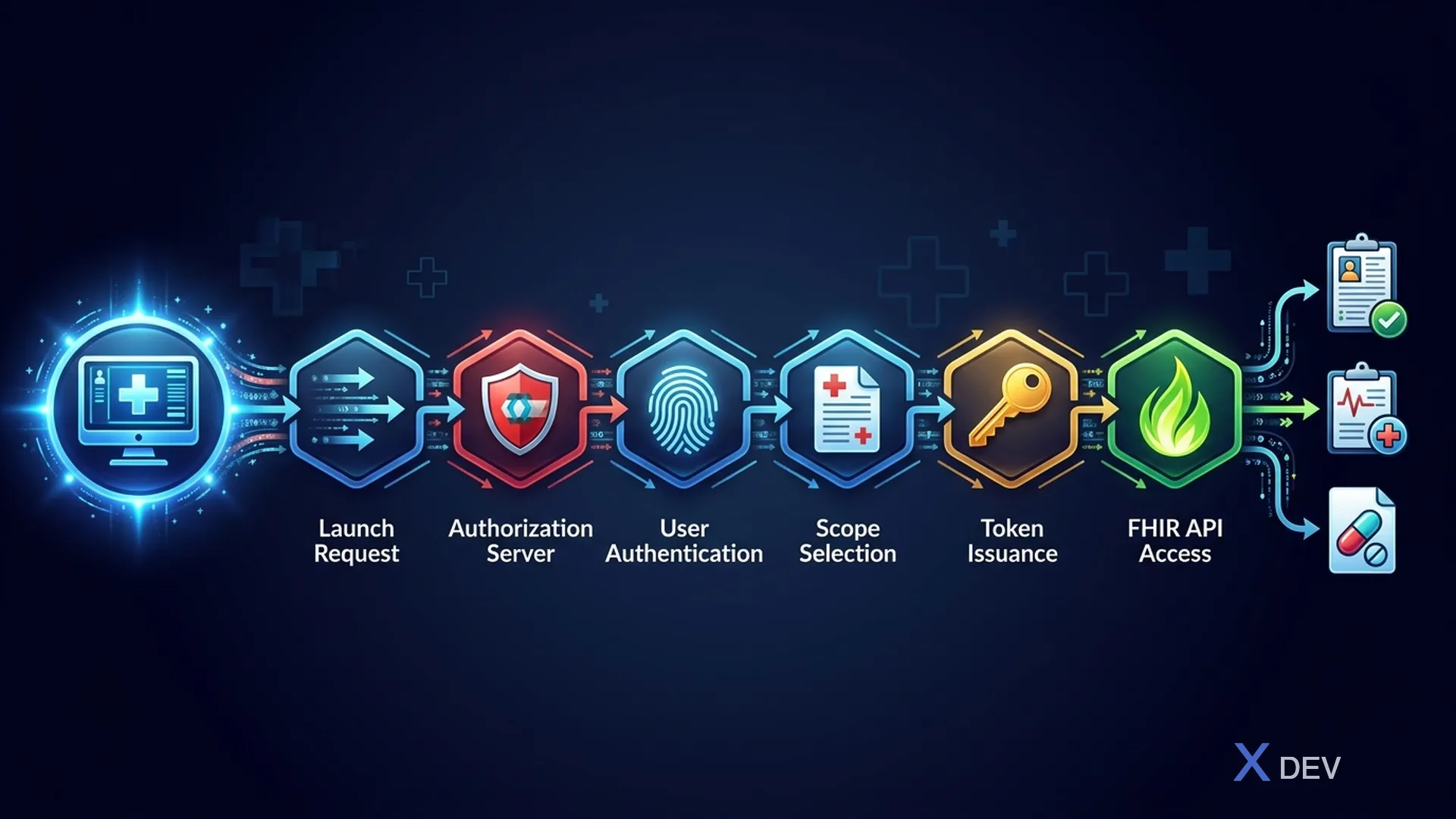
1.1. SMART là gì?
SMART (Substitutable Medical Applications, Reusable Technologies) on FHIR là một tiêu chuẩn mở cho phép các ứng dụng third-party truy cập dữ liệu y tế một cách an toàn thông qua FHIR APIs. SMART định nghĩa:
- App Launch Framework: Cách app được khởi chạy từ EHR hoặc standalone
- Authorization scopes: Granular permissions cho FHIR resources
- Launch context: Patient, encounter, location context truyền cho app
- Backend Services: Service-to-service authorization không cần user interaction
1.2. SMART App Launch Flows
EHR Launch Flow:
- User clicks "Launch App" in EHR
- EHR sends launch request with context (patient ID, encounter ID)
- App redirects to Authorization Server (Keycloak)
- User authenticates (or SSO)
- Keycloak issues access token with SMART scopes
- App uses token to access FHIR resources
Standalone Launch Flow:
- User opens app directly (e.g., mobile app)
- App redirects to Keycloak for authentication
- User authenticates with credentials + MFA
- App requests SMART scopes
- If patient context needed → patient picker
- Keycloak issues access token
- App accesses FHIR resources
Backend Services Authorization:
- Service authenticates with signed JWT assertion
- Keycloak validates JWT and issues access token
- Service accesses FHIR resources → No user interaction required. Used for: data sync, analytics, reporting.
2. SMART Scopes
2.1. FHIR Resource Scopes
Format: <context>/<resource>.<permission>

Context:
  patient  → Access linked to a specific patient
  user     → Access linked to the current user
  system   → Full system-level access (backend services)

Resource:
  Patient, Observation, MedicationRequest, DiagnosticReport,
  Condition, Encounter, AllergyIntolerance, Immunization, etc.

Permission:
  read     → Search and read resources
  write    → Create, update, delete resources
  *        → All permissions
2.2. Scope Examples cho Healthcare
# Bác sĩ: Truy cập hồ sơ bệnh nhân trong context đang khám
user/Patient.read
user/Observation.read
user/Observation.write          # Vital signs, clinical observations
user/Condition.read
user/Condition.write            # Diagnoses
user/MedicationRequest.write    # Prescriptions
user/DiagnosticReport.read      # Lab results
user/AllergyIntolerance.read

# Bệnh nhân: Truy cập hồ sơ của chính mình
patient/Patient.read
patient/Observation.read
patient/MedicationRequest.read
patient/DiagnosticReport.read
patient/AllergyIntolerance.read
patient/Immunization.read

# Backend Service: Sync lab results
system/DiagnosticReport.write
system/Observation.write
system/ServiceRequest.read

# Ứng dụng nghiên cứu (de-identified data)
system/Patient.read?_elements=gender,birthDate,address.state
system/Condition.read
system/Observation.read
2.3. Keycloak Client Scopes cho SMART
{
  "clientScopes": [
    {
      "name": "patient/*.read",
      "description": "Read all FHIR resources for a specific patient",
      "protocol": "openid-connect",
      "attributes": {
        "include.in.token.scope": "true",
        "display.on.consent.screen": "true",
        "consent.screen.text": "Đọc hồ sơ bệnh án của bạn"
      },
      "protocolMappers": [
        {
          "name": "smart-patient-scope",
          "protocol": "openid-connect",
          "protocolMapper": "oidc-hardcoded-claim-mapper",
          "config": {
            "claim.name": "scope",
            "claim.value": "patient/*.read",
            "access.token.claim": "true"
          }
        }
      ]
    },
    {
      "name": "launch/patient",
      "description": "EHR launch with patient context",
      "protocol": "openid-connect",
      "attributes": {
        "include.in.token.scope": "true"
      },
      "protocolMappers": [
        {
          "name": "patient-launch-context",
          "protocol": "openid-connect",
          "protocolMapper": "oidc-usersessionmodel-note-mapper",
          "config": {
            "user.session.note": "patient_id",
            "claim.name": "patient",
            "access.token.claim": "true"
          }
        }
      ]
    },
    {
      "name": "fhirUser",
      "description": "FHIR User identity claim",
      "protocol": "openid-connect",
      "protocolMappers": [
        {
          "name": "fhir-user-mapper",
          "protocol": "openid-connect",
          "protocolMapper": "oidc-hardcoded-claim-mapper",
          "config": {
            "claim.name": "fhirUser",
            "claim.value": "",
            "access.token.claim": "true",
            "id.token.claim": "true"
          }
        }
      ]
    }
  ]
}
3. SMART on FHIR với Quarkus
3.1. FHIR Resource Server Implementation
@Path("/fhir/r4")
@Authenticated
@Produces("application/fhir+json")
public class FhirPatientResource {

    @Inject
    SecurityIdentity identity;

    @Inject
    PatientRepository patientRepository;

    @Inject
    SmartScopeValidator scopeValidator;

    @GET
    @Path("/Patient/{id}")
    public Response readPatient(@PathParam("id") String id) {
        // Validate SMART scopes
        scopeValidator.requireScope(identity, "patient/Patient.read",
                                    "user/Patient.read");

        // If patient context → verify patient match
        String launchPatient = identity.getAttribute("patient");
        if (launchPatient != null && !launchPatient.equals(id)) {
            if (scopeValidator.hasOnlyPatientScopes(identity)) {
                throw new ForbiddenException(
                    "Patient scope restricted to patient: " + launchPatient);
            }
        }

        Patient patient = patientRepository.findById(id);
        if (patient == null) {
            return Response.status(404).entity(
                createOperationOutcome("Patient not found")).build();
        }

        return Response.ok(patient.toFhirJson()).build();
    }

    @GET
    @Path("/Patient")
    public Response searchPatients(
            @QueryParam("name") String name,
            @QueryParam("birthdate") String birthdate,
            @QueryParam("identifier") String identifier,
            @QueryParam("_count") @DefaultValue("20") int count) {

        scopeValidator.requireScope(identity,
            "patient/Patient.read", "user/Patient.read", "system/Patient.read");

        // Apply patient context restriction
        SearchParams params = SearchParams.builder()
            .name(name)
            .birthdate(birthdate)
            .identifier(identifier)
            .count(Math.min(count, 100))  // Cap results
            .patientContext(identity.getAttribute("patient"))
            .build();

        Bundle bundle = patientRepository.search(params);
        return Response.ok(bundle.toFhirJson()).build();
    }
}
3.2. SMART Scope Validator
@ApplicationScoped
public class SmartScopeValidator {

    public void requireScope(SecurityIdentity identity, String... anyOfScopes) {
        Set<String> grantedScopes = getSmartScopes(identity);

        boolean hasScope = Arrays.stream(anyOfScopes)
            .anyMatch(scope -> matchScope(grantedScopes, scope));

        if (!hasScope) {
            throw new ForbiddenException(
                "Insufficient SMART scope. Required one of: " +
                String.join(", ", anyOfScopes));
        }
    }

    public boolean hasOnlyPatientScopes(SecurityIdentity identity) {
        return getSmartScopes(identity).stream()
            .allMatch(s -> s.startsWith("patient/") || s.equals("openid") ||
                          s.equals("fhirUser") || s.startsWith("launch/"));
    }

    private boolean matchScope(Set<String> granted, String required) {
        // Direct match
        if (granted.contains(required)) return true;

        // Wildcard match: patient/*.read matches patient/Patient.read
        String[] parts = required.split("[/.]");
        if (parts.length == 3) {
            String wildcardScope = parts[0] + "/*." + parts[2];
            return granted.contains(wildcardScope);
        }

        return false;
    }

    private Set<String> getSmartScopes(SecurityIdentity identity) {
        // Extract scopes from JWT claim
        JsonArray scopeClaim = identity.getAttribute("scope");
        if (scopeClaim != null) {
            return scopeClaim.stream()
                .map(JsonValue::toString)
                .collect(Collectors.toSet());
        }
        return Set.of();
    }
}
3.3. SMART Well-Known Configuration
@Path("/.well-known/smart-configuration")
public class SmartConfigurationResource {

    @GET
    @Produces(MediaType.APPLICATION_JSON)
    public Response getSmartConfiguration() {
        return Response.ok(Map.of(
            "authorization_endpoint",
                "https://keycloak.hospital.vn/realms/healthcare/protocol/openid-connect/auth",
            "token_endpoint",
                "https://keycloak.hospital.vn/realms/healthcare/protocol/openid-connect/token",
            "introspection_endpoint",
                "https://keycloak.hospital.vn/realms/healthcare/protocol/openid-connect/token/introspect",
            "revocation_endpoint",
                "https://keycloak.hospital.vn/realms/healthcare/protocol/openid-connect/revoke",
            "capabilities", List.of(
                "launch-ehr",
                "launch-standalone",
                "client-public",
                "client-confidential-symmetric",
                "sso-openid-connect",
                "context-passthrough-banner",
                "context-passthrough-style",
                "context-ehr-patient",
                "context-ehr-encounter",
                "context-standalone-patient",
                "permission-offline",
                "permission-patient",
                "permission-user",
                "authorize-post"
            ),
            "scopes_supported", List.of(
                "openid", "fhirUser", "launch", "launch/patient",
                "patient/*.read", "patient/*.write",
                "user/*.read", "user/*.write",
                "system/*.read", "system/*.write"
            ),
            "response_types_supported", List.of("code"),
            "code_challenge_methods_supported", List.of("S256"),
            "token_endpoint_auth_methods_supported", List.of(
                "client_secret_basic", "client_secret_post", "private_key_jwt"
            )
        )).build();
    }
}
4. FHIR Consent Resource
4.1. Patient Consent Management
{
  "resourceType": "Consent",
  "id": "consent-001",
  "status": "active",
  "scope": {
    "coding": [{
      "system": "http://terminology.hl7.org/CodeSystem/consentscope",
      "code": "patient-privacy"
    }]
  },
  "category": [{
    "coding": [{
      "system": "http://loinc.org",
      "code": "59284-0",
      "display": "Patient Consent"
    }]
  }],
  "patient": {
    "reference": "Patient/P-001"
  },
  "dateTime": "2026-04-01T10:00:00+07:00",
  "provision": {
    "type": "permit",
    "period": {
      "start": "2026-04-01",
      "end": "2027-04-01"
    },
    "actor": [{
      "role": {
        "coding": [{
          "system": "http://terminology.hl7.org/CodeSystem/v3-ParticipationType",
          "code": "PRCP",
          "display": "Primary Care Provider"
        }]
      },
      "reference": {
        "reference": "Organization/BV-cho-ray"
      }
    }],
    "action": [{
      "coding": [{
        "system": "http://terminology.hl7.org/CodeSystem/consentaction",
        "code": "access"
      }]
    }],
    "purpose": [{
      "system": "http://terminology.hl7.org/CodeSystem/v3-ActReason",
      "code": "TREAT",
      "display": "Treatment"
    }]
  }
}
5. Backend Services Authorization
5.1. Service Authentication với Signed JWT
// Backend service authenticates with JWT assertion
@ApplicationScoped
public class FhirBackendServiceClient {

    @ConfigProperty(name = "fhir.service.private-key-path")
    String privateKeyPath;

    @ConfigProperty(name = "fhir.service.client-id")
    String clientId;

    @ConfigProperty(name = "fhir.keycloak.token-url")
    String tokenUrl;

    public String getAccessToken() {
        // Create signed JWT assertion (RFC 7523)
        PrivateKey key = loadPrivateKey(privateKeyPath);

        String jwt = Jwt.issuer(clientId)
            .subject(clientId)
            .audience(tokenUrl)
            .expiresIn(Duration.ofMinutes(5))
            .jws().keyId("service-key-1")
            .sign(key);

        // Exchange JWT for access token
        return WebClient.create(tokenUrl)
            .post()
            .sendForm(MultiMap.caseInsensitiveMultiMap()
                .add("grant_type", "client_credentials")
                .add("client_assertion_type",
                    "urn:ietf:params:oauth:client-assertion-type:jwt-bearer")
                .add("client_assertion", jwt)
                .add("scope", "system/*.read system/*.write"))
            .await()
            .bodyAsJsonObject()
            .getString("access_token");
    }
}
6. Tổng kết
Trong bài học này, chúng ta đã:
- Hiểu SMART on FHIR framework và 3 launch flows
- Thiết kế SMART scopes cho healthcare resources
- Cấu hình Keycloak Client Scopes cho SMART
- Implement FHIR Resource Server trên Quarkus với scope validation
- Xây dựng SMART Well-Known Configuration endpoint
- Triển khai Patient Consent management với FHIR Consent resource
- Implement Backend Services Authorization với signed JWT
Bài tập
- Cấu hình Keycloak client cho SMART EHR Launch với patient context
- Implement FHIR Observation resource server với SMART scope validation
- Tạo SMART Well-Known configuration endpoint
- Viết integration test cho EHR Launch flow
| ◀ Bài trước | Bài tiếp theo ▶ |
|---|---|
| Bài 6: RBAC & ABAC - Phân quyền Bác sĩ, Y tá, Bệnh nhân | Bài 8: MFA, Passkeys & Emergency Access cho Nhân viên Y Tế |