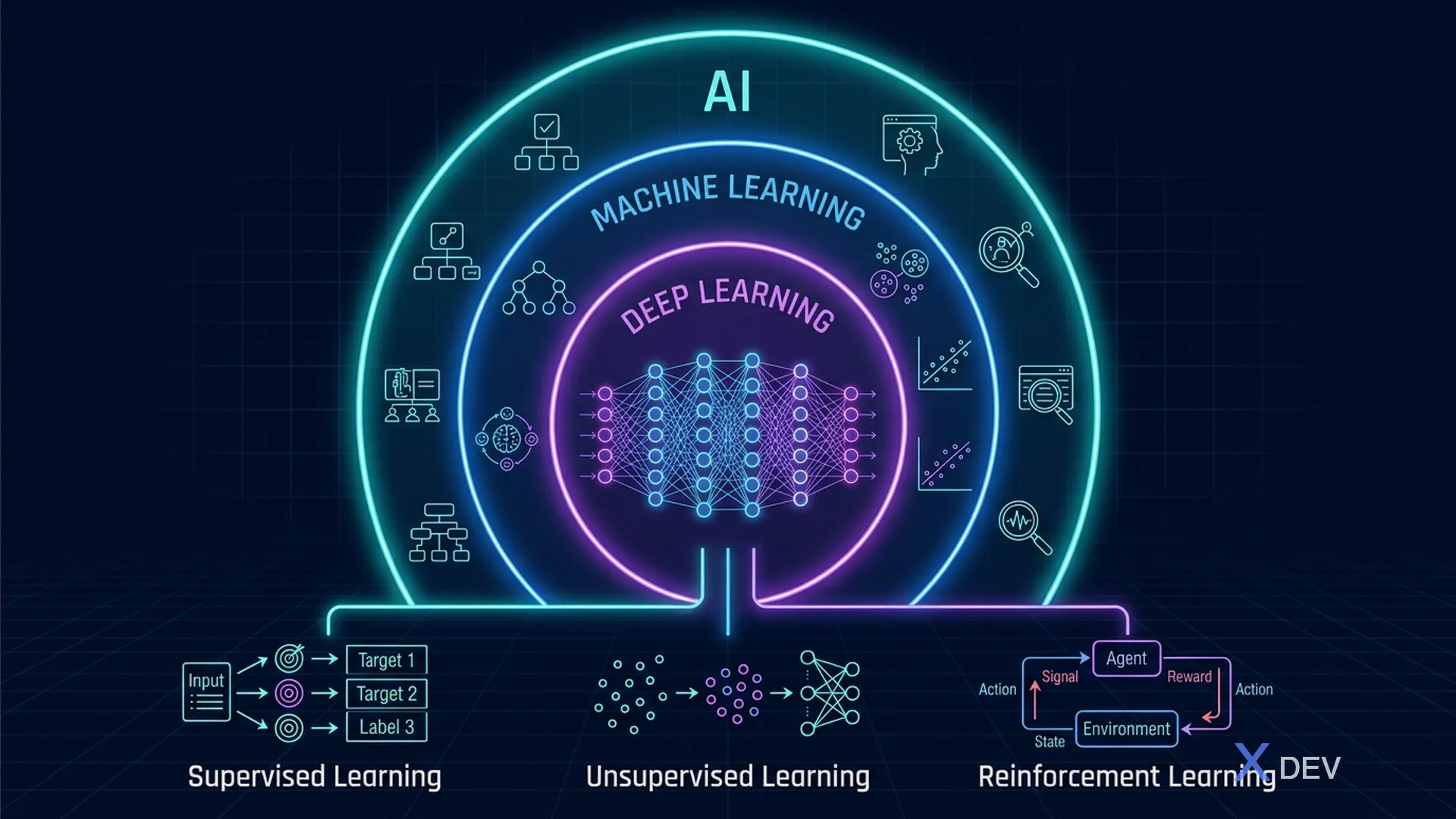
AI, ML và Deep Learning — quan hệ lồng nhau và ba paradigm học máy
Tổng quan Domain 1
Domain 1 chiếm 20% đề thi AIF-C01. Bạn cần hiểu rõ các khái niệm nền tảng về AI, ML, và Deep Learning — không cần code, nhưng phải phân biệt được khi nào dùng approach nào.
Exam tip: Domain này thường có các câu hỏi dạng "Which type of machine learning is BEST suited for..." — yêu cầu bạn chọn đúng paradigm cho use case.
1. AI vs Machine Learning vs Deep Learning
Ba khái niệm này có quan hệ lồng nhau (nested relationship):
┌─────────────────────────────────────────────┐
│  Artificial Intelligence (AI)               │
│  "Machines that mimic human intelligence"   │
│  ┌───────────────────────────────────────┐   │
│  │  Machine Learning (ML)               │   │
│  │  "Learning from data without         │   │
│  │   explicit programming"              │   │
│  │  ┌─────────────────────────────────┐  │   │
│  │  │  Deep Learning (DL)             │  │   │
│  │  │  "Neural networks with many     │  │   │
│  │  │   layers"                       │  │   │
│  │  └─────────────────────────────────┘  │   │
│  └───────────────────────────────────────┘   │
└─────────────────────────────────────────────┘
| Concept | Definition | Example |
|---|---|---|
| AI | Broad field — machines performing tasks that typically require human intelligence | Chatbot, self-driving car, chess engine |
| ML | Subset of AI — algorithms learn patterns from data | Spam filter, recommendation engine |
| DL | Subset of ML — neural networks with multiple layers | Image recognition, language translation |
Key Differences for the Exam
- Traditional Programming: Rules + Data → Output
- Machine Learning: Data + Output → Rules (model learns the rules)
- Deep Learning: Tự động extract features từ raw data (không cần manual feature engineering)
2. Three ML Paradigms
2.1. Supervised Learning
Model học từ labeled data — mỗi input đi kèm output đúng (label/target).
| Task Type | Output | Use Case | Algorithms |
|---|---|---|---|
| Classification | Discrete category | Spam vs Not Spam, Fraud detection | Logistic Regression, Random Forest, SVM |
| Regression | Continuous number | House price prediction, Stock forecast | Linear Regression, XGBoost |
Exam tip: Nếu đề bài nói "predict a category" hoặc "classify" → Classification. Nếu nói "predict a number/value" → Regression.
2.2. Unsupervised Learning
Model học từ unlabeled data — tự tìm patterns, structure trong dữ liệu.
| Task Type | What it does | Use Case |
|---|---|---|
| Clustering | Group similar data points | Customer segmentation, Document grouping |
| Dimensionality Reduction | Reduce features while preserving info | Data visualization, noise reduction |
| Anomaly Detection | Find unusual data points | Fraud detection, equipment failure |
| Association | Find rules between items | "Customers who bought X also bought Y" |
2.3. Reinforcement Learning (RL)
Agent học bằng cách trial-and-error trong một environment. Nhận reward (positive) hoặc penalty (negative) cho mỗi action.
Agent → Action → Environment → State + Reward → Agent (loop)
Use cases:
- Game AI (AlphaGo)
- Robotics navigation
- Autonomous driving
- AWS DeepRacer (self-driving car simulation)
2.4. Choosing the Right Paradigm — Exam Decision Tree
Do you have labeled data?
├── YES → Supervised Learning
│   ├── Predicting a category? → Classification
│   └── Predicting a number? → Regression
├── NO →
│   ├── Want to find groups/patterns? → Unsupervised (Clustering)
│   └── Learning through trial & error? → Reinforcement Learning
3. Data Concepts for ML
3.1. Data Types
| Type | Description | Examples |
|---|---|---|
| Structured | Organized in rows & columns (tabular) | CSV, database tables, spreadsheets |
| Semi-structured | Has some organization but flexible | JSON, XML, log files |
| Unstructured | No predefined format | Images, videos, audio, free text |
| Time-series | Data points indexed by time | Stock prices, IoT sensor readings |
3.2. Labeled vs Unlabeled Data
- Labeled data: Mỗi data point có kèm answer (label). Ví dụ: email + tag "spam"/"not spam". Dùng cho Supervised Learning.
- Unlabeled data: Chỉ có data, không có label. Dùng cho Unsupervised Learning.
- Amazon SageMaker Ground Truth: Dịch vụ AWS giúp label data (human + ML-assisted labeling).
3.3. Training, Validation, Test Sets
┌────────────────────────────────────────────────┐
│              Full Dataset (100%)               │
├──────────────────┬──────────┬──────────────────┤
│  Training (70%)  │ Val(15%) │   Test (15%)     │
│  Model learns    │ Tune     │ Final evaluation │
│  from this data  │ hyper-   │ (never seen      │
│                  │ params   │  during training) │
└──────────────────┴──────────┴──────────────────┘
- Training set: Model học patterns từ đây
- Validation set: Tune hyperparameters, chống overfitting
- Test set: Đánh giá cuối cùng — model chưa bao giờ thấy data này
4. Neural Networks Basics
4.1. Architecture
Input Layer → Hidden Layer(s) → Output Layer
    x₁ ──┐     ┌── h₁ ──┐
    x₂ ──┼─────┼── h₂ ──┼──── ŷ (prediction)
    x₃ ──┘     └── h₃ ──┘

Each connection has a weight (w)
Each neuron applies an activation function
Key components:
- Weights: Parameters the model learns during training
- Bias: Additional parameter to shift the activation function
- Activation Function: ReLU, Sigmoid, Softmax — introduces non-linearity
- Loss Function: Measures how wrong the model's predictions are
- Optimizer: Updates weights to minimize loss (e.g., SGD, Adam)
4.2. Types of Neural Networks
| Type | Best For | AWS Service |
|---|---|---|
| CNN (Convolutional NN) | Images, video | Amazon Rekognition |
| RNN/LSTM (Recurrent NN) | Sequential data, time series | Amazon Forecast |
| Transformer | NLP, text generation | Amazon Bedrock (LLMs) |
| GAN (Generative Adversarial) | Generate new data (images) | — |
5. Model Evaluation Concepts
5.1. Overfitting vs Underfitting
| Problem | Training Accuracy | Test Accuracy | Cause | Solution |
|---|---|---|---|---|
| Overfitting | Very High | Low | Model memorizes training data | More data, regularization, dropout, early stopping |
| Underfitting | Low | Low | Model too simple | More features, more complex model, longer training |
| Good Fit | High | High | Balanced complexity | — |
5.2. Bias-Variance Tradeoff
- High Bias = Underfitting (model quá đơn giản, bỏ qua patterns)
- High Variance = Overfitting (model quá phức tạp, nhạy cảm với noise)
- Mục tiêu: tìm sweet spot giữa bias và variance
5.3. Common Metrics
Classification metrics:
| Metric | Formula | When to use |
|---|---|---|
| Accuracy | (TP + TN) / Total | Balanced classes |
| Precision | TP / (TP + FP) | "Don't flag innocent as spam" |
| Recall | TP / (TP + FN) | "Don't miss any fraud" |
| F1 Score | 2 × (P × R) / (P + R) | Imbalanced classes |
| AUC-ROC | Area under ROC curve | Binary classification overall |
Regression metrics:
- RMSE (Root Mean Square Error): Penalizes large errors
- MAE (Mean Absolute Error): Average error magnitude
- R²: How well model explains variance (1.0 = perfect)
6. Key Terms Cheat Sheet
| Term | Definition (for exam) |
|---|---|
| Feature | Input variable used for prediction (column in data) |
| Label / Target | The answer we want the model to predict |
| Hyperparameter | Settings configured BEFORE training (learning rate, epochs) |
| Parameter | Values the model learns DURING training (weights, biases) |
| Epoch | One complete pass through the entire training dataset |
| Batch Size | Number of samples processed before updating weights |
| Inference | Using a trained model to make predictions on new data |
| Transfer Learning | Using a pre-trained model and adapting it for a new task |
7. Practice Questions
Q1: A company wants to predict whether customers will cancel their subscription (yes/no). Which ML approach is most appropriate?
- A) Unsupervised Learning — Clustering
- B) Supervised Learning — Regression
- C) Supervised Learning — Classification ✓
- D) Reinforcement Learning
Explanation: Predicting a binary outcome (yes/no) with labeled historical data = supervised classification.
Q2: A retail company has customer purchase data but NO predefined groups. They want to segment customers into groups for targeted marketing. Which approach should they use?
- A) Supervised Learning — Classification
- B) Unsupervised Learning — Clustering ✓
- C) Reinforcement Learning
- D) Supervised Learning — Regression
Explanation: No labels + finding natural groups in data = unsupervised clustering.
Q3: A model performs extremely well on training data (99% accuracy) but poorly on new data (65% accuracy). What is this called?
- A) Underfitting
- B) Overfitting ✓
- C) High bias
- D) Regularization
Explanation: High training accuracy + low test accuracy = overfitting (model memorized training data).